Back to war: Wounded Ukrainians return to battle after amputation重返战场:截肢后受伤的乌克兰士兵重返战场
Many brigades have at least one amputee soldier still on active duty — men who returned to combat despite the grim outlook for their country.
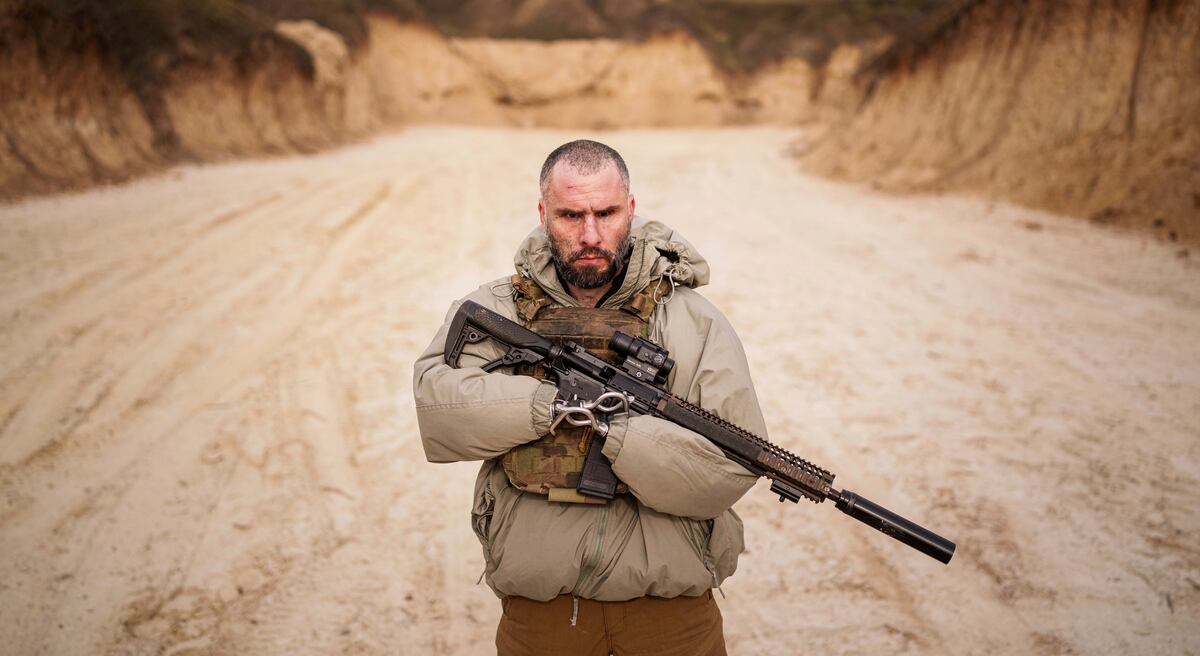
DONETSK REGION, Ukraine (AP) — The Ukrainian intelligence soldier doesn’t know how long his clinical death lasted after an explosive detonated beneath him.
All Andrii Rubliuk remembers is overwhelming cold, darkness and fear. When he regained consciousness in his shattered body — missing both arms and his left leg — excruciating pain engulfed him, and hallucinations clouded his mind.
“It’s an experience you wouldn’t wish on anyone,” the now 38-year-old says.
Two years later, Rubliuk is again dressed in military fatigues, his missing limbs replaced by prosthetics — hooks in place of fingers, one leg firmly planted on an artificial limb.
From the moment of the explosion, Rubliuk knew his life had changed forever. But one thing was certain — he vowed to return to the battlefield.
“Fighting with arms and legs is something anyone can do. Fighting without them — that’s a challenge,” he says. “But only those who take on challenges and fight through them are truly alive.”
Many Ukrainian brigades have at least one, and often several, amputee soldiers still on active duty — men who returned to combat out of a sense of duty amid the grim outlook for their country.
They are among Ukraine’s 380,000 war wounded, according to President Volodymyr Zelenskyy . Some 46,000 soldiers have been killed during the three-year war, and tens of thousands are missing and in captivity.
On the front line Russia is expending huge amounts of weaponry a
Serhii Pozniak, a sniper unit commander with the 27th national guard brigade, speaks to soldiers during training near Kyiv, Ukraine, Feb. 17, 2025. (Evgeniy Maloletka/AP)
nd human life to make small but steady territorial gains to the nearly one-fifth of Ukraine it controls.
Meanwhile Ukraine, outnumbered and outgunned, faces challenges not only on the battlefield but also in diplomacy , as its once strongest ally — the U.S.— enters talks with Russia , raising fears that Ukraine and its European partners will be sidelined.
It is this dire situation that has driven wounded soldiers back to the front, where little has changed since they first left their civilian lives to defend their families from an invading neighbor.
For them, lying in a hospital bed was unbearable compared to standing alongside their brothers-in-arms to defend Ukraine. But they all agree on one thing — when the war ends, they won’t spend another day in uniform; joining the army was never their first choice.
Rubliuk rejoined the special forces last spring as a senior sergeant in the Artan intelligence unit, training new soldiers and monitoring enemy drones. His rehabilitation began in late 2022, but he believes it never truly ends.
“Every new day is part of my rehabilitation,” he says. His new body, he adds, is a balance between self-acceptance and continuous recovery.
A comrade who was with Rubliuk when the explosion happened and suffered minor injuries remembers the moment vividly.
“I thought he was dead,” said the soldier, who did not give his name in compliance with special forces rules.
Leonid Lobchuk, a soldier with Ukraine's 127th brigade who lost a leg in combat in eastern Ukraine in 2015, walks near his self-propelled howitzer in Ukraine's Kharkiv region, Feb. 10, 2025. (Evgeniy Maloletka/AP)
At that moment, Rubliuk’s life hung in the balance. He was transported to a nearby hospital, suffered cardiac arrest and eventually was resuscitated, said Dr. Anton Yakovenko, a military surgeon who treated him.
After months in hospital wards and rehabilitation centers in Philadelphia and Florida, Rubliuk has returned to take on a role near the front line where, like others who have done so, his knowledge and experience are the greatest weapon.
Back in uniform like ‘returning home’
Maksym Vysotskyi had just completed a drone mission in November 2023, when he took a detour after heavy rains turned the battlefield into a swamp.
The explosion when he stepped on a land mine was instantaneous. When he looked down at his left leg, all he saw was bone.
“I quickly accepted the fact that my leg was gone. What’s the point of mourning? Crying and worrying won’t bring it back,” the 42-year-old says.
By May, he was back in uniform, describing the feeling as “returning home.”
“You need to come out of this not as someone broken by the war and written off, but as someone they tried to break, but couldn’t,” he says. “You came back, proved you could still do something, and you’ll step away only when you decide to.”
Maksym Vysotskyi, a drone unit commander with Ukraine's 82nd assault brigade, sits on a sofa near the front line in Ukraine's Kharkiv region, Feb. 2, 2025. (Evgeniy Maloletka/AP)
Vysotskyi now commands a team operating explosives-laden drones on nighttime missions. He assesses risk and makes strategic decisions but rarely goes on combat missions. Despite his injury, he has never regretted enlisting.
“Everyone must walk their own path, and there will be challenges along the way. You can try to escape your fate, but it will always catch up with you,” he says. “That’s why I never had regrets.”
A combat medic who became a war psychologist
Two and a half years ago, when Capt. Oleksandr Puzikov called his wife to tell her his left arm had been severed, she thought he was joking.
“I will never forget that day,” says Iryna Puzikova, her voice trembling. “When I walked into the ICU, his first words were, ‘You won’t leave me, right?’”
She stayed by his side, traveling from hospital to hospital as he recovered and learned to live with a full-arm amputation.
When he decided to return to the military, she wasn’t surprised.
“I never doubted for a moment that it could be any different,” she says.
Before his injury, Puzikov, now 40, was a combat medic. After returning to service, he retrained as a psychologist, helping soldiers cope with the mental toll of three years of war.
“As long as the war continues, I won’t leave — I’ll help in any way I can,” he says.
Yet, his own struggle continues. He suffers from phantom limb pain. It feels as if his missing hand is clenched in a fist, the pain so sharp it cuts like a knife. He hopes another surgery might finally relieve it.
A proper prosthetic remains out of reach due to bureaucratic delays and poor-quality options. Like many other amputees struggling to find a good arm prosthesis, he continues his military duties without one.
After he lost his right arm in battle, Oleksandr Zhalinskyi transitioned from an infantry soldier to a navigator-driver and chose not to use a prosthetic.
“It’s only good for fishing,” jokes the 34-year-old of a hobby he still enjoys.
In his current role, he evaluates missions and finds the safest evacuation routes.
“At first, I did not like this job. When I returned to service, I was ready to go back to the infantry,” Zhalinskyi says. “But over time, I accepted this new role.”
A sticker of a wheelchair-bound soldier holding a rifle on the windshield during a drive in Ukraine's Kharkiv region, Feb. 3, 2025. (Evgeniy Maloletka/AP)
When an artillery strike hit his position in the fall of 2023, severing his arm, the pain was unbearable. He pushed himself up, scanning for comrades; he was the only one who survived.
He tried three times to tighten a tourniquet, but it wouldn’t hold.
With communications destroyed and no way to call for help, he had only one option — move toward the evacuation point, forcing himself to stay conscious with every step.
“It felt like I was walking forever.”
Dark thoughts crept in, but he reminded himself of his five godchildren — he had to survive.
Soldiers from a neighboring unit spotted him, stabilized him, and got him to safety. From that moment, there was no doubt — once he recovered, he would return to the fight.
But once he sheds his uniform, he has a plan.
Before the invasion, he dreamed of opening a pub in his hometown. That dream remains — except he’s changed its name.
Now, he plans to call it Amputated Conscience.
乌克兰顿涅茨克地区(美联社)——一名乌克兰情报士兵不知道在他脚下爆炸后,他的临床死亡状态持续了多久。
安德烈·鲁布柳克只记得极度的寒冷、黑暗和恐惧。当他恢复意识时,发现自己身处残破的躯体之中——双臂和左腿都已失去——剧烈的疼痛瞬间将他吞噬,幻觉也开始在他脑海中浮现。
“这是任何人都不希望经历的事情,”这位现年 38 岁的男子说道。
两年后,鲁布柳克再次穿上了军装,他缺失的肢体被假肢取代——手指变成了钩子,一条腿牢牢地固定在人造肢体上。
爆炸发生的那一刻,鲁布柳克就知道他的人生从此彻底改变。但有一件事是肯定的——他发誓要重返战场。
“用手脚战斗人人都能做到。但失去手脚后跟去战斗——那才叫挑战,”他说。“只有那些勇于接受挑战并战胜挑战的人,才算是真正地活着。”
许多乌克兰旅至少有一名,甚至通常有几名截肢士兵仍在服役——这些士兵在国家前景黯淡的情况下,出于责任感重返战场。
据乌克兰总统泽连斯基称,他们是乌克兰38万战争伤员中的一部分。在这场持续三年的战争中,约有4.6万名士兵阵亡,另有数万人失踪或被俘。
在前线,俄罗斯正在消耗大量的武器。
2025年2月17日,乌克兰基辅附近,国民警卫队第27旅狙击部队指挥官谢尔盖·波兹尼亚克在训练期间向士兵们讲话。(Evgeniy Maloletka/AP)
以牺牲人类生命为代价,逐步蚕食其控制的近五分之一的乌克兰领土。
与此同时,兵力和火力都处于劣势的乌克兰不仅在战场上面临挑战,在外交上也面临挑战,因为其曾经最强大的盟友——美国——正在与俄罗斯进行谈判,这引发了人们的担忧,即乌克兰及其欧洲伙伴将被边缘化。
正是这种严峻的形势迫使受伤的士兵重返前线,而自从他们离开平民生活保卫家人免受邻国入侵以来,前线的情况几乎没有改变。
对他们来说,躺在病床上远比与战友并肩作战保卫乌克兰痛苦得多。但他们都一致认为——战争结束后,他们绝不会再穿一天军装;参军从来都不是他们的首选。
鲁布柳克去年春天重返特种部队,担任阿尔坦情报部队的高级士官,负责训练新兵和监控敌方无人机。他的康复治疗始于2022年底,但他认为康复之路永无止境。
“每一天都是我康复过程的一部分,”他说。他还补充道,他现在的身体状态是自我接纳和持续康复之间平衡的结果。
爆炸发生时与鲁布柳克在一起并受了轻伤的一位同志对那一刻记忆犹新。
“我以为他死了,”这名士兵说道,他没有透露姓名,以遵守特种部队的规定。
2015年在乌克兰东部的一场战斗中失去一条腿的乌克兰第127旅士兵列昂尼德·洛布丘克,于2025年2月10日在乌克兰哈尔科夫州的一辆自行榴弹炮旁行走。(Evgeniy Maloletka/AP)
当时,鲁布柳克的生命危在旦夕。他被送往附近医院,心脏骤停,最终被抢救过来,负责治疗他的军医安东·雅科文科医生说。
在费城和佛罗里达的医院病房和康复中心待了几个月后,鲁布柳克重返一线,像其他曾经在前线工作过的人一样,他的知识和经验是他最大的武器。
重新穿上制服就像“回家”一样
2023 年 11 月,马克西姆·维索茨基刚刚完成一次无人机任务,由于暴雨将战场变成了沼泽,他不得不绕道而行。
他踩到地雷的那一刻,爆炸瞬间发生。他低头看向自己的左腿,只见骨头都露出来了。
“我很快就接受了腿没了的事实。哀悼有什么用呢?哭泣和担忧也无法让它回来,”这位42岁的男子说道。
到了五月份,他重新穿上了军装,并将这种感觉形容为“回家”。
“你从这场战争中走出来,不应该被视为一个被战争击垮、被社会抛弃的人,而应该被视为一个他们试图击垮却失败的人,”他说。“你回来了,证明了你仍然能够有所作为,只有当你自己决定离开的时候,你才会离开。”
2025年2月2日,乌克兰第82突击旅无人机部队指挥官马克西姆·维索茨基坐在乌克兰哈尔科夫州前线附近的一张沙发上。(Evgeniy Maloletka/AP)
维索茨基现在指挥着一支夜间执行任务的无人机部队,这些无人机都装载着爆炸物。他负责评估风险并制定战略决策,但很少亲自参与战斗任务。尽管受过伤,他从未后悔参军。
“每个人都必须走自己的路,一路上总会遇到挑战。你可以试图逃避命运,但它终究会追上你,”他说。“这就是为什么我从不后悔。”
一位从战地医护兵转型为战争心理学家的
两年半前,当奥列克桑德·普济科夫上尉打电话告诉妻子他的左臂被砍断时,她以为他在开玩笑。
“我永远不会忘记那天,”伊琳娜·普济科娃声音颤抖地说,“我走进重症监护室时,他说的第一句话是:‘你不会离开我,对吗?’”
她一直陪伴在他身边,在他康复并学会适应截肢后的生活期间,辗转于各个医院之间。
当他决定重返军队时,她并不感到意外。
“我从未怀疑过结果会有所不同,”她说。
现年40岁的普济科夫在受伤前是一名战地医护兵。重返部队后,他接受了心理学家的培训,帮助士兵们应对三年战争带来的精神创伤。
“只要战争继续,我就不会离开——我会尽我所能提供帮助,”他说。
然而,他自己的痛苦仍在继续。他饱受幻肢痛的折磨。他感觉自己缺失的那只手仿佛紧握成拳,剧痛如刀割般刺痛。他希望再次手术能彻底缓解这种痛苦。
由于官僚主义作风和假肢质量低劣,合适的假肢对他来说仍然遥不可及。像许多其他苦苦寻找合适假肢的截肢者一样,他只能在没有假肢的情况下继续履行军职。
在战斗中失去右臂后,奥列克桑德·扎林斯基从一名步兵士兵转为一名导航员兼驾驶员,并且选择不使用假肢。
“它只适合钓鱼,”这位34岁的男子开玩笑说,他仍然很喜欢钓鱼这项爱好。
他目前的职责是评估任务并寻找最安全的撤离路线。
“起初,我并不喜欢这份工作。当我重返部队时,我甚至想回到步兵部队,”扎林斯基说。“但随着时间的推移,我接受了这个新角色。”
2025年2月3日,在乌克兰哈尔科夫州的一辆汽车前挡风玻璃上贴着一张贴纸,贴纸上是一位坐在轮椅上的士兵手持步枪。(Evgeniy Maloletka/AP)
2023年秋天,一次炮击击中了他的阵地,炸断了他的手臂,剧痛难忍。他挣扎着站起来,四处张望寻找战友;他是唯一的幸存者。
他尝试了三次收紧止血带,但都失败了。
通讯中断,无法呼救,他只有一个选择——向疏散点移动,每一步都强迫自己保持清醒。
“感觉自己好像走了永远也走不完的路。”
黑暗的念头涌上心头,但他提醒自己还有五个教子——他必须活下去。
邻近部队的士兵发现了他的伤情,稳定了他的伤势,并将他转移到了安全地带。从那一刻起,就毫无疑问——一旦他康复,他就会重返战场。
但一旦脱下制服,他就有了自己的计划。
入侵之前,他梦想在家乡开一家酒吧。这个梦想依然存在——只是他把酒吧的名字改了。
现在,他计划将这部作品命名为《截肢的良知》。