French missile double punch adds new naval capability for Europe法国导弹双重打击为欧洲增添了新的海军能力。
Two cruise missiles, timed to hit the same target at the same time from different angles, could help overwhelm enemy air defenses, according to analysts.
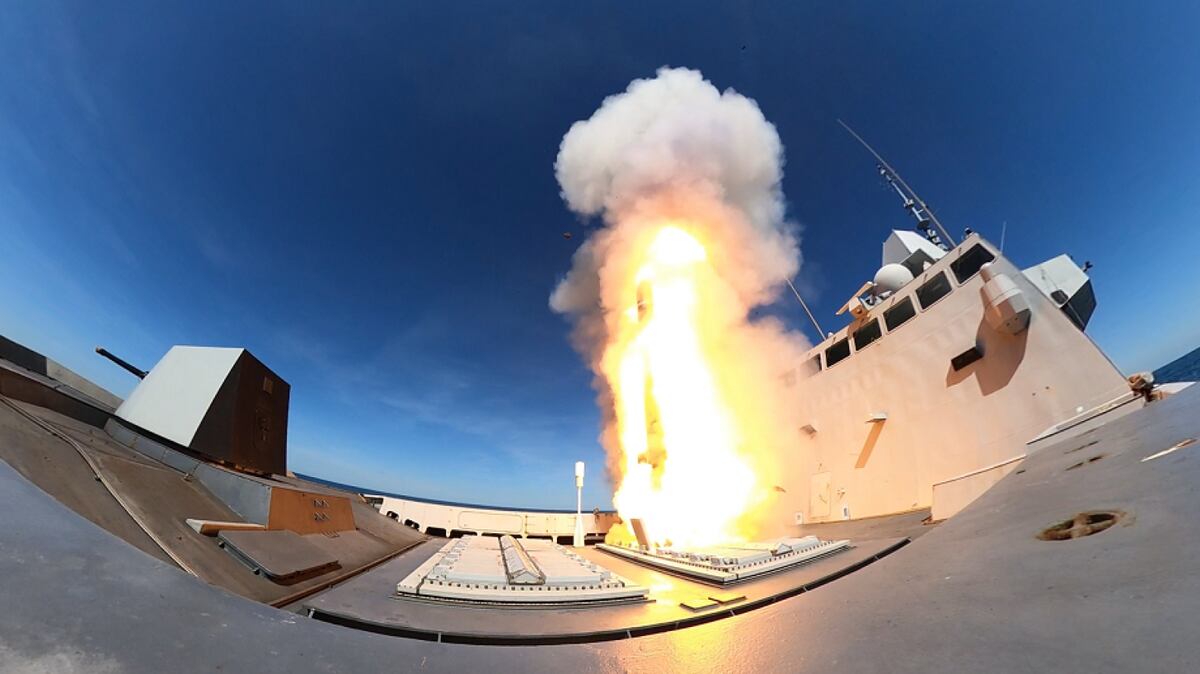
PARIS — France’s synchronized test firing of naval cruise missiles from a surface ship and a submarine 400 kilometers apart adds a land-attack capability for European navies that may be more difficult for air defenses to counter, analysts told Defense News.
The French frigate Aquitaine and a Suffren-class nuclear-powered attack submarine, sailing near Quimper and Biscarosse, respectively, last week each fired a Missile de Croisière Naval or MdCN that simultaneously hit a target at a military testing site in south-west France, a first for the French Navy.
Coordinated cruise missile strikes could be used to saturate adversary defense systems, raising the chance of a successful hit on defended targets in a high-intensity context, the French Navy said in statement to Defense News. The synchronized double shot of the domestically developed MdCN relied on existing systems and software, the service said.
The French Navy’s coordinated launch from different platforms “is a notable development,” said Nick Childs, senior fellow for Naval Forces and Maritime Security at the International Institute for Strategic Studies in London. “Being able to carry out strikes from different platforms in different locations at the same time complicates the air-defense challenge for the opponent.”
Whether it’s possible to actually saturate air defenses depends on how many missiles can be launched and the sophistication of the defense, Childs said. He said both France and the U.K. already had the ability to carry out complex strikes through the combination of air-launched missiles and weapons from naval platforms.
The synchronized cruise-missile firing is “something special,” as few navies in Europe perform land strikes, said Sebastian Bruns, senior researcher at the Institute for Security Policy Kiel University (ISPK). He said the exercise is “more of a capability demonstrator,” meant to validate the technology and telegraph the implications to would-be adversaries at the same time.
The political winds surrounding such military capabilities are changing, he added. “Land attack is entering the realm of the imaginable.”
The MdCN is France’s answer to the U.S.-made Tomahawk, and was developed by pan-European missile maker MBDA following a contract in 2006. The naval cruise missile entered service in 2017 and was used operationally by France for the first time in strikes against Syria in 2018.
“This development gives some operational advantage to the French Navy as a single service and more options for French planners,” Childs at the IISS said. “But it is probably not a game-changer in terms of capability.”
The French Navy said it regularly trains on multiple missile launches from different carriers, with trajectory coordination and synchronized missile arrival the most important training goals. Training on joint strikes is also planned with U.S. and U.K. partners, with regular exercises on coordinating trajectories and missile arrivals, according to the Navy.
Missile coordination is an active field of research, and a Google Scholar search for the term finds dozens of studies since 2023, including on neural networks for warhead coordination and ant-colony-based algorithms for missile-flight planning. Of the first 20 studies that show up, 16 are by authors affiliated with Chinese research institutes and companies.
While the U.S. can carry out this type of synchronized firing from different carriers, the U.K. only has this capability on its nuclear-powered attack submarines, according to the French Navy. The U.K.’s Trafalgar-class submarine Triumph fired Tomahawk missiles at Libyan air defenses during Operation Ellamy in 2011.
The U.K. Royal Navy aims to have similar options when its Type-26 frigates enter service with the ability to launch cruise missiles, Childs said. The Navy’s current Type-45 destroyers were originally intended to be fitted with land-attack cruise missiles, but that was never funded, he said.
The long-range capability provided by the MdCN “makes it possible to impose a military threat from the very outset of a crisis, thus influencing the will of competitors,” the French Armed Forces Ministry said in statement last week.
The French naval cruise missile is powered by Safran’s Microturbo TR 50 engine, and has a speed of around 1,000 kilometers per hour and a range of about 1,000 kilometers, according to official data . The 6.5-meter, 1.4-metric ton missile is launched using a first-stage booster that separates before wing deployment, and French submarines can launch the missile from their torpedo tubes in a protective shell that is discarded on breaking the surface.
Firing cruise missiles from a naval platform provides a permanent presence and “undeniable freedom of action” at sea, as there are no diplomatic overflight constraints, the Navy said. The use from a submarine also allows for actions that require greater discretion, it said.
The Netherlands has said it will equip its four current Zeven Provinciën-class frigates with Tomahawk missiles during maintenance in the 2025-2029 period, adding a land deep-strike capability the Dutch navy currently lacks. The Dutch also plan to fit the cruise missiles to their future air-defense frigates and submarines .
Sebastian Sprenger in Cologne, Germany, contributed to this report.
Rudy Ruitenberg is a Europe correspondent for Defense News. He started his career at Bloomberg News and has experience reporting on technology, commodity markets and politics.
巴黎——分析人士告诉《防务新闻》,法国从相距 400 公里的水面舰艇和潜艇上同步试射海军巡航导弹,为欧洲海军增加了对陆攻击能力,这可能使防空系统更难应对。
上周,法国护卫舰“阿基坦”号和一艘“苏弗伦”级核动力攻击潜艇分别在坎佩尔和比斯卡罗斯附近航行时,各自发射了一枚海军巡航导弹(MdCN),同时击中了法国西南部军事试验场的目标,这是法国海军的首次此类行动。
法国海军在发给《防务新闻》的一份声明中表示,协同巡航导弹打击可用于饱和敌方防御系统,从而提高在高强度作战环境下成功击中防御目标的概率。该军种表示,国产MdCN巡航导弹的同步双发发射依赖于现有的系统和软件。
伦敦国际战略研究所海军力量与海上安全高级研究员尼克·查尔兹表示,法国海军从不同平台协同发起攻击“是一项值得关注的进展”。“能够同时从不同地点的不同平台发动打击,增加了对手防空的难度。”
查尔兹表示,能否真正突破防空系统取决于导弹发射数量和防御系统的先进程度。他还指出,法国和英国都已具备通过空射导弹和海军舰艇武器相结合的方式实施复杂打击的能力。
基尔大学安全政策研究所(ISPK)高级研究员塞巴斯蒂安·布伦斯表示,同步巡航导弹发射“非同寻常”,因为欧洲很少有海军进行对陆打击。他指出,此次演习“更像是一次能力验证”,旨在验证这项技术,并同时向潜在对手传递其潜在影响。
他补充说,围绕此类军事能力的政治风向正在发生变化。“陆地进攻正进入一个难以想象的领域。”
MdCN是法国对抗美国制造的战斧导弹的武器,由泛欧导弹制造商MBDA在2006年签订合同后研制。该舰载巡航导弹于2017年服役,并于2018年首次在对叙利亚的打击行动中被法国投入实战使用。
国际战略研究所的查尔兹表示:“这一进展为法国海军作为一个单一军种带来了一定的作战优势,也为法国规划人员提供了更多选择。但就能力而言,这可能不会带来颠覆性的改变。”
法国海军表示,他们定期进行从不同航母上发射多枚导弹的训练,其中弹道协调和导弹同步落点是最重要的训练目标。海军方面还表示,他们计划与美国和英国伙伴开展联合打击训练,定期进行弹道协调和导弹落点演习。
导弹协同是一个活跃的研究领域,在谷歌学术上搜索该术语,可以找到自2023年以来数十篇相关研究,包括利用神经网络进行弹头协同以及基于蚁群算法的导弹飞行规划等。在搜索结果的前20篇论文中,有16篇的作者隶属于中国科研院所或公司。
据法国海军称,虽然美国可以从不同的航母上进行这种同步发射,但英国只有其核动力攻击潜艇具备这种能力。2011年“埃拉米行动”期间,英国特拉法加级潜艇“凯旋”号曾向利比亚防空系统发射战斧巡航导弹。
查尔兹表示,英国皇家海军计划在其26型护卫舰服役时也具备发射巡航导弹的能力,并拥有类似的选项。他还说,海军现役的45型驱逐舰最初也计划配备陆攻巡航导弹,但该项目从未获得资金支持。
法国武装部队部上周在一份声明中表示,MdCN提供的远程作战能力“使得从危机伊始就能施加军事威胁,从而影响竞争对手的意志”。
据官方数据显示,法国海军巡航导弹采用赛峰集团的TR 50微型涡轮发动机,速度约为每小时1000公里,射程约为1000公里。这枚长6.5米、重1.4吨的导弹由一级助推器发射,助推器在展开翼片前分离。法国潜艇可从鱼雷发射管发射该导弹,导弹带有保护壳,在潜艇出水后抛弃。
海军方面表示,从海军平台发射巡航导弹能够确保海上永久存在和“无可争议的行动自由”,因为不受外交飞越限制。海军还指出,从潜艇发射巡航导弹还能执行一些需要更大谨慎性的行动。
荷兰表示,将在2025年至2029年期间,对其现有的四艘“七省”级护卫舰进行维护保养,为其配备“战斧”巡航导弹,从而提升荷兰海军目前所缺乏的陆上纵深打击能力。荷兰还计划为其未来的防空护卫舰和潜艇配备这种巡航导弹。
德国科隆的塞巴斯蒂安·斯普伦格对本报道亦有贡献。
鲁迪·鲁伊滕贝格是《防务新闻》的欧洲记者。他的职业生涯始于彭博新闻社,拥有报道科技、大宗商品市场和政治方面的经验。