The OV-1 Mohawk Was One Of The U.S. Military’s First Forgotten Light Attack PlanesOV-1“莫霍克”是美国军方最早一批被遗忘的轻型攻击机之一。
Infighting within the US Army and with the US Air Force meant the plane never got to reach its full potential.
新闻视频
By Joseph Trevithick
Updated Jul 12, 2018 1:58 PM EDT
As the U.S. Air Force continues to stumble through its latest attempt to procure a light attack aircraft , it is important to remember just how often the U.S. military as a whole has waffled , dithered , and squabbled over the concept in the past. The U.S. Army’s OV-1 Mohawk, which did have a lengthy career as a surveillance aircraft, is one of the earliest examples of competing priorities and infighting between services killing plans for what could have also been an effective light attack platform.
By the time the Grumman-made aircraft, also known as the G-134 , first flew in 1959, the Mohawk program had already been something of a saga for nearly three years. Originally the Army had teamed up with the U.S. Marine Corps to work on a plane to replace the small Cessna O-1 Bird Dog observation plane that both services were still flying at the time.
“The requirement was for an aircraft capable of rough field operation with short take-off performance and equipped for tactical observation and battlefield surveillance missions,” according to an official Army historical monograph the service published in 1991. “The Marines withdrew from the project before the first flight, leaving the Army to continue development alone.”
But the Army and the Marines had both relied on the U.S. Navy’s Bureau of Aeronautics to do the contracting. So, as it happened, the Army received its first nine prototype Mohawks via a Navy-run deal in 1959.
The Mohawk has a unique and instantly recognizable shape with a distinctive triple tail – the original design actually had a T-shaped tail – turboprop engines mounted over its wings, and bug-eyed cockpit. The latter design element provided the crew of two with excellent visibility to spot targets of interest on the ground.
A low-quality image showing a mockup of what could have been the US Marine Corps’ “OF-1” Mohawk, featuring the early T-tail design., via SDASM
By the end of 1959, the Army had ordered more than 70 Mohawks in three variants and assigned them each designations in its own short-lived aircraft nomenclature system. The bulk of these were AO-1AFs was a visual surveillance type with a KA-30 film camera in the fuselage that the crew could point to the left or the right of the aircraft as desired. Pods with upward ejecting flares would provide illumination for night photography.
The AO-1BF carried a then state-of-the-art AN/APS-94 side-looking airborne radar (SLAR), a radar imaging sensor, in a long pod under the right side of the forward fuselage. The AO-1CF was virtually identical to the AF version, but carried an AN/UAS-4 infrared line-scanning camera. Both of these variants could collect imagery day and night without the need for flares. In 1962, under the new tri-service designation system, the AO-1AF, BF, and CF became the OV-1A, B, and C, respectively.
An AO-1AF Mohawk, later known as the OV-1A., US Army
The Mohawks were a key component of the Army’s then relatively novel “ airmobile ” concept, which envisioned troops employing both helicopters and light fixed-wing transports to rapidly deploy into certain areas to perform tasks such as establishing a “beachhead” of sorts for follow-on forces or quickly encircling opponents. The aircraft actually used the same Lycoming T53 turboprop engine as the then relatively new Bell Huey helicopter , which would have helped simplify maintenance requirements in the field.
Since the airmobile doctrine inherently expected those troops to operate for an extended period of time without necessarily being able to rely on support from other Army units or forces from other services, the potential value of arming at least some of the Mohawks quickly became apparent. The service even experimented with using its new AC-1 Caribou light transports – later known as CV-2s and then C-7s – as small mid-air refueling tankers to help extend the range and loiter time of the OV-1s for both reconnaissance and light attack missions.
The fledgling Special Forces community, which also expected to operate behind enemy lines for extended periods detached from conventional support, was also immediately interested in the Mohawk as a light attack aircraft. This was part of a larger plan called Light Aviation Special Support Operations, or LASSO, which shouldn’t be confused with U.S. Special Operations Command’s present-day Light Attack Support for Special Operations program, also abbreviated as LASSO , though it might help explain the choice of name.
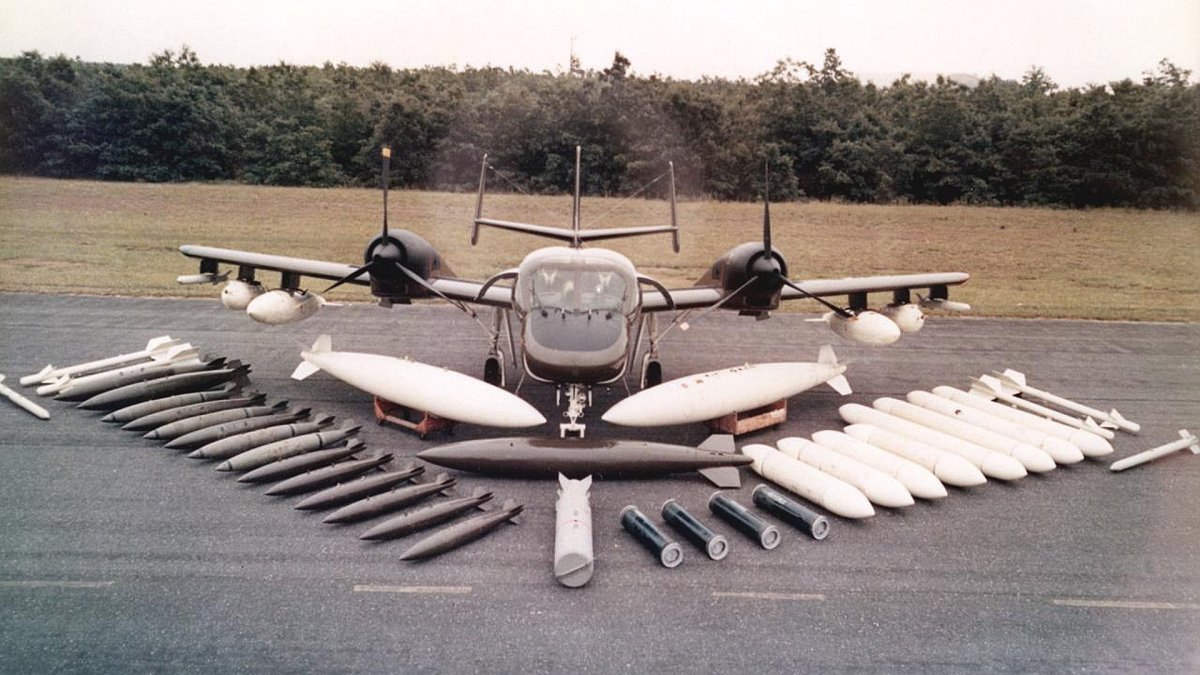
So, by the end of 1960, the Army had already begun testing the Mohawks with almost any weapons it could get its hand on. The vast majority of these were gun pods, unguided rockets, and dumb bombs.
One of the gun pods that went under the Mohawk’s wings during testing was a design containing a single .50 caliber machine gun that U.S. Air Force had purchased for T-28 Trojan propeller engine trainers that it used to train foreign air forces before delivering them directly to those countries for light attack missions – something that services still does in many ways today with its A-29 Super Tucano training program . This system contained 100 rounds of ammunition.
Weapons under an OV-1A Mohawk’s wing. From left to right, a 19-shot 2.75″ FFAR pod, a .50 caliber gun pod with 100 rounds of ammunition, and a Mk 79 Mod 0 napalm canister., US Army via Ray Wilhite
The Army eventually developed its own, more capable pod, the XM14, which would work with both light fixed-wing aircraft, such as the Mohawk, and helicopters. This weapon system had a faster-firing M3 .50 caliber machine gun and 750 rounds to go with it.
The OV-1s also served as one testbed for the much more obscure XM13, which contained a single 40mm M75 automatic grenade launcher . There was also the M18, with a fast-firing 7.62mm Minigun , and the XM19, containing a pair of 7.62mm M60 machine guns .
The XM13 40mm grenade launcher pod on an OV-1 Mohawk during a test., US Army
The rockets the Army tested on the Mohawk were a mix of old and new designs. These included 5” High Velocity Aircraft Rockets (HVAR) left over from the Korean War, as well as pods holding 2.75” Folding Fin Aerial Rockets (FFAR) and 5” Zuni rockets .
The possible bomb loads similarly included World War II-era types still in U.S. military inventory, as well as the more modern low-drag Mk 80-series types . The Army also evaluated the OV-1’s ability to carry napalm tanks, incendiary cluster bombs , and flare racks, the latter being useful for nighttime attacks.
Another Mohawk test loadout. From left to right, an AN/M65A1 1,000-pound class bomb, an AN/M64A1 500-pound class bomb, and another 19-shot pod of 2.75″ FFAR rockets., US Army via Ray Wilhite
But the Army didn’t stop there. What if the Mohawks had to engage larger, better-protected targets because other support was unavailable or defend themselves against enemy aircraft? In these cases, respectively, the OV-1s might have carried AGM-12 Bullpup radio command-guided missiles or AIM-9B Sidewinders .
A piece of contemporary promotional art from the Ryan Aeronautical Company depicted one of the planes carrying an experimental anti-radiation missile , presumably to take on hostile air defenses. However, this seems to have been a particularly optimistic understanding of the type’s capabilities, even against contemporary threats in the 1960s.
An AIM-9B Sidewinder along with two Mk 80-series bombs on another Mohawk., US Army via Ray Wilhite
By 1961, Grumman itself was marketing the Mohawk as a light attack platform with a low operating cost compared to combat jets, which would be easy to fly and maintain and able to operate from areas with unimproved runways with limited support – capabilities that are still the main selling points of light attack aircraft to this day . The firm even pitched the idea of installing a 20mm M61 Vulcan cannon in a blister fairing underneath the fuselage.
An artist’s conception of a Mohawk armed with a Vulcan cannon., Grumman via the OV-1 Mohawk Association
While the results of the tests were generally positive and the concept of arming the OV-1As and Cs seemed particularly viable, the prospect of light attack Mohawks almost immediately ran into a number of hurdles. Opposition from the Air Force to the idea of the Army having any fixed-wing aircraft, let alone combat-capable planes, was by far the biggest.
The Army eventually renamed the aircraft it had configured to carry weapons as JOV-1A and JOV-1Cs, with the “J” standing for a temporary modification. This seems to have been an attempt to label the entire project as limited “experiment” in order to avoid complaints force the Air Force.
A US Army carrying an AGM-12 Bullpup missile, which clearly appears to have come by way of the US Air Force. To the right, you can also see the tail of an Italian made Fiat G.91 combat jet, which the Army also evaluated briefly for its own use., US Army via Ray Wilhite
Even within the Army, the idea of armed Mohawks wasn’t entirely safe. Many in the service’s senior leadership were particularly opposed to giving OV-1s in any configuration to Special Forces units, which had already found themselves in conflict with “Big Army” priorities, according to the 1991 Army history.
The critics initially lost out, at least initially and in 1962, the Army began forming two Special Warfare Aviation Detachments. By the end of that year, the second one of these units, the 23rd Special Warfare Aviation Detachment, had arrived in South Vietnam with its six JOV-1Cs.
Ryan Aeronautical Company concept art of an OV-1 Mohawk carrying a pair of anti-radiation missiles., SDASM
Though billed as a supporting asset for Special Forces units in the country, the planes flew surveillance and armed reconnaissance missions in support of South Vietnam Army divisions and that country’s Railway Security Agency. In the latter case, the aircraft helped guard the railroads against Viet Cong sabotage and ambushes. The aircraft’s relatively low acoustic signature made it well suited to these missions during the day and at night, flying quietly around its assigned areas and giving the insurgents less time to react and either flee the area or try and attack the plane.
Infighting with the Air Force hampered its operations with the Army eventually restricting the aircraft to load outs consisting of just a pair of XM14 gun pods and flares, which the crew could only employ in self-defense. Pictures existing that show the unit continued to employ rockets afterward, though.
The 23rd and evaluators from the Army Concept Team In Vietnam (ACTIV), which reported on the value of new technologies in the war zone, were both of the belief that these limitations prevented the Army from getting the most out of its OV-1s. “Current test restrictions prevent exploitation of the full capabilities of these versatile aircraft,” ACTIV concluded in 1963.
An XM14 gun pod in between two racks of flares on an OV-1 Mohawk, similar to the loadouts the 23rd Special Warfare Aviation Detachment and its successors could have used in South Vietnam., US Army via Ray Wilhite
In 1964, the matter became increasingly moot when Army leadership finally succeeded in shutting down the 23rd. At that time, it merged with other units to form the non-Special Forces focused 73rd Aviation Company (Aerial Surveillance).
This was in many ways the beginning of the end not just for the armed OV-1s, but for the fixed wing component of the Army’s airmobility concept. In 1966, the service finally made a deal with the Air Force and ended its fixed-wing tactical transport ambitions . The next year, it passed the remaining Caribous to the Air Force, as well, leaving airmobile forces with only helicopters.
The Air Force, Navy, and Marine Corps did operate a number of different fixed-wing light attack aircraft during the Vietnam War. In particular, the conflict gave the Korean War-era A-1 Skyraider another chance to shine and saw the introduction of the OV-10 Bronco , the aircraft the Marines went with after abandoning the OV-1 program.
The JOV-1s that had provisions for weapons did filter out to other Mohawk units in South Vietnam and there is significant evidence that they continued to fly with both gun pods and rockets “for self-defense” in defiance of the Army-Air Force agreement. In February 1968, U.S Army Captain Ken Lee allegedly managed to shoot down a North Vietnamese MiG-17 with a combination of rocket and machine gun fire while flying in an OV-1A over the A Shau Valley near the border with Laos, though it may simply have crashed into a mountain after trying to jump the lower and slower flying aircraft.
The story seems apocryphal given that it is hard to imagine a single MiG-17 would have been operating that far south in Laos at a time when North Vietnamese pilots typically avoided potential engagements with American aircraft, preferring to only briefly harass aircraft flying into North Vietnam and then return to the safety of their bases. And while it makes sense that Lee’s superiors would have told him to keep quiet about it the incident for fear of exposing that they were still flying with weapons, it also makes the event that much more difficult to confirm.
Regardless, it does suggest that armed Mohawks continued to prowl South Vietnam for years after they were officially supposed to cease such operations. This didn’t survive the end of the Vietnam War, though.
It’s not entirely clear what happened to the JOV-1As and JOV-1Cs, but it is likely that any surviving examples either went into retirement or got converted into OV-1Ds. This variant effectively blended the B and C models together, being able to carry the SLAR pod and infrared imaging equipment as necessary.
Some OV-1Cs and OV-1Ds also ended up as electronic intelligence gathering platforms as part of the Quick Look project. These variants became known as RV-1Cs and RV-1Ds and the Army further converted an even smaller number to an improved configuration known variously as the EV-1E or RV-1E.
Though it abandoned armed variants, the Army continued employing Mohawks for battlefield surveillance and reconnaissance missions in Europe, South Korea, and Latin America, for decades after the Vietnam War ended, notably deploying some during Operation Desert Storm in Iraq in 1991. It retired all of the remaining OV-1s in 1996 in favor the larger, multi-mission four-engine EO-5C Airborne Reconnaissance Low aircraft.
Few other countries followed suit in adopting the Mohawk, with France, Germany, and Japan all passing on the type after evaluating it. Small numbers did end up in service with Argentina’s Army and the Israel Defense Forces, as well as the U.S. Customs Service and NASA.
A NASA OV-1B uses its SLAR and an additional sensor system mounted in the tail to map ice over the Great Lakes in 1973., NASA
The OV-1 did enjoy a brief return to the limelight in the mid-2000s. After the U.S.-led invasion of Iraq in 2003, the security situation there quickly deteriorated, with improvised explosive devices becoming a particularly pronounced danger to U.S. and other coalition troops. The U.S. military as a whole kicked off a large number of crash programs to respond to the threat, including a host of aerial, persistent surveillance systems on manned and unmanned aircraft.
Lawrence Livermore National Laboratory (LLNL) led development on what it called the Sonoma Persistent Surveillance System . The main sensor was a large megapixel camera arrangement that could rapidly collect still images, combined with a processing system that could identify the motion of up to 8,000 vehicle-sized objects within the field of view. For perspective, the original 22-megapixel prototype camera system could take high-resolution images of an area roughly one quarter the size of Washington, D.C. The improved 66-megapixel design could scan the entire city. The third, sensor, which sources show was either a 163- or 176-megapixel , gave analysts the ability to spot targets in an area that would also have included suburbs in Maryland and Virginia.
A satellite map of the greater Washington, D.C area as it could be viewed using different sensors. The second prototype Sonoma camera system, the 66-megapixel “Thunderbolt,” encompasses the entire city itself., LLNL
With these images in hand, combined with the tracks noting vehicle motion, intelligence specialists could develop so-called “ patterns of life ” and isolate potentially unusual activity over time. In Iraq, this sort of capability helped analysts isolate activity near where American forces encountered roadside bombs and use that information to trace individuals and vehicles back to bomb-making workshops or other insurgent hideouts. Wide area surveillance systems have since become an invaluable tool for tracking small groups of militants or even individual terrorists .
LLNL eventually developed a successor system and installed it on an OV-1D that the Army pulled out of storage. This system, dubbed Mohawk Stare, which went under the nose where the SLAR pod would have been, was functional, but eventually, the LLNL and the service decided to shift platforms .
The follow-on Constant Hawk wide-area surveillance system ended up first on a contractor-operated Shorts 360 and then on ubiquitous Beechcraft King Air twin-engine turboprops. The Army subsequently bought the latter aircraft from the private companies that had been flying them and has since upgraded them, resulting in the MC-12S Enhanced Medium Altitude Reconnaissance and Surveillance System-G ( EMARSS-G ) aircraft, with the “G” standing for geo-intelligence. Another successor sensor package, Gorgon Stare , is still in service on Air Force MQ-9 Reaper drones .
A US Army OV-1D Mohawk with the Mohawk Stare pod, but without the camera actually fitted in the rear., PV Labs
The armed configuration remained largely forgotten through these twilight years. Still, one has to wonder how effective a modernized OV-1D with its own weapons to take on any targets of opportunity might have been in Iraq in the mid-to-late 2000s or Afghanistan today. It would likely have taken minimal effort to install a more modern sensor turret – the Customs Service’s Mohawks got nose-mounted forward-looking infrared turrets in the late 1970s – which could have enabled the air to conduct persistent day and night surveillance and potentially employ precision-guided munitions. This all sounds almost exactly like what the Air Force claims it wants, at least conceptually , when it comes to a prospective future light attack platform.
And when it comes to weapons, the low-cost Advanced Precision Kill Weapon System II ( APKWS II ) laser-guided 70mm rocket, a vastly improved derivative of the 2.75″ FFARs the Mohawks employed in Vietnam, could have been a particularly deadly option. This was the primary weapon U.S. Special Operations Command personnel employed in a limited, but highly successful field test involving a pair of modernized OV-10G+ Bronco light attack aircraft in Iraq in 2015.
If anything, the story of the armed Mohawks only underscores how much history the U.S. military has with light attack aircraft already, but that they have failed to take full advantage of for various reasons. Hopefully, the Air Force is at least making full use of this extensive institutional experience as it tries to push ahead with its latest light attack project.
Contact the author: jtrevithickpr@gmail.com
Comments couldn’t be loaded. Please refresh the page.
作者:约瑟夫·特雷维西克
更新于美国东部时间2018年7月12日下午1:58
美国空军在采购轻型攻击机的最新尝试中仍然步履维艰,我们有必要回顾一下,过去美军在这一概念上曾多少次犹豫不决、拖延不决、争吵不休。美国陆军的OV-1“莫霍克”侦察机,虽然曾长期作为侦察机服役,但它却是军种间相互冲突的优先事项和内讧扼杀轻型攻击机计划的早期例证之一,而这款原本也可能成为有效的轻型攻击平台。
格鲁曼公司制造的飞机,也称为G-134,于1959年首飞时,“莫霍克”计划已经持续了近三年之久。最初,美国陆军与海军陆战队合作,研发一种飞机来取代当时两军仍在使用的塞斯纳O-1“猎犬”小型侦察机。
根据陆军1991年出版的一份官方历史专著,“要求是研制一种能够在简陋的野外条件下起降、具有短距起飞性能,并配备战术观察和战场监视任务所需设备的飞机。海军陆战队在首飞前退出了该项目,陆军只能独自继续研发。”
但陆军和海军陆战队都依赖美国海军航空局进行合同签订。因此,陆军的首批九架莫霍克原型机于1959年通过海军主导的交易获得。
莫霍克飞机外形独特,极具辨识度,其标志性的三垂尾(最初的设计实际上是T形垂尾)和安装在机翼上方的涡轮螺旋桨发动机,以及形似昆虫的驾驶舱,都令人印象深刻。这种设计为两名机组人员提供了极佳的视野,便于他们发现地面目标。
一张低质量图片,展示了美国海军陆战队“OF-1 Mohawk”战斗机的模型,图中可见早期的T型尾翼设计。(图片来自SDASM)
到1959年底,陆军已订购了70多架莫霍克飞机,分为三种型号,并根据其短暂沿用的飞机命名系统为每种型号分配了不同的编号。其中大部分是AO-1AF型,这是一种目视侦察机,机身内装有一台KA-30胶片相机,机组人员可以根据需要将其指向飞机的左侧或右侧。带有向上喷射照明弹的吊舱可以为夜间摄影提供照明。
AO-1BF型飞机在机身前部右侧下方的长吊舱内搭载了当时最先进的AN/APS-94侧视机载雷达(SLAR)和雷达成像传感器。AO-1CF型飞机与AF型几乎完全相同,但搭载了AN/UAS-4红外线扫描相机。这两种型号都能昼夜采集图像,无需使用照明弹。1962年,根据新的三军命名系统,AO-1AF、BF和CF型飞机分别更名为OV-1A、B和C型。
一架AO-1AF“莫霍克”攻击机,后改名为OV-1A,美国陆军
莫霍克直升机是当时陆军相对较新的“空中机动”概念的关键组成部分。该概念设想部队利用直升机和轻型固定翼运输机快速部署到特定区域,执行诸如为后续部队建立“滩头阵地”或迅速包围敌军等任务。该机实际上使用了与当时相对较新的贝尔休伊直升机相同的莱康明T53涡轮螺旋桨发动机,这有助于简化野战维护工作。
由于空中机动作战理论本身就要求这些部队在不一定能依赖其他陆军部队或其他军种部队支援的情况下长时间作战,因此武装部分“莫霍克”攻击机的潜在价值很快显现出来。陆军甚至尝试使用其新型AC-1“驯鹿”轻型运输机(后来被称为CV-2,再后来是C-7)作为小型空中加油机,以帮助延长OV-1攻击机执行侦察和轻型攻击任务的航程和滞空时间。
新成立的特种部队也预计会在敌后长时间作战,且无法获得常规支援,因此他们立即对莫霍克轻型攻击机产生了兴趣。这是名为“轻型航空特种支援行动”(Light Aviation Special Support Operations,简称LASSO)的更大计划的一部分。LASSO不应与美国特种作战司令部现今的“特种作战轻型攻击支援计划”(Light Attack Support for Special Operations,简称LASSO)混淆,尽管后者或许有助于解释其名称的选择。
因此,到1960年底,陆军已经开始用几乎所有能弄到手的武器测试“莫霍克”装甲车。其中绝大多数是机炮吊舱、无制导火箭和普通炸弹。
在莫霍克战斗机测试期间,机翼下安装的其中一个机枪吊舱,是美国空军为T-28“特洛伊”螺旋桨发动机教练机采购的,该教练机配备一挺.50口径机枪。美国空军用T-28“特洛伊”教练机训练外国空军,然后将这些教练机直接交付给相关国家执行轻型攻击任务——如今,美国空军仍然在A-29“超级巨嘴鸟”训练项目中沿用类似的训练方法。该系统配备100发子弹。
OV-1A“莫霍克”攻击机机翼下的武器。从左至右依次为:一个可发射19发子弹的2.75英寸FFAR火箭筒吊舱、一个装有100发子弹的.50口径机枪吊舱,以及一个Mk 79 Mod 0型凝固汽油弹发射罐。(图片来自美国陆军,由Ray Wilhite提供)
陆军最终研发出了性能更强大的XM14吊舱,该吊舱可与莫霍克等轻型固定翼飞机和直升机配合使用。这套武器系统配备了一挺射速更快的M3型.50口径机枪,并附带750发子弹。
OV-1型坦克也曾作为鲜为人知的XM13型坦克的测试平台之一,该型坦克配备了一门40毫米M75型自动榴弹发射器。此外还有M18型坦克,配备一门速射7.62毫米迷你炮;以及XM19型坦克,配备两挺7.62毫米M60型机枪。
美国陆军:OV-1“莫霍克”攻击机正在进行测试,图中为XM13 40毫米榴弹发射器吊舱。
陆军在“莫霍克”号上测试的火箭是新旧设计的混合体。其中包括朝鲜战争遗留下来的5英寸高速航空火箭(HVAR),以及装有2.75英寸折叠翼航空火箭(FFAR)和5英寸祖尼火箭的发射舱。
可能的炸弹载荷同样包括二战时期美军仍在使用的炸弹,以及更现代的低阻力Mk 80系列炸弹。陆军还评估了OV-1携带凝固汽油弹罐、燃烧集束炸弹和照明弹架的能力,后者在夜间袭击中非常有用。
另一组莫霍克导弹测试载荷。从左至右依次为:一枚AN/M65A1型1000磅级炸弹、一枚AN/M64A1型500磅级炸弹,以及另一组装有19枚2.75英寸FFAR火箭弹的发射巢。(图片由美国陆军提供,经Ray Wilhite授权使用)
但陆军并未止步于此。如果“莫霍克”攻击机因其他支援不足而必须攻击更大、防护更严密的目标,或者需要防御敌机攻击,该怎么办?在这种情况下,OV-1攻击机可能分别携带AGM-12“牛头犬”无线电指令制导导弹或AIM-9B“响尾蛇”导弹。
瑞安航空公司的一幅当代宣传画描绘了一架飞机携带实验性反辐射导弹,大概是为了对抗敌方防空系统。然而,即使面对20世纪60年代的威胁,这种对该机型性能的理解也显得过于乐观了。
一枚AIM-9B“响尾蛇”导弹和两枚Mk 80系列炸弹挂载在另一架“莫霍克”装甲车上。(图片来自美国陆军,Ray Wilhite提供)
到1961年,格鲁曼公司开始将“莫霍克”轻型攻击机作为一款轻型攻击平台进行推广,其运营成本远低于战斗机,易于飞行和维护,并且能够在简易跑道和有限后勤保障的地区起降——这些能力至今仍是轻型攻击机的主要卖点。该公司甚至还提出了在机身下方的凸起整流罩内安装一门20毫米M61“火神”机炮的方案。
艺术家绘制的配备火神炮的莫霍克飞机概念图。图片来自格鲁曼公司,经由OV-1莫霍克协会提供。
尽管测试结果总体积极,而且为OV-1A和OV-1C配备武器的设想似乎也十分可行,但轻型攻击型“莫霍克”飞机的计划几乎立刻就遇到了诸多障碍。其中最大的阻力来自空军,他们反对陆军拥有任何固定翼飞机,更不用说具备作战能力的飞机了。
陆军最终将改装用于携带武器的飞机重新命名为JOV-1A和JOV-1C,“J”代表临时改装。这似乎是为了将整个项目贴上“实验性”的标签,以避免空军方面提出异议。
一架美国陆军飞机携带一枚AGM-12“牛头犬”导弹,这枚导弹显然来自美国空军。右侧还可以看到一架意大利制造的菲亚特G.91战斗机的尾翼,美国陆军也曾短暂评估过该机型是否适合自身使用。(图片来自美国陆军,由Ray Wilhite提供)
即使在陆军内部,武装莫霍克人的想法也并非完全安全。根据1991年陆军史料记载,许多陆军高级领导尤其反对将任何配置的OV-1飞机配发给特种部队,因为特种部队已经发现自己与“陆军大部”的优先事项存在冲突。
批评者最初并未成功,至少在初期是这样。1962年,陆军开始组建两个特种作战航空分遣队。到当年年底,第二个分遣队,即第23特种作战航空分遣队,已携其六架JOV-1C飞机抵达南越。
瑞安航空公司绘制的OV-1“莫霍克”概念图,图中显示一架飞机携带两枚反辐射导弹(SDASM)。
尽管这些飞机被宣传为该国特种部队的支援力量,但它们实际上执行的是监视和武装侦察任务,支援南越陆军师和该国铁路安全局。在后者中,这些飞机协助保护铁路免受越共的破坏和伏击。由于其相对较低的声学特征,这些飞机非常适合昼夜执行此类任务,能够在指定区域上空悄无声息地飞行,从而减少叛乱分子的反应时间,使他们难以逃离该区域或试图攻击飞机。
与空军的内讧阻碍了其行动,陆军最终限制该型飞机的挂载量,仅允许携带两枚XM14机炮吊舱和照明弹,且机组人员只能在自卫时使用。不过,现存的照片显示,该部队此后仍在继续使用火箭弹。
第23届陆军航空兵团和驻越陆军概念小组(ACTIV)的评估人员都认为,这些限制阻碍了陆军充分发挥OV-1飞机的性能。ACTIV曾就新技术在战区的价值提交过报告。“目前的测试限制阻碍了这些多用途飞机的全部性能得到发挥,”ACTIV在1963年得出结论。
一架OV-1“莫霍克”攻击机上,两排照明弹架之间挂载着一门XM14机炮吊舱,类似于第23特种作战航空分遣队及其后继部队在南越可能使用的装备。(图片来自美国陆军,Ray Wilhite提供)
1964 年,随着陆军领导层最终成功解散第 23 航空团,此事变得越来越没有意义。当时,该团与其他部队合并,组成了不以特种部队为重点的第 73 航空连(空中监视)。
从很多方面来看,这不仅是武装型OV-1的终结,也是陆军空中机动概念中固定翼飞机部分的终结。1966年,陆军最终与空军达成协议,放弃了其固定翼战术运输的计划。次年,陆军又将剩余的“驯鹿”运输机移交给空军,使得空中机动部队只剩下直升机。
在越南战争期间,空军、海军和海军陆战队都曾使用过多种不同的固定翼轻型攻击机。尤其值得一提的是,这场冲突让朝鲜战争时期服役的A-1“空中袭击者”攻击机再次大放异彩,同时也见证了OV-10“野马”攻击机的问世——海军陆战队在放弃OV-1项目后选择了OV-10。
那些配备武器的JOV-1飞机确实流入了南越其他莫霍克部队,并且有大量证据表明,他们继续携带机炮吊舱和火箭弹“用于自卫”,公然违反了陆军航空队的协议。1968年2月,据称美国陆军上尉肯·李驾驶OV-1A飞机在老挝边境附近的阿绍山谷上空飞行时,用火箭弹和机枪火力击落了一架北越的米格-17战斗机,但也有可能是米格-17在试图超越这架飞行高度更低、速度更慢的飞机时撞山坠毁。
鉴于很难想象当时一架米格-17战斗机会在老挝南部如此遥远的地方活动,而且当时北越飞行员通常会避免与美军飞机发生潜在的冲突,他们更倾向于只短暂骚扰飞入北越的飞机,然后返回安全的基地,因此这个故事听起来像是杜撰的。虽然李的上级可能出于担心暴露他们仍在携带武器飞行而让他对此事保持沉默,但这同时也使事件更难得到证实。
无论如何,这确实表明,在官方规定停止此类活动之后,武装的莫霍克人仍在南越境内活动了数年。不过,这种情况在越南战争结束后就消失了。
目前尚不完全清楚JOV-1A和JOV-1C的最终去向,但很可能幸存的机型要么退役,要么被改装成了OV-1D。OV-1D有效地融合了B型和C型的特点,能够根据需要携带SLAR吊舱和红外成像设备。
部分OV-1C和OV-1D最终也被改装成电子情报收集平台,作为“快速侦察”(Quick Look)项目的一部分。这些改型机被称为RV-1C和RV-1D,陆军还进一步将数量更少的飞机改装成改进型,这种改进型被称为EV-1E或RV-1E。
尽管放弃了武装型,但越南战争结束后的几十年里,陆军仍然继续在欧洲、韩国和拉丁美洲使用“莫霍克”飞机执行战场监视和侦察任务,尤其是在 1991 年伊拉克“沙漠风暴”行动期间部署了一些。1996 年,陆军退役了所有剩余的 OV-1 飞机,转而使用更大、多用途的四引擎 EO-5C 低空空中侦察机。
其他国家鲜少效仿,纷纷采用莫霍克步枪。法国、德国和日本在评估后均放弃了该型号。不过,少量莫霍克步枪最终还是装备了阿根廷陆军、以色列国防军、美国海关和美国国家航空航天局(NASA)。
1973年,一架NASA OV-1B飞机利用其SLAR雷达和安装在尾部的另一个传感器系统绘制了五大湖上空的冰情图。
OV-1在2000年代中期曾短暂地重回大众视野。2003年美国领导的入侵伊拉克之后,当地安全局势迅速恶化,简易爆炸装置对美军和其他联军部队构成了尤为突出的威胁。为了应对这一威胁,美军启动了大量紧急项目,其中包括在有人和无人驾驶飞机上部署一系列空中持续监视系统。
劳伦斯·利弗莫尔国家实验室 (LLNL) 牵头开发了名为“索诺玛持续监视系统”的装置。该系统的主传感器是一个高像素摄像头阵列,能够快速采集静态图像,并配备一个处理系统,可以识别视野范围内多达 8000 个车辆大小的物体的运动轨迹。作为参考,最初的 2200 万像素原型摄像头系统可以拍摄大约相当于华盛顿特区四分之一大小区域的高分辨率图像。改进后的 6600 万像素设计可以扫描整个城市。据消息人士透露,第三个传感器的像素为 1.63 亿或 1.76 亿,使分析人员能够发现包括马里兰州和弗吉尼亚州郊区在内的目标。
这是一张利用不同传感器观测到的大华盛顿特区卫星地图。第二套索诺玛原型相机系统,即6600万像素的“雷霆”(Thunderbolt),可以覆盖整个城市。(劳伦斯利弗莫尔国家实验室)
有了这些图像,结合车辆行驶轨迹记录,情报专家就能梳理出所谓的“生活模式”,并随着时间的推移,识别出潜在的异常活动。在伊拉克,这种能力帮助分析人员锁定美军遭遇路边炸弹地点附近的活动,并利用这些信息追踪人员和车辆,最终找到炸弹制造窝点或其他叛乱分子藏身之处。此后,广域监控系统已成为追踪小股武装分子乃至单个恐怖分子的宝贵工具。
劳伦斯利弗莫尔国家实验室(LLNL)最终开发出了一套后续系统,并将其安装在陆军从仓库中取出的一架OV-1D飞机上。这套名为“莫霍克凝视”(Mohawk Stare)的系统安装在机头下方,取代了原先的SLAR吊舱,功能完好。但最终,LLNL和陆军决定更换平台。
后续的“恒鹰”(Constant Hawk)广域监视系统最初安装在承包商运营的肖特360飞机上,随后又安装在广泛使用的比奇空中国王(Beechcraft King Air)双引擎涡轮螺旋桨飞机上。陆军随后从运营这些飞机的私营公司手中购入了后者,并对其进行了升级,最终形成了MC-12S增强型中空侦察监视系统-G(EMARSS-G)飞机,“G”代表地理情报。另一款后续传感器组件“戈尔贡之眼”(Gorgon Stare)目前仍在空军的MQ-9“死神”(Reaper)无人机上服役。
一架美国陆军OV-1D“莫霍克”攻击机,配有“莫霍克凝视”吊舱,但后部并未实际安装摄像头。(PV Labs)
在这些年末,武装配置基本上被人们遗忘了。然而,人们不禁会想,如果一架经过现代化改造、配备自身武器的OV-1D能够在2000年代中后期在伊拉克或如今的阿富汗打击任何机会目标,其效能会有多大。安装更现代化的传感器转塔可能只需付出极小的努力——美国海关的“莫霍克”直升机在20世纪70年代末就配备了机头安装的前视红外转塔——这就能使飞机进行持续的昼夜监视,并有可能使用精确制导武器。这一切听起来几乎与美国空军声称的未来轻型攻击平台(至少在概念上)的设想完全一致。
就武器而言,低成本的先进精确杀伤武器系统II(APKWS II)激光制导70毫米火箭弹,是越战中“莫霍克”部队使用的2.75英寸FFAR火箭弹的改进型,本可能是一种特别致命的选择。2015年,美国特种作战司令部人员在伊拉克进行了一次规模有限但非常成功的实地测试,使用了两架现代化OV-10G+“野马”轻型攻击机,而APKWS II正是该武器的主要使用对象。
如果说武装莫霍克人的故事有什么意义的话,那就是它凸显了美军在轻型攻击机领域拥有多么丰富的历史,但由于种种原因,他们未能充分利用这些经验。希望空军至少能够充分利用这些丰富的经验,推进其最新的轻型攻击机项目。
联系作者:jtrevithickpr@gmail.com
评论加载失败,请刷新页面。