Why Multi-Billion Dollar Nuclear Submarines Still Run Into Things Underwater为什么价值数十亿美元的核潜艇仍然会在水下发生碰撞
A veteran submariner explains the challenges crews face navigating complex undersea environments that they can't even see.
Updated Oct 11, 2021 6:01 PM EDT
On October 7, 2021, we learned that one of the U.S. Navy’s prized Seawolf class nuclear fast attack submarines—one of just three ever built—had suffered a serious underwater collision . The incident supposedly occurred while the USS Connecticut (SSN-22) was operating in or very near the tumultuous South China Sea . The damaged submarine subsequently limped its way to Guam so that the damage can be assessed. Thankfully, nobody on board died and the vessel’s nuclear reactor remained in a safe condition.
Exactly what Connecticut hit remains a mystery, but many have expressed their utter puzzlement to us as to how a multi-billion dollar nuclear submarine that is laden with some of the most capable sensors on the planet — literally one of the most advanced vehicles mankind has ever built — can just run into something below the waves.
USS Connecticut seen underway during better times., USN
With that question in mind, we reached out to veteran submariner Aaron Amick , a friend and contributor to the site and the proprietor of Sub Brief , who spent 20 years as a sonarman aboard America’s attack and ballistic missile submarine force , as well as an instructor to new sonarmen. If anyone could give us the bottom line on how incidents like this can keep happening , as well as what would have happened aboard Connecticut after the collision and what might come next for some of the crew, he could.
Just as we thought, he certainly did just that. Here is our exchange:
What are the pitfalls and blind spots that could result in a multi-billion dollar submarine loaded with the most advanced sensors on earth colliding with something underwater?
Submarine navigation requires very detailed knowledge of the immediate surrounding area. There are two common methods of achieving safe, submerged navigation: Detailed charts and active high-frequency sonar employment.
Highly accurate charts are always the first choice. Active sonar transmissions are used to confirm the water depth checks with the chart. These active sonar pulses can be transmitted in front and to the sides of modern submarines. These short-range, high-frequency sonar systems reveal nearby underwater objects with great clarity. Submerged objects, such as mines, wrecks, and other submarines are plainly visible to a trained sonar operator .
The downside to the use of active sonar is that it is detectable and at approximately two times the range it allows the operator to search, in most ocean environments. A typical high-frequency, high-resolution sonar may see out to 5,000 yards and is vulnerable to detection out to least 10,000 yards or farther in good conditions. This means an adversary can localize a submarine’s position, and it can remain undetected while trailing the active-sonar emitting submarine for as long as it uses its high-resolution sonar.
Sonarmen aboard a U.S. Navy nuclear submarine., DOD PHOTO BY PETTY OFFICER 1ST CLASS DAVID C. LLOYD, U.S. NAVY. (RELEASED)
This vulnerability to detection is why active sonar is rarely used. If bottom-mapping sonars verify the submarine’s position on the chart, there is less need to use a high-frequency, forward-looking sonar that may reveal your position.
U.S. Navy charts are the most accurate charts in use today. They are digital (with paper backups), which allows them to be updated more frequently. Ideally, every sub in the U.S. Navy has the most recent chart that accurately reflects reality outside the hull. In practice, we have found that this is not always the case. Some areas of the world have tens of yards between soundings, these blind spots may hide topographical formations that rise up from the bottom into a submarine’s operating envelope.
If a submarine is operating in an area where they suspect the presence of adversary submarines, they may choose to not use high-frequency active sonar to verify surrounding topography. This, as described earlier, is because the sonar transmissions will give away their position if detected. This means the submarine relies on accelerometer dead-reckoning for the ship’s position.
This type of navigation has very small errors that compound over time. Eventually, the submarine can be out of position by hundreds of yards or more. The error grows with time until the next navigational fix. There are ways to fix the submarine’s position that doesn’t involve sonar, but they don’t reveal what topography is hidden between soundings on a chart.
How can other submarines and the emergence of unmanned underwater vehicles be a factor?
Collision with manned submarines in the South China Sea is a very real concern. The body of water is bordered by many nations that operate conventional and nuclear-powered submarines. China operates the largest submarine base in Asia, Yulin Naval Base , in the South China Sea. At any time, there could be multiple submarines operating in the area.
A Los Angeles class fast attack submarine at periscope depth., USN
Cooperative nations like Australia and Vietnam work with allies to manage water space and avoid collisions. This helps mitigate the risk of collision. Other countries that do not deconflict submarine operations pose a real risk to themselves and other submarines.
The risk of submarine collision in the South China Sea is more likely than in other areas of the world because it’s a very busy area for vessels of all types, including submarines. The increased activity makes passive sonar less effective. Submarines can, and will, hide in noisy areas to mask their passive broadband signature with background noise. The means two submarines may pass very close to each other, and neither will hear the other, if background noise is loud enough to mask both submarines.
Unmanned underwater vehicles are changing the way we operate submarines. UUVs can operate in very shallow or restricted waters that a nuclear submarine would not be able to. UUVs use a combination of sonars and artificial intelligence to navigate submerged with less risk to human life. If a UUV runs aground, it doesn’t risk damaging a nuclear reactor or injuring crewmen because it has neither. This capability has put UUVs in high demand and employed by many navies around the globe.
The South China Sea is supposedly very challenging to navigate for submarines in some areas, especially large types. Is its unique underwater ‘littoral’ topography a major issue?
The topography of the South China Sea is very difficult to navigate because of its high tectonic activity. The bottom is in a constant state of change. Some areas of the South China Sea are very deep, with sudden changes in depth to very shallow, near vertical-like structures that can rise to the surface.
Topography of the South China Sea. , NASA
These pinnacles are navigation hazards and, if not detected in time, may result in a submerged collision. Measuring bottom depth below the submarine may not give it enough time to maneuver out of the way of a near-vertical topographical change just ahead.
What generally would happen inside a submarine when a collision occurs? Is the decision to limp back to port under the submarine’s own power a challenging one to make?
The standard procedure during a collision while submerged is to immediately move shallow and maintain positive buoyancy on the trim. The Collision Alarm is sounded. All hands report to predetermined damage control stations with gear in hand. An announcement is made over the 1MC circuit, and all spaces will report damage to Damage Control Central (DC Central). Any additional damage like flooding or fire as a result of collision will be dealt with by the crew and coordinated by the person in charge in DC Central.
As the submarine comes shallow, the Officer of the Deck will determine if it is safe to surface immediately. If it is safe, the submarine will come straight up to the surface and assess the situation. This all happens in a matter of seconds. Having good situational awareness at all times is key to safe recovery from any casualty and prevents compounding the casualty by colliding again with an overhead vessel.
Crewman train to respond to damage aboard USS Rhode Island. , USN
At this point, the submarine will not submerge again if the hull is compromised in any way. If the sonar dome is damaged, for example, there may be more damage in the ballast tanks that is not visible. Therefore, the submarine will remain on the surface until it returns to port.
The largest concern, after crew safety, is the nuclear power plant. Containment is very important and will be checked immediately. The pumps and valves that service these high-pressure, high-temperature systems are very robust and designed to withstand shock, but systems checks will be run on every system in the engine room to ensure nuclear safety.
Historically speaking, what happens to commanders of boats where collisions have occurred in the past?
Historically speaking, the Commanding Officer will be relieved of command at the earliest opportunity. A command qualified officer from the Submarine Squadron will typically take command unceremoniously and an announcement will be made to the crew. The Executive Officer will not take command, typically.
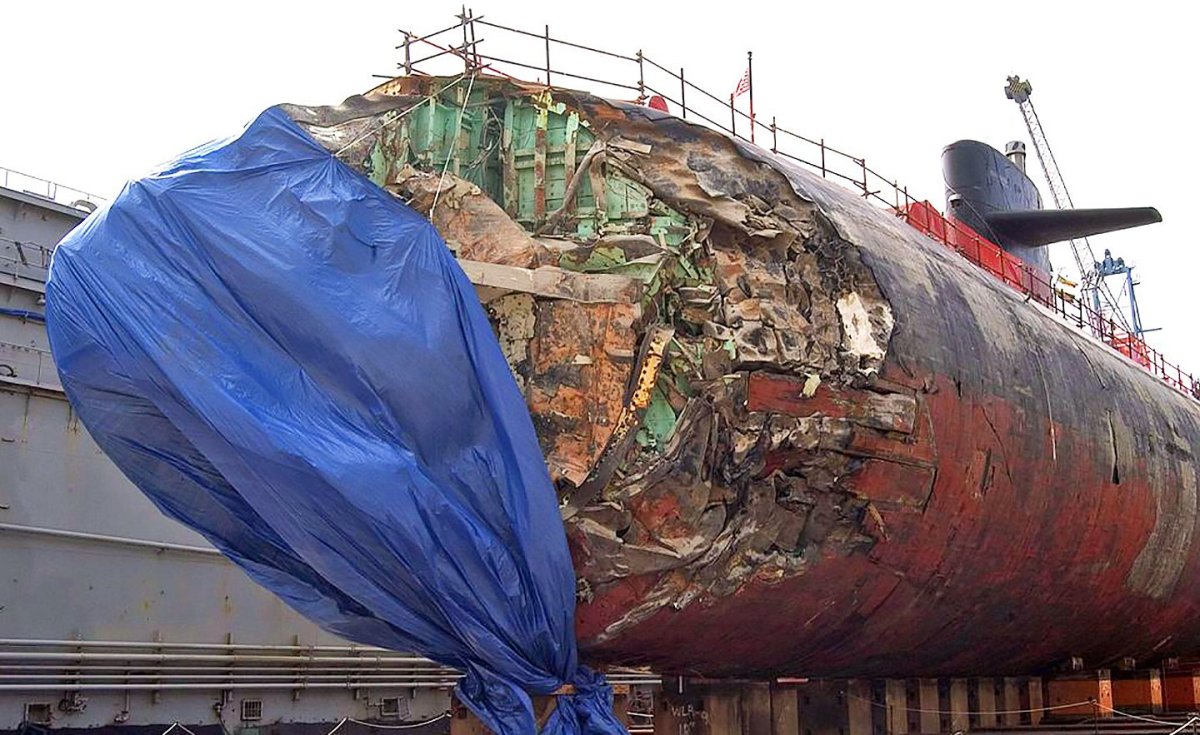
USS San Francisco pulling into Guam after its impact with a seamount. The damage seen in the top shot is also of San Francisco before a new bow was grafter onto her hull from an out-of-commission donor submarine., Public Domain
The investigation will determine who else may be at fault. The Navigator, Assistant Navigator and Quartermaster on watch will very likely be disqualified from their station, at the very least. The investigation will check equipment operation, watchstander logs, and immediate actions during the collision to determine who else is disciplined.
Every piece of equipment that moves on a submarine is carefully balanced. From gyroscopes to seawater pumps, every piece of gear will have to be checked and probably replaced to retain a quiet posture going forward. This will require a lot of drydock time and follow-on trials.
Contact the editor: Tyler@thedrive.com
Comments couldn’t be loaded. Please refresh the page.
更新于美国东部时间2021年10月11日下午6:01
2021年10月7日,我们获悉美国海军引以为傲的“海狼”级核动力攻击潜艇之一——全球仅建造了三艘——遭遇了一起严重的水下碰撞事故。据称,事故发生在“康涅狄格”号(SSN-22)在波涛汹涌的南海海域或附近海域执行任务时。受损的潜艇随后艰难地驶往关岛,以便进行损伤评估。所幸的是,艇上无人伤亡,核反应堆也安然无恙。
康涅狄格号究竟撞到了什么仍然是个谜,但许多人向我们表达了他们的困惑:一艘价值数十亿美元、配备了地球上一些最先进传感器的核潜艇——堪称人类建造过的最先进的交通工具之一——怎么会在水下撞到什么东西呢?
康涅狄格号战列舰在战况较好时期航行中的照片。(美国海军)
带着这个问题,我们联系了资深潜艇兵亚伦·阿米克,他是本网站的朋友和撰稿人,也是Sub Brief网站的所有者。他曾在美国攻击型和弹道导弹潜艇部队担任声呐兵20年,也曾担任新声呐兵的教官。如果有人能告诉我们这类事件为何屡屡发生,以及康涅狄格号潜艇在碰撞后会发生什么,以及部分船员接下来的命运,那非他莫属。
正如我们所料,他果然这么做了。以下是我们的对话:
一艘价值数十亿美元、搭载着地球上最先进传感器的潜艇,在设计过程中可能存在哪些陷阱和盲点,导致其与水下物体发生碰撞?
潜艇航行需要对周围区域有非常详细的了解。实现安全水下航行的常用方法有两种:使用详细海图和主动运用高频声呐。
高精度海图始终是首选。主动声呐发射用于验证水深与海图的匹配程度。这些主动声呐脉冲可以向现代潜艇的前方和侧方发射。这些短程、高频声呐系统能够清晰地探测到附近的水下目标。训练有素的声呐操作员可以清楚地看到水下目标,例如水雷、沉船残骸和其他潜艇。
主动声呐的缺点在于,在大多数海洋环境中,其探测范围约为操作员有效搜索范围的两倍,且容易被探测到。典型的高频高分辨率声呐的有效探测距离为5000码,但在良好条件下,其探测范围至少可达10000码甚至更远。这意味着敌方可以定位潜艇的位置,并在潜艇使用高分辨率声呐期间,持续跟踪并保持隐蔽。
美国海军核潜艇上的声呐兵。(美国国防部照片,由美国海军一级士官大卫·C·劳埃德拍摄)
正是由于这种易受探测性的影响,主动声呐很少被使用。如果海底测绘声呐能够验证潜艇在海图上的位置,那么就没有必要使用可能暴露自身位置的高频前视声呐了。
美国海军海图是目前使用的最精确的海图。它们是数字化的(并有纸质备份),因此可以更频繁地更新。理想情况下,美国海军的每艘潜艇都应配备最新海图,以准确反映艇体外部的实际情况。但在实践中,我们发现情况并非总是如此。世界上某些区域的测深点相距数十码,这些盲区可能会掩盖从海底隆起并进入潜艇作业范围的地形地貌。
如果潜艇在疑似敌方潜艇出没的区域作业,可能会选择不使用高频主动声呐来探测周围地形。如前所述,这是因为声呐信号一旦被探测到就会暴露自身位置。这意味着潜艇会依靠加速度计进行航位推算来确定自身位置。
这种导航方式误差很小,但会随着时间的推移而累积。最终,潜艇的定位偏差可能达到数百码甚至更多。误差会不断增大,直到下一次导航定位。虽然有一些方法可以不用声呐来修正潜艇的位置,但这些方法无法揭示海图上测深点之间隐藏的地形信息。
其他潜艇和无人水下航行器的出现会如何影响这一现象?
在南海与载人潜艇发生碰撞是一个非常现实的问题。南海周边有许多国家拥有常规动力和核动力潜艇。中国在南海拥有亚洲最大的潜艇基地——榆林海军基地。任何时候,都可能有多艘潜艇在该区域活动。
一艘洛杉矶级快速攻击潜艇处于潜望镜深度。(美国海军)
像澳大利亚和越南这样的合作国家与盟友共同管理水域,避免碰撞。这有助于降低碰撞风险。其他不协调潜艇行动的国家则对自身和其他潜艇构成真正的威胁。
南海潜艇碰撞的风险比世界其他地区更高,因为这里是各类船只(包括潜艇)往来频繁的区域。日益频繁的航行活动降低了被动声呐的效能。潜艇可以而且会隐藏在嘈杂的海域,利用背景噪声掩盖其被动宽带声呐信号。这意味着,如果背景噪声足够大,足以掩盖两艘潜艇的信号,即使两艘潜艇近距离通过,彼此也听不到对方的声音。
无人水下航行器(UUV)正在改变我们操作潜艇的方式。UUV 可以在核潜艇无法进入的极浅或受限水域作业。UUV 结合声呐和人工智能技术进行水下导航,大大降低了人员伤亡风险。即使 UUV 搁浅,也不会像核潜艇那样损坏核反应堆或造成人员伤亡,因为它本身不具备这些功能。正是由于这种能力,UUV 的需求量激增,并已被全球许多国家的海军广泛采用。
据称,南海某些区域对潜艇航行极具挑战性,尤其是大型潜艇。其独特的近岸水下地形是否构成主要问题?
由于构造活动频繁,南海地形复杂,航行难度极大。海底地貌不断变化。南海部分区域水深极深,深度骤然变化,形成近乎垂直的浅滩,甚至有近乎垂直的构造隆起至海面。
南海地形图。(美国国家航空航天局)
这些尖峰是航行障碍,如果未能及时发现,可能导致水下碰撞。测量潜艇下方的水深可能不足以让潜艇有足够的时间避开前方近乎垂直的地形变化。
潜艇发生碰撞时,艇内通常会发生什么?决定依靠潜艇自身动力缓慢返回港口是否是一个艰难的决定?
水下碰撞的标准程序是立即驶向浅水区,并保持船体纵倾时的正浮力。碰撞警报响起。所有人员携带装备前往预定的损管站。通过1MC频道发布通知,所有舱室均需向损管中心(DC Central)报告损坏情况。碰撞造成的任何其他损坏,例如进水或火灾,将由船员处理,并由损管中心的负责人协调。
当潜艇下潜至浅水区时,值班军官会判断是否可以立即上浮。如果安全,潜艇将直接上浮并评估情况。这一切都在几秒钟内完成。始终保持良好的态势感知能力是安全脱险的关键,也能防止因再次与上方船只相撞而加重损失。
美国海军“罗德岛”号航空母舰上的船员正在进行应对舰上损伤的训练。
此时,如果潜艇艇体有任何损坏,将不会再次下潜。例如,如果声呐罩受损,压载舱可能也存在肉眼无法看到的损坏。因此,潜艇将保持在水面,直至返回港口。
除了船员安全之外,最令人担忧的是核电站。安全壳至关重要,我们将立即进行检查。为这些高压高温系统提供服务的泵和阀门非常坚固耐用,设计能够承受冲击,但为了确保核安全,我们将对机舱内的每个系统进行系统检查。
从历史角度来看,过去发生过碰撞事故的船只指挥官会面临怎样的处境?
从历史经验来看,指挥官通常会在最早的时机卸任。潜艇中队的一名合格指挥官通常会悄然接管指挥权,并向全体艇员宣布。执行官一般不会接管指挥权。
“旧金山”号潜艇在撞击海山后驶入关岛。顶部照片显示的是“旧金山”号在从一艘退役潜艇上移植新的艇首之前的受损情况。(公共领域)
调查将确定还有哪些人可能负有责任。至少,领航员、助理领航员和值班军需官很可能会被取消职务。调查将检查设备操作、值班日志以及碰撞发生时的立即行动,以确定还有哪些人需要受到纪律处分。
潜艇上所有活动的部件都经过精心平衡。从陀螺仪到海水泵,每一件设备都必须经过检查,必要时可能需要更换,以确保潜艇未来航行时的平稳运行。这将需要大量的干船坞维修时间和后续试验。
联系编辑:Tyler@thedrive.com
评论加载失败,请刷新页面。