Navy F/A-18 Squadron Commander’s Take On AI Repeatedly Beating Real Pilot In Dogfight海军F/A-18中队指挥官谈人工智能在空战中屡次击败真实飞行员
Everyone has an opinion when it comes to the stunning results of DARPA's AlphaDogfight trials, now hear what the skipper of a fighter squadron thinks.
新闻视频
By Commander Colin 'Farva' Price
Updated Nov 27, 2020 6:27 PM EST
The recent 5 to 0 victory of an Artificial Intelligence (AI) pilot developed by Heron Systems over an Air Force F-16 human pilot does not have me scrambling to send out applications for a new job . However, I was impressed by the AlphaDogfight trials and recognize its value in determining where the military can capitalize on AI applications.
For most military aviators, it may be easy to scoff at the artificiality of the contest. I may have even mumbled, “Never would have happened to a Navy pilot…” Instead, I think it is important not to get wrapped too much around the axle about the rules of the contest and instead focus on a couple of details that really jumped out at me on the advantages an AI pilot would have over a human pilot.
For the contest setup, the argument about the death of the dogfight, or that there is no need for within visual range engagements anymore is a tired one. There was a pretty popular movie in the ‘80s about that very argument, so I am not going to rehash it here. The fact is we still constantly train to dogfight in the Navy, or as it is more commonly referred to ‘Basic Fighter Maneuvers,’ or BFM for short.
Editor’s note: To get up to speed, you can read all about the AlphaDogfight trials and their stunning outcome in this recent War Zone piece. You can also watch the final round where the AI faced-off against the USAF F-16 Weapons Instructor and hear some commentary about the high-profile trials from those that worked on it for DARPA in the official video below.
BFM is great airborne training for gaining an understanding of your energy state in relation to the enemy and to exercise your situational awareness in a three-dimensional space in a physically demanding environment. An aviator has to understand how to aggressively maneuver their aircraft while at the same time integrating their weapon systems to cue a weapon, assess the quality of the weapons track, and determine if the trigger should be pulled to employ the weapon. All at the same time, they must be preventing the enemy from accomplishing the same process. It is a dynamic and stressful environment that creates better fighter pilots. I have yet to meet a pilot who is an above-average BFM pilot, but struggles in other mission sets.
There are multiple reasons why aircrew may find themselves at the merge with the enemy. But if they do end up at the merge, the goal is always the same: take the first shot to kill the enemy before they can shoot them.
This fact sometimes gets lost in training engagements. To maximize the training, the BFM fight will often be taken to a “logical conclusion.” Even though each aircraft may trade shots early in the fight, the two aircraft will keep fighting down to the hard deck till there is an obvious winner. Aircrew will come to the debrief patting themselves on the back for the gun footage they have of the other aircraft, but once the footage is played, they realize they absorbed the first shot well before their triumphant gun pipper placement. The real-world logical conclusion could have been very different if they were missing a wing or engine because of a missile impact.
The goal at the merge of achieving the first shot must be continually hammered home.
Still, the reality is that missiles do not always guide and fuze, thus we extend fights to teach aviators how to continue to survive or turn a defensive situation into an offensive one. The true sport of fighter jet aviators is a guns-only BFM engagement. A guns-only BFM engagement is a test of who can efficiently maximize their energy package and capitalize on each merge. Much like chess, truly great BFM pilots are thinking two to three merges ahead, not just reacting.
It does not take much skill to put the aircraft’s lift-vector on the other aircraft and yank on the Gs. In fact, if in doubt, just doing that will take care of 75 percent of the fight. But BFM is about being smoothly aggressive . Understanding the difference between when it is necessary to max-perform the aircraft and when it is time to preserve or efficiently gain energy back is key. In a tight turning fight, gaining a couple of angles at each merge can suddenly result in one aircraft saddled in the other aircraft’s control zone working a comfortable rear quarter gun-tracking shot.
In true gamesmanship fashion, the guns-only BFM engagement was the setting for the AlphaDogfight contest. So what jumped out at me about the engagements? Three main points. First was the aggressive use of accurate forward quarter gun employment. Second, was the AI’s efficient use of energy. Lastly was the AI’s ability to maintain high-performance turns.
During BFM engagements, we use training rules to keep aircrew and aircraft safe. An example of this is using a hard deck, which is usually 5,000 feet above the ground. Aircraft can fight down to this pretend ground level and if an aircraft goes below the hard deck, they are considered a “rocks kill” and the fight is ended. The 5,000 feet of separation from the actual ground provides a safety margin during training.
Another training rule is forward-quarter gunshots are prohibited. There is a high potential for a mid-air collision if aircraft are pointing at each other trying to employ their guns. Due to the lack of ability to train to forward-quarter gunshots, it is not in most aviators combat habit patterns approaching the merge to employ such a tactic. Even so, it would be a low probability shot.
A pilot must simultaneously and continuously solve for plane-of-motion, range, and lead for a successful gun employment. It is difficult enough for a heart of the envelope rear-quarter tracking shot while also concentrating on controlling a low amount of closure and staying above the hard deck. At the high rates of closure normal for a neutral head-on merge, a gun envelope would be available for around three seconds. Three seconds of intense concentration to track, assess, and shoot, while at the same time avoiding hitting the other aircraft. The Heron Systems AI on several occasions was able to rapidly fine-tune a tracking solution and employ its simulated gun in this fashion. Additionally, AI would not waste any brain cells on self-preservation approaching the merge avoiding the other aircraft. It would just happen. The tracking, assessing, and employing process for a missile is not much different than the gun. I am pretty confident AI could shoot a valid missile shot faster than I can, given the same data I am currently presented within the cockpit.
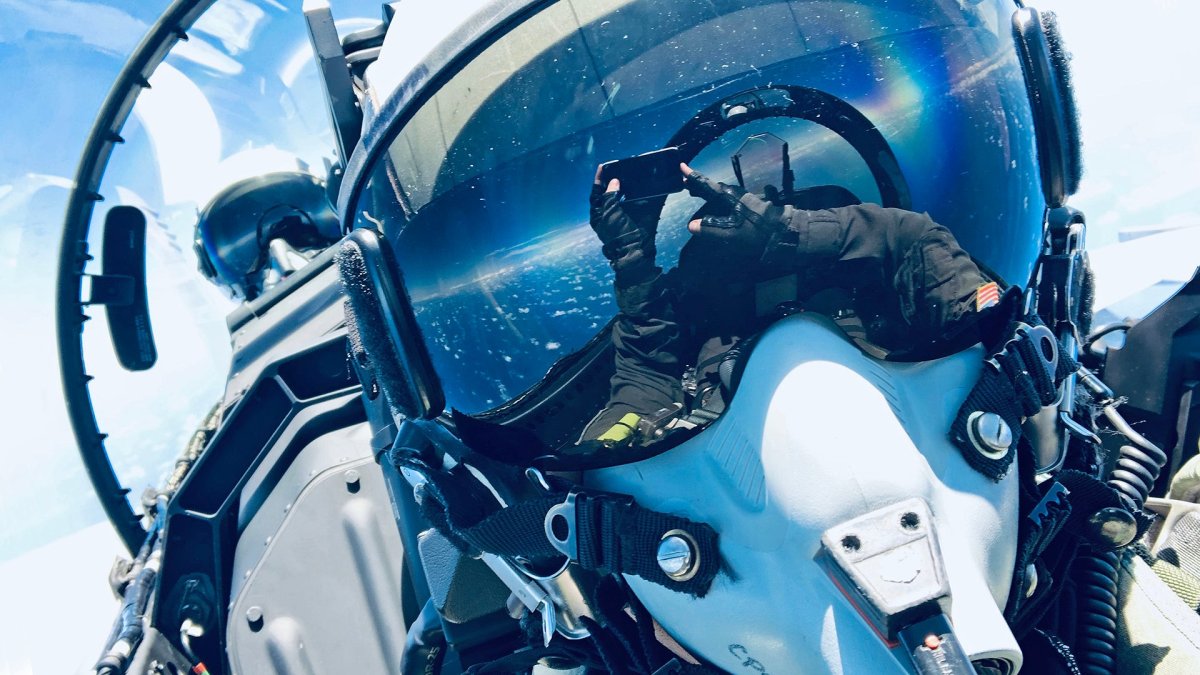
Super Hornet pilot in the cockpit about to launch off the deck. , SuUSN
The second advantage of AI was its ability to maintain an efficient energy state and lift vector placement. BFM flights certainly instill aviators with confidence in flying their aircraft aggressively in all regimes of the flight envelope. However, in today’s prevalent fly-by-wire aircraft, there is less aircraft feel providing feedback to the pilot. It takes a consistent instrument scan to check the aircraft is at the correct G, airspeed, or angle-of-attack for the given situation.
Even proficient aviators have to use a percentage of their concentration (i.e. situation awareness) on not over-performing or under-performing the aircraft. AI could easily track this task and would most likely never bleed airspeed or altitude excessively, preserving vital potential and kinetic energy while also fine-tuning lift vector placement on the other aircraft to continue the fight if required.
Lastly is AI’s freedom from human physiological limitations. During the last engagement, both aircraft were in a prolonged two-circle fight at 9 Gs on the deck. A two-circle fight is also referred to as a ‘rate fight.’ The winner is the aircraft who can track its nose faster around the circle, which is directly proportional (disregarding other tools such as thrust vectoring ) to the amount of Gs being pulled. More Gs means a faster turn rate. 9 Gs is extremely taxing on the body, which the pilot in the contest did not have to deal with, either. A human pilot would have to squeeze every muscle in the legs and abdominals in addition to focused breathing in order to not blackout. During training, I maintained 9 Gs in the centrifuge for about 30 seconds. Then I went home and took a nap, and that was without being shot at. AI does not care about positive or negative Gs. It will perform the aircraft at the level required.
F/A-18F manuevering hard. , USN
The truth is current aircraft have to be built to support the ‘pile of human’ sitting in it. The human will always be the limiting factor in the performance of an aircraft. I fight the jet differently now than I did as a junior officer when I was young and flexible. I have to fight differently. I know what my capabilities are to get a consistent and repeatable shot with the little bit of neck magic I have left to keep sight of the other aircraft. The fact that in the contest, the AI had perfect information at all times, and rules of engagement were not a factor, are not inconsequential details. I recognize that providing the amount of data and sensor fusion the AI would require to perform at the same level in a real aerial engagement (one that does not take place in cyberspace) is not a small undertaking and still a bit in the future. The rules of engagement discussion could fill up the syllabus for the entire semester of an ethics class, and will always be a touchy subject with regards to AI’s involvement in war.
I am not an engineer, nor an ethics professor. Yet, as a pilot, I am intrigued. A computer model was able to react to the movements of a human pilot and effectively employ weapons. During the five engagements, the AI had 15 valid gun employments and the human pilot had zero. These results also hint at the AI’s ability to avoid being shot while effectively employing its own weapons.
Farve and his fellow Black Knights of VFA-154 flying and fighting in the age of COVID., Courtesy of Commander Price
An AI-enhanced weapon’s employment system in my aircraft? I am not ready for Skynet to become self-aware, but I am certainly ready to invite AI into the cockpit. Hell, I am only a voting member as far as the flight controls are concerned in the Super Hornet anyways. If I put a control input in that is not aerodynamically sound (i.e. could result in a departure from controlled flight), the flight control system will not move the control surface or will move a different surface to give me the movement I am requesting. Who is flying who?
So, if tomorrow my seven-year-old daughter decides she wants to become a Naval Aviator, I am not going to shoot down the notion and go on a rant about the last generation of fighter pilots. I know there will be a Navy jet for her to fly. My future grandchildren, however? Saddle up kids and prepare yourself for some of Grandad’s wild tails of the greatest flight in Naval Aviation: the one-hour BFM cycle back to the Case One s**t-hot break . Those were the days!
Contact the editor: Tyler@thedrive.com
Comments couldn’t be loaded. Please refresh the page.
作者:科林·“法瓦”·普莱斯指挥官
更新于美国东部时间2020年11月27日下午6:27。
最近,Heron Systems公司开发的人工智能(AI)飞行员以5比0的比分战胜了空军F-16战斗机的人类飞行员,但这并没有让我急于投递新简历。然而,AlphaDogfight的测试给我留下了深刻的印象,我也意识到它在确定军方可以在哪些方面充分利用人工智能应用方面的价值。
对于大多数军用飞行员来说,他们或许很容易对这场比赛的人为性嗤之以鼻。我甚至可能嘟囔着:“海军飞行员绝不可能遇到这种事……” 但我认为,重要的是不要过分纠结于比赛规则,而应该关注一些让我印象深刻的细节,这些细节展现了人工智能飞行员相对于人类飞行员的优势。
就比赛设置而言,关于近距离空战已死,或者说不再需要视距内交战的争论早已老生常谈。上世纪80年代有一部很受欢迎的电影就探讨过这个话题,所以我在这里就不赘述了。事实上,海军仍然在持续进行近距离空战训练,或者更常见的说法是“基础战斗机机动训练”,简称BFM。
编者按:为了更好地了解情况,您可以阅读这篇近期发表在《战区》(War Zone)上的文章,其中详细介绍了 AlphaDogfight 测试及其令人震惊的结果。您还可以观看下方官方视频,观看人工智能与美国空军 F-16 武器教官的最终对决,并聆听参与 DARPA 项目的专家们对此次备受瞩目的测试的评论。
近距离机动飞行(BFM)是一项极佳的空中训练,能够帮助飞行员了解自身能量状态与敌方实力之间的关系,并在高强度的三维空间环境中锻炼其态势感知能力。飞行员必须掌握如何积极操控飞机,同时还要整合武器系统,完成武器瞄准、弹道轨迹评估以及判断是否扣动扳机等一系列操作。与此同时,他们还必须阻止敌方完成同样的操作。这种动态且充满压力的环境能够培养出更优秀的战斗机飞行员。我至今还没有遇到过一位近距离机动飞行水平高于平均水平,但在其他任务类型中表现不佳的飞行员。
机组人员与敌机交战的原因有很多。但如果真的到了交战阶段,目标始终如一:抢先一步,在敌人开火之前将其击毙。
在训练演习中,这一事实有时会被忽略。为了最大限度地提高训练效果,近距离空战(BFM)通常会进行到“逻辑终点”。即使双方飞机在战斗初期互射,两架飞机也会一直战斗到决出胜负。机组人员在战后总结会上会为自己拍摄到的对方飞机的机炮画面而沾沾自喜,但当播放这些画面时,他们才意识到,在他们得意洋洋地瞄准目标之前,就已经被对方击中了。如果因为导弹击中而损失了机翼或发动机,那么在现实世界中,最终的结果可能会截然不同。
在合并阶段,必须不断强调取得首发成功这一目标。
然而,现实情况是导弹并非总能制导并引信,因此我们延长空战时间,是为了训练飞行员如何继续生存或将防御局面转化为进攻局面。战斗机飞行员真正的竞技乐趣在于纯机炮近距离格斗。纯机炮近距离格斗考验的是谁能最有效地利用自身能量,并在每次交战中占据优势。就像下棋一样,真正优秀的近距离格斗飞行员会提前思考两到三次交战,而不仅仅是被动反应。
将飞机的升力矢量对准对方飞机并施加过载并不需要太多技巧。事实上,如果拿不定主意,这样做就能解决75%的战斗问题。但近距离空战的精髓在于平稳地发起进攻。理解何时需要发挥飞机的最大性能,何时应该保存或高效地恢复能量,这一点至关重要。在激烈的转弯缠斗中,每次交战时获得几个角度优势,就能让一架飞机突然进入另一架飞机的控制区,从而轻松地进行后方四分之一角度的机炮跟踪射击。
秉承竞技精神,AlphaDogfight 竞赛的场地设定为仅限机炮的近距离空战模式。那么,这些交战中哪些方面最让我印象深刻呢?主要有三点。首先是AI对精准的前部四分之一炮位射击的积极运用。其次是AI对能量的高效利用。最后是AI保持高水平转弯的能力。
在近距离空战(BFM)训练中,我们使用训练规则来保障机组人员和飞机的安全。例如,我们会设置一个模拟地面高度为5000英尺的硬地。飞机可以向下飞行至这个模拟地面高度进行空战,如果飞机低于硬地,则视为“岩石击落”,空战结束。与实际地面保持5000英尺的距离为训练提供了安全裕度。
另一条训练规则是禁止向前斜角射击。如果飞机在交战过程中机枪指向彼此,极易发生空中相撞。由于缺乏向前斜角射击的训练,大多数飞行员在接近交战区域时,其作战习惯中并不包含这种战术。即便如此,这种射击的概率仍然很低。
飞行员必须同时持续地计算运动平面、距离和提前量,才能成功使用机炮。在保持低距离并保持在硬甲板上方的同时,还要集中精力进行后方四分之一跟踪射击,这本身就极具挑战性。在通常情况下,中立迎头交战时飞机接近速度很快,机炮的有效射击时间只有大约三秒钟。这三秒钟需要高度集中注意力进行跟踪、评估和射击,同时还要避免击中对方飞机。Heron Systems 的人工智能系统曾多次能够快速微调跟踪方案,并以这种方式使用其模拟机炮。此外,人工智能在接近交战区域时不会浪费任何精力在避免与对方飞机碰撞上,而是会自动完成这些操作。导弹的跟踪、评估和使用过程与机炮并无太大区别。我很有信心,在座舱内呈现相同数据的情况下,人工智能可以比我更快地发射有效的导弹。
超级大黄蜂战斗机飞行员在驾驶舱内,即将从甲板上起飞。
人工智能的第二个优势在于其能够维持高效的能量状态和升力矢量定位。BFM飞行无疑增强了飞行员在飞行包线所有区域内积极驾驶飞机的信心。然而,在如今普遍采用电传操纵的飞机中,飞行员获得的飞机路感反馈较少。飞行员需要持续进行仪表扫描,才能确认飞机在特定情况下是否处于正确的过载、空速或迎角。
即使是技术娴熟的飞行员也必须将一部分注意力(即态势感知能力)用于控制飞机的飞行性能,避免过度操控或操控不足。人工智能可以轻松完成这项任务,并且很可能不会过度损失空速或高度,从而保留关键的势能和动能,同时还能微调对另一架飞机的升力矢量定位,以便在必要时继续战斗。
最后一点是人工智能不受人类生理限制。在上次交锋中,两架飞机在甲板上以9G的过载进行了长时间的双圈缠斗。双圈缠斗也称为“速率缠斗”。获胜者是能够更快地绕圈飞行的飞机,这(忽略推力矢量等其他辅助手段)与所承受的过载成正比。过载越大,转弯速率越快。9G对身体来说是极大的负担,而参赛飞行员无需承受这种负担。人类飞行员除了要集中呼吸外,还必须绷紧腿部和腹部的每一块肌肉才能不至于昏厥。在训练中,我曾在离心机中保持9G的过载约30秒。然后我回家睡了一觉,而且当时并没有遭到攻击。人工智能不受正负过载的影响。它会根据要求使飞机达到相应的性能水平。
F/A-18F 操纵困难。 , 美国海军
事实是,目前的飞机必须按照机上人员的重量来设计。人的因素始终是飞机性能的限制因素。我现在驾驶战机的方式与我年轻时作为一名初级军官灵活时截然不同。我必须改变作战方式。我知道自己的能力范围,如何在仅存的一点颈部灵活性下,保持对敌机的视野,从而实现稳定且可重复的射击。在对抗中,人工智能始终掌握着完美的信息,交战规则也并非考量因素,但这并非无关紧要的细节。我意识到,要让人工智能在真实的空战(而非网络空间)中达到同样的水平,需要提供大量的数据和传感器融合,这绝非易事,而且距离实现还有一段距离。关于交战规则的讨论足以填满一整个学期的伦理课,而且在人工智能参与战争的问题上,它始终是一个敏感话题。
我既不是工程师,也不是伦理学教授。然而,作为一名飞行员,我对此很感兴趣。一个计算机模型能够对人类飞行员的动作做出反应,并有效地使用武器。在五次交战中,人工智能成功使用了15次武器,而人类飞行员一次也没有。这些结果也暗示了人工智能在有效使用自身武器的同时,还能躲避敌人的攻击。
法夫和他的VFA-154“黑骑士”战友们在新冠疫情时代执行飞行和战斗任务。(图片由普莱斯指挥官提供)
我的飞机上要装一套人工智能增强型武器运用系统?我还没准备好迎接天网觉醒自我意识,但我绝对愿意让人工智能进入驾驶舱。说真的,在超级大黄蜂的飞行控制系统里,我只不过是个投票成员而已。如果我输入一个不符合空气动力学原理的控制指令(比如可能导致偏离受控飞行),飞行控制系统要么不会移动控制面,要么会移动另一个控制面来实现我想要的动作。到底是谁在操控谁?
所以,如果明天我七岁的女儿突然想当海军飞行员,我不会立刻否定她的想法,也不会长篇大论地抱怨上一代战斗机飞行员的遭遇。我知道她以后肯定能开上海军的喷气式飞机。但是,我未来的孙辈们呢?孩子们,准备好听爷爷讲述海军航空史上最伟大的飞行故事吧:一小时的BFM循环,然后回到Case One的紧急停顿点。那才是真正的美好时光!
联系编辑:Tyler@thedrive.com
评论加载失败,请刷新页面。