The Navy Concluded Transmedium Flying Submersibles Were Possible A Decade Ago海军十年前就得出结论,超中型飞行潜水器是可行的。
A vehicle that can travel under the sea and in the air may seem like a fantasy, but the Navy says it is possible and relevant for special operations.
Updated Jun 12, 2021 10:01 AM EDT
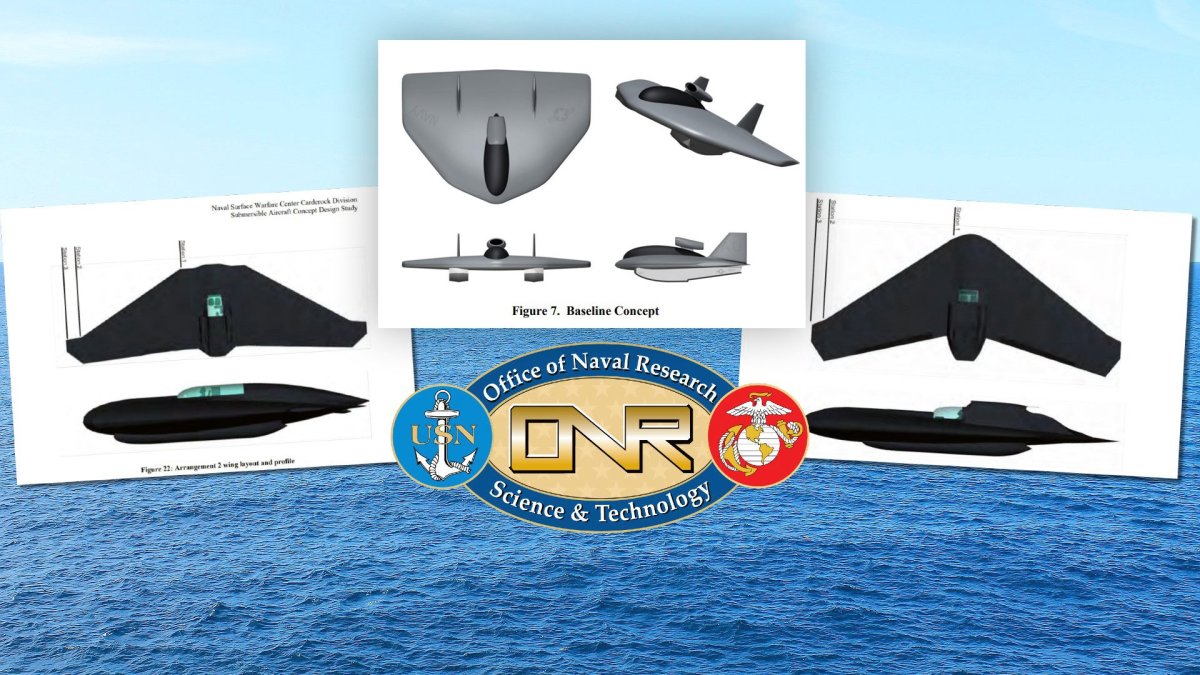
A U.S. Navy research document from 2010 outlines the Naval Surface Warfare Center (NSWC) Carderock Division ‘s efforts to create a working design of a manned vehicle capable of both airborne flight and submerged travel. The craft was intended to provide stealthy transport for Special Forces units into and out of operating areas. This wasn’t the first study of its kind to propose such a “transmedium” vehicle, defined as one capable of operating in multiple domains, such as in the air and underwater, but building such a craft has proven itself time and time again to be difficult, to say the least. It’s not clear how far the Navy’s efforts went, but the document’s conclusions are significant in that they show that over a decade ago, Naval researchers concluded that a “working design is feasible within the current state of the art.”
Aircraft that could also operate under the sea have long been pursued by the U.S. Navy and other militaries. A number of often unworkable or heavily compromised designs have been proposed and even tested by armed forces around the world since at least the 1950s , including various forms of submersible aircraft , to more modern designs like the short-lived Lockheed Martin Cormorant . While the degree to which these designs have been able to operate in both the sea and air environments vary greatly, among the “holy grails” of aerospace research is a truly hybrid vehicle , a submersible aircraft or “flying submarine” that can travel near-seamlessly between the sky and the sea.
In 2010, NSWC Carderock published its study of just such a vehicle concept. The idea was to research the feasibility of designing a vehicle that combined “the speed and range of an airborne platform with the stealth of an underwater vehicle by developing a vessel that can both fly and submerge.” The ultimate goal was to work towards developing a vehicle that could insert and extract Special Forces units at much greater ranges and speeds than existing platforms at the time, and be able to do so in locations that were “not previously accessible without direct support from additional military assets.” There have been far less ambitious boat-submarine concepts brought to life as of late , that try to address the issues of getting around the inherent limitations of existing swimmer delivery options . But the technological chasm between creating a vehicle that can transition between the surface and subsurface of the ocean and creating a true flying submarine is absolutely massive.
The study was born out of a Broad Area Announcement (BAA) issued by DARPA in 2008 calling for design proposals for such a Special Forces vehicle and defining a Concept of Operations (CONOP) for potential designs. NSWC Carderock based its study off of that CONOP, which outlined the need for a vehicle whose capabilities included:
– Deployment from a naval/auxiliary platform; – take-off from the water surface and transit 400 miles airborne, then land on the water surface; – submerge and transit 12 [nautical miles] underwater before deploying Special Forces; – loiter for up to 72 hours fully submerged; – retrieve Special Forces whilst submerged before transiting submerged to 12 [nautical miles] off the coast, take-off and return 400 miles to the mother ship
– Deployment from a naval/auxiliary platform;
– take-off from the water surface and transit 400 miles airborne, then land on the water surface;
– submerge and transit 12 [nautical miles] underwater before deploying Special Forces;
– loiter for up to 72 hours fully submerged;
– retrieve Special Forces whilst submerged before transiting submerged to 12 [nautical miles] off the coast, take-off and return 400 miles to the mother ship
To meet that need, NSWC Carderock and the Office of Naval Research conducted a study that would determine the feasibility of building a manned triangular, “submersible aircraft” that could insert Special Forces operators “covertly at a higher speed and more independently than is currently achievable.”
NSCW Carderock came up with two blended wing-body/flying wing-type designs for their submersible aircraft concept, one with a wingspan of 92 feet, and another with a wingspan of 109 feet. Aside from differences in size, both designs had fairly similar specifications in terms of payload, speed, and weight:
The submersible aircraft was designed to be operated by a crew of two, with room to accommodate six more Special Forces personnel for transportation. When underwater, the craft would have an operating depth of 30 meters and a speed of 6 knots; in the air, the craft would reach 200 mph.
Propulsion was an obvious challenge the study considered, and the authors note that “It quickly became apparent that turbofans, turbo-props, and pulse jets systems should be considered in more detail.” In the end, based on fuel considerations and each propulsion methods’ ability to be sealed when underwater, it was decided that the best propulsion choices were “twin turbofans within sealable nacelles for air and sea-surface operating modes,” while “a single drop-down electrically driven thruster” was chosen for submerged operations.
In order to assess the feasibility of the overall concept, a scale model with a six-foot wingspan powered by two 11-volt motors was constructed for testing. In flight tests, the vehicle displayed “very good directional stability” despite its lack of vertical stabilizers, which designers thought would severely limit the aircraft’s yaw control. The craft lost control only once during testing due to high winds, but this “was not believed to be a significant problem as the scale velocity of the wind was high,” meaning a full-sized aircraft would not have been affected as much as the small scale model was.
When floats were attached to the scale model aircraft for water testing, its designers encountered difficulty in maintaining directional control. As a result, the study notes, “Attempts made to reach take-off speed and carry out a short take-off and landing were unsuccessful.” The failure was attributed to the inaccurate alignment of the model’s floats and the “inherent flex” of the Velcro used to attach the floats. Despite the failures, the report concluded that the tests validated the concept for the transmedium vehicle’s design and made plans to address the flaws in subsequent designs and tests.
While it’s unknown if the study led to any further testing or development, the submersible aircraft study conducted by NSWC Carderock reached several conclusions, including that “feasible vehicle concepts can be generated using current technology and materials” and that “a hybrid flying wing/blended body design offers a viable solution” for transmedium vehicles and “offers a practical compromise between performance in flight, on the surface and when submerged.”
Other concepts were created in response to DARPA’s BAA for a submersible aircraft and were published in aerospace academic publications throughout the early 2010s, like the submersible airplane design seen below.
NSWC Carderock wasn’t the only laboratory pursuing transmedium vehicle research at the time. The Naval Research Laboratory (NRL) was also testing small, air-launched unmanned vehicles that could dive into bodies of water and travel short distances underwater in the early 2010s. According to a study published in 2014, these “vehicles demonstrated mixed-mode operation through dozens of swim tests and three flight tests,” although the study never accomplished air to underwater operation in a single test. The Office of Naval Research (ONR) also developed at least one such vehicle, the Flying Sea Glider , that was designed to be dropped from as high as 30,000 feet before gliding above the water and finally diving beneath the surface.
The Office of Naval Research’s Flying Sea Glider, a demonstrator for which is seen here on display in 2017, was considered for use in resupplying submerged submarines., Joseph Trevithick
In 2018, a DARPA-sponsored research project conducted at North Carolina State University reported a “seabird-inspired fixed-wing hybrid UAV-UUV system” that successfully conducted both air flights and submerged operations that demonstrated “egress from water, flight in air, ingress into water in each flight, and water locomotion.”
In addition to Department of Defense-funded laboratories, there has been a clear, demonstrated interest in multi-medium vehicles by the military-industrial complex. Large aerospace contractors likewise possess patents for transmedium vehicles, such as the curiously low-key name “Vehicle” patent assigned to Lockheed Martin. The “Vehicle” patent describes a turbofan-powered vertical take-off and landing (VTOL) craft “capable of travel on the water, vertical flight, and hovercraft type operation.” One of the primary purposes of the patent was to provide a VTOL vehicle capable of traveling long distances on the water.
A schematic from Lockheed Martin’s “Vehicle” patent. Just a fun side note, one of the designers is Steve Justice, who held a top position at the Skunk Works before going on to being one of the stars on the History Channel show Unidentified and part of Tom Delonge’s To The Stars Academy., USPTO
Lockheed Martin also developed and patented the Cormorant, a stealthy, jet-powered drone that could be both launched and recovered by submerged submarines and carry a 1,000-pound payload in its modular bay. The Cormorant’s design was informed specifically by Navy specifications for unmanned aerial vehicles that could be launched by its converted Ohio -class guided-missile submarines (SSGN) at depths up to 150 feet. You can read all about Cormorant and the Navy’s ability to launch flying drones from submarines in this past feature of ours .
A non-flying Cormorant test article., USN
Like so many other transmedium vehicle projects, it’s unclear just how far the Cormorant project went after DARPA canceled the project in 2008. However, Lockheed Martin filed a patent for a separate transmedium vehicle a year later described as being able to “float in a body of water, or submerge itself underneath the water, and then later launch from the water without human intervention to perform a flying mission.”
Using a modified MiG-15 to illustrate its patent components, Lockheed recently patented a true transmedium vehicle that could fly above and navigate below the waves., USPTO
So far, there is no hard evidence that the decades-long search for a true hybrid aerospace-underwater vehicle has resulted in anything but a trove of conceptual studies hidden away in academic literature and a handful UUV/UAV concepts that have shown promise in testing. The full-scale development of such a craft either went dark or never went much farther. Still, the fact that a Navy study concluded over a decade ago that such a concept was “feasible within the current state of the art” shows just how close we may be to seeing the dream of a submersible airplane finally realized.
Considering the tactical issues facing the U.S. military and the rise of peer state competitors like China, especially in regards to its anti-access umbrella and the long distances that would be involved in a war in the Pacific, such a vehicle would be far more relevant now than in the last few decades. A low-flying, somewhat low-observable craft could convey special operators through contested airspace and then deliver them into outright enemy territory while submerged. It’s not like the special operations community hasn’t delved into exotic infiltration capabilities before .
With all that being said, and considering the generous and far more agile budget the special operations community has, it wouldn’t be outside the realm of the possible that a concept like this is indeed in some form of development or could even exist in a clandestine operational state today.
The enemy certainly would have a hard time even figuring out what the heck they were looking at if they ran into one.
Contact the author: Brett@TheDrive.com
Comments couldn’t be loaded. Please refresh the page.
更新于美国东部时间2021年6月12日上午10:01
美国海军2010年的一份研究文件概述了海军水面作战中心(NSWC)卡德罗克分部为研发一种能够同时进行空中飞行和水下航行的载人飞行器所做的努力。该飞行器旨在为特种部队提供进出作战区域的隐蔽运输。这并非首个提出此类“跨介质”飞行器(定义为能够在空中和水下等多个领域运行的飞行器)的研究,但建造此类飞行器已被反复证明极其困难。目前尚不清楚海军的研究进展到了什么程度,但该文件的结论意义重大,因为它表明,早在十多年前,海军研究人员就已得出结论:“在现有技术条件下,设计出一种可行的飞行器是完全可行的。”
能够同时在空中和水下运行的飞行器一直是美国海军和其他国家的军队长期追求的目标。自至少20世纪50年代以来,世界各国的军队已经提出并测试了许多设计方案,其中不乏一些难以实现或存在严重缺陷的方案,包括各种类型的潜水飞机,以及像昙花一现的洛克希德·马丁“鸬鹚”这样的现代设计。尽管这些设计在海空环境下的运行能力差异很大,但航空航天研究的“圣杯”之一,是一种真正的混合动力飞行器,即能够在天空和海洋之间近乎无缝地穿梭的潜水飞机或“飞行潜艇”。
2010年,美国海军水面作战中心卡德罗克分部(NSWC Carderock)发表了一项关于此类载具概念的研究。该研究旨在探索设计一种能够兼具“空中平台的速度和航程以及水下航行器的隐蔽性”的载具的可行性,即开发一种既能飞行又能潜水的舰艇。其最终目标是研发一种能够以远超当时现有平台的速度和距离投放和撤离特种部队的载具,并且能够在“此前在没有其他军事力量直接支援的情况下无法到达”的地点执行任务。近年来,一些规模小得多的潜艇概念也相继问世,它们试图解决现有潜水员投放方式固有的局限性。然而,从制造一种能够在海面和水下之间转换的载具到制造真正的飞行潜艇,两者之间存在着巨大的技术鸿沟。
这项研究源于美国国防高级研究计划局 (DARPA) 于 2008 年发布的一项广泛领域公告 (BAA),该公告征集特种部队车辆的设计方案,并为潜在设计方案制定了作战概念 (CONOP)。美国海军水面作战中心卡德罗克分部 (NSWC Carderock) 的研究正是基于该作战概念,其中概述了对具备以下能力的车辆的需求:
– 从海军/辅助平台部署;– 从水面起飞,飞行400英里后降落水面;– 潜入水下12海里后部署特种部队;– 完全潜航,最长可达72小时;– 潜航回收特种部队后,潜航至距海岸12海里处,起飞并飞行400英里返回母舰。
– 从海军/辅助平台部署;
– 从水面起飞,飞行 400 英里后降落在水面上;
– 在部署特种部队之前,潜入水下航行 12 [海里];
– 完全浸没后可停留长达 72 小时;
在潜航至距海岸12海里处之前,先在水下回收特种部队,然后起飞并返回母舰400英里处。
为了满足这一需求,NSWC Carderock 和海军研究办公室进行了一项研究,旨在确定建造一种载人三角形“潜水飞机”的可行性,这种飞机能够“以比目前所能达到的更高的速度和更独立的方式”秘密投放特种部队人员。
NSCW Carderock 为其潜水器概念设计了两种翼身/飞翼式混合结构,一种翼展为 92 英尺,另一种翼展为 109 英尺。除了尺寸差异外,两种设计在有效载荷、速度和重量方面都相当相似:
这架潜水飞机设计由两名机组人员操作,并可容纳六名特种部队人员用于运输。水下作业深度为30米,航速为6节;空中飞行速度可达200英里/小时。
推进系统显然是该研究考虑的一大挑战,作者指出:“很快我们就意识到,涡扇发动机、涡桨发动机和脉冲喷气发动机系统需要更深入的探讨。”最终,基于燃料消耗和各种推进方式在水下密封性方面的考量,研究人员决定,最佳推进方案是“在空中和海面作业模式下采用可密封短舱内的双涡扇发动机”,而水下作业则采用“单个可拆卸式电动推进器”。
为了评估整体概念的可行性,我们制作了一个翼展六英尺、由两台11伏电机驱动的比例模型进行测试。飞行测试表明,尽管该飞行器缺少垂直尾翼(设计者认为垂直尾翼会严重限制其偏航控制),但它仍展现出“非常好的方向稳定性”。测试期间,该飞行器仅因强风而失控一次,但“由于风速在模型中较高,因此这被认为并非重大问题”,这意味着全尺寸飞机受到的影响远小于小型模型。
当为进行水上测试而将浮筒安装到缩比模型飞机上时,设计人员发现难以保持方向控制。因此,研究指出,“尝试达到起飞速度以及进行短距起降均告失败。”失败的原因归结于模型浮筒的对准不准确以及用于固定浮筒的魔术贴的“固有柔韧性”。尽管存在这些失败,报告仍得出结论,测试验证了跨介质飞行器的设计概念,并制定了在后续设计和测试中解决这些缺陷的计划。
虽然尚不清楚该研究是否促成了进一步的测试或开发,但美国海军水面作战中心卡德罗克分部进行的潜水器研究得出了一些结论,包括“利用现有技术和材料可以生成可行的车辆概念”,以及“混合飞翼/混合体设计为跨介质车辆提供了一种可行的解决方案”,并且“在飞行、水面和水下性能之间提供了一种切实可行的折衷方案”。
为响应 DARPA 的 BAA 潜水飞机计划,人们创造了其他一些概念,并在 2010 年代初期的航空航天学术出版物上发表,例如下图所示的潜水飞机设计。
当时,NSWC Carderock并非唯一一家从事跨介质飞行器研究的实验室。海军研究实验室(NRL)也在2010年代初测试小型空射无人飞行器,这些飞行器可以潜入水体并在水下短距离航行。根据2014年发表的一项研究,这些“飞行器通过数十次游泳测试和三次飞行测试验证了混合模式运行能力”,尽管该研究从未在单次测试中实现空对水的转换。海军研究办公室(ONR)也开发了至少一款此类飞行器——“飞行海上滑翔机”(Flying Sea Glider),其设计目的是从高达30,000英尺(约9,120米)的高空投放,在水面上滑翔,最终潜入水下。
美国海军研究办公室的“飞行海上滑翔机”(图中所示为2017年展出的演示样机)曾被考虑用于为水下潜艇提供补给。——约瑟夫·特雷维西克
2018 年,北卡罗来纳州立大学开展了一项由 DARPA 赞助的研究项目,报告称“受海鸟启发的固定翼混合无人机-无人水下航行器系统”成功进行了空中飞行和水下作业,展示了“从水中起飞、空中飞行、每次飞行中进入水中以及水上运动”。
除了国防部资助的实验室外,军工联合体也对多介质飞行器表现出了明显的兴趣。大型航空航天承包商同样拥有多介质飞行器的专利,例如洛克希德·马丁公司拥有的名为“Vehicle”(车辆)的专利,该专利名称颇为低调。“Vehicle”专利描述了一种涡扇动力垂直起降(VTOL)飞行器,“能够在水上行驶、垂直飞行以及进行类似气垫船的操作”。该专利的主要目的之一是提供一种能够在水上长距离航行的垂直起降飞行器。
这是洛克希德·马丁公司“车辆”专利中的一张示意图。顺便提一下,其中一位设计师是史蒂夫·贾斯蒂斯,他曾在臭鼬工厂担任要职,之后成为历史频道节目《不明身份》的明星之一,并参与了汤姆·德隆的《星际学院》节目。(美国专利商标局)
洛克希德·马丁公司还研发并获得了“鸬鹚”(Cormorant)无人机的专利。这是一款隐形喷气式无人机,可由潜艇发射和回收,其模块化弹舱可携带1000磅有效载荷。“鸬鹚”的设计特别参考了海军对无人机的具体要求,这些无人机可由其改装的俄亥俄级导弹潜艇(SSGN)在150英尺(约46米)深的水下发射。您可以在我们之前的专题报道中了解更多关于“鸬鹚”以及海军从潜艇发射无人机的能力。
美国海军一架非飞行型鸬鹚试验机。
与其他许多跨介质飞行器项目一样,在 DARPA 于 2008 年取消“鸬鹚”项目后,该项目究竟进展到什么程度尚不清楚。然而,一年后,洛克希德·马丁公司为另一款跨介质飞行器申请了专利,该飞行器被描述为能够“漂浮在水体中,或潜入水下,然后在无需人为干预的情况下从水中发射,执行飞行任务”。
洛克希德公司最近利用一架改装的米格-15战斗机来展示其专利部件,并申请了一项真正的跨介质飞行器专利,该飞行器既能在水面上飞行,也能在水下航行。(美国专利商标局)
迄今为止,尚无确凿证据表明,数十年来对真正的空天两用飞行器的探索取得了任何实质性成果,除了学术文献中大量概念研究和少数在测试中展现出潜力的无人水下航行器/无人机概念之外。此类飞行器的全面研发要么陷入停滞,要么从未取得实质性进展。然而,十多年前海军的一项研究得出结论,认为这种概念“在现有技术条件下是可行的”,这表明我们距离实现水下飞机的梦想可能已经非常接近了。
考虑到美军面临的战术问题以及中国等势均力敌的竞争对手的崛起,尤其是在其反介入/区域拒止能力以及太平洋战争涉及的广阔距离方面,这种飞行器如今比过去几十年都更具现实意义。这种低空飞行、隐蔽性较强的飞行器可以将特种作战人员运送穿越敌方空域,然后潜入敌方领空。事实上,特种作战部队此前也曾探索过一些特殊的渗透能力。
综上所述,考虑到特种作战部队拥有慷慨且更为灵活的预算,这种概念实际上可能正在以某种形式发展,甚至可能如今已秘密投入使用,也并非不可能。
如果敌人遇到这样的装置,肯定很难弄清楚自己到底看到的是什么。
联系作者:Brett@TheDrive.com
评论加载失败,请刷新页面。