Brics leaders unite on Middle East calm despite deep divisions尽管存在严重分歧,金砖国家领导人仍就中东局势保持稳定达成共识
NEW DELHI, Sept 13 — Members of the 11-nation Brics group including China, Russia, Iran and India called for calm in the Middle East at a summit in New Delhi on Saturday,...
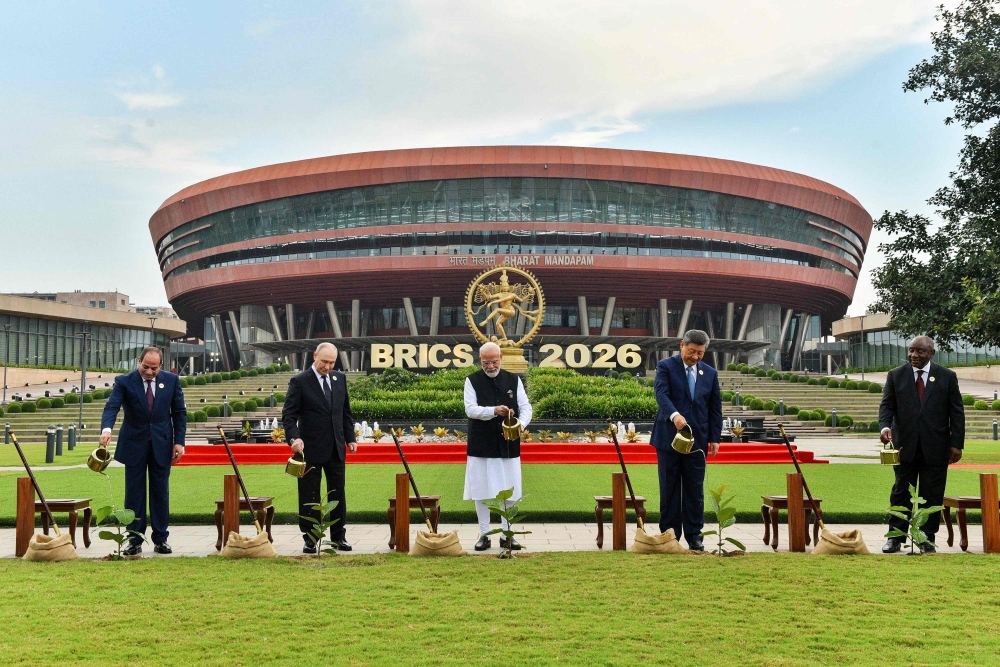
At the Brics summit in New Delhi, leaders from China, Russia, Iran, India, and other member nations issued a joint statement calling for restraint in the Middle East, overcoming previous disagreements to address ongoing conflicts and promote peace.
Indian Prime Minister Narendra Modi highlighted the bloc's significant global influence, emphasizing cooperation over competition.
Chinese President Xi Jinping's visit marked a diplomatic milestone amidst lingering territorial disputes between China and India.
The summit aimed to enhance Brics' global influence by addressing issues like conflict resolution, trade challenges, and energy security.
NEW DELHI, Sept 13 — Members of the 11-nation Brics group including China, Russia, Iran and India called for calm in the Middle East at a summit in New Delhi on Saturday, overcoming earlier divisions to issue a joint statement.
Chinese President Xi Jinping, who joined Russian, Iranian, Indian and other leaders in India’s capital, told the summit that the Middle East war “does not serve the common interests of the international community”.
Foreign ministers of the Brics grouping had failed to agree on a joint statement when they met in New Delhi in May, with Iran, Saudi Arabia and the United Arab Emirates divided over the war that began with US-Israeli strikes on February 28.
But leaders issued a statement on Saturday after intense diplomatic efforts by host India, as the bloc seeks to bolster its global influence and address conflict, trade turbulence and energy security.
“We express deep concern over the continued escalation of tensions in Middle East/West Asia,” the joint statement said, adding the countries “call for exercising maximum restraint, as well as avoiding actions that could further aggravate the situation”.
Brics was created in 2009 as a forum for major emerging economies seeking greater influence in institutions dominated by Western powers.
“We have to transform this pyramid of privilege into a platform of partnership,” Indian Prime Minister Narendra Modi told Xi, Russian President Vladimir Putin, Iranian President Masoud Pezeshkian and other leaders as he opened the two-day summit.
Modi said Brics nations “represent 50 percent of the world’s population, 40 percent of global GDP and more than 25 percent of global trade”.
But finding balance in the bloc is a tough diplomatic task.
India maintains cordial relations with both Iran and US ally Israel, but is also careful to strike a delicate balance in its ties with Washington.
Iran’s Pezeshkian attended the summit shortly after warning that the Middle East does not need the United States to be a “regional policeman”, with the two countries at war and tensions threatening the vital Strait of Hormuz.
Pezeshkian met with Abu Dhabi Crown Prince Khaled bin Mohamed bin Zayed Al Nahyan on the summit sidelines.
India has navigated the energy crisis caused by the US-Iran war in part by turning to Russia, despite Moscow’s war in Ukraine and pressure from Washington and other Western capitals.
Modi embraced Putin before talks on Friday. The Russian president, who last visited India in December 2025, is one of New Delhi’s most important strategic partners.
‘Handling differences’
Xi’s participation is also being closely watched because it is his first visit to neighbouring India since 2019, and the biggest step yet in a cautious thaw between the nuclear-armed rivals.
Xi was given a red-carpet welcome, with an honour guard of soldiers and traditional dancers in colourful dresses.
“Although our two countries are different in many respects, they are fully capable of complementing each other’s strengths, supporting one another, achieving mutual success and advancing together,” Xi said as he met Modi, in a video released from New Delhi.
His visit comes six years after a deadly military clash along the disputed Tibetan border between China and India, with ties gradually improving through restored flights, visas and high-level contacts.
The underlying territorial dispute remains unresolved, and both sides retain heavy military deployments along their roughly 3,500-kilometre (2,175-mile) high-altitude border.
India’s foreign ministry said in a statement after the meeting that “the two leaders expressed commitment to a fair, reasonable, and mutually acceptable resolution of the boundary question”.
Modi “underlined the need for both sides to observe existing agreements and understandings on border related issues,” the foreign ministry added.
Deep mistrust remains, with their contested Himalayan frontier, a widening trade deficit and strategic rivalry continuing to complicate ties.
“Both sides should... work hand-in-hand to promote high-quality major financial cooperation, advocate an equal and sustainable global order, and foster an economic globalisation that is open and inclusive,” Xi said.
Dozens of Tibetans protested in New Delhi on Friday – exiles, like their Buddhist leader the Dalai Lama, who has lived in India since fleeing a Chinese crackdown in 1959 – waving placards against Xi’s visit. — AFP
Brics ends on high note, but old rivalries linger beneath the surface
China steps up AI push with open-source zone for Brics countries
Merchant ship strike in Hormuz Strait kills one, injures three
Malaysia’s Brics partnership broadens trade ties while keeping ‘middle path’, says J-KOM
FDS crash: Dr Ainul’s husband thanks all, calls nationwide support a ‘blessing’
MOH to review all FDS helicopter contracts, RM30 flight allowance after fatal Sarawak crash
在新德里举行的金砖国家峰会上,中国、俄罗斯、伊朗、印度和其他成员国的领导人发表联合声明,呼吁中东保持克制,克服以往的分歧,解决持续的冲突,促进和平。
印度总理纳伦德拉·莫迪强调了该集团在全球的重要影响力,并强调合作而非竞争。
中国国家主席习近平的访问标志着中印之间长期存在的领土争端中,外交关系出现了一个里程碑式的进展。
此次峰会旨在通过解决冲突解决、贸易挑战和能源安全等问题,增强金砖国家的全球影响力。
新德里,9 月 13 日——包括中国、俄罗斯、伊朗和印度在内的 11 个金砖国家成员周六在新德里举行峰会,呼吁中东保持冷静,克服了此前的分歧,发表了一份联合声明。
中国国家主席习近平与俄罗斯、伊朗、印度等国领导人齐聚印度首都,在峰会上表示,中东战争“不符合国际社会的共同利益”。
金砖国家外长在5月份于新德里举行会议时未能就联合声明达成一致,伊朗、沙特阿拉伯和阿拉伯联合酋长国在2月28日美国和以色列发动空袭引发的战争问题上存在分歧。
但在东道主印度的密集外交努力下,各国领导人于周六发表了一份声明,该集团寻求加强其全球影响力,并解决冲突、贸易动荡和能源安全问题。
联合声明称:“我们对中东/西亚地区紧张局势的持续升级深表关切”,并补充说,各国“呼吁各方保持最大限度的克制,并避免采取可能进一步恶化局势的行动”。
金砖国家成立于2009年,是一个主要新兴经济体寻求在西方大国主导的机构中拥有更大影响力的论坛。
“我们必须将这种特权金字塔转变为伙伴关系平台,”印度总理纳伦德拉·莫迪在为期两天的峰会开幕式上对习近平、俄罗斯总统弗拉基米尔·普京、伊朗总统马苏德·佩泽什基扬和其他领导人说。
莫迪表示,金砖国家“占世界人口的50%,占全球GDP的40%,占全球贸易额的25%以上”。
但在集团内部寻求平衡是一项艰巨的外交任务。
印度与伊朗和美国的盟友以色列都保持着友好关系,但同时也小心翼翼地在与华盛顿的关系中寻求微妙的平衡。
伊朗总理佩泽什基安出席峰会前不久曾警告说,中东不需要美国充当“地区警察”,因为美伊两国处于战争状态,紧张局势威胁着至关重要的霍尔木兹海峡。
佩泽什基安在峰会期间会见了阿布扎比王储哈立德·本·穆罕默德·本·扎耶德·阿勒纳哈扬。
尽管莫斯科在乌克兰发动战争,并且面临来自华盛顿和其他西方国家的压力,但印度在一定程度上通过转向俄罗斯来应对由美伊战争引起的能源危机。
周五会谈前,莫迪与普京拥抱致意。这位俄罗斯总统上次访问印度是在2025年12月,他是新德里最重要的战略伙伴之一。
“处理分歧”
习近平的出席也备受关注,因为这是他自 2019 年以来首次访问邻国印度,也是这两个拥有核武器的对手之间谨慎解冻进程中的最大一步。
习近平受到了隆重的红毯欢迎,仪仗队由士兵组成,还有身着艳丽服饰的传统舞蹈演员。
“尽管我们两国在许多方面不同,但完全有能力发挥彼此的优势,相互支持,实现共同成功,携手前进。”习近平在新德里发布的一段视频中与莫迪会面时表示。
此次访问距离中印两国在西藏争议边界发生致命军事冲突已过去六年,随着航班、签证和高层接触的恢复,两国关系正在逐步改善。
根本的领土争端仍未解决,双方在长约 3500 公里(2175 英里)的高海拔边界沿线都保持着大量的军事部署。
印度外交部在会后发表声明称,“两国领导人表示致力于以公平、合理和双方都能接受的方式解决边界问题”。
外交部补充说,莫迪“强调双方有必要遵守现有的有关边界问题的协议和谅解”。
两国之间根深蒂固的不信任依然存在,喜马拉雅山脉边界争端不断,贸易逆差日益扩大,战略竞争持续加剧两国关系的复杂性。
习近平表示,“双方应携手推进高质量重大金融合作,倡导平等可持续的世界秩序,推动开放包容的经济全球化。”
周五,数十名藏人在新德里举行抗议活动,他们和他们的佛教领袖达赖喇嘛一样流亡海外。达赖喇嘛自1959年逃离中国镇压后一直居住在印度。他们挥舞着标语牌,反对习近平的访问。——法新社
金砖国家峰会圆满落幕,但旧日的恩怨情仇仍潜藏于表面之下。
中国加大人工智能投入,为金砖国家设立开源区
霍尔木兹海峡商船相撞事故造成一人死亡,三人受伤。
J-KOM表示,马来西亚加入金砖国家伙伴关系,在保持“中间道路”的同时,也拓展了贸易联系。
FDS 事故:艾努尔医生的丈夫感谢大家,称全国的支持是“福气”
卫生部将审查所有FDS直升机合同,此前砂拉越发生致命空难,飞行津贴改为30令吉。