Eurofighter vendor targets ‘combat mass’ over next-gen buzz欧洲战斗机供应商将目标锁定在“战斗规模”而非下一代战斗机的热潮上
The idea of producing “combat mass” for Europe, as the CEO called it, follows the urgency of recent conflicts sprung on the continent and its environs.
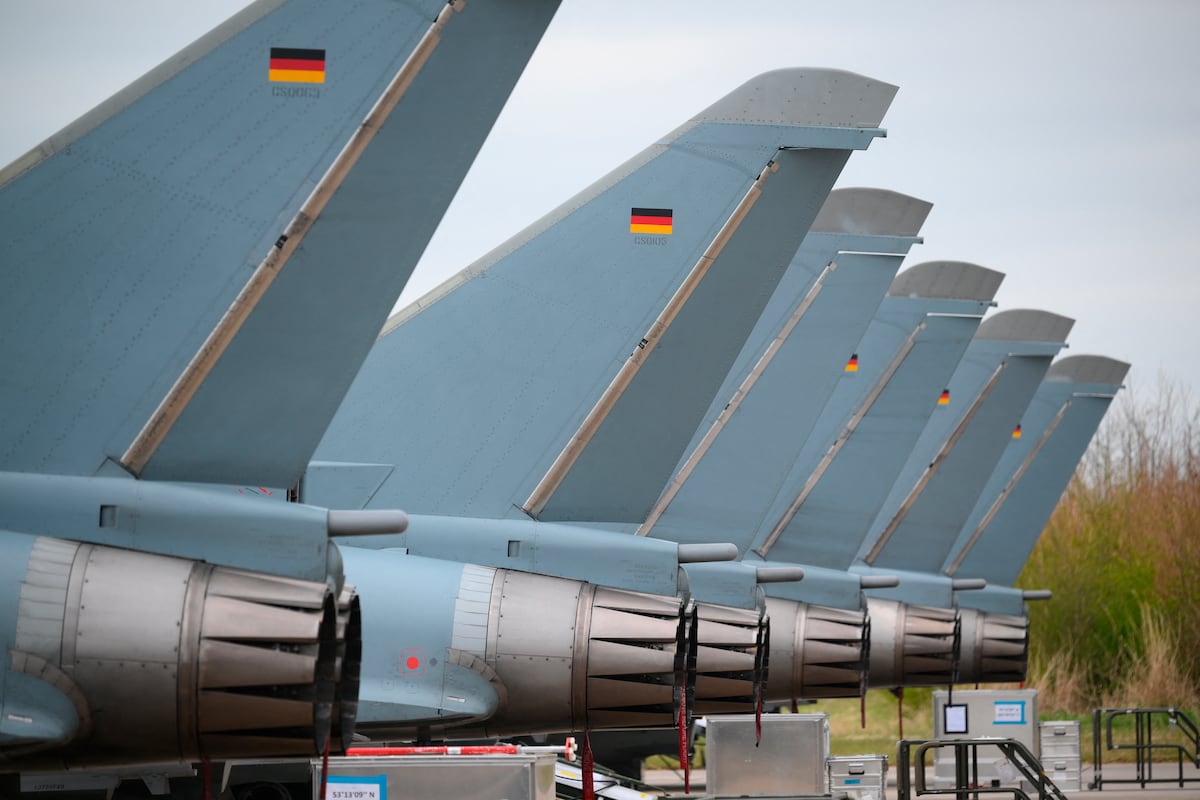
PARIS — The companies behind the Eurofighter, Europe’s most prevalent homegrown combat jet, have set new growth targets that prize a near-term fleet buildup over more distant breakthroughs expected from sixth-generation programs like the Future Combat Air System, or FCAS.
The plan envisions an annual Eurofighter production boost from 14 planes now to 20 copies within 36 months, eying 30 at some point after that, said Jorge Tamarit Degenhardt, CEO of a consortium combining Airbus, Leonardo and BAE Systems.
Degenhardt told reporters at the Paris Air Show in June that he expects the export business to grow, with sales campaigns humming in Turkey, Saudi Arabia, Poland, Austria and Portugal. That is in addition to requests for planes and upgrades from the core users Germany, Spain, Italy and the United Kingdom.
“We didn’t max out yet,” Degenhardt said, referring to company plans to make more jets, faster.
The idea of producing “combat mass” for Europe, as the CEO called it, follows the urgency of recent conflicts sprung on the continent and its environs, most notably Russia’s war against Ukraine.
In that logic, a large fleet of warplanes of the generation 4-plus, which means capable but not stealthy, for example, is better than a futuristic airpower weapon that exists only on paper.
For now, Eurofighter officials are pitching to client nations a mid-life upgrade program aimed at modernizing the jet’s computing power and other basic features. Integrating drone buddies with the manned planes is also under consideration.
Asked about a price tag, Degenhardt demurred, saying only the envisioned technology upgrades are essential to keep the fleet viable.
“Jets delivered today will fly into the 2060s,” he said.
France and Germany are leading the sixth-generation FCAS program meant to produce a brand new warplane-drone mixture sometime in the 2040s.
That approximate target date appears to have become more squishy, as nations absorb lessons in combat adaption from Ukraine that are measured in days, weeks or months – not decades.
As a result, talk at Paris Air Show about FCAS took a more distant, aspirational tone, compared to the premise of a European rallying cry for all things air power under which it began.
A similar trend is playing out in France, where national warplane champion Dassault has eyes mostly on its own Rafale jet development and upcoming drone accoutrements.
The company is looking to extend the operational lifespan of the Rafale by at least two more decades and is currently preparing the next F5 standard upgrade for the fighter, which will add improved connectivity to integrate with other systems and the possibility to team up with a stealthy unmanned wingman drone.
Dassault Aviation CEO Eric Trappier has said the Rafale F5 standard is expected in the 2030-2035 window, with ongoing improvements to the existing aircraft in the coming ten years with partners Thales and Safran, with a focus on networking and connectivity.
The company last year was tasked by France’s Directorate General for Armament to develop the stealthy wingman based on its nEUROn demonstrator, operating ahead of the Rafale and controlled by the pilot of the manned aircraft.
Trappier told a parliamentary committee in April that the next-generation fighter is for the 2040s and beyond, and more likely 2045, with the Rafale and the future aircraft operating side by side for a period of time. Dassault representatives at the air show this week confirmed that schedule of the Rafale F5 standard bridging the 2035-2045 gap.
Meanwhile, FCAS partner Airbus said the goal for the Next Generation Weapons System remains to deliver capabilities to the three partner nations by 2040, and Jean-Brice Dumont, the company’s head of air power, told reporters in a press conference at the air show he had “no breaking news” on the project.
He said phase 1B of the program had “clearly” observed difficulties in execution, and the partners have to accelerate.
Trappier told lawmakers in his April hearing that working with Airbus is “very, very difficult” amid continued bickering over work share.
Dumont said his company is not challenging Dassault Aviation’s role as the appointed leader of the fighter development within the wider program. He said the issue of work share should be treated in “a rather soft manner” to avoid it becoming toxic in the program.
“We today have to protect our intellectual property and tomorrow we will have to share everything, and I believe that’s one of the sources of tensions in this program,” Dumont said. “Maybe some elements of work share may have to be changed to make the program executable.”
The Airbus executive said what is needed now to make FCAS happen is political will and an agreed joint operational need.
“These programs come like the whole foundation of Airbus, like many of the many of the European projects, they come because there is a political will,” Dumont said. “The political will has to be there, otherwise it doesn’t happen.”
Rudy Ruitenberg is a Europe correspondent for Defense News. He started his career at Bloomberg News and has experience reporting on technology, commodity markets and politics.
Sebastian Sprenger is associate editor for Europe at Defense News, reporting on the state of the defense market in the region, and on U.S.-Europe cooperation and multi-national investments in defense and global security. Previously he served as managing editor for Defense News. He is based in Cologne, Germany.
巴黎——欧洲战斗机(欧洲最普遍的国产战斗机)背后的公司制定了新的增长目标,这些目标更重视近期机队的建设,而不是像未来作战空中系统(FCAS)这样的第六代项目所带来的更长远的突破。
由空客、莱昂纳多和英国航空航天系统公司组成的财团首席执行官豪尔赫·塔马里特·德根哈特表示,该计划设想在 36 个月内将欧洲战斗机的年产量从目前的 14 架提高到 20 架,并计划在此之后的某个时候达到 30 架。
德根哈特在六月份的巴黎航展上告诉记者,他预计出口业务将会增长,在土耳其、沙特阿拉伯、波兰、奥地利和葡萄牙的销售活动正在如火如荼地进行。此外,核心用户德国、西班牙、意大利和英国也提出了飞机采购和升级需求。
“我们还没有达到极限,”德根哈特说,他指的是公司计划更快地制造更多喷气式飞机。
首席执行官称之为为欧洲生产“战斗力量”的想法,源于近期在欧洲大陆及其周边地区爆发的冲突的紧迫性,尤其是俄罗斯对乌克兰的战争。
按照这种逻辑,一支庞大的 4 代以上战机机队(这意味着它们性能强大但不具备隐身能力),例如,比一种只存在于纸面上的未来空中力量武器要好。
目前,欧洲战斗机公司官员正在向客户国推介一项中期升级计划,旨在提升战机的计算能力和其他基本功能。此外,将无人机伙伴与有人驾驶飞机整合也在考虑之中。
当被问及价格时,德根哈特避而不谈,只表示只有设想中的技术升级对于保持舰队的可用性至关重要。
他说:“今天交付的飞机可以一直飞到2060年代。”
法国和德国正在领导第六代未来空中作战系统(FCAS)项目,旨在2040年代的某个时候生产一种全新的战机-无人机混合体。
这个大致的目标日期似乎变得更加模糊,因为各国从乌克兰吸取的作战适应经验是以天、周或月来衡量的,而不是以十年来衡量的。
因此,与最初作为欧洲空中力量集结号召的开端相比,巴黎航展上关于未来空中作战系统(FCAS)的讨论变得更加遥远、更具憧憬性。
类似的趋势也发生在法国,法国国家战机冠军达索公司主要关注的是其自身的阵风战斗机研发和即将推出的无人机配件。
该公司希望将阵风战斗机的使用寿命至少延长二十年,目前正在为该战斗机准备下一代 F5 标准升级,这将增加改进的连接性,以便与其他系统集成,并有可能与隐形无人僚机协同作战。
达索航空首席执行官埃里克·特拉皮耶表示,阵风F5标准预计将在2030-2035年期间推出,未来十年将与合作伙伴泰雷兹和赛峰集团一起对现有飞机进行持续改进,重点是网络和连接性。
去年,法国军备总局委托该公司在其 nEUROn 验证机的基础上开发隐形僚机,该僚机将在阵风战斗机前方运行,并由有人驾驶飞机的飞行员控制。
特拉皮耶在四月份向议会委员会表示,下一代战斗机将面向2040年代及以后,更有可能是2045年,届时“阵风”战斗机和未来的战机将并肩作战一段时间。达索公司代表本周在航展上证实了“阵风”F5标准的研发计划,该计划旨在填补2035年至2045年之间的空白。
与此同时,FCAS 的合作伙伴空中客车公司表示,下一代武器系统的目标仍然是到 2040 年向三个伙伴国家交付能力。该公司空中力量负责人让-布里斯·杜蒙在航展期间的新闻发布会上告诉记者,他对该项目“没有突发消息”。
他表示,该计划的 1B 阶段“明显”出现了执行困难,合作伙伴必须加快进度。
特拉皮耶在 4 月份的听证会上告诉立法者,由于双方在工作分配问题上持续争吵,与空客合作“非常非常困难”。
杜蒙表示,他的公司并未质疑达索航空公司作为整个项目中战斗机研发指定领导者的地位。他表示,工作分工问题应以“较为温和的方式”处理,以避免其在项目中引发冲突。
“今天我们必须保护我们的知识产权,明天我们就必须共享一切,我认为这是该项目紧张局势的根源之一,”杜蒙说。“或许需要对工作共享的一些要素进行修改,才能使该项目得以实施。”
空客高管表示,现在要实现未来空中作战系统(FCAS),需要的是政治意愿和双方共同认可的作战需求。
杜蒙表示:“这些项目就像空客的整个基础一样,就像许多欧洲项目一样,它们的出现都源于政治意愿。必须要有政治意愿,否则这一切都不会发生。”
鲁迪·鲁伊滕贝格是《防务新闻》的欧洲记者。他的职业生涯始于彭博新闻社,拥有报道科技、大宗商品市场和政治方面的经验。
塞巴斯蒂安·斯普伦格是《防务新闻》欧洲版副主编,负责报道该地区的防务市场状况,以及美欧在防务和全球安全领域的合作和多国投资。此前,他曾担任《防务新闻》执行主编。他现居德国科隆。