So Long, Samurai: Japan Bids Farewell To Its Final Frontline Phantoms再见了,武士:日本向其最后的前线幽灵告别
The Japan Air Self-Defense Force has retired its last frontline F-4 Phantom fighter jets as more F-35s wait in the wings.
Updated Nov 27, 2020 6:02 PM EST
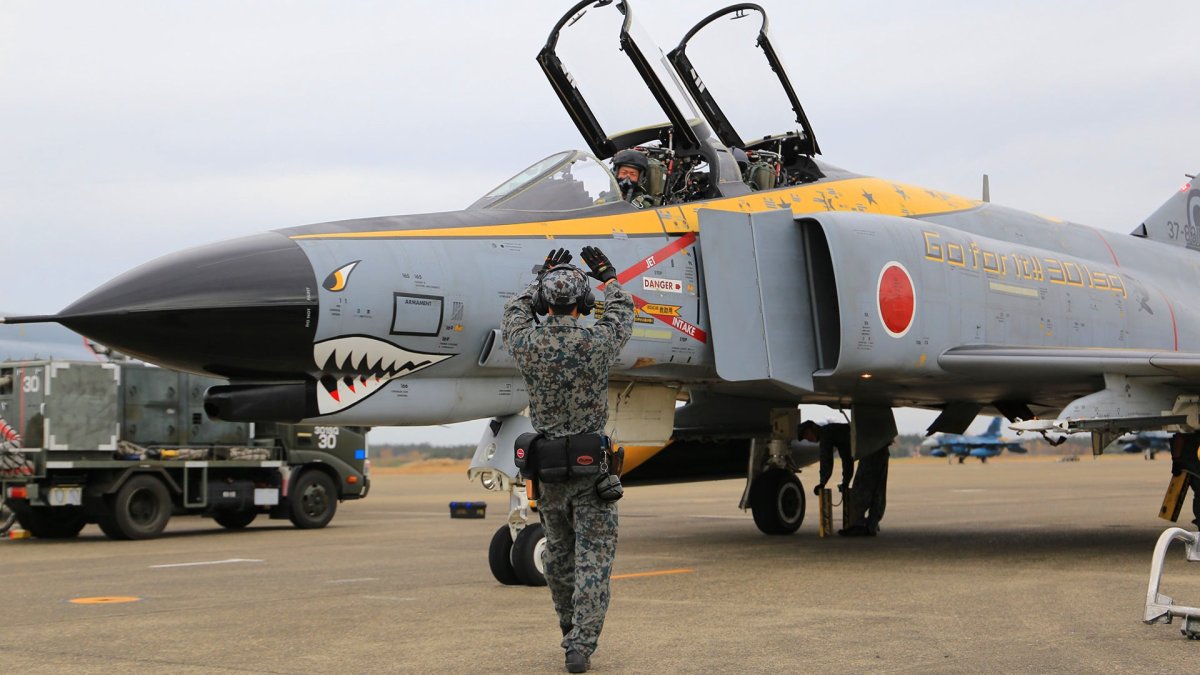
After 48 years, Japan’s days of flying F-4 Phantom II fighters in a combat role are coming to an end. The landmark was formally marked today, with a send-off event for the jets. The aircraft were from 301 Hikotai, the country’s last combat unit equipped with the type, and it’s expected to cease flying operations next month. The remaining F-4EJs will, in the future, only be flown by the country’s Air Development and Test Wing.
The ceremony to mark the end of the Japan Air Self-Defense Force (JASDF) operating the F-4EJ took place at Hyakuri Air Base, 301 Hikotai’s home base, in Ibaraki Prefecture, 50 miles northeast of Tokyo. Representatives from the base, various squadron commanders, as well as officials representing the wider JASDF attended the event.
Japan’s Phantom story began in 1968 when the McDonnell Douglas type was selected for the JASDF, an order being placed for 140 F-4EJ versions, based on the U.S. Air Force’s then-standard F-4E . The production effort was of considerable significance for Japan’s aerospace industry, with all but the first two F-4EJs being completed under license by Mitsubishi Heavy Industries (MHI).
Meanwhile, the initial pair from the production line in St Louis, Missouri, touched down in Japan on July 25, 1971. The first Phantoms to be based at Hyakuri arrived there in 1972 and were assigned to 301 Hikotai, which was declared fully operational the following year.
A pre-upgrade JASDF F-4EJ of the 304 Hikotai during Exercise Cope North 89-2, a quarterly, joint JASDF and U.S. Air Force exercise, in 1989., NATIONAL ARCHIVES
The Japanese production run also included the last of the 5,195 Phantoms built anywhere in the world — F-4EJ 17-8440 rolled off the MHI production line on May 21, 1981. The following year, Japan kicked off a major upgrade effort for its F-4EJ fleet, which would bring 96 examples up to F-4EJ Kai standard, with “Kai” meaning “improved.”
The definitive F-4EJ Kai, which the JASDF had continued to fly in a frontline role until today, had new avionics other systems installed, including an enhanced bombing computer. It also featured an AN/APG-66J pulse-Doppler radar, based on the standard AN/APG-66 used in early F-16 Viper fighter jets. The upgraded Phantoms gained the AN/ASN-141 inertial navigation system, similar to the one found in Japan’s F-15J air superiority fighters, as well.
The final special color scheme applied to commemorate the retirement of the Phantom from combat duty., JASDF/HYAKURI
Two specially marked jets on the Hyakuri flight line. , JASDF/HYAKURI
The 301 Hikotai retirement “special.”, JASDF/HYAKURI
The 301 Hikotai “special” heads out for a farewell flight, with an F-2 in the background., JASDF/HYAKURI
In the cockpit, the F-4EJ Kais received modern hands-on throttle and stick (HOTAS) controls and a head-up display (HUD). Additional avionics changes included the installation of the AN/APX-76A identification friend or foe (IFF) system and the J/APR-6 radar warning receiver (RWR) suite, while AN/ALE-40 countermeasures dispensers were fitted for self-defense.
The F-4EJ Kai’s airframe was also reworked to add another 2,000 hours of flight time, while weapons options were expanded to include the indigenous ASM-2 anti-ship missile and AAM-3 air-to-air missile, and eventually the Joint Direct Attack Munition (JDAM) — all of which can be seen in the photos below, together with a towed target. The improved variant of the fighter entered service beginning in 1989.
As well as the F-4EJ, Japan had acquired Phantoms for the reconnaissance role. The first of an initial batch of 14 unarmed RF-4E variants were delivered by McDonnell Douglas in 1974 to replace the aging RF-86F Sabre .
Another 15 existing F-4EJs were later converted to RF-4EJ standard, but these lacked any internal reconnaissance equipment and were limited to carry external reconnaissance pods. These jets also underwent their own upgrades during their service, receiving AN/APQ-172 terrain-following radar, a new inertial navigation system, and modified RWRs.
An RF-4E of 501 Hikotai at Yokota Air Base in 2003., MORIO/WIKIMEDIA COMMONS
At its peak, the F-4EJ equipped six JASDF squadrons, spread across four bases. Most of these were gradually re-equipped as the force received more modern and capable equipment, chiefly the F-15J and the Mitsubishi F-2 multirole fighter.
The last two operational units flying variants of the F-4EJ at Hyakuri were 301 Hikotai and 501 Hikotai. 301 Hikotai had left Hyakuri in 1985 for Nyutabaru Air Base, before returning to its original home in 2016 and operating in an air defense capacity. 501 Hikotai, the Teisatsu Kokutai, or Reconnaissance Air Group, flew RF-4Es and ceased operations in March.
Personnel gather for the retirement ceremony at Hyakuri. , JASDF/HYAKURI
A three-ship flypast to mark the retirement of the frontline Phantom in Japan., JASDF/HYAKURI
The marking on the tail of the 301 Hikotai jets shows a frog that is found on Mount Tsukuba, near Hyakuri., JASDF/HYAKURI
The retirement of the Phantom doesn’t signal the end for 301 Hikotai. It is now due to move to Misawa Air Base, where it will become the second JASDF squadron to be equipped with the F-35A stealth fighter.
The JASDF established its first operational F-35A squadron, 302 Hikotai, at Misawa in March 2019. This squadron was another former Phantom operator that gave up its last F-4EJs at Hyakuri in 2019 before switching to its new base. As for Hyakuri, it will continue to serve as a fighter base, with 3 Hikotai scheduled to transfer its F-2s there from its current base at Misawa.
The introduction of the F-35 in Japan is following in similar ways to the country’s Phantom program, too. MHI worked with Lockheed Martin to establish a Final Assembly and Check-Out (FACO) facility for the JASDF’s F-35A variant in Nagoya, Japan, after the first four F-35s for the service were built at Lockheed’s plant in Fort Worth, Texas.
However, the JASDF’s F-35 fleet now looks set to exceed the peak size of its F-4 force after the U.S. State Department approved the possible sale to Japan of an additional 105 Joint Strike Fighters, worth an estimated $23.11 billion, earlier this year. The proposed contract also includes 42 F-35B Short takeoff and vertical landing (STOVL) jets, to conduct fixed-wing operations from Japan’s two Izumo class helicopter carriers .
The State Department’s approval of this proposed deal follows Tokyo’s initial order for 42 conventional takeoff and landing (CTOL) F-35A variants, deliveries of which are now well underway. One of the F-35As has been lost, in a fatal accident that occurred over the Pacific Ocean in April 2019.
The end of Phantom combat operations in Japan comes at a time in which the country is stepping up military spending and looking to modernize its military, as a whole, in response to increasing national security threats and challenges, especially from China and North Korea. In terms of its tactical aviation fleets, in addition to the F-35, Japan is also now embarking on its next-generation combat aircraft , which will likely be co-developed with an aerospace firm from the United States or the United Kingdom.
The end of the line for frontline Phantoms in Japan also further reduces the dwindling total of F-4s still in operational service throughout the world. Surviving frontline Phantoms are now only found among the air forces of Greece , Iran, Turkey, and South Korea.
Trading in the Phantom, a classic Cold War-era fighter jet, for the F-35 is the latest, and one of the more visible steps, in the ongoing modernization of the JASDF. Still, saying farewell to the iconic F-4, after almost a half-century of service, will surely be bittersweet for the JASDF.
Contact the author: thomas@thedrive.com
Comments couldn’t be loaded. Please refresh the page.
更新于美国东部时间2020年11月27日下午6:02
服役48年后,日本F-4“鬼怪II”战斗机的作战生涯即将结束。今天,日本举行了F-4“鬼怪II”战斗机的退役仪式,正式标志着这一历史性时刻的到来。这些战机来自日本最后一支装备该型战机的作战部队——第301飞行队,预计将于下个月停止飞行任务。未来,剩余的F-4EJ战机将仅由日本航空开发试验联队使用。
为纪念日本航空自卫队(JASDF)停止使用F-4EJ战斗机,相关仪式在位于东京东北方向50英里(约80公里)的茨城县百里空军基地举行,该基地是第301飞行队的驻地。基地代表、各飞行队指挥官以及日本航空自卫队其他部门的官员出席了此次活动。
日本的“鬼怪”战斗机故事始于1968年,当时日本航空自卫队选择了麦克唐纳·道格拉斯公司的F-4EJ型战斗机,并订购了140架,该型战斗机以当时美国空军的标准F-4E战斗机为基础。这项生产工作对日本航空航天工业意义重大,除最初两架外,其余所有F-4EJ均由三菱重工(MHI)获得许可后完成生产。
与此同时,来自密苏里州圣路易斯生产线的首批两架“鬼怪”战斗机于 1971 年 7 月 25 日抵达日本。首批驻扎在百里空军基地的“鬼怪”战斗机于 1972 年抵达,并被分配到第 301 飞行队,该飞行队于次年宣布全面投入使用。
1989年,日本航空自卫队第304飞行队的一架未升级的F-4EJ战斗机参加了“北方之盾89-2”演习,这是日本航空自卫队和美国空军每季度一次的联合演习。(国家档案馆)
日本的生产批次中还包括了全球生产的 5,195 架“鬼怪”战斗机中的最后一架——F-4EJ 17-8440 于 1981 年 5 月 21 日从三菱重工的生产线下线。次年,日本启动了对其 F-4EJ 机队的大规模升级计划,将 96 架飞机升级到 F-4EJ Kai 标准,“Kai”的意思是“改进”。
日本航空自卫队至今仍在服役的F-4EJ Kai型战斗机,是该型战斗机的最终改进型,它安装了新的航电系统和其他系统,包括增强型轰炸计算机。此外,它还配备了基于早期F-16“蝰蛇”战斗机所用标准型AN/APG-66雷达的AN/APG-66J脉冲多普勒雷达。升级后的“鬼怪”战斗机还配备了与日本F-15J空中优势战斗机类似的AN/ASN-141惯性导航系统。
为纪念“鬼怪”战斗机退役而采用的最终特殊涂装方案。(日本航空自卫队/百里)
两架涂有特殊标记的喷气式飞机停在百里飞行线上。(日本航空自卫队/百里)
301 Hikotai 退役“特别”,JASDF/HYAKURI
第301飞行队“特技飞行队”正在进行告别飞行,背景中可以看到一架F-2战斗机。(日本航空自卫队/HYAKURI)
在座舱内,F-4EJ Kai 配备了现代化的油门杆和操纵杆(HOTAS)控制系统以及抬头显示器(HUD)。其他航电升级包括安装 AN/APX-76A 敌我识别(IFF)系统和 J/APR-6 雷达告警接收机(RWR)套件,同时还加装了 AN/ALE-40 对抗措施投放器用于自卫。
F-4EJ Kai的机身也经过重新设计,增加了2000小时的飞行时间,武器选项也得到了扩展,包括国产ASM-2反舰导弹和AAM-3空空导弹,最终还增加了联合直接攻击弹药(JDAM)——所有这些都可以在下面的照片中看到,照片中还包括一个拖曳靶标。改进型战斗机于1989年开始服役。
除了F-4EJ之外,日本还采购了F-4“鬼怪”战斗机用于侦察任务。1974年,麦克唐纳·道格拉斯公司交付了首批14架无武装的RF-4E改进型,用于替换老旧的RF-86F“佩刀”战斗机。
另有15架现有的F-4EJ战斗机后来被改装成RF-4EJ标准,但这些飞机缺乏任何内部侦察设备,只能携带外部侦察吊舱。这些飞机在服役期间也进行了升级,加装了AN/APQ-172地形跟踪雷达、新型惯性导航系统和改进型雷达告警接收机(RWR)。
2003 年横田空军基地的 501 Hikotai 的一架 RF-4E。, MORIO/WIKIMEDIA COMMONS
F-4EJ战斗机鼎盛时期装备了日本航空自卫队分布在四个基地的六个中队。随着部队接收更现代化、性能更强大的装备,主要是F-15J和三菱F-2多用途战斗机,这些中队中的大多数都逐步换装了F-4EJ。
百里空军基地最后两个仍在使用F-4EJ战斗机的作战单位是第301飞行队和第501飞行队。第301飞行队于1985年离开百里空军基地前往新田原空军基地,后于2016年返回原基地,并承担防空任务。第501飞行队,即侦察航空队,装备RF-4E侦察机,已于今年3月停止作战。
人员聚集在百里基地参加退役仪式。(日本航空自卫队/百里基地)
三架战机编队飞越上空,纪念日本前线“鬼怪”战斗机退役。(日本航空自卫队/HYAKURI)
第301飞行队喷气式飞机的尾翼上涂有图案,图案中的青蛙是筑波山(位于百里附近)上的一种青蛙。(日本航空自卫队/百里)
“鬼怪”战斗机的退役并不意味着第301飞行队的终结。该部队即将移驻三泽空军基地,成为日本航空自卫队第二个装备F-35A隐形战斗机的飞行队。
日本航空自卫队于2019年3月在三泽基地组建了首个作战型F-35A战斗机中队——第302飞行队。该中队此前也曾使用过F-4“鬼怪”战斗机,并于2019年将其在百里基地的最后几架F-4EJ战斗机全部移交给新基地。百里基地将继续作为战斗机基地使用,第3飞行队计划将其F-2战斗机从目前的三泽基地转移至该基地。
日本引进F-35战斗机的方式与该国的“鬼怪”战斗机项目类似。在洛克希德·马丁公司位于德克萨斯州沃斯堡的工厂为日本航空自卫队生产了首批四架F-35战斗机后,三菱重工与洛克希德·马丁公司合作,在日本名古屋建立了一个F-35A型战斗机的总装和检验(FACO)工厂。
然而,今年早些时候,美国国务院批准向日本增购105架联合攻击战斗机(JSF),总价值约231.1亿美元,此后,日本航空自卫队的F-35机队规模预计将超过其F-4机队的巅峰水平。拟议合同还包括42架F-35B短距起飞/垂直降落(STOVL)战斗机,用于在日本的两艘出云级直升机航母上执行固定翼作战任务。
美国国务院批准这项拟议交易之前,东京方面已订购了42架常规起降型(CTOL)F-35A战斗机,目前交付工作正在顺利进行。其中一架F-35A战斗机在2019年4月太平洋上空发生的致命事故中坠毁。
日本结束“幻影”战斗机的作战行动之际,正值该国加大军费开支,并寻求全面推进军队现代化,以应对日益严峻的国家安全威胁和挑战,尤其是来自中国和朝鲜的威胁。在战术航空机队方面,除了F-35之外,日本目前也正在着手研发下一代战斗机,这些飞机很可能与美国或英国的航空航天公司联合开发。
日本一线F-4“鬼怪”战斗机的退役,也进一步减少了全球仍在服役的F-4战斗机数量。目前,仅在希腊、伊朗、土耳其和韩国空军中还能找到一线F-4“鬼怪”战斗机。
用F-35战斗机替换冷战时期的经典战斗机“鬼怪”是日本航空自卫队持续现代化进程中的最新举措,也是最引人注目的一步。然而,告别服役近半个世纪的标志性F-4战斗机,对日本航空自卫队来说无疑是苦乐参半的。
联系作者:thomas@thedrive.com
评论加载失败,请刷新页面。