Multiple Destroyers Were Swarmed By Mysterious ‘Drones’ Off California Over Numerous Nights加利福尼亚附近海域多艘驱逐舰连续数晚遭到神秘“无人机”围攻
The disturbing series of events during the summer of 2019 resulted in an investigation that made its way to the highest echelons of the Navy.
新闻视频
By Adam Kehoe and Marc Cecotti
Updated May 23, 2021 3:53 PM EDT
In July of 2019, a truly bizarre series of events unfolded around California’s Channel Islands. Over a number of days, groups of unidentified aircraft, which the U.S. Navy simply refers to as ‘drones’ or ‘UAVs,’ pursued that service’s vessels, prompting a high-level investigation.
During the evening encounters, as many as six aircraft were reported swarming around the ships at once. The drones were described as flying for prolonged periods in low-visibility conditions, and performing brazen maneuvers over the Navy warships near a sensitive military training range less than 100 miles off Los Angeles. The ensuing investigation included elements of the Navy, Coast Guard, and the Federal Bureau of Investigation (FBI). The incidents received major attention, including from the Chief of Naval Operations—the apex of the Navy’s chain of command.
The following is our own investigation into these events, during which we discovered these events were far more extensive in scale than previously understood.
A Strange Story Emerges
Last year, documentary filmmaker Dave Beaty uncovered initial details about the events, centering on the Arleigh Burke class destroyer USS Kidd (DDG-100). That initial account described a tense encounter, culminating in the deployment of onboard intelligence teams.
New documents significantly expand the public’s knowledge of the scope and severity of that incident and reveal others that occurred around the same time. These details come largely from our Freedom of Information Act (FOIA) requests, which resulted in the disclosure of deck logs from the ships involved. Additionally, our investigation utilized hundreds of gigabytes of automatic identification system (AIS) ship location data to forensically reconstruct the position of both military and civilian ships in the area during this strange series of events.
By using the USS Kidd ‘s position as a starting point, we were able to identify several other ships in close proximity to it during the incidents in question, including U.S. Navy destroyers USS Rafael Peralta , USS Russell , USS John Finn, and the USS Paul Hamilton . Subsequent FOIA requests for these ships’ records allowed us to build a composite picture of the events as a whole.
Night One: July 14th, 2019
It appears the incidents began with an initial ‘UAV’ sighting by the USS Kidd around 10:00 PM on the night of July 14th, 2019. Deck logs like the one below provide information about the course and speed of the ship. Additionally, they record any other relevant information about unusual events or changes in the ship’s behavior. This log records the first drone sighting:
As previously reported, two drones, typically described as UAVs or unmanned aerial vehicles throughout the logs, were spotted by the Kidd. The Ship Nautical Or Otherwise Photographic Interpretation and Exploitation team, or “SNOOPIE team,” refers to an onboard photographic intelligence team tasked with documenting unknown contacts, events of interest, and other objects of interest on short order.
A member of a destroyer’s SNOOPIE team with a video camera in hand., USN
Though an Aegis-equipped ship like the USS Kidd has some of the most sophisticated sensors on earth, sailors equipped with consumer-grade cameras act as a kind of nimble spotting and event recording team, able to quickly adapt to changing conditions while providing situational awareness and recording what they see through traditional video and photo methods. You can see a SNOOPIE team in action and one of their products in the video below:
Moments after the sighting on July 14th, the USS Kidd entered into a condition of restricted communications designed to enhance operational security and enhance survivability. This is noted throughout many of the logs as “River City 1.” During the events, the ships often engaged “emissions control,” or EMCON, protocols designed to minimize their electronic emissions profile.
Less than 10 minutes after the sighting, the USS Kidd advised the USS Rafael Peralta of the situation. The USS Rafael Peralta logs show that at around 10:00 PM it activated its own SNOOPIE team. They also show that reports of additional sightings were coming in from the USS John Finn .
For its part, the logs of the USS John Finn simply reported possible UAV activity, and deactivation of the ship’s AIS transponder system. In fact, the selective deactivation of AIS was a challenge for us in reconstructing ship positions, as we sometimes had to rely on cross-comparison of deck logs to locate the position of the ships.
Shortly after the initial sighting, a red flashing light was spotted.
Among the more dramatic entries in the logs from this incident is the one below from the USS Rafael Peralta, describing a white light hovering over the ship’s flight deck.
The log reflects that the drone managed to match the destroyer’s speed with the craft moving at 16 knots in order to maintain a hovering position over the ship’s helicopter landing pad. To further complicate what was already a complex maneuver, the drone was operating in low visibility conditions (less than a nautical mile) and at night.
By this point, the encounter had lasted over 90 minutes—significantly longer than what commercially available drones can typically sustain.
The red-lit bridge of an Arleigh Burke class destroyer at night., USN
According to AIS data, few civilian ships were in the immediate vicinity. AIS is not strictly mandatory in all cases, and can be turned off, so it is possible other vessels could have been nearby, as well. The civilian bulk carrier Bass Strait , cited later in the investigation, was situated towards the northern edge of the encounter area. A Liberian-flagged oil tanker, the Sigma Triumph, was just south of the position of the three destroyers. The ORV Alguita , a 50-foot catamaran, briefly a subject of interest in the official investigation that would come, was just off the western tip of San Clemente Island. Importantly, San Clemente Island is owned by the Navy and is frequently used for military training and testing purposes.
The following map shows maritime traffic around the ports of Los Angeles and San Diego on July 14th. The position of each ship at 10:00 PM is marked with a black indicator, and the track of the ship before and after the incident time is marked with colored dots. The approximate positions of each cluster of ships are numerically marked.
Author’s illustration
The two groups of destroyers and the ORV Alguita form a roughly triangular shape with each side approximately 50 nautical miles long, containing an area just over 1000 square nautical miles. The Bass Strait and the USS Paul Hamilton were in relatively close proximity at marker one. The ORV Alguita was off the northern tip of San Clemente Island at marker two. The USS Kidd was at marker three, and the formation of three destroyers was at marker four. The tanker Sigma Triumph was just to the west of the formation of three destroyers, at marker five.
Night Two: July 15th, 2019
Due to new FOIA disclosures, we now know that another major series of incursions occurred on the following night, July 15th, 2019.
This time, the USS Rafael Peralta was the first to spot the objects and to deploy its SNOOPIE teams at 8:39 PM.
By 9:00 PM, the USS Kidd had also spotted the drones and again deployed its SNOOPIE team. The drones seem to have pursued the ships, even as they continued to maneuver throughout the incident.
By 9:20 PM, the USS Kidd logs simply remark “Multiple UAVs around ship” – with the word “above” crossed out:
17 minutes later, the command is issued to man Mark 87 stations:
The meaning of this is not exactly clear, but it could be referring to the Mark 87 Electro-Optical Director that is a component of the massive infrared and optical turret known as the Mk20 Electro-Optical Sighting System (EOSS) located above the bridge. This system was originally meant to help direct the ship’s 5-inch gun, but also provides surveillance and tracking over long distances. The War Zone has done a complete profile on this powerful optical system , which could have been useful in trying to understand what was going on around the ship and to possibly identify the drones at night.
The Mk20 EOSS., USN/L3Harris
The reference could also be in regards to the ship’s 25mm/87 Mk38 chain guns that are also equipped for remote use via a FLIR ball, although this is less likely. There is also the Mk 87 line throwing rifle adapter used for firing lines to other ships during underway replenishment and other activities, but this makes little sense in the context of the moment.
At approximately the same time, the USS Russell records a frenzy of activity:
The logs describe drones dropping in elevation, and apparently moving forward and backward, left and right.
Meanwhile, the USS Rafael Peralta received a radio call from a passing cruise ship, the Carnival Imagination, notifying them that the drones are not theirs, and that they also see as many as five or six drones maneuvering nearby:
The incident continued into the night, with the USS Rafael Peralta first recording two UAVs and then four UAVs near their ship:
Approaching midnight, the USS Russell reports a final sighting:
Despite the nearly three-hour duration of the event, none of the warships involved appear to have been able to identify the drones.
An Arleigh Burke destroyer underway at night., USN
In contrast to the first night, the second set of encounters occurred closer to shore. Several of the drone sightings placed their position between San Clemente Island and San Diego. The approximate positions of the ships and drone sightings are depicted below. Note that the track dots indicate the position of the ships throughout the event, with a larger black dot indicating the position of each ship near the start of the incident at 8:45 PM.
The Official Investigation
As might be expected for such an unusual set of encounters, a formal investigation appears to have been launched immediately. The first email we obtained was dated July 17th, and referenced earlier phone conversations.
By the morning of July 18th, a Navy liaison to the Coast Guard began requesting updates for information on vessels involved in the encounter, citing “higher-level visibility.”
An hour later, a special agent with Naval Criminal Investigative Service (NCIS), assigned to 3rd Fleet as a “Staff CI Officer,” with CI likely standing for “counter-intelligence,” thanked a colleague in the Coast Guard. They mentioned that the information would go directly to the commander of the Pacific Fleet and to the Chief of Naval Operations (CNO) – the top of the Navy hierarchy, and a member of the Joint Chiefs of Staff.
It appears the initial focus of their investigation was the ORV Alguita. An email sent just 10 minutes later expressed the need to relay information about the ship to a larger team.
By this time, an agent with the Los Angeles office of the FBI was included in the email chain. Preliminary information indicated that while the ORV Alguita did have drones onboard, they had very limited capabilities.
A follow-up email on the evening of July 18th indicated that the Coast Guard had contacted the ship directly via satellite phone. Based on the subject line reference to San Nicolas Island and the time period given by investigators, it seems the ORV Alguita was being examined specifically for the events of July 14th.
The investigators had encountered several problems at this point. The owners of the Alguita denied operating a drone during the time in question, and claimed that their drones were incapable of operating more than a few feet from the ship. Further, the Phantom IV drone is a small quadcopter and has a maximum flight time of 28 minutes, according to manufacturer DJI , which is inconsistent with the long durations of the incidents and general performance described as observed in the deck logs.
Although not referenced in these emails, the Alguita was also significantly west of the events of the second night, July 15th, based on AIS data. Apparently recognizing that ORV Alguita was a poor fit, investigators conceded that they needed to keep looking. Emails reflect that Navy intelligence began to take a more active role in the investigation by July 19th, with the director of the Maritime Intelligence Operations Center (MIOC) within 3rd Fleet, identified by the acronym C3F, “looping in” the rest of the command’s intelligence office, or N2.
Investigators next sought to rule out the possibility that the drones were operated by the Navy itself. By Tuesday of the following week, a representative from the Fleet Area Control and Surveillance Facility (FACSFAC) based in San Diego clarified that UAVs were only operated by the Navy in certain limited areas. They then provided the following map of operational areas (OPAREAS) with a breakdown of platforms in use.
Somewhat cryptically, one of the investigators referenced “recent observations” and further clarified the need to “correlate or rule out operations.” He further requested data detailing operations between the 14th to the 17th of July.
FACSFAC San Diego, in turn, sent spreadsheets of scheduled activity during that time, and explained that UAV operations are highlighted in yellow. Though the flight schedules released to us for July 14th are completely redacted, the underlying highlighting is visible. No yellow highlighting can be seen for July 14th:
By the afternoon of July 23, the investigators were still grappling with determining the intent behind the incidents.
The last email disclosed to us was from July 25th. It references a classified briefing on drones (referred to here as UAS).
A further FOIA request for information about these briefings was denied due to their classification level. After July 25th, the email trail turns cold.
Remarkably, the drone incidents began occurring again around this time. Renewed sightings occurred during the early hours of July 25th and July 30th, just as investigators were beginning to examine classified briefings and were apparently still seeking to identify the intent behind the July 14th and 15th incursions.
The incident on the 25th involving the USS Kidd began around 1:20 AM, with the SNOOPIE team being deactivated around 1:52 AM.
The incident on July 30th was longer, with the team activated around 2:15 AM and only deactivated by 3:27 AM:
These later incidents are notable because they occurred during the investigation, and after FACSFAC San Diego had been closely consulted.
At the time of writing, we do not have complete deck logs for the month of July except for USS Kidd , so it remains uncertain if other ships also continued to have drone encounters later in the month.
Further information continues to emerge from FOIA requests, but based on the available evidence it appears that the initial investigation did not ultimately identify the source of the drones.
Increasingly Pressing Questions
Cumulatively, these new details raise a host of difficult questions.
It is unclear why anyone would operate drones near Navy warships in such a brazen manner. Commercially available drones are not commonly capable of flying for such long durations across great distances with speeds in excess of 45 miles an hour. Based on the pooled data available from the deck logs, we estimate the drones traversed at least 100 nautical miles in the July 14th incident.
Furthermore, the drones were able to locate and catch a destroyer traveling at 16 knots in conditions with less than one nautical mile of visibility. Equally baffling, their operators appear to have coordinated at least five to six drones simultaneously. Then there is the question of line-of-sight control, and control methods in general, which make the capabilities described all that much more puzzling.
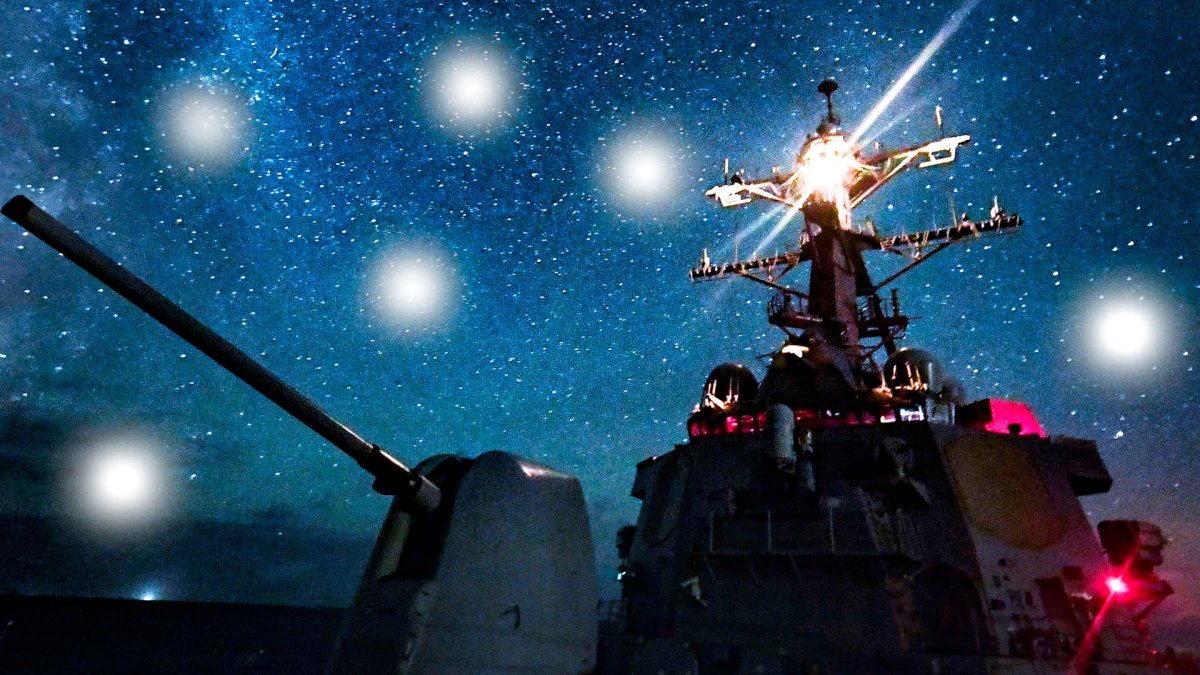
A U.S. Navy destroyer cruises under the stars. , USN
To be sure, San Clemente Island and nearby training area FLETA HOT are hosts to a bevy of testing, which can include classified programs. Is it possible that the drones were operated by the military itself in an errant test of some kind?
If so, the incursions continued after a concerted investigation that reached the highest level of the Navy hierarchy. It also appears that no UAV activity was scheduled by FASFAC San Diego during July 14th. On the other hand, it is a general area where extremely strange things have occurred in the past .
If the drones were not operated by the American military, these incidents represent a highly significant security breach. If they were part of some kind of covert action, it is nonetheless unclear why they were flown so openly and so frequently in almost a harassing manner. More troubling still, if a foreign state actor was involved, where exactly were the drones launched from?
One thing is fairly sure: the U.S. Navy has a large amount of data on these events. The documents above reflect that multiple independent photographic intelligence teams were deployed. These teams are only a small part of a sophisticated suite of surveillance capabilities and advanced sensors , including the ability to detect radio emissions in the vessels’ vicinity, available to any one of the ships involved. This is on top of the land-based sensors that closely surveil the area. In fact, it is puzzling that those sensors, coupled with a likely extensive photographic record, were not sufficient in and of themselves to resolve the matter. This calls into question the “drone” designation. Was there ever even a hard description of these craft beyond lights in the sky?
The question remains: who was operating these craft with apparent impunity, and for what purpose, and was this extremely bizarre case ever resolved?
Our investigation is into this event is still underway and we will update you as soon as more information becomes available.
Contact the editor: Tyler@thedrive.com
Comments couldn’t be loaded. Please refresh the page.
作者:亚当·基欧和马克·切科蒂
更新于美国东部时间2021年5月23日下午3:53
2019年7月,加利福尼亚海峡群岛附近发生了一系列离奇事件。在接下来的几天里,一群身份不明的飞行器(美国海军统称为“无人机”或“UAV”)追逐着美国海军的舰艇,引发了一场高级别调查。
据报道,当晚有多达六架无人机同时在舰艇周围盘旋。这些无人机被描述为在低能见度条件下长时间飞行,并在距离洛杉矶不到100英里的敏感军事训练场附近,肆无忌惮地在海军军舰上空进行机动飞行。随后的调查由海军、海岸警卫队和联邦调查局(FBI)联合开展。这些事件引起了广泛关注,包括海军作战部长——海军指挥系统的最高指挥官——的关注。
以下是我们对这些事件的调查,在此过程中,我们发现这些事件的规模远比之前所了解的要大得多。
一个离奇的故事浮出水面
去年,纪录片导演戴夫·比蒂揭露了有关事件的初步细节,事件的核心是阿利·伯克级驱逐舰“基德”号(DDG-100)。最初的报道描述了一场紧张的遭遇战,最终导致舰上情报小组的部署。
新文件极大地扩展了公众对该事件的范围和严重程度的了解,并揭示了同期发生的其他事件。这些细节主要来自我们根据《信息自由法》(FOIA)提出的申请,这些申请最终公开了涉事船只的航海日志。此外,我们的调查还利用了数百GB的船舶自动识别系统(AIS)定位数据,通过法证重建了这一系列离奇事件发生期间该区域军用和民用船只的位置。
以“基德”号驱逐舰的位置为起点,我们确定了事发时与其距离较近的其他几艘舰艇,包括美国海军“拉斐尔·佩拉尔塔”号、“拉塞尔”号、“约翰·芬恩”号和“保罗·汉密尔顿”号驱逐舰。随后,我们根据《信息自由法》申请查阅了这些舰艇的记录,从而得以构建出事件的整体概貌。
第一晚:2019年7月14日
事件似乎始于2019年7月14日晚10点左右,基德号驱逐舰首次发现无人机。类似下方这样的航海日志记录了舰艇的航向和航速信息。此外,日志还会记录任何其他与异常事件或舰艇行为变化相关的信息。以下日志记录了首次发现无人机的情况:
正如之前报道,基德号发现了两架无人机,航海日志中通常将其描述为无人驾驶飞行器(UAV)。“船舶航海或其他摄影判读与利用小组”(简称“SNOOPIE小组”)指的是船上的一个摄影情报小组,其任务是迅速记录不明接触、感兴趣的事件和其他感兴趣的目标。
美国海军驱逐舰“史努比”小组的一名成员,手持摄像机。
虽然像“基德”号这样的宙斯盾舰艇配备了地球上一些最先进的传感器,但配备消费级相机的舰员们却能像一支灵活的侦察和事件记录团队一样,迅速适应不断变化的情况,同时提供态势感知,并通过传统的视频和照片方式记录所见所闻。您可以在下面的视频中看到SNOOPIE团队的行动以及他们的一款产品:
7月14日发现目标后不久,基德号驱逐舰便进入了通信受限状态,旨在加强作战安全和提高生存能力。许多航海日志中将此状态记录为“河城1号”。事件期间,舰艇频繁启用“电磁辐射控制”(EMCON)协议,以最大限度地降低其电子辐射。
目击事件发生不到十分钟后,“基德”号驱逐舰就将情况通报给了“拉斐尔·佩拉尔塔”号驱逐舰。“拉斐尔·佩拉尔塔”号的航海日志显示,大约晚上十点,该舰启动了自己的“史努比”小组。日志还显示,“约翰·芬”号驱逐舰也报告了其他目击事件。
约翰·芬恩号驱逐舰的航海日志仅记录了可能的无人机活动以及舰艇AIS应答器系统的停用。事实上,AIS的选择性停用给我们重建舰艇位置带来了挑战,因为我们有时不得不依靠航海日志的交叉比对来确定舰艇的位置。
最初发现该物体后不久,就发现了一束红色闪光。
在本次事件的日志中,有一条来自“拉斐尔·佩拉尔塔”号航空母舰的日志,描述了一道白光盘旋在舰艇的飞行甲板上,这条日志颇为引人注目。
日志显示,无人机以16节的航速与驱逐舰保持同步,从而得以在舰艇直升机停机坪上空悬停。更复杂的是,无人机是在能见度极低(不足一海里)且夜间的情况下执行任务的。
到这时,这次遭遇已经持续了 90 多分钟——远远超过了市售无人机通常能够持续的时间。
夜幕降临,阿利·伯克级驱逐舰舰桥被红色灯光照亮。(美国海军)
根据AIS数据,事发海域附近几乎没有民用船只。AIS并非在所有情况下都强制使用,而且可以关闭,因此也可能存在其他船只在附近。调查中后来提到的民用散货船“巴斯海峡号”(Bass Strait)位于遭遇海域的北缘。悬挂利比里亚国旗的油轮“西格玛凯旋号”(Sigma Triumph)位于三艘驱逐舰位置的南侧。50英尺长的双体船“阿尔圭塔号”(ORV Alguita)曾一度成为后续官方调查的关注对象,当时它位于圣克莱门特岛西端附近。值得注意的是,圣克莱门特岛归海军所有,并经常用于军事训练和测试。
下图显示了7月14日洛杉矶和圣地亚哥港口附近的海上交通情况。每艘船在晚上10点的位置用黑色标记标出,事故发生前后船舶的航迹用彩色圆点标出。每组船舶的大致位置用数字标出。
作者插图
两组驱逐舰和“阿尔圭塔”号水下航行器大致呈三角形,每边长约50海里,总面积略超过1000平方海里。巴斯海峡和“保罗·汉密尔顿”号驱逐舰在1号航标处距离较近。“阿尔圭塔”号水下航行器位于圣克莱门特岛北端附近,在2号航标处。“基德”号驱逐舰位于3号航标处,三艘驱逐舰编队位于4号航标处。油轮“西格玛·凯旋”号位于三艘驱逐舰编队西侧,在5号航标处。
第二晚:2019年7月15日
由于新的《信息自由法》披露,我们现在知道,在随后的晚上,即 2019 年 7 月 15 日,又发生了一系列重大入侵事件。
这一次,拉斐尔·佩拉尔塔号驱逐舰率先发现了这些物体,并在晚上 8 点 39 分部署了其 SNOOPIE 小组。
晚上9点,基德号驱逐舰也发现了无人机,并再次部署了“史努比”无人机侦察小组。无人机似乎一直在追踪这些舰船,即使它们在整个事件过程中持续进行机动。
晚上 9 点 20 分,基德号驱逐舰的航海日志只简单地记录了“舰艇周围有多架无人机”——其中“上方”一词被划掉了:
17分钟后,命令下达,要求人员进入Mark 87工作站:
这句话的含义尚不完全明确,但可能指的是位于舰桥上方的大型红外和光学炮塔——Mk20光电瞄准系统(EOSS)的组成部分——的Mark 87光电指挥仪。该系统最初用于辅助引导舰上的5英寸舰炮,但也具备远距离监视和跟踪功能。“战区”(The War Zone)网站曾对这套强大的光学系统进行过全面介绍,这或许有助于了解舰艇周围的情况,并有可能在夜间识别无人机。
Mk20 EOSS,美国海军/L3Harris
这里提到的也可能是指舰上配备的25毫米/87 Mk38链式机炮,该炮也可通过前视红外球进行远程操控,但这可能性较小。此外,还有一种Mk 87型抛绳步枪适配器,用于在海上补给或其他作业期间向其他舰艇发射绳索,但这在当时的语境下意义不大。
大约在同一时间,拉塞尔号驱逐舰记录到了一系列繁忙的活动:
日志显示无人机高度下降,并且似乎向前、向后、向左、向右移动。
与此同时,拉斐尔·佩拉尔塔号驱逐舰收到一艘路过的游轮“嘉年华幻想号”的无线电呼叫,通知他们这些无人机并非他们的,而且他们还看到附近有五六架无人机在盘旋:
事件一直持续到夜间,拉斐尔·佩拉尔塔号驱逐舰先是记录到两架无人机在其舰艇附近出现,随后又记录到四架无人机:
临近午夜时分,拉塞尔号驱逐舰报告了最后一次目击事件:
尽管事件持续了近三个小时,但参与其中的军舰似乎都未能识别出这些无人机。
一艘阿利·伯克级驱逐舰夜间航行中。(美国海军)
与第一晚的情况不同,第二轮遭遇事件发生在更靠近海岸的地方。多次无人机目击事件表明,无人机位于圣克莱门特岛和圣地亚哥之间。船只和无人机目击事件的大致位置如下图所示。请注意,轨迹点表示事件期间船只的位置,较大的黑点表示每艘船只在晚上 8:45 事件开始时的位置。
官方调查
正如预期的那样,对于这样一系列不同寻常的遭遇,正式调查似乎立即展开。我们收到的第一封电子邮件日期为7月17日,其中提到了之前的电话交谈。
7 月 18 日上午,海军与海岸警卫队的联络员开始请求提供有关此次遭遇事件中涉及的船只的最新信息,理由是“更高级别的关注”。
一小时后,一名隶属于海军犯罪调查局(NCIS)的特工,被派往第三舰队担任“反情报参谋官”(CI很可能指“反情报”),向海岸警卫队的一位同事表示感谢。他们提到,这些信息将直接上报给太平洋舰队司令以及海军作战部长(CNO)——海军最高指挥官,同时也是参谋长联席会议成员。
他们的初步调查似乎集中在“阿尔圭塔”号海上救援船上。仅仅十分钟后,他们就发来一封电子邮件,表示需要将有关该船的信息传递给一个更大的团队。
此时,一名来自联邦调查局洛杉矶办事处的特工也加入了邮件往来。初步信息显示,虽然“阿尔圭塔”号越野船确实搭载了无人机,但这些无人机的功能非常有限。
7月18日晚间的一封后续邮件显示,海岸警卫队已通过卫星电话直接联系了该船。根据邮件主题中提及的圣尼古拉斯岛以及调查人员提供的时间段,看来“阿尔圭塔”号海上巡逻艇正在接受专门针对7月14日事件的调查。
调查人员此时遇到了几个问题。“阿尔古塔”号的船东否认在事发期间操作过无人机,并声称他们的无人机只能在距离船只几英尺的范围内飞行。此外,根据制造商大疆创新(DJI)的说法,Phantom IV无人机是一款小型四旋翼飞行器,最大飞行时间为28分钟,这与航海日志中记录的事件持续时间和总体性能描述不符。
虽然这些邮件中没有提及,但根据AIS数据,阿尔圭塔号(Alguita)当时的位置也明显偏西,位于7月15日第二个晚上事件发生的地点以西。调查人员显然意识到阿尔圭塔号与事件不符,承认需要继续寻找。邮件显示,海军情报部门在7月19日开始更加积极地参与调查,第三舰队海上情报作战中心(MIOC,代号C3F)主任将调查工作“纳入”了该司令部其他情报部门(N2)的调查范围。
接下来,调查人员试图排除无人机由海军自行操作的可能性。到下周二,位于圣地亚哥的舰队区域控制和监视设施(FACSFAC)的一名代表澄清说,海军仅在某些特定区域操作无人机。随后,他们提供了以下作战区域(OPAREAS)地图,并详细列出了正在使用的平台。
其中一名调查人员措辞有些含糊,提到了“最近的观察结果”,并进一步澄清了“关联或排除某些行动”的必要性。他还要求提供7月14日至17日期间行动的详细数据。
圣地亚哥FACSFAC随后发送了该时段的活动安排表,并解释说无人机作业以黄色高亮显示。虽然我们收到的7月14日飞行计划表已被完全涂黑,但其下方的黄色高亮部分仍然可见。7月14日当天没有任何黄色高亮显示:
截至7月23日下午,调查人员仍在努力确定这些事件背后的意图。
我们获悉的最后一封电子邮件来自 7 月 25 日。邮件中提到了一份关于无人机(此处称为 UAS)的机密简报。
由于这些简报内容属于机密级别,我们根据《信息自由法》提出的进一步信息请求被拒绝。7月25日之后,电子邮件线索就此中断。
值得注意的是,无人机事件大约在此时再次发生。7月25日和30日凌晨,无人机再次出现,而此时调查人员正开始审查机密简报,显然仍在试图查明7月14日和15日入侵事件背后的意图。
25 日发生在“基德”号驱逐舰上的事件大约在凌晨 1 点 20 分开始,“史努比”小组大约在凌晨 1 点 52 分解散。
7月30日发生的事件持续时间更长,救援队于凌晨2点15分左右启动,直到凌晨3点27分才解除任务:
这些后来的事件之所以引人注目,是因为它们发生在调查期间,并且在圣地亚哥 FACSFAC 得到密切咨询之后。
截至撰写本文时,除“基德”号驱逐舰外,我们没有 7 月份完整的航海日志,因此尚不确定其他舰艇是否在当月晚些时候也继续遭遇无人机。
根据《信息自由法》的请求,更多信息不断涌现,但根据现有证据,初步调查似乎最终未能确定无人机的来源。
日益紧迫的问题
总而言之,这些新细节引发了一系列棘手的问题。
目前尚不清楚为何有人会如此明目张胆地在海军军舰附近操控无人机。市面上常见的无人机通常不具备以超过每小时45英里的速度长时间远距离飞行的能力。根据航海日志的汇总数据,我们估计在7月14日的事件中,这些无人机至少飞行了100海里。
此外,这些无人机能够在能见度不足一海里的情况下,定位并捕获一艘以16节航速航行的驱逐舰。同样令人费解的是,操作人员似乎同时协调了至少五到六架无人机。此外,还有视线控制以及一般控制方法的问题,这些问题使得上述能力更加令人费解。
一艘美国海军驱逐舰在星空下巡航。
可以肯定的是,圣克莱门特岛和附近的FLETA HOT训练区是众多测试的所在地,其中可能包括一些机密项目。这些无人机是否有可能是军方在一次误操作测试中造成的?
如果情况属实,那么在经过海军最高层级的全面调查后,入侵事件仍在继续。此外,圣地亚哥联邦航空安全部队司令部(FASFAC San Diego)似乎并未在7月14日安排任何无人机活动。另一方面,该地区过去曾发生过一些极其怪异的事件。
如果这些无人机并非由美国军方操控,那么这些事件就构成了一起极其严重的安全漏洞。即便它们是某种秘密行动的一部分,也仍然不清楚为何要如此公开、如此频繁地以近乎骚扰的方式操控它们。更令人担忧的是,如果涉及外国行为体,那么这些无人机究竟是从哪里发射的?
有一点可以肯定:美国海军掌握了大量关于这些事件的数据。上述文件显示,当时部署了多个独立的摄影情报小组。这些小组只是整套复杂监视能力和先进传感器的一小部分,其中包括探测舰艇附近无线电辐射的能力,任何参与行动的舰艇都可以使用这些能力。此外,还有陆基传感器对该区域进行密切监视。事实上,令人费解的是,这些传感器,再加上可能大量的照片记录,竟然不足以解决问题。这让人对“无人机”这一称谓产生质疑。除了天空中的光点之外,是否曾对这些飞行器进行过任何明确的描述?
问题依然存在:究竟是谁在肆无忌惮地操控这些飞行器?他们的目的是什么?这起极其离奇的案件最终是否得到了解决?
我们仍在对此事进行调查,一旦有更多信息,我们将立即通知您。
联系编辑:Tyler@thedrive.com
评论加载失败,请刷新页面。