How Russia is turning Ukraine’s drones against NATO俄罗斯如何利用乌克兰的无人机对抗北约
A Russian drone wounded two civilians in Romania on Friday, days after Lithuania detailed how Moscow is also steering Ukraine's drones onto allied soil.
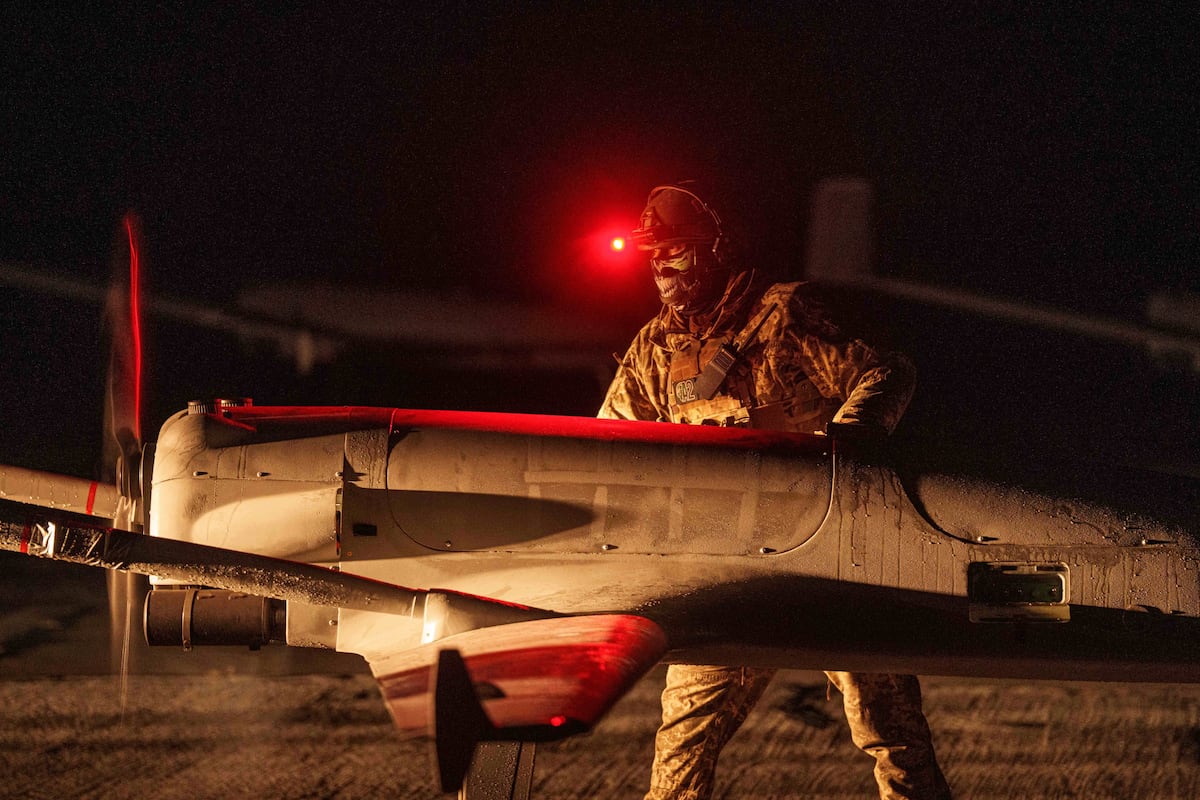
KYIV, Ukraine — Russia is using GPS spoofing to steer Ukrainian strike drones off course and into NATO airspace, Lithuania said this week, days before one of Moscow’s own drones hit a Romanian apartment block and wounded two civilians — likely the first casualties on NATO soil since Russia’s 2022 invasion of Ukraine.
Russia’s interference reached Lithuania’s capital on May 20, when a drone forced Vilnius into shelters , shut its airport and cleared parliament, the first such alert in the city since 2022.
The jamming has been escalating for nearly three years, since Russia began disrupting signals around the 2023 NATO summit in Vilnius, and now spikes whenever Ukrainian drones fly toward Russian targets.
“This is the new reality of what the Baltic states face,” Lithuanian Defense Minister Robertas Kaunas said last week.
Romanian F-16s scrambled in response, President Nicușor Dan said.
Unlike the attacks that struck homes in Romania on Friday, most of the drones that have crossed into Baltic airspace over the last few months have not been launched by Russia, but instead have been operated by Ukraine and thrown off course by Russia.
Both strike drones launched at refineries and ports inside Russia and interceptor drones meant to take out incoming attacks have been steered off course and into NATO airspace by Russian spoofing several times over the last few years.
They have already done damage on allied soil: one struck a Latvian oil depot on May 7, exploding on impact. On May 19, a Romanian F-16 on NATO patrol shot another down over Estonia, the first time an allied jet had downed a drone believed to be Ukrainian.
From Kaliningrad, Russian transmitters broadcast counterfeit satellite signals strong enough to seize a drone’s navigation in flight, feed it false coordinates and send it off course.
Lithuania counted 36 of those spoofing transmitters this week, up from three at the start of 2025, reaching 450 kilometers (280 miles) across the region, according to Reuters .
NATO has condemned each strike and scrambled jets to meet them, but has not threatened any retaliation.
Romania’s foreign minister said the Galați strike could justify emergency consultations under NATO’s Article 4, the treaty’s mechanism for talks when a member’s security is threatened.
After speaking with Dan on Friday, Secretary-General Mark Rutte said the alliance stands ready to defend “every inch” of allied territory.
No member, though, has invoked Article 5, the clause that treats an attack on one ally as an attack on all.
Spoofing, meanwhile, is a form of electronic warfare that works by deception rather than brute force.
While jamming overwhelms a drone’s receiver with noise until it can no longer fix its position, spoofing instead sends a stronger, counterfeit signal that the receiver treats as genuine.
“The idea behind spoofing is to create deception,” Thomas Withington, an electronic-warfare specialist at the Royal United Services Institute, told PBS .
When a drone is fed a false fix, it can fly on a completely different path than its operator intended.
The drones most exposed are Ukraine’s long-range models, which fly north toward Russian oil-export terminals on the Gulf of Finland, including Ust-Luga and Primorsk near St. Petersburg.
Their routes hug the Baltic coast, where Russian electronic warfare is densest, and a drone that loses its true fix drifts into allied airspace, according to the Atlantic Council .
Drones crossed into Latvia “as a result of Russian electronic warfare systems,” Ukrainian Foreign Minister Andrii Sybiha said this month.
Ukraine’s own investigations, he said, “proved that this was the result of Russian electronic warfare deliberately diverting Ukrainian drones from their targets in Russia.”
Outside researchers have started to locate the transmitters.
A team from Gdynia Maritime University and the University of Colorado traced Baltic interference over the last year to two coastal sites in Kaliningrad, near the town of Okunevo and the naval base at Baltiysk, each beside known Russian electronic-warfare units.
“Interfering with GNSS signals is, unfortunately, very easy,” Ralf Ziebold of the German Aerospace Center told Defense News.
The network has only grown more entrenched.
“Now they have built up the infrastructure and the interference has become systemic, permanent,” Darius Kuliešius, deputy head of Lithuania’s communications regulator, told Reuters this week.
Ukraine has spent weeks insisting the strays are not its fault. Kyiv says it never routes attacks through allied airspace and has apologized to the Baltic states for drones it argues Russian jamming pushed off course.
Heorhii Tykhyi, the Foreign Ministry spokesperson, said as much after the Estonia shootdown on May 19.
“Moscow does this on purpose,” he said, apologizing to “Estonia and all our Baltic friends” and noting Ukraine’s only targets lie inside Russia.
Russia has denied steering the drones, casting the incursions instead as proof that the Baltics are abetting Ukrainian attacks.
To beat the spoofing, Ukraine is building drones that can fly without satellites at all.
Newer long-range models carry controlled-reception-pattern antennas that filter out spoofing signals, plus cameras and inertial backups that hold a course when the satellite link drops. Kyiv unveiled one, the Sichen, built to fly “under conditions of active electronic warfare,” in April, according to Militarnyi .
Countering wired drones that emit no signal at all is another challenge.
“Fiber-optic drones have shown us that drones insensitive to electronic warfare are a serious threat to logistics and personnel,” Defense Minister Mykhailo Fedorov said last month.
Kyiv is racing to field more of them, even building a shared ground station to fly them at scale, he said, though the skyrocketing cost of fiber-optic cable limits how far they reach.
Officials from Kyiv and the Baltic states said they hope that increasing air defense coordination between countries in the region will help counter the threat, according to ERR .
Sybiha has offered to send Ukrainian experts to strengthen Baltic air defenses, and Kyiv and Vilnius agreed this week to build drones together and station Ukrainian specialists in Lithuania, according to Militarnyi .
The decision to fire on an intruding drone rests with national governments, not the alliance: NATO’s Baltic air-policing mission, run from a combined air operations center in Uedem, Germany , intercepts only on a member’s behalf, and each country sets its own rules of engagement.
Romania changed its law in 2024 to let its military shoot down intruding drones as a last resort, and its pilots were cleared to fire over Galați had they been able to do so without endangering civilians.
For the alliance’s frontline states, the working assumption is that the drones will keep coming.
“We need to adapt,” Lithuanian Defense Minister Robertas Kaunas said, “because the possibility of repeated similar scenarios is very high.”
乌克兰基辅——立陶宛本周表示,俄罗斯正在使用 GPS 欺骗技术引导乌克兰攻击无人机偏离航线,进入北约领空。几天后,莫斯科的一架无人机击中罗马尼亚的一栋公寓楼,造成两名平民受伤——这可能是自俄罗斯 2022 年入侵乌克兰以来,北约领土上首次出现人员伤亡。
5月20日,俄罗斯的干预蔓延到了立陶宛首都维尔纽斯。一架无人机迫使维尔纽斯市民进入避难所,关闭了机场,并清空了议会大楼。这是自2022年以来该市首次出现此类警报。
自俄罗斯在维尔纽斯举行的 2023 年北约峰会前后开始干扰信号以来,干扰活动已经持续升级近三年,现在每当乌克兰无人机飞向俄罗斯目标时,干扰就会加剧。
“这就是波罗的海国家面临的新现实,”立陶宛国防部长罗伯塔斯·考纳斯上周表示。
罗马尼亚总统尼库索尔·丹表示,罗马尼亚F-16战斗机紧急升空予以回应。
与周五发生在罗马尼亚的袭击事件不同,过去几个月进入波罗的海空域的大多数无人机并非由俄罗斯发射,而是由乌克兰操控,并被俄罗斯干扰偏离航线。
过去几年里,俄罗斯多次利用欺骗手段,将攻击俄罗斯境内炼油厂和港口的攻击无人机以及旨在拦截来袭攻击的拦截无人机引导至北约领空,使其偏离航线。
它们已经对盟国领土造成了破坏:5月7日,一架无人机击中了拉脱维亚的一个油库,并在撞击时爆炸。5月19日,一架执行北约巡逻任务的罗马尼亚F-16战斗机在爱沙尼亚上空击落了另一架无人机,这是盟军战机首次击落据信属于乌克兰的无人机。
俄罗斯从加里宁格勒发射伪造的卫星信号,其强度足以干扰无人机的飞行导航,向其提供错误的坐标,使其偏离航线。
据路透社报道,立陶宛本周统计到 36 个此类欺骗发射器,而 2025 年初时只有 3 个,其影响范围覆盖该地区 450 公里(280 英里)。
北约谴责了每一次袭击,并紧急出动战机予以回应,但并未威胁进行任何报复。
罗马尼亚外交部长表示,加拉茨袭击事件可能构成根据北约条约第 4 条进行紧急磋商的理由,该条约规定了当成员国安全受到威胁时进行谈判的机制。
周五与丹通话后,秘书长马克·吕特表示,北约已准备好捍卫盟国领土的“每一寸”。
然而,没有任何成员国援引第五条,该条款规定对一个盟国的攻击将被视为对所有盟国的攻击。
与此同时,欺骗是一种电子战形式,它通过欺骗而不是蛮力来发挥作用。
干扰是通过向无人机的接收器发送噪声,使其无法确定自身位置;而欺骗则是发送更强的伪造信号,接收器会将其视为真实信号。
“欺骗背后的理念是制造欺骗,”皇家联合军种研究所的电子战专家托马斯·威辛顿告诉PBS。
当无人机接收到错误的定位信息时,它的飞行路径可能与操作员预想的完全不同。
最容易受到攻击的是乌克兰的远程无人机,它们向北飞往芬兰湾的俄罗斯石油出口码头,包括圣彼得堡附近的乌斯季卢加和普里莫尔斯克。
据大西洋理事会称,他们的航线沿着波罗的海沿岸飞行,而俄罗斯的电子战在那里最为密集,失去真正定位的无人机就会漂移到盟军领空。
乌克兰外交部长安德烈·西比哈本月表示,无人机越境进入拉脱维亚是“俄罗斯电子战系统造成的”。
他说,乌克兰自己的调查“证明,这是俄罗斯电子战蓄意转移乌克兰无人机攻击俄罗斯境内目标的结果”。
外部研究人员已开始定位发射器。
来自格丁尼亚海事大学和科罗拉多大学的一个团队追踪到,过去一年波罗的海的干扰源位于加里宁格勒的两个沿海地点,一个靠近奥库涅沃镇,另一个靠近波罗的斯克海军基地,这两个地点都位于已知的俄罗斯电子战部队旁边。
“不幸的是,干扰 GNSS 信号非常容易,”德国航空航天中心的拉尔夫·齐博尔德告诉《防务新闻》。
该网络已经变得更加根深蒂固。
“现在他们已经建立起了基础设施,这种干预已经变得系统化、永久性了,”立陶宛通信监管机构副主管达里乌斯·库列修斯本周告诉路透社。
乌克兰数周以来一直坚称无人机偏离航线并非其过错。基辅方面表示,乌克兰从未将攻击路线引至盟国领空,并就无人机偏离航线一事向波罗的海国家道歉,乌克兰方面则辩称,俄罗斯的干扰导致无人机偏离航线。
外交部发言人赫奥尔希·蒂赫伊在 5 月 19 日爱沙尼亚击落事件后也表达了类似的观点。
“莫斯科是故意这么做的,”他说道,并向“爱沙尼亚和我们所有的波罗的海朋友”道歉,同时指出乌克兰的唯一目标都在俄罗斯境内。
俄罗斯否认操控无人机,反而将这些入侵事件视为波罗的海国家协助乌克兰袭击的证据。
为了应对欺骗攻击,乌克兰正在研制无需卫星即可飞行的无人机。
新型远程无人机配备了可控接收模式天线,能够滤除欺骗信号,还配备了摄像头和惯性备用系统,以便在卫星链路中断时保持航向。据米利塔尼称,基辅方面于今年4月推出了一款名为“西琴”(Sichen)的无人机,该无人机专为“在活跃的电子战条件下”飞行而设计。
对抗完全不发出信号的有线无人机是另一个挑战。
“光纤无人机已经向我们表明,对电子战不敏感的无人机对后勤和人员构成严重威胁,”国防部长米哈伊洛·费多罗夫上个月表示。
他说,基辅正在竞相部署更多此类设备,甚至建造了一个共享地面站以大规模飞行,但光纤电缆成本的飙升限制了它们的覆盖范围。
据ERR报道,基辅和波罗的海国家的官员表示,他们希望加强该地区各国之间的防空协调将有助于应对这一威胁。
据米利塔尼称,锡比哈已提出派遣乌克兰专家加强波罗的海防空力量,基辅和维尔纽斯本周也同意共同建造无人机,并在立陶宛驻扎乌克兰专家。
是否向入侵的无人机开火的决定权在于各国政府,而不是北约:北约的波罗的海空中警戒任务由位于德国于德姆的联合空中作战中心负责,它只代表成员国进行拦截,每个国家都制定自己的交战规则。
罗马尼亚在 2024 年修改了法律,允许其军队在万不得已的情况下击落入侵的无人机,并允许其飞行员在不危及平民的情况下向加拉茨上空开火。
对于联盟的前线国家来说,目前的假设是无人机将会持续出现。
立陶宛国防部长罗伯塔斯·考纳斯表示:“我们需要适应,因为类似情况再次发生的可能性非常高。”