China is building launch pads near its nuclear missile silos中国正在其核导弹发射井附近修建发射台
China’s nuclear missiles can reach any U.S. city. Now, satellite images show Beijing is building a sprawling web of military sites near its nuclear silos.
In a remote Chinese desert, a vast military complex is taking shape that some security scholars say appears built to ensure no American first strike on China’s nuclear arsenal could reliably knock out Beijing’s ability to hit back.
China’s nuclear missiles can already reach any city in the United States. Now, satellite images reviewed by Reuters show Beijing is building a sprawling web of launch pads, bunkers and communications nodes near the isolated nuclear silos that hold the Chinese military’s longest-range missiles.
The images reveal more than 80 pads for possible use by China’s expanding fleet of mobile missile launchers and air-defense batteries. They also show facilities that may serve electronic warfare, satellite communications and command operations, according to three security analysts, who assessed the imagery for Reuters.
The scale of the construction, which hasn’t been previously reported, points to a sweeping expansion of hardened infrastructure designed to protect and operate China’s land-based nuclear forces.
Taken together, the network signals a significant upgrade in Beijing’s efforts to ensure second-strike capability, underscoring intensifying nuclear competition with the United States as tensions rise over issues such as Taiwan’s sovereignty.
“We can see this infrastructure is being built on a grand scale, covering thousands of square kilometers of desert beyond the silo fields,” said Alexander Neill, an adjunct fellow at Hawaii’s Pacific Forum think tank. Depending on the precise capabilities, he said, “we’re looking at a very considerable enhancement and diversification of China’s strategic nuclear deterrent.”
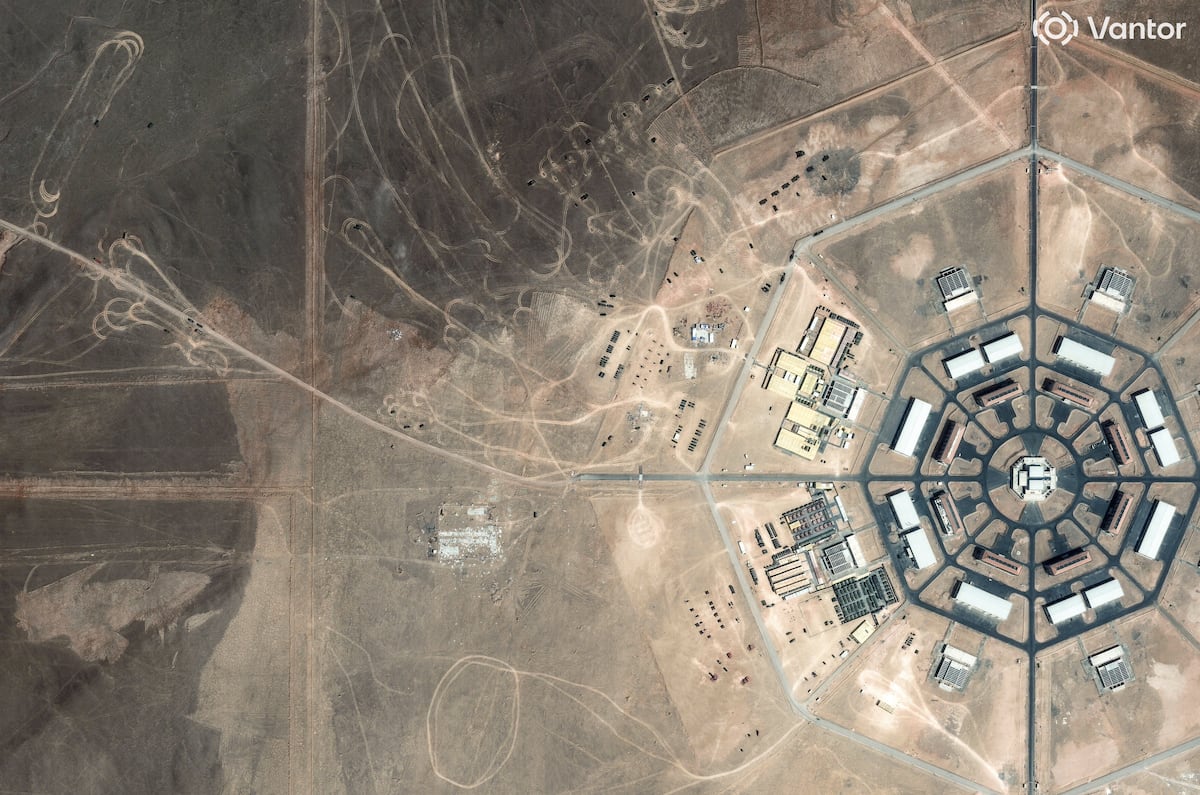
Satellite image shows one of the two Xinjiang octagon-shaped military facilities, Xinjiang Uyghur Autonomous Region, China, Aug. 4, 2025. (Vantor/Handout via Reuters)
The ability to protect its desert silos is key to China’s stated goal of forging a minimal but credible nuclear deterrent — a policy grounded in the capacity to retaliate if it is struck first.
While the People’s Liberation Army (PLA) can fire nuclear weapons from submarines and aircraft, the silo fields in the northwestern Xinjiang region and Gansu province are the core of its nuclear forces.
China’s nuclear build-up is among the most scrutinized facets of President Xi Jinping’s military modernization because of what some foreign diplomats describe as Beijing’s lack of transparency and failed efforts by the United States to engage the Chinese leadership on its evolving nuclear capabilities and intentions.
A cornerstone of China’s doctrine is its “no first use” policy, meaning its forces wouldn’t initiate a nuclear exchange. But some senior Western diplomats and analysts say China would possibly resort to nuclear coercion to limit outside involvement in a conflict over Taiwan.
Xi this month warned U.S. President Donald Trump that mishandling of their countries’ disagreements over Taiwan, which China claims as its territory, could lead them to a “dangerous place.” Taiwan’s government rejects China’s sovereignty claim.
China’s defense ministry didn’t respond to questions about its nuclear program and the developments revealed in the satellite imagery. The Pentagon said it wouldn’t comment on intelligence-related matters.
The new desert infrastructure is centered on two octagon-shaped installations built over the past six years in eastern Xinjiang. Both are southwest of the Hami nuclear silo fields — one is about 140 kilometers away, the other some 230 kilometers.
Satellite images show the octagon structures contain housing for personnel and large military vehicles. They are flanked by armored bunkers and fortified weapons-storage areas, as well as airfields and railheads that link the octagons to the Hami silos.
Exercises involving large military vehicles occurred around the northern octagon this month and during April, the images show.
Also evident in recent images are large tents and what two analysts said appear to be camouflaged launch sites cut into the desert, some with air-defense missile batteries.
Satellite image shows a purported launch pad, part of two isolated desert networks linked by roads and possible communications, Xinjiang Uyghur Autonomous Region, China, April 10, 2026. (Vantor/Handout via Reuters)
The existence of the octagons has been documented previously. But Reuters is the first to report the extent of the launch-pad network linked to the octagons; recent military activity around one of the facilities; and analysts’ assessments that the pads could field mobile missile launchers and electronic-warfare operations.
Five security scholars interviewed by Reuters agreed the infrastructure broadly could support China’s nuclear program, as well as other military purposes. But they cautioned that key details remain unknown — including the weapons China might deploy at the launch pads and whether the octagon structures house truck-mounted ballistic missiles or facilities for fitting nuclear warheads.
The PLA displayed nuclear-capable weapons during a parade in Beijing last September to mark the 80th anniversary of the end of the Second World War. These included silo-based and truck-mounted intercontinental ballistic missiles.
U.S. officials and arms-control analysts say China is expanding and improving its nuclear weapons capabilities faster than any other nation. The latest Pentagon report on China’s military modernization says the country’s warhead production has slowed but it is on track to field 1,000 warheads by 2030. The December report estimated China is likely to have loaded 100 ICBMs across its three main silo fields.
China has also been strengthening its early-warning system, underpinned by its Huoyan-1 satellites, according to U.S. officials. The system can detect an incoming ICBM within 90 seconds of launch and alert a command center within three to four minutes, according to the Pentagon — sufficient time for China to fire its own silo-based weapons before they are hit.
Significantly, each octagon sits at the core of a network of dirt roads and conduits that stretch far into the desert. These routes connect to the concrete pads, which are nestled among rocky outcrops and dry creekbeds.
The pads could be used to deploy mobile air-defense missiles, electronic warfare nodes or, from some of the larger ones, road-mobile ICBM launchers, three security scholars said.
Satellite image reportedly shows a fortified weapons storage installation, revealing revetments around the building, a perimeter wall and guard towers, Xinjiang Uyghur Autonomous Region, China, March 19, 2026. (Vantor/Handout via Reuters)
Hans Kristensen, director of the Federation of American Scientists’ Nuclear Information Project, said while it was difficult to conclude how the various installations would be used, “it is hard to rule anything out” given the scale of the infrastructure in such a hostile environment.
The conduits that link the pads to the octagon structures may contain fiber-optic cables for communications, Kristensen and Neill said.
At the northernmost octagon, a possible space or microwave communications facility is also under construction, three analysts said, pointing to satellite dishes and two large towers.
“Taken together, I think there is a real possibility that the octagonal structures and the strange towers are linked to C3 - command, control, and communications - as well as maintenance and storage activities related to China’s nuclear operations at the Hami ICBM silo site,” said Tong Zhao, a senior fellow in nuclear policy at the Carnegie Endowment for International Peace.
A third octagon-shaped installation south of the Lop Nur nuclear test facilities is less developed. It appears to be used as a target range: Images show pock-marked earth, damaged buildings and what analysts at Vantor, a commercial provider of satellite imagery, said are mock-ups of Western jet fighters.
The extent of the defensive network near its silos potentially sets China apart from the other major nuclear powers. The U.S. and Russia — whose warhead stockpiles and deployed weapons far exceed Beijing’s — rely on a combination of sheer numbers of silos, their relative isolation and hardened construction to deter a first strike, rather than extensive missile defense, Kristensen said.
The scale of what is emerging in China’s northwestern desert has left even seasoned analysts startled.
“I’ve never seen anything quite like it,” Kristensen said. “It’s an extraordinary effort.”
在中国偏远的沙漠中,一个庞大的军事基地正在形成。一些安全学者表示,该基地的建设目的似乎是为了确保美国对中国核武库的任何先发制人打击都无法可靠地摧毁北京的反击能力。
中国的核导弹已经能够打到美国的任何一座城市。现在,路透社审阅的卫星图像显示,北京正在中国军方射程最远的导弹发射井附近,建造一个庞大的发射台、掩体和通信节点网络。
图像显示,中国正在不断扩充其移动导弹发射车和防空炮部队,可能使用超过80个发射平台。据三位为路透社评估图像的安全分析师称,图像还显示了可能用于电子战、卫星通信和指挥作战的设施。
此前未曾报道过的这项工程规模表明,旨在保护和运行中国陆基核力量的加固基础设施正在大规模扩建。
总而言之,该网络标志着北京在确保二次打击能力方面取得了重大进展,凸显了随着台湾主权等问题紧张局势加剧,中美核竞争日益激烈。
“我们可以看到,这项基础设施正在大规模建设,覆盖了筒仓区以外数千平方公里的沙漠,”夏威夷太平洋论坛智库的兼职研究员亚历山大·尼尔说。他表示,根据具体能力的不同,“我们看到的是中国战略核威慑力量的显著增强和多样化。”
卫星图像显示了新疆维吾尔自治区两座八角形军事设施之一,拍摄于2025年8月4日。(Vantor/路透社供图)
保护其沙漠导弹发射井的能力对于中国实现其既定目标——打造最小但可信的核威慑力量——至关重要,这一政策的基础是如果首先遭到打击,中国有能力进行报复。
虽然中国人民解放军可以从潜艇和飞机上发射核武器,但位于西北新疆地区和甘肃省的导弹发射井群是其核力量的核心。
由于一些外国外交官认为北京缺乏透明度,以及美国试图就中国不断发展的核能力和意图与中国领导层进行沟通的努力失败,中国的核武库建设是习近平主席军事现代化进程中最受关注的方面之一。
中国战略的核心是“不首先使用核武器”政策,这意味着中国军队不会主动发起核战争。但一些西方高级外交官和分析人士表示,中国可能会诉诸核威慑,以限制外部势力介入台湾冲突。
习近平本月警告美国总统特朗普,如果两国处理台湾问题上的分歧不当,可能会将两国带入“危险境地”。中国声称台湾是其领土。台湾当局拒绝接受中国的主权声索。
中国国防部未回应有关其核计划以及卫星图像所揭示情况的问题。五角大楼表示不会对情报相关事宜发表评论。
新的沙漠基础设施以过去六年在新疆东部建造的两座八角形设施为中心。这两座设施都位于哈密核导弹发射井群西南方向——一座距离约140公里,另一座距离约230公里。
卫星图像显示,这些八角形建筑内设有人员住所和大型军用车辆停放处。它们两侧是装甲掩体和加固的武器库,以及连接这些八角形建筑和哈密导弹发射井的机场和铁路枢纽。
图片显示,本月和四月份在北八角大楼附近举行了涉及大型军用车辆的演习。
最近的照片还显示,沙漠中出现了大型帐篷,两位分析人士称,这些帐篷似乎是伪装的发射场,其中一些还配备了防空导弹阵地。
卫星图像显示,中国新疆维吾尔自治区境内,一处疑似发射台,是两个通过道路和可能的通信设施连接的独立沙漠网络的一部分。拍摄于2026年4月10日。(Vantor/路透社供图)
八角形设施的存在此前已有记录。但路透社首次报道了与这些八角形设施相连的发射台网络规模;近期在其中一个设施附近发生的军事活动;以及分析人士对这些发射台可能部署移动导弹发射器和进行电子战行动的评估。
路透社采访的五位安全问题专家一致认为,这些基础设施总体上可以支持中国的核计划以及其他军事用途。但他们也提醒说,一些关键细节仍然未知,包括中国可能在发射台部署的武器,以及这些八角形建筑内是存放车载弹道导弹还是用于安装核弹头。
去年9月,为纪念二战结束80周年,解放军在北京举行阅兵式,展示了具备核能力的武器,其中包括井基和车载式洲际弹道导弹。
美国官员和军控分析人士表示,中国核武器能力的扩张和提升速度超过任何其他国家。五角大楼最新发布的关于中国军事现代化的报告指出,中国核弹头生产速度有所放缓,但仍有望在2030年前部署1000枚核弹头。去年12月发布的报告估计,中国可能已在其三大主要发射井群中装载了100枚洲际弹道导弹。
据美国官员称,中国一直在加强其预警系统,该系统以“火眼一号”卫星为基础。五角大楼表示,该系统可在洲际弹道导弹发射后90秒内探测到来袭目标,并在三到四分钟内向指挥中心发出警报——这足以让中国在被击中前发射其井基导弹。
值得注意的是,每个八边形都位于延伸至沙漠深处的土路和管道网络的核心位置。这些道路与混凝土平台相连,而这些平台则掩映在岩石露头和干涸的河床之间。
三位安全学者表示,这些发射台可用于部署移动式防空导弹、电子战节点,或者从一些较大的发射台上部署公路机动式洲际弹道导弹发射器。
据报道,卫星图像显示,中国新疆维吾尔自治区一处加固的武器库设施,图像显示建筑物周围有护墙、围墙和瞭望塔,拍摄于2026年3月19日。(Vantor/路透社供图)
美国科学家联盟核信息项目主任汉斯·克里斯滕森表示,虽然很难断定各种设施将如何使用,但考虑到在如此恶劣的环境中基础设施的规模,“很难排除任何可能性”。
克里斯滕森和尼尔表示,连接垫子和八角形结构的管道可能包含用于通信的光纤电缆。
三位分析人士指出,在最北端的八角形区域,可能正在建设一个太空或微波通信设施,他们指着卫星天线和两座大塔说道。
“综合来看,我认为八角形结构和奇怪的塔楼很有可能与中国在哈密洲际弹道导弹发射井的核行动相关的 C3(指挥、控制和通信)以及维护和储存活动有关,”卡内基国际和平基金会核政策高级研究员童钊说。
罗布泊核试验场以南的第三个八角形设施开发程度较低。它似乎被用作靶场:图像显示地面坑坑洼洼,建筑物受损,以及据卫星图像商业供应商Vantor的分析人士所称的西方喷气式战斗机模型。
中国导弹发射井附近防御网络的规模,使其与其他主要核大国截然不同。克里斯滕森表示,美国和俄罗斯——它们的核弹头储备和部署的武器数量远远超过北京——依靠的是发射井的数量优势、相对的隔离位置以及坚固的防御工事来威慑先发制人的核打击,而不是广泛的导弹防御系统。
中国西北沙漠地区正在发生的事情的规模,甚至让经验丰富的分析人士都感到震惊。
克里斯滕森说:“我从未见过这样的事情。这真是一项非凡的成就。”