Pentagon looks to reinvent the bunker-buster bomb五角大楼计划重新研制钻地炸弹。
The goal is to go beyond the traditional brute-force approach of giant bombs and instead manipulate shock waves to destroy targets.
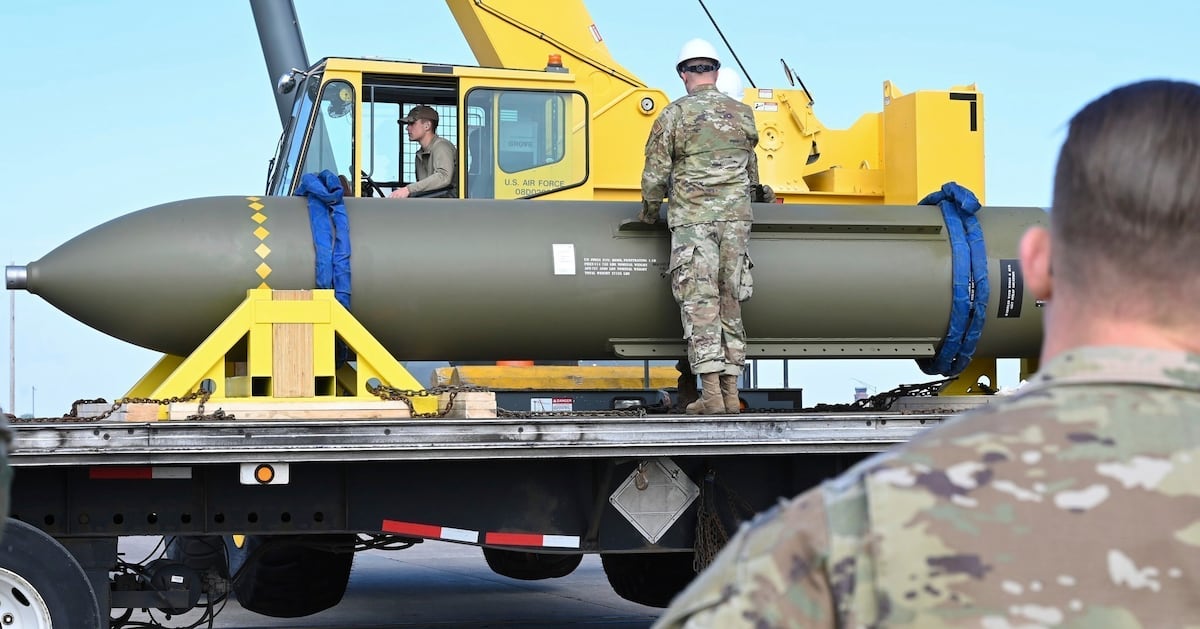
With nations such as Iran protecting their arsenals by burying them deep underground, the Pentagon’s Defense Advanced Research Projects Agency is searching for new types of bunker-buster bombs .
The goal is to go beyond the traditional brute-force approach of giant bombs that rely on the force of gravity to smash their way deep into the ground before exploding.
During World War II, the Royal Air Force dropped 22,000-pound “Grand Slam” bombs. Eight decades later, the U.S. Air Force has used the 30,000-pound GBU-57 Massive Ordnance Penetrator in the campaign against Iran.
Now, DARPA wants to pivot away from the traditional bunker busters and instead manipulate shock waves to destroy targets.
“The government is explicitly interested in concepts that move beyond traditional mass-velocity scaling and empirical design toward mechanisms that deliberately shape, steer, amplify, or suppress stress waves within homogeneous and heterogeneous materials,” according to DARPA’s Request for Information. The deadline is June 26.
“Areas of interest include, but are not limited to, transient material state manipulation under extreme loading, non-linear and anisotropic wave control, dynamic impedance matching, controlled failure initiation and progression, and the coupling of structural, material, and geometric effects to achieve step-change performance against complex targets,” DARPA continued.
DARPA also seeks “new regimes of performance or observability in shock-dominated environments.”
Potential advances include “architected or actively tunable materials, novel fabrication methods that embed function into structure,” and “advanced diagnostics capable of resolving high-strain-rate phenomena in situ.”
DARPA’s quest for better bunker-busters comes as the future of warfare heads beneath the surface. Iran has embedded nuclear facilities and missile stockpiles inside mountains . North Korea uses bunkers and tunnels to conceal nuclear sites, missile launchers and artillery.
Even non-state actors such as Hamas and Hezbollah — and before them, the Viet Cong — waged war from underground. In the Ukraine War, drones have become such a pervasive threat that human soldiers spend much of their time in bunkers.
Rooting out insurgents from tunnels is hard enough, as the U.S. Army’s “tunnel rats” can attest. Trying to destroy an Iranian nuclear site 300 feet underground is an order of magnitude harder.
That’s why weapons like Grand Slam and the Massive Ordnance Penetrator were invented. But the Grand Slam could be carried only by a specially modified Lancaster four-engine bomber, while the MOP is dropped by a B-2 bomber , of which the U.S. Air Force has only 19 operational .
DARPA’s RFI doesn’t mention reducing the size of bunker-buster bombs. But if scientists can devise ways to exploit shock waves to destroy targets, this opens the possibility of smaller bunker-busters that can be carried by a variety of aircraft.
Michael Peck is a correspondent for Defense News and a columnist for the Center for European Policy Analysis. He holds an M.A. in political science from Rutgers University. Find him at theuncommondefense.com. His email is mikedefense1@gmail.com.
由于伊朗等国将武器库深埋地下以保护其安全,五角大楼的国防高级研究计划局正在寻找新型的钻地炸弹。
目标是超越传统的巨型炸弹依靠重力冲击地面深处然后爆炸的蛮力方法。
二战期间,英国皇家空军投掷了重达22000磅的“大满贯”炸弹。八十年后,美国空军在对伊朗的军事行动中使用了重达30000磅的GBU-57巨型穿透炸弹。
现在,DARPA希望摆脱传统的掩体破坏器,转而利用冲击波摧毁目标。
根据美国国防高级研究计划局(DARPA)的信息征询书,政府明确对超越传统质量-速度缩放和经验设计的概念感兴趣,这些概念旨在探索能够人为地塑造、引导、放大或抑制均质和非均质材料内部应力波的机制。截止日期为6月26日。
DARPA 继续说道:“感兴趣的领域包括但不限于:极端载荷下的瞬态材料状态操控、非线性各向异性波控制、动态阻抗匹配、可控失效的萌生和发展,以及结构、材料和几何效应的耦合,以实现针对复杂目标的阶跃式性能提升。”
DARPA 还寻求“在冲击主导的环境中实现新的性能或可观测性机制”。
潜在的进展包括“结构化或主动可调材料、将功能嵌入结构的新型制造方法”以及“能够原位解析高应变率现象的先进诊断技术”。
随着未来战争的重心转向地下作战,美国国防高级研究计划局(DARPA)对更有效的掩体破坏武器的追求也随之而来。伊朗已将核设施和导弹库隐藏在山脉之中。朝鲜则利用掩体和隧道来掩藏核设施、导弹发射装置和火炮。
即使是哈马斯和真主党等非国家行为体——以及更早的越共——也曾进行过地下战争。在乌克兰战争中,无人机已成为一种无处不在的威胁,以至于士兵们大部分时间都待在掩体里。
从隧道中清除叛乱分子已属不易,美国陆军的“隧道鼠”们对此深有体会。而试图摧毁位于地下300英尺的伊朗核设施,难度则要高出一个数量级。
这就是“大满贯”和“巨型穿甲弹”等武器被发明的原因。但“大满贯”只能由经过特殊改装的兰开斯特四引擎轰炸机携带,而“巨型穿甲弹”则由B-2轰炸机投放,美国空军目前只有19架B-2轰炸机可以作战。
DARPA 的信息征询书中并未提及缩小掩体炸弹的尺寸。但如果科学家能够找到利用冲击波摧毁目标的方法,那么就有可能制造出更小的掩体炸弹,并可由多种飞机携带。
迈克尔·佩克是《防务新闻》的通讯员,也是欧洲政策分析中心的专栏作家。他拥有罗格斯大学政治学硕士学位。您可以在theuncommondefense.com找到他。他的邮箱是mikedefense1@gmail.com。