NASA Once Built This Armored HAZMAT Response Vehicle That Was Loaded With Futuristic Features美国宇航局曾建造过这种配备诸多未来科技的装甲危险品应急车辆。
NASA Once Built This Armored Personnel Carrier With A Giant Robot Arm For Hazmat Emergencies
新闻视频
Published Jan 22, 2022 3:35 PM EST
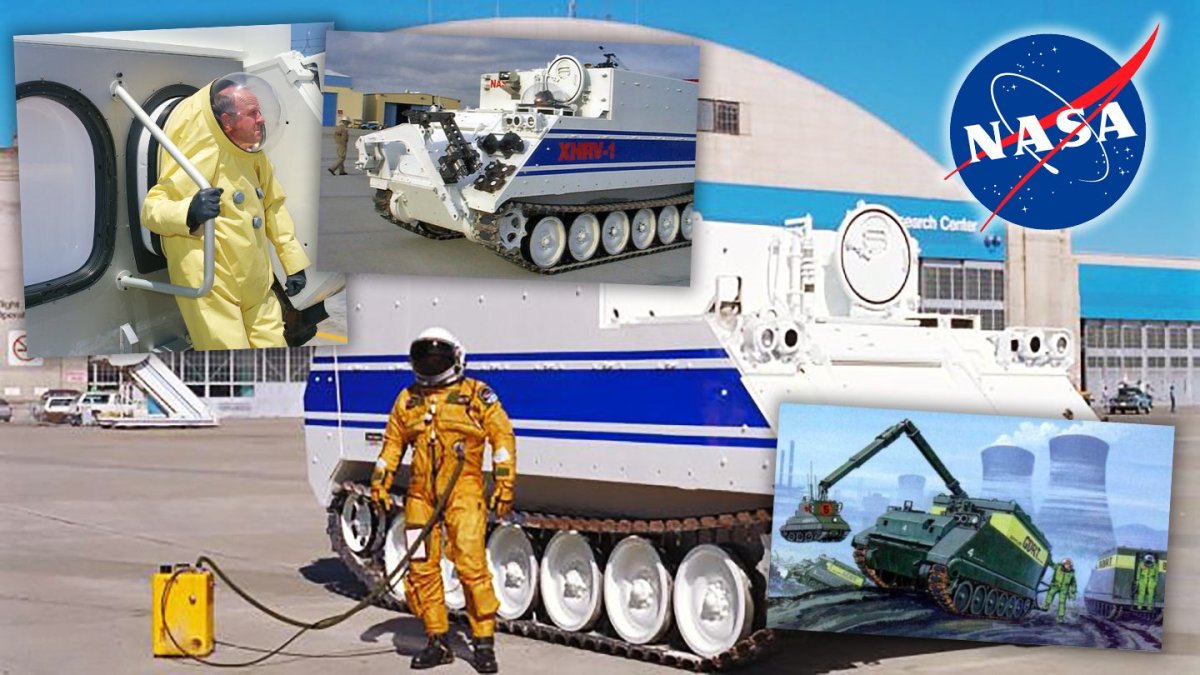
In the 64 years since its creation, the National Aeronautics and Space Administration (NASA) has pioneered a wide range of vehicle technologies that pushed the boundaries of engineering. While its high-flying designs would forever change both manned and unmanned flight, some of NASA vehicles were destined to live out their lives on the ground in support roles. One of the more curious of NASA’s ground-bound creations was an armored personnel carrier with a giant robotic arm on the front and a ton of other novel features, some of which were quite ahead of their time. It was dubbed the XHRV-1 and it was intended to be used in response to hazardous material emergencies, although that never really happened as planned.
NASA started using the M113 during the Apollo program as personnel carriers in which firefighters and rescue teams would stand by during manned launches. According to David Seymour, Battalion Chief with NASA’s Kennedy Space Center Fire Department, the space agency chose the M113 because the carrier is “virtually indestructible” and could provide protection for rescue teams in and out of the launch area in the event of emergencies. “We want to give the astronauts, close-out crew, and ice inspection team the comfort to know that when called we are going to be there no matter what happens,” Seymour said in a 2011 NASA feature .
NASA M113 during as Shuttle launch., NASA
NASA used two M113s during Space Shuttle launches at Kennedy Space Center. Inside one, a specialized firefighting team would be fully suited up with protective suits and air supplies, ready to deploy within seconds in the event of a launchpad emergency. A second M113 sat waiting close to an emergency bunker by the launchpad. If astronauts aboard the shuttle had to abort their mission and use emergency slidewire baskets to escape the shuttle stack as it sat on the pad, the second M113 would be waiting for them on the ground with its ramp down.
NASA owned four M113s for emergency use at Kennedy Space Center, but retired them in 2013, thankfully without ever having to use them in an actual emergency situation. The M113s were replaced by four Caiman Mine Resistant Ambush Protected vehicles, or MRAPs , which NASA modified by adding rear ramps to replace the original boarding ladders.
A NASA MRAP, left, and an older M113, right., NASA
In addition to the four M113s used for rescue at Kennedy Space Center, NASA acquired a fifth M113 in 1994, more specifically an M113 variant known as the M577A3 Armored Command Post Vehicle . The M577A3 featured a longer body with a sixth roadwheel, a commander’s hatch, and no weapons mounts. This variant was designed primarily to serve as a mobile tactical operations center and saw use from the Vietnam War to the invasion of Iraq in 2003. Starting in 2020, the U.S. Army began the process of replacing the M577A3 with the Armored Multi-Purpose Vehicle, or AMPV .
NASA acquired this fifth M113 with a special use in mind: hazardous materials response, or HAZMAT. To be able to more safely respond to incidents involving toxic, radioactive, or otherwise dangerous substances, NASA engineers at the Ames Research Center in California envisioned creating a specialized vehicle that could not only safely transport personnel in and out of HAZMAT areas, but also allow them to respond to these emergencies without ever leaving their vehicle. NASA called this program the eXperimental HAZMAT Response Vehicle, or XHRV-1 .
The XHRV-1 prior to the addition of its robotic arm., NASA
The space agency handles many volatile and extremely dangerous substances, including those related to rocket fuels and propellants, but concept art from the XHRV-1 program shows that the vehicle was also envisioned as being able to assist law enforcement or public safety agencies in other scenarios such as nuclear powerplant malfunctions or terrorist attacks. There were many of these vehicles that were becoming obsolete in the military, so turning them into highly-specialized HAZMAT response vehicles with totally unique capabilities made some sense.
Concept art showing the XHRV-1 in action., Tanks-Encyclopedia.com
The XHRV-1 replaced the M577A3’s commander’s hatch with a clear polycarbonate dome, providing a near 360-degree view of the vehicle’s surroundings. The vehicle’s armor would provide protection from fires, explosions, or debris, while its continuous tank-style tracks would allow it to navigate very roughly terrain such as a collapsed building. An air-conditioning overpressure system would not only keep crews comfortable inside, but could also help prevent potentially contaminated outside air from entering the XHRV-1. This hardening against nuclear, biological, and chemical hazards (NBC) is a widely realized capability among armored combat systems.
The XHRV-1 in an early demonstration., NASA
One of the vehicle’s most unique features was its suitports , special rear hatches onto which safety suits could be mounted. These ports were designed to allow HAZMAT crew members to enter their suits directly from a vehicle, or exit their suits by sliding out backwards into the cabin once their remote work is done.
An interior view of the XHRV-1’s suitports, left, and an exterior view showing empty suits mounted on the ports on the vehicle’s exterior., Tanks-encyclopedia.com
NASA spacesuit engineer Jerry James exiting through the XHRV-1’s suitport., NASA
A 1996 patent for a suit docking mechanism assigned to NASA contains concept art of personnel entering and exiting their suits with the help of an overhead bar on which they could hold themselves up. In theory, the concept would allow crew to enter and exit the vehicle without ever being exposed to the air outside. It’s unknown how many crewmen the vehicle was designed to carry, but concept images depict up to six crewmembers for a single XHRV-1.
The second defining capability of the XHRV-1 was its front manipulator, a massive robotic arm with a 600-lb capacity and the ability to cut through obstacles. This was controlled from inside the vehicle’s cabin at an elaborate workstation. Closed-circuit video from multiple angles, including from the tip of the arm itself, would help the operator manipulate objects in their surroundings.
Concept art also showed that NASA had plans for a bulldozer blade for the XHRV-1, but that feature does not appear in the few images of the XHRV-1 prototype. There were also plans for a “robot helicopter,” what we today would call a drone, although it seems this feature was never added in the one XHRV-1 built. Still, this was wildly ahead of its time. Equipping individual armored vehicles with their own drones is just now becoming a very hot trend .
NASA spacesuit engineer Jerry James beside the XHRV-1., NASA
Ultimately, the XHRV-1 would never go on to operational use, and the prototype built by Ames was stripped of its manipulator arm and bubble dome before being sent off for disposal. A military history preservation non-profit, the Eagle Field Foundation , would eventually repaint the XHRV-1 olive drab green and display it as an example of a vintage military medical vehicle.
The repainted, decommissioned XHRV-1., Tanks-Encyclopedia.com
Fast forward to today and unmanned robots fulfill some of the same types of tasks the XHRV-1 was designed to, further keeping emergency responders out of harm’s way. Yet the XHRV-1 was truly a charismatic, sci-fi-like vehicle that seemed more like something a kid would draw than something real. In some ways, it was maybe ahead of its time. As such, the obscure armored vehicle deserves a special place in the annals of NASA history.
Author’s note: Special thanks to Tanks-Encyclopedia.com who had great info on this obscure armored vehicle.
Contact the author: Brett@TheDrive.com
Comments couldn’t be loaded. Please refresh the page.
发布于 2022 年 1 月 22 日下午 3:35(美国东部时间)
自成立以来的64年间,美国国家航空航天局(NASA)开创了众多飞行器技术,不断突破工程技术的极限。其高空飞行器设计将永远改变载人和无人飞行,而NASA的一些飞行器则注定要在地面上承担支援任务。NASA众多地面装备中,最引人注目的当属一款装甲运兵车,它前端装有巨大的机械臂,并拥有许多其他新颖的功能,其中一些在当时可谓相当超前。这款名为XHRV-1的装备原本计划用于应对危险物质事故,但最终并未按计划投入使用。
在阿波罗计划期间,NASA开始使用M113型消防车作为人员运输车,供消防员和救援队在载人发射期间待命。据NASA肯尼迪航天中心消防局营长戴维·西摩(David Seymour)介绍,NASA之所以选择M113,是因为它“几乎坚不可摧”,能够在紧急情况下为发射区域内外的救援队提供保护。西摩在2011年NASA的一篇专题报道中表示:“我们希望让宇航员、收尾人员和冰层检查小组安心,让他们知道无论发生什么,只要接到召唤,我们都会及时赶到。”
NASA M113 在航天飞机发射期间。
在肯尼迪航天中心进行航天飞机发射时,NASA 使用了两辆 M113 应急车。其中一辆 M113 内配备一支专业的消防队,队员们身着全套防护服,携带充足的空气,一旦发射台发生紧急情况,即可在数秒内迅速展开救援。另一辆 M113 则停放在发射台附近的应急掩体旁。如果航天飞机上的宇航员不得不中止任务,并使用紧急滑索篮从停在发射台上的航天飞机残骸中逃生,那么第二辆 M113 的坡道就会放下,在地面等候他们。
美国宇航局(NASA)在肯尼迪航天中心拥有四辆M113防雷车,用于紧急情况,但于2013年退役,所幸从未在实际紧急情况下使用过。M113被四辆凯门防雷反伏击车(MRAP)取代,NASA对MRAP进行了改装,加装了后部坡道以取代原有的登车梯。
左图为NASA的MRAP装甲车,右图为较老的M113装甲车。(图片来源:NASA)
除了肯尼迪航天中心用于救援的四辆M113装甲车外,NASA于1994年还购入了第五辆M113,更确切地说,是M577A3装甲指挥车的改进型。M577A3车身更长,配备第六个负重轮、指挥官舱门,并且没有武器挂架。该改进型主要设计用作移动战术作战中心,从越南战争一直服役到2003年入侵伊拉克。从2020年开始,美国陆军逐步用装甲多用途车(AMPV)替换M577A3。
美国国家航空航天局(NASA)购置这第五辆M113装甲车,其用途十分特殊:危险品应急响应(HAZMAT)。为了更安全地应对涉及有毒、放射性或其他危险物质的事故,NASA位于加利福尼亚州艾姆斯研究中心的工程师们设想制造一种专用车辆,该车辆不仅能够安全地将人员运送进出危险品应急区域,还能让他们在无需离开车辆的情况下应对这些紧急情况。NASA将该项目命名为“实验性危险品应急响应车辆”(eXperimental HAZMAT Response Vehicle),简称XHRV-1。
XHRV-1 在加装机械臂之前的照片,美国国家航空航天局(NASA)
该航天机构负责处理许多易挥发且极其危险的物质,包括与火箭燃料和推进剂相关的物质。但XHRV-1项目的概念图显示,该车辆的设计初衷还在于协助执法部门或公共安全机构应对其他情况,例如核电站故障或恐怖袭击。当时军方有很多此类车辆正在逐渐淘汰,因此将它们改造成具备独特能力的特种危险品应急车辆不失为一个明智之举。
XHRV-1作战概念图,来自Tanks-Encyclopedia.com
XHRV-1用透明聚碳酸酯圆顶取代了M577A3的指挥官舱盖,使车内人员能够近乎360度地观察周围环境。车辆的装甲能够抵御火灾、爆炸或碎片冲击,而其连续履带式设计使其能够穿越诸如倒塌建筑物等极其崎岖的地形。正压空调系统不仅能确保乘员在车内舒适,还能有效防止可能受到污染的外部空气进入XHRV-1。这种抵御核生化灾害(NBC)的能力在装甲作战系统中已得到广泛应用。
XHRV-1早期演示,美国宇航局
该车辆最独特的功能之一是其防护服舱口,即特殊的后舱门,防护服可以安装在这些舱口上。这些舱口的设计旨在方便危险品处理小组成员直接从车内穿上防护服,或在完成远程作业后向后滑出防护服进入驾驶室。
左图为XHRV-1装甲车内部的宇航服接口,右图为外部接口处安装的空宇航服。(图片来源:Tanks-encyclopedia.com)
美国宇航局宇航服工程师杰里·詹姆斯正从XHRV-1飞船的宇航服出口离开。
1996年,美国宇航局(NASA)获得了一项宇航服对接机构的专利,其中包含一张概念图,图中显示宇航员借助头顶横杆的支撑,可以进出宇航服。理论上,该设计可以让宇航员在完全不接触外界空气的情况下进出飞行器。目前尚不清楚该飞行器设计搭载多少名宇航员,但概念图显示,单架XHRV-1最多可搭载六名宇航员。
XHRV-1的第二个关键能力是其前置机械臂,这是一个重达600磅(约272公斤)的巨型机械臂,能够切割障碍物。该机械臂由车内驾驶舱内一个精密的操控工作站控制。多角度闭路电视监控系统,包括从机械臂末端拍摄的画面,可以帮助操作员操控周围环境中的物体。
概念图显示,NASA曾计划为XHRV-1配备推土铲,但这一特征并未出现在为数不多的XHRV-1原型车照片中。此外,还有“机器人直升机”(即我们今天所说的无人机)的计划,不过XHRV-1原型车似乎并未配备这一功能。即便如此,这在当时也堪称超前之举。如今,为单辆装甲车辆配备无人机正逐渐成为一种热门趋势。
美国宇航局宇航服工程师杰里·詹姆斯站在XHRV-1号飞船旁。
最终,XHRV-1未能投入实战,艾姆斯制造的原型车在被送往报废场之前,其机械臂和气泡穹顶已被拆除。一家名为“鹰场基金会”(Eagle Field Foundation)的军事历史保护非营利组织最终将XHRV-1重新涂装成橄榄绿色,并将其作为老式军用医疗车辆的典范进行展示。
重新涂装的退役XHRV-1坦克。(Tanks-Encyclopedia.com)
时至今日,无人机器人已经能够完成XHRV-1最初设计的一些相同任务,进一步保障了应急人员的安全。然而,XHRV-1确实是一款极具魅力、充满科幻色彩的车辆,与其说是真实存在的,不如说更像是孩童的画作。在某些方面,它或许超前于时代。因此,这款鲜为人知的装甲车理应在NASA的历史上占有一席之地。
作者注:特别感谢 Tanks-Encyclopedia.com 网站,该网站提供了关于这款鲜为人知的装甲车辆的精彩信息。
联系作者:Brett@TheDrive.com
评论加载失败,请刷新页面。