Fighter Pilots Reveal Why You Don’t Want To Mess With The A-10 Warthog In A Dogfight战斗机飞行员揭秘为何在空战中千万别招惹A-10“疣猪”攻击机
Pilots discuss how the A-10 Warthog's tight turning radius coupled with its big gun means it can sting even the best fighters in a dogfight.
新闻视频
Published Jan 26, 2021 1:20 PM EST
While the Fairchild Republic A-10 Thunderbolt II is the king of close air support (CAS) — supporting troops on the ground with its blistering array of firepower — many would be surprised to know that it is also no slouch when it comes to air-to-air fighting. While the “Warthog” isn’t optimized for the air superiority role and lacks key capabilities, such as high-speed, radar, and radar-guided long-range missiles that make its fighter brethren such air-to-air supremos, even the greatest fighter pilots are rightfully wary of getting into a close-in turning dogfight with a ‘lowly’ mud-moving A-10.
The slow-speed agility of the tank-busting Warthog, combined with some clever tactics, means that even the most advanced fighter aircraft can get a nasty sting from an accomplished “Hog” driver. Indeed, the U.S. Air Force Weapons School at Nellis Air Force Base in Nevada, actually teaches the art of Basic Fighter Maneuvers (BFM) in its bi-annual A-10 class, just in case pilots find themselves in a sticky situation with a pouncing enemy fighter.
Colonel Denny “Gator” Yount retired from the USAF in 2011 with an impressive 3,852 hours in the A-10. He says that of the many highlights in his career, specializing in A-10 BFM at the Weapons School as an instructor ranks as one of the most rewarding. “The air-to-air guys have a radar and they are a lot faster than we are, but they quickly learn that it doesn’t pay for them to get into the proverbial phone booth with us for a close-in dogfight .”
An A-10C of the 66th Weapons Squadron carrying an AN/ALQ-131 electronic countermeasures pod on its outer left wing station., Jamie Hunter
“The Weapons School takes the best of the best pilots from the operational A-10 wings. It runs two six-month courses each year and the students start out with academics for a couple of weeks and then they begin flying,” explains Yount. “BFM was, and still remains, the first phase of the course. It’s like planting the flag — no matter how good the student thinks they are, this is how tough the course is going to be. The Weapons School flies at a level the students have never previously experienced.”
Yount went through Weapons School in 1993 as a student. As he stated, today, the 66th Weapons Squadron’s A-10 course at Nellis still kicks-off with BFM as its opening phase. While it teaches pilots how to react to an air threat, it’s more geared towards teaching them how to max-perform the Warthog — pushing it right to its prescribed limits — before progressing into the more traditional A-10 air-to-ground mission sets. On the A-10 Weapons School course, the students will drop and employ almost every weapon in the Hog’s impressive arsenal.
Yount returned to Nellis as a Weapons School instructor from January 1996 until October 1999. “I was primarily the BFM guy,” he explains. “We pretty much stripped the airplanes off — most of the pylons and TERs [Triple Ejector Racks] — but kept two AIM-9 Sidewinders and our ECM [electronic countermeasures] pod. We taught the principles of BFM, which was based around 1-v-1 close-in fighting with another A-10. The BFM phase led into an ACM [Air Combat Maneuvering] phase, and we did some 2-v-1 and 2-v-2 set-ups. We used to bring in the German F-4 training unit from Holloman [AFB, New Mexico] or work with the Nellis aggressor F-16s .”
An A-10 Weapons School instructor pilot., Jamie Hunter
“Even if a student was pretty good, if they couldn’t teach the techniques, they were no good to us as a Weapons Officer. Whether you’re the best bomb-dropper or best at BFM, if you can’t go back to your squadron and teach it, you’re worthless. You’ve got to be able to spread the knowledge in the squadrons.”
“BFM was one of my natural inclinations,” Yount continues. “I was always pretty good at it, having started out as a T-38 Talon Instructor Pilot. Some of my F-15 friends taught me the basics. By the time I went through Fighter Lead-In Training in the Talon, I had about 1,200 hours in that jet.”
Yount says operational A-10 squadrons don’t regularly practice BFM at the unit level, because they typically have so many higher-priority boxes to tick for CAS and bomb-dropping, for example. However, there are examples of fighter squadrons requesting Dissimilar Air Combat Training (DACT) with A-10 units to gain insight into dealing with this tricky opponent.
One F-16 pilot told The War Zone “We actually fly DACT with A-10s quite a bit. We call it “Hog Popping” and it’s quite popular! They start their circle of Hogs to cover each others’ six o’clocks in a defensive posture. Then we poke our noses in and try to pick them off. The key is to come in with lots of speed, shoot, and climb back up where the “Hogs” don’t have the energy to point their nose up.”
Yount says: “The fighters generally stay high and try to point their nose in, trying to get the shot, and then get the hell out of there — because we can’t chase them out high and we can’t run them down. But if they stay in the turning fight with us in our environment we are very happy to do that all day long.”
“BFM is a mission set that A-10 guys hopefully never have to use, because the theory is that you’re doing it in self-defense. The F-15s, or other Defensive Counter Air jets, should be on top of us, keeping all that stuff out of our way. But if you get a “leaker” [an enemy fighter that gets past the DCA] you need to train how to survive with the two AIM-9M Sidewinders and the ECM [ AN/ALQ-131 electronic countermeasures] pod. These are the only things that stay on the airplane if you hit the big red button to punch off the stores.” This throws off the excess weight and drag of the external stores, making the A-10 more agile, and giving the pilot a greater chance of evading the threat.
The Radar Warning Receiver (RWR) in the A-10 alerts the pilot if the aircraft is being tracked by an enemy radar. The ECM pod provides an opportunity to jam the fighter’s radar, however, Yount says at this point the main tactic is to try and get into the doppler notch [a tactical move used to hide in a fighter radar’s blind spot, that you can read all about here ], to change altitude, and try to pitch back into the approaching fighter. “Whether you are the attacker or the defender, you want to make the first move. If you aren’t driving the fight, you’re being driven.”
“Most pilots of other types didn’t really understand our strengths until they had fought us a few times. Regardless of their turn rate, the best turn radius will get the first shot opportunity. At the corner, our turn radius was about 1,700 feet, and when I’m almost dead out of energy it’s about 2,100 feet — that’s not very big at all. So, even if they can out rate me, my gun can cross their nose before they can come around. They have to respect that gun — which means they have to jink out of the way, which in turn presents some opportunities. If you put an A-10 in that close turning fight, we do very, very , well.”
An A-10C from the USAF Weapons School dispenses decoy flares. Note the inboard leading-edge slats., Jamie Hunter
The two offensive weapons available to an A-10 pilot in this situation are the AIM-9 Sidewinder heat-seeking missile, and the fearsome GAU-8/A Avenger 30mm seven-barrel Gatling-style cannon, which is traditionally regarded as an air-to-ground strafe weapon, but it’s also very lethal for air-to-air gunnery. The A-10 is not equipped with the newer AIM-9X , so despite pilots now wearing the Thales Scorpion helmet-mounted sight, they aren’t able to engage an adversary with a high off-boresight missile shot. Therefore, the turn rate is critical when it comes to bringing the Sidewinder or the gun to bear on an enemy bandit.
“If they get into the turning fight with us they deplete a lot of energy,” explains Yount. “Then they want to bug out, light the afterburner and get away — but all that does is make my AIM-9 lock-on alarm scream louder!”
If the pilot selects the AIM-9 it switches the weapons system in the A-10 to an air-to-air mode. If the pilot wants to employ the gun, it presents a “funnel” in the Head-Up Display (HUD) to give the pilot an idea of the bullet track and distance to the target. The A-10 lacks a radar, so using this symbology effectively is as much an art form as a science. Yount says selecting the AIM-9 or the gun very much depends on the range of the opponent. “When we train, of course, we don’t have live rounds in the gun — we are only shooting electrons — but you can still see everything in the HUD.”
“What you can’t simulate is the effect of the gun firing,” Yount enthuses. “That plume of white smoke usually flows underneath the airplane, but when it rolls up over the canopy, it shows you’re pulling hard and it has a real effect on the opponent, knowing they are being fired at by that gun. It helps with you being really threatening — make them want to get out of the way of the gun and the Sidewinder, so they have to go away, and then re-engage.”
“You’re going to do a one-to-two second burst with the gun, that’s about 100 rounds. You can’t just hammer down. I’ve shot the gun in an air-to-air scenario while pulling Gs, and when you’re pulling hard, the smoke is flowing up and over the canopy — you can’t see!”
Gun gas spills from the A-10’s 30mm cannon., USAF/SrA Mercedee Wilds
When a fighter squadron plans some dogfighting time with A-10s, it does so with a mindset that the Hogs are at a clear disadvantage. So there are some sensible limitations placed on the fighters, such as the air-to-air hardware that they can employ.
Recalling a recent DACT detachment to fight with A-10s, one F-15C pilot told The War Zone : “The slow speed handling and tiny turn circle size threw most of us off for the first fight. A lot of the fights ended neutral — apart from when we took shots with our AIM-9X combined with the Joint Helmet-Mounted Cueing System of course. Some Hogs took shots on us — mostly with the gun because we aren’t used to looking at an A-10, so range cues were a lot different, plus their gun has so much longer range than the cannons in most fighters. However, they don’t have exact ranging, so any time they can point at you they will call a gunshot, regardless of whether it will get there or not. All the shots I saw were at least in the ballpark, but they are just being taken way longer ranges than anyone else — so guys aren’t expecting that. It’s really hard to aim that far away, so I’m not sure how it would’ve gone if it had been real.”
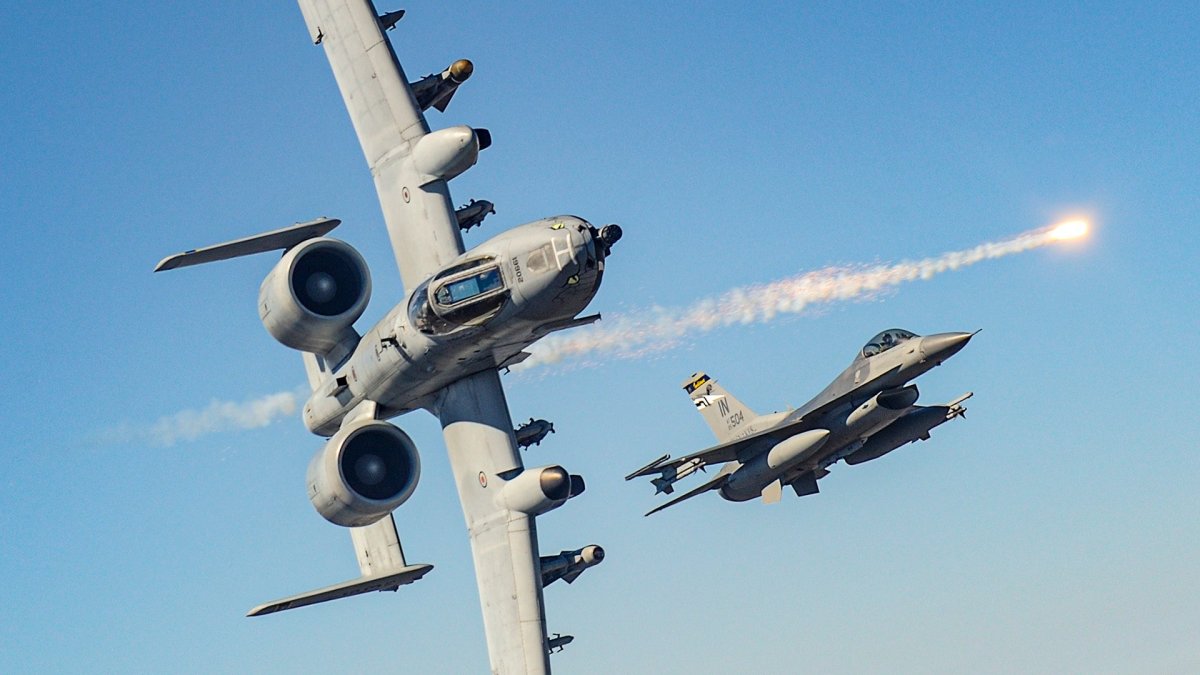
An F-16C flies alongside an A-10C Thunderbolt II., Jamie Hunter
The Weapons School used to conduct air-to-air gunnery detachments to Tyndall AFB, Florida, to live-fire AIM-9s as well as to shoot the Aerial Gunnery Target (AGT) with the Avenger cannon. “An F-15 would pull the AGT for us, but we had to be really careful not to hit that, because our rounds would just shred it. So we had to go for near misses, and use the acoustic scoring system that picked up the “cracks” as the rounds shot past.”
Discussing the BFM techniques he taught at the Weapons School, Yount says: “We started out with the offensive aircraft in a high perch behind the defensive aircraft, so it had every advantage. You move into the 6,000-9,000-feet range in a five to seven o’clock position, then it’s “ready, ready, fight’s on!” We then moved into some neutral setups where we would split, point at each other, and when we passed abeam each other, we called “fight’s on” at the merge.”
Chasing down an opponent, Yount says “you want to be just outside the flightpath and slightly high. If you think of them towing a cone-like a windsock behind, that’s where you want to be — just above that sock, and stay there. About 1,500-6,000-feet back works for any airplane, but staying there is tough. I can drag my lower wing through that wake turbulence, and that’s how I taught guys where they needed to be if they couldn’t visualize it — that’s the flight path.”
An A-10C assigned to the USAF Weapons School., Jamie Hunter
“As a defender, I used to call it my “cone head defense.” I’d take my arms and put them above my head to make a cone — that’s what you want to point at the opponent, because that’s the top of your lift vector. If they slide back, it’s harder to get the cone pointing at them — they’re building angles on you.”
The A-10 pilot has an audible stall warning system known as the “horn,” which advances in a “chopped tone” under sustained heavy G. These are staged warnings as a measure of the aircraft’s performance. “There are slats on the leading edge of the inner portion of the wing,” Yount explains. “If you get the chopped tone too long, you’ll stall that portion of the wing. I could trim the airplane to a speed and I didn’t need to jink all over the place, I just had to keep that cone on the other jet. I could just put my hands above my head and fly with my knees.”
“We also did some low-level escape and evasion. Most guys weren’t trained down to 100 feet — and chasing students down at that height is a lot of fun! Get below 80 feet with any kind of downward vector and “Bitching Betty” would ask you to pull up.”
“If you are down low, you have some advantages in the air-to-air fight with ground clutter or if the pilot of the other jet just didn’t want to follow you down there. But it’s better to maintain height, because it gives you more options.”
“What the A-10 doesn’t do very well is get its energy back quickly. We always said with regard to the [General Electric TF34] engines that we don’t need more speed, we need more power. The speeds we operate and drop at are plenty fast enough for what we are doing. For BFM, we are at a great speed and turn radius to point and shoot.”
Devoid of heavy external stores, this A-10C of the Weapons School returns to Nellis AFB., Jamie Hunter
Despite the many attempts to kill-off the A-10 , Yount is adamant that no other jet can do the job like the Warthog. “Until the USAF has a platform that can turn on a dime and bring all those weapons to bear at relatively close quarters, there’s no substitute for that.”
While the A-10 has a ferocious reputation for supporting troops on the ground, and for Combat Search And Rescue, wheeling above the battlefield and dishing out punishment where it’s needed, it also has a nasty bite if any enemy fighters want to give them a hard time.
Instructors like Colonel Yount made it their job to ensure that if the time came when an A-10 pilot was threatened by a marauding fighter, they knew exactly what to do, so they could defend themselves by either putting up a fight or running away bravely to fight another day.
Contact the editor: Tyler@thedrive.com
Comments couldn’t be loaded. Please refresh the page.
发布于 2021 年 1 月 26 日下午 1:20(美国东部时间)
虽然费尔柴尔德共和国A-10“雷电II”攻击机是近距离空中支援(CAS)之王——凭借其强大的火力支援地面部队——但许多人可能会惊讶地发现,它在空战中也毫不逊色。尽管“疣猪”并非为夺取制空权而优化,也缺乏一些关键能力,例如高速导弹、雷达制导导弹以及雷达制导远程导弹——而这些正是其战斗机同系产品成为空战霸主的关键所在——但即使是最优秀的战斗机飞行员,在与一架“不起眼”的A-10进行近距离缠斗时,也理所当然地会心存戒备。
A-10“疣猪”攻击机低速机动灵活,配合一些巧妙的战术,即使是最先进的战斗机也可能被经验丰富的“疣猪”飞行员狠狠打击。事实上,位于内华达州内利斯空军基地的美国空军武器学校在其每两年一次的A-10课程中,专门教授基础战斗机机动(BFM)技巧,以防飞行员在遭遇敌方战斗机的猛烈攻击时陷入困境。
丹尼·“鳄鱼”·尤恩特上校于2011年从美国空军退役,拥有令人瞩目的3852小时A-10飞行时间。他表示,在他职业生涯的众多亮点中,在武器学校担任A-10近距离空战教官是最令人难忘的经历之一。“空战飞行员有雷达,速度也比我们快得多,但他们很快就会明白,跟我们近距离缠斗是得不偿失的。”
第66武器中队的一架A-10C攻击机,其左翼外侧挂架上挂载了AN/ALQ-131电子对抗吊舱。(杰米·亨特摄)
“武器学校从作战A-10联队中挑选最优秀的飞行员。它每年开设两期为期六个月的课程,学员们先进行几周的理论学习,然后开始飞行训练,”尤恩特解释道。“基础飞行训练(BFM)过去是,现在仍然是课程的第一阶段。这就像插旗一样——无论学员自认为多么优秀,课程的难度都将是这样的。武器学校的飞行训练水平是学员们以前从未体验过的。”
尤恩特于1993年以学员身份参加了武器学校的培训。正如他所说,如今,内利斯空军基地第66武器中队的A-10课程仍然以近距离格斗训练(BFM)作为第一阶段。虽然该训练旨在教授飞行员如何应对空中威胁,但其重点在于如何最大限度地发挥“疣猪”战机的性能——将其性能发挥到极致——然后再逐步过渡到更传统的A-10对地攻击任务。在A-10武器学校的课程中,学员们将投放并使用“疣猪”战机强大武器库中的几乎所有武器。
尤恩特于1996年1月至1999年10月回到内利斯空军基地担任武器学校教官。“我主要负责近距离空战训练,”他解释说,“我们几乎把飞机上的挂架和三联装弹射挂架都拆掉了,只保留了两枚AIM-9响尾蛇导弹和我们的电子对抗吊舱。我们教授近距离空战的基本原理,主要内容是与另一架A-10进行一对一的近距离空战。近距离空战训练之后是空中机动训练阶段,我们会进行一些二对一和二对二的演练。我们以前会从霍洛曼空军基地(新墨西哥州)调来德国的F-4训练部队,或者与内利斯空军基地的假想敌F-16战斗机进行联合训练。”
A-10武器学校教官飞行员杰米·亨特
“即使学员技术很好,但如果他们不能传授这些技巧,对我们这些武器官来说也毫无用处。无论你是最好的投弹手还是最好的近距离火力指挥官,如果你不能回到你的中队去教别人,你就毫无价值。你必须能够把知识传播到各个中队。”
“近距离空战是我的天性之一,”尤恩特继续说道。“我一直都很擅长近距离空战,因为我最初是T-38‘鹰爪’教练机的飞行员。我的一些F-15战机飞行员朋友教了我一些基础知识。等我参加‘鹰爪’战斗机进阶训练的时候,我已经驾驶这架战机飞行了大约1200个小时。”
尤恩特表示,作战中的A-10中队通常不会在部队层面进行近距离空战(BFM)训练,因为他们通常有更多优先级更高的任务需要完成,例如近距离空中支援(CAS)和投弹。然而,也有一些战斗机中队会请求与A-10部队进行异型机空战训练(DACT),以深入了解如何应对这种棘手的对手。
一位F-16飞行员告诉《战区》杂志:“我们经常和A-10一起执行远程空中打击任务(DACT)。我们管这叫‘A-10扫荡’,而且很受欢迎!A-10会组成一个圆圈,互相掩护,摆出防御姿态。然后我们探出头去,尝试逐个击落它们。关键是要高速接近,开火,然后爬升到A-10没有力气抬起机头的高度。”
尤恩特说:“这些拳手通常会保持高位站位,试图用鼻子顶住我们的拳台,寻找机会击中目标,然后赶紧撤退——因为我们无法在高位追击他们,也无法追上他们。但如果他们愿意在我们的主场与我们进行转身缠斗,我们非常乐意整天都和他们打。”
“近距离空战(BFM)是A-10飞行员希望永远用不到的任务模式,因为理论上来说,这属于自卫。F-15或其他防空战斗机应该在我们上方盘旋,把所有这些东西都挡在外面。但如果你遇到‘漏网之鱼’(敌方战斗机突破了防空拦截区),你就需要训练如何在携带两枚AIM-9M“响尾蛇”导弹和电子对抗吊舱(AN/ALQ-131电子对抗吊舱)的情况下生存下来。如果你按下红色按钮卸下外挂武器,这些是唯一留在飞机上的装备。” 卸下外挂武器可以减轻额外的重量和阻力,使A-10更加灵活,并让飞行员有更大的机会躲避威胁。
A-10攻击机上的雷达告警接收器(RWR)会在飞机被敌方雷达跟踪时向飞行员发出警报。电子对抗吊舱可以提供干扰战斗机雷达的机会,但尤恩特表示,此时的主要战术是设法进入多普勒盲区(一种用于隐藏在战斗机雷达盲区的战术动作,详情请点击此处),改变高度,并尝试向接近的战斗机俯冲。“无论你是攻击者还是防御者,你都想先发制人。如果你不掌控战局,就会被对手牵着鼻子走。”
“其他机型的飞行员大多要跟我们交战几次后才能真正了解我们的优势。无论他们的转弯速率如何,转弯半径最小的飞机总能抢占先机。在转弯处,我们的转弯半径大约是1700英尺,即使我的能量几乎耗尽,转弯半径也只有2100英尺左右——这其实并不算大。所以,即使他们的转弯速率比我快,我的炮弹也能在他们转弯之前越过他们的机头。他们必须重视我的炮弹——这意味着他们必须躲避,而这反过来又会给我们创造机会。如果你让A-10参与这种近距离的转弯空战,我们绝对能取得非常好的战果。”
美国空军武器学校的一架A-10C攻击机正在投放诱饵弹。请注意其内侧前缘缝翼。——杰米·亨特
在这种情况下,A-10飞行员可用的两种进攻性武器分别是AIM-9“响尾蛇”红外制导导弹和威力强大的GAU-8/A“复仇者”30毫米七管加特林式机炮。GAU-8/A机炮传统上被认为是一种空对地扫射武器,但它在空对空射击方面也极具杀伤力。A-10并未配备新型的AIM-9X导弹,因此,尽管飞行员现在佩戴了泰雷兹“蝎子”头盔瞄准器,他们也无法使用偏离瞄准线较大的导弹攻击敌机。因此,在用“响尾蛇”导弹或机炮瞄准敌机时,转弯速率至关重要。
“如果他们和我们进行缠斗,就会消耗大量能量,”尤恩特解释说。“然后他们就想逃跑,打开加力燃烧室逃脱——但这只会让我的AIM-9锁定警报声更大!”
如果飞行员选择AIM-9导弹,A-10的武器系统将切换到空对空模式。如果飞行员想使用机炮,抬头显示器(HUD)上会显示一个“漏斗图”,让飞行员了解子弹的轨迹和与目标的距离。A-10没有雷达,因此有效运用这些符号既是一门科学,也是一门艺术。尤恩特说,选择AIM-9还是机炮很大程度上取决于对手的距离。“当然,训练时机炮里没有实弹——我们只发射电子弹——但你仍然可以在HUD上看到所有信息。”
“你无法模拟的是机炮开火的效果,”尤恩特兴奋地说。“那缕白烟通常会在飞机下方飘过,但当它翻滚到座舱盖上方时,就表明你正在猛烈拉杆,这会对对手产生实实在在的影响,让他们知道自己正被这门机炮攻击。这有助于你营造真正的威胁——让他们想要躲开机炮和响尾蛇导弹的攻击范围,这样他们就不得不撤退,然后你再重新投入战斗。”
“你要用这门枪进行一到两秒的短点射,大概能打出100发子弹。你不能猛踩油门。我曾经在空战场景中承受过载射击过这门枪,当你用力拉动机枪时,烟雾会向上飘过座舱盖——你什么都看不见!”
A-10攻击机30毫米机炮的燃气泄漏。(美国空军高级空军士兵梅赛德斯·威尔兹摄)
当战斗机中队计划与A-10进行近距离空战时,他们会抱着A-10明显处于劣势的心态。因此,对战斗机的使用会有一些合理的限制,例如他们可以使用的空对空武器装备。
一位F-15C飞行员在接受《战区》采访时回忆起最近一次与A-10交战的DACT分遣队:“低速操控和极小的转弯半径让我们大多数人在第一场战斗中都措手不及。很多战斗都以平局告终——当然,除了我们用AIM-9X导弹配合联合头盔瞄准系统(JHMCS)进行射击的时候。一些A-10向我们开火——主要是用机炮,因为我们不习惯瞄准A-10,所以射程判断非常不同,而且他们的机炮射程比大多数战斗机的机炮远得多。然而,他们的测距并不精确,所以只要他们能瞄准你,就会喊“开火”,不管子弹能不能打中。我看到的所有射击至少都大致命中,但他们的射击距离比其他任何飞机都远得多——所以大家都没有预料到。瞄准那么远的距离真的很难,所以我不确定如果……那是真的。
一架F-16C战斗机与一架A-10C“雷电II”攻击机并排飞行。——杰米·亨特
武器学校过去常常派遣空对空射击分队前往佛罗里达州廷德尔空军基地,进行AIM-9导弹实弹射击以及使用复仇者战斗机机炮射击空中射击目标(AGT)。“一架F-15战斗机将为我们拉起AGT,但我们必须非常小心,不能击中目标,因为我们的炮弹会将其彻底摧毁。所以我们只能尽量打偏,并利用声学计分系统来捕捉炮弹掠过时发出的‘噼啪声’。”
尤恩特在谈到他在武器学校教授的近距离空战技巧时说:“我们一开始让进攻型飞机占据防御型飞机后方的高空,这样它就拥有了所有优势。然后我们进入6000到9000英尺的高度,处于五点到七点钟方向,接着就喊‘准备,准备,开战!’。之后我们进入一些中立阵型,彼此分开,互相瞄准,当两机并排飞行时,我们就喊‘开战!’。”
尤恩特说,追击对手时,“你要保持在他们飞行路径之外,略高一些。你可以想象他们身后拖着一个锥形的风向标,那就是你要待的位置——就在风向标上方,并且保持在那里。任何飞机都可以保持在1500到6000英尺的高度,但要一直保持在那里很难。我可以拖着下翼穿过尾流湍流,我就是这样教那些无法想象飞行路径的人的——那就是他们应该待在哪里。”
一架隶属于美国空军武器学校的A-10C攻击机。——杰米·亨特
“作为一名防守队员,我以前称之为‘锥形头防守’。我会把双臂举过头顶,形成一个锥形——这就是你要指向对手的方向,因为那是你上升力矢量的顶点。如果他们后撤,就很难让锥形头指向他们——他们会利用角度来防守你。”
A-10飞行员配备了一种名为“喇叭”的失速警告系统,在持续高G力作用下会发出“断续音”。这些断续的警告是用来衡量飞机性能的。“机翼内侧前缘有缝翼,”尤恩特解释说,“如果断续音持续时间过长,机翼的这一部分就会失速。我可以把飞机调整到某个速度,而不需要到处乱窜,我只需要保持与另一架飞机保持直线飞行即可。我甚至可以把手举过头顶,用膝盖控制方向飞行。”
“我们也进行了一些低空逃脱和躲避训练。大多数人都没有接受过100英尺以下的飞行训练——在那个高度追着学生跑可真有意思!只要你低于80英尺,哪怕是任何向下的飞行方向,“爱抱怨的贝蒂”都会让你拉升。”
“如果你飞得很低,在空战中,由于地面杂波的影响,或者对方飞行员不想跟你飞那么低,你会有一些优势。但最好还是保持高度,因为这样你有更多选择。”
“A-10 的一个缺点是能量恢复速度不够快。我们一直强调,对于通用电气 TF34 发动机,我们需要的不是更高的速度,而是更大的动力。我们目前的飞行速度和下降速度已经足够满足我们的需求了。对于近距离空战来说,我们拥有极佳的速度和转弯半径,可以进行快速瞄准射击。”
这架隶属于武器学校的A-10C攻击机没有携带重型外挂物,返回内利斯空军基地。——杰米·亨特
尽管多次有人试图淘汰A-10,但尤恩特坚信没有任何其他战机能像“疣猪”那样胜任这项任务。“除非美国空军拥有一种能够原地转向并在相对近距离内使用所有武器的平台,否则A-10是无可替代的。”
A-10 攻击机以其在地面部队支援、战斗搜救、在战场上空盘旋并向需要的地方施以打击而享有盛誉,但如果任何敌方战斗机想要给它制造麻烦,它也会毫不留情地反击。
像尤恩特上校这样的教官的职责是确保,如果A-10飞行员受到来袭战斗机的威胁,他们确切地知道该怎么做,以便他们能够通过奋起反抗或勇敢地逃跑来保护自己,以便日后卷土重来。
联系编辑:Tyler@thedrive.com
评论加载失败,请刷新页面。