In rain and mud, French artillery unit shows lessons from Ukraine war在雨水和泥泞中,法国炮兵部队展现了从乌克兰战争中汲取的教训。
The demonstration showed how France’s 35th Parachute Artillery Regiment is trying to adapt to a drone-dominated battlefield.
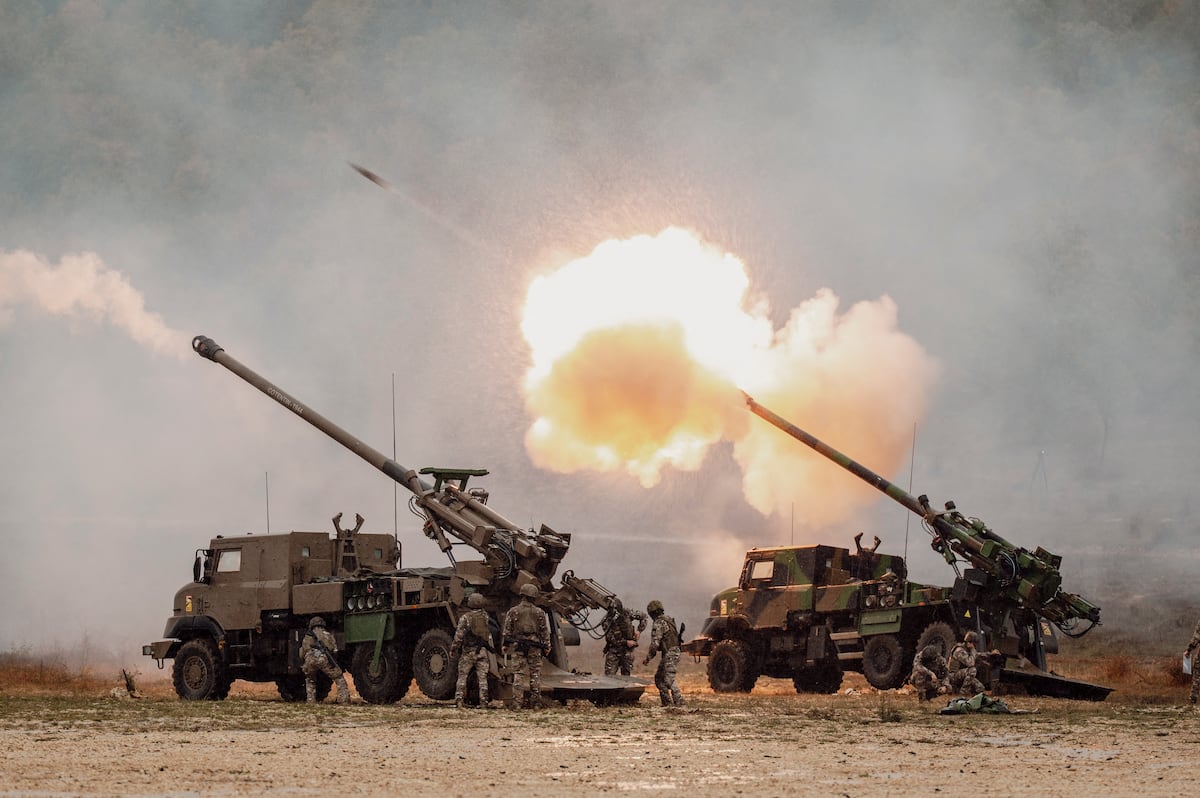
CANJUERS, France — A French Army artillery demonstration in pouring rain in the south-east of the country last week showed the limits of modern warfare: When the weather gets miserable, cannons may still fire, but drones stay grounded.
It’s a lesson already learned in Ukraine, where Russian forces have been timing mechanized assaults with rain and foggy conditions , according to the Institute for the Study of War.
The French Army hadn’t banked on a downpour for last week’s demonstration of unmanned air systems and artillery at Camp de Canjuers, with arms manufacturer KNDS and several foreign military delegations present, after a mostly sunny October at Europe’s largest permanently garrisoned military camp.
The bad weather grounded helicopters, drones and prevented airdrops of equipment and parachutists, while forcing civilian traffic unable to land at nearby Nice airport into a holding pattern over Canjuers that made even artillery fire uncertain.
The demonstration still showed how France’s 35th Parachute Artillery Regiment is trying to adapt to a drone-dominated battlefield, with truck-mounted 20mm cannons, nets, decoys and handheld jammers to protect its howitzer and mortar teams.
For all the attention to drones, feedback from Ukraine shows artillery remains more important than ever, said Lt. Col. Renaud Durbecq, operations and training chief of the regiment, known by its French acronym 35e RAP. The regiment operates the Caesar 155mm howitzer, produced by KNDS, as its main artillery gun.
“Artillery is becoming increasingly important on the battlefield, since our guns are precisely the weapon that allows us to fire at the furthest range – there where, most often, drones cannot go,” Durbecq told reporters at the Canjuers range.
Nevertheless, “dronization” of the 35e RAP is happening at breakneck pace, with five times as many drones in the regiment as a year ago, triple the number of drone pilots and with flight hours doubling, according to the operations and training commander.
The regiment operates the Delair DT46 drone with a range of around 80 kilometers for intelligence gathering and target acquisition, squad-level drones for close-in defense and local reconnaissance, and first-person-view or FPV drones for reconnaissance and strike operations.
One major change for artillery is “acceleration of the intelligence loop,” with DT46 drones directly plugged into fire-control communications, allowing immediate fire upon target detection by the drone, Durbecq said. He said plans are to double regimental DT46 capacity in the coming year, while declining to give drone numbers.
Another change is the arrival of six experimental Proteus anti-drone cannons in the regiment, filling a counter-UAS capacity gap.
The 35e RAP tested Proteus several days before the demonstration, using the 20mm cannon to down two drones immobilized by the Nerod handheld jammer developed by French tech firm MC2 Technologies, as well as to destroy a moving FPV drone.
The regiment is the first French unit to operate the system, cobbled together in four months using a 1970s era 20mm anti-air cannon on a 1980s four-wheel truck , coupled with a thermal camera and fire-control computer.
The army is working on an updated version equipped with artificial intelligence for improved detection, mounted on a more modern Scania truck.
Ukraine’s evolving drone and artillery war has seen other tactical innovations that could be adopted by the French Army, according to Olivier Fort, a former artillery colonel now at KNDS and in charge of selling the Caesar cannon.
He described new tactics that include prepositioning artillery rounds and propellant charges at firing locations rather than carrying ordnance on board the truck-mounted Caesar, avoiding the risk of a secondary explosion in case of drone attack.
“These are things that had not been considered previously, but now the omnipresence of drones is forcing them to do this,” Fort said on the sidelines of the demonstration at Canjuers.
Fort said around 75% of artillery pieces in Ukraine are destroyed by remotely operated munitions such as Russia’s Lancet drone.
Armored tracked howitzers with automated loading systems carry their charge onboard, making them vulnerable to secondary explosions, according to Fort. The Caesar and Ukraine’s domestically developed Bohdana are loaded externally.
“In reality, what will destroy any artillery piece is not the three kilograms of explosives in the Lancet,” Fort said. “If you move without ammunition on board, the three kilos will seriously damage the Caesar, or all the other cannons too, but there won’t be a secondary explosion.”
KNDS says the attrition rate of the 120 Caesar guns operating in Ukraine is 15%, whereas Fort cited a loss rate of more than 50% for some tracked armored guns.
“This is not what we imagined before the war in Ukraine,” Fort said. “People often thought that tracked armored vehicles were necessary, but the destruction rate of tracked armored vehicles in Ukraine is very, very high.”
Another developing tactic is to use artillery to destroy anti-drone nets and wiring that protect trenches and roads to clear the way for loitering munitions, according to Fort.
Both sides increasingly place their artillery guns in dug-in protected positions, as immediate mobility to avoid counterfire has become less important in the war, the KNDS executive said.
Fort argued being mobile remains important for resupply of ammunition and fuel, which he said can be done in minutes on the Caesar, and may take half an hour on some of the tracked armored howitzers.
And with Russian troops now sometimes attacking a single vehicle with ten or twenty drones, anti-drone wire may not be enough. Camouflage, decoys, plenty of anti-drone systems as well as mobility are all important, according to Fort, who pointed to the parachute regiment’s demonstration of those elements in Canjuers.
The war in Ukraine has made clear the need for greater combat mass, and the 35th Parachute Artillery Regiment is bringing reserves into operational readiness, including reservists being trained for artillery expertise, Lt. Col. Durbecq said.
Within the larger 11th Parachute Brigade, the need for mass and firepower meant recreating mortar support teams in infantry regiments, with the 2nd Foreign Parachute Regiment deploying its newly created mortar section at Canjuers for training and certification by the artillery regiment.
The regiment is also turning up the dial on operational preparation for longer engagements, with a six-week training deployment at Canjuers.
As for the Caesar, Durbecq said he’s “very satisfied” with the gun in the current iteration, with its combination of mobility, range and firepower, after taking into account the feedback from Ukraine.
“Each system has its advantages and disadvantages,” Durbecq said, following several salvos in the rain and mud of Canjuers. “But as a user of the regiment, today I believe that I need a system that is reliable, and that must be its greatest quality.”
Rudy Ruitenberg is a Europe correspondent for Defense News. He started his career at Bloomberg News and has experience reporting on technology, commodity markets and politics.
法国坎茹尔——上周,法国陆军在该国东南部冒着倾盆大雨进行了一次炮兵演习,这展现了现代战争的局限性:天气恶劣时,大炮或许还能开火,但无人机却只能停飞。
据战争研究所称,乌克兰已经吸取了这一教训,俄罗斯军队一直在利用雨雾天气发动机械化进攻。
法国陆军没有料到,在坎茹尔营地举行的无人机系统和火炮演示活动中会遭遇暴雨。武器制造商 KNDS 和几个外国军事代表团出席了此次演示。此前,欧洲最大的常驻军营坎茹尔营地在 10 月份大部分时间都是阳光明媚。
恶劣天气导致直升机和无人机停飞,无法进行空投设备和跳伞员,同时迫使无法在附近尼斯机场降落的民用飞机在坎茹尔斯上空盘旋,甚至连炮火射击都变得不确定。
此次演示仍然展现了法国第35伞兵炮兵团如何努力适应无人机主导的战场,他们使用卡车搭载的20毫米火炮、网、诱饵和手持干扰器来保护其榴弹炮和迫击炮小组。
尽管无人机备受关注,但来自乌克兰的反馈表明,火炮的重要性依然比以往任何时候都更加突出,第35炮兵团(法语缩写为35e RAP)作战训练主管雷诺·杜尔贝克中校说道。该团的主力火炮是KNDS公司生产的凯撒155毫米榴弹炮。
“火炮在战场上变得越来越重要,因为我们的火炮正是能够让我们在最远距离进行射击的武器——而无人机通常无法到达那里,”杜尔贝克在坎茹尔斯靶场告诉记者。
尽管如此,据作战和训练指挥官称,第 35 皇家突击队团的“无人机化”正在以惊人的速度进行,该团的无人机数量是去年的五倍,无人机飞行员数量是去年的三倍,飞行时间也翻了一番。
该团使用射程约 80 公里的 Delair DT46 无人机进行情报收集和目标获取,使用班组级无人机进行近距离防御和局部侦察,并使用第一人称视角 (FPV) 无人机进行侦察和打击行动。
杜尔贝克表示,炮兵的一项重大变革是“加速情报循环”,DT46无人机直接接入火控通信系统,一旦无人机发现目标,即可立即开火。他还表示,计划在未来一年内将团级DT46无人机的数量增加一倍,但拒绝透露具体数量。
另一个变化是该团引进了六门实验性的“普罗透斯”反无人机炮,填补了反无人机系统能力的空白。
35e RAP 在演示前几天测试了 Proteus,使用 20 毫米炮击落了两架被法国科技公司 MC2 Technologies 开发的 Nerod 手持干扰器瘫痪的无人机,并摧毁了一架移动中的 FPV 无人机。
该团是第一个操作该系统的法国部队,该系统是在四个月内拼凑而成的,它使用了一门 20 世纪 70 年代的 20 毫米防空炮,安装在一辆 20 世纪 80 年代的四轮卡车上,并配以热成像仪和火控计算机。
军方正在研发一款升级版卡车,该卡车配备了人工智能技术,以提高探测能力,并安装在更现代化的斯堪尼亚卡车上。
据前炮兵上校、现任 KNDS 公司负责人、负责销售凯撒大炮的奥利维尔·福特 (Olivier Fort) 称,乌克兰不断演变的无人机和火炮战争中出现了一些其他战术创新,法国军队可以借鉴这些创新。
他描述了新的战术,包括将炮弹和推进剂装药预先部署在射击地点,而不是将弹药装载在卡车上的凯撒火箭炮上,从而避免在无人机攻击的情况下发生二次爆炸的风险。
“这些都是以前没有考虑过的事情,但现在无人机的无处不在迫使他们这样做,”福特在坎胡尔斯的示威活动间隙说道。
福特表示,乌克兰境内约 75% 的火炮被俄罗斯“柳叶刀”无人机等遥控弹药摧毁。
据《堡垒》杂志报道,配备自动装填系统的履带式装甲榴弹炮将弹药装填在炮身内部,因此容易受到二次爆炸的影响。“凯撒”榴弹炮和乌克兰国产的“博赫达纳”榴弹炮则采用外部装填。
“实际上,真正能摧毁任何火炮的并非‘柳叶刀’号上的那三公斤炸药,”福特说道。“如果船上没有弹药,这三公斤炸药会严重损坏‘凯撒’号,或者其他所有火炮,但不会发生二次爆炸。”
KNDS 表示,在乌克兰服役的 120 门凯撒火炮的损耗率为 15%,而 Fort 则指出,某些履带式装甲火炮的损失率超过 50%。
“这和我们在乌克兰战争爆发前想象的完全不同,”福特说。“人们过去常常认为履带式装甲车是必要的,但乌克兰履带式装甲车的损毁率非常非常高。”
据 Fort 称,另一种正在发展的战术是使用火炮摧毁保护战壕和道路的反无人机网和电线,为巡飞弹开辟道路。
KNDS 执行官表示,双方越来越多地将火炮部署在掩体中,因为在战争中,立即机动以避免反击的重要性已经降低。
福特认为机动性对于弹药和燃料的补给仍然很重要,他说凯撒坦克可以在几分钟内完成补给,而一些履带式装甲榴弹炮可能需要半个小时才能完成补给。
鉴于俄军现在有时会动用十到二十架无人机攻击一辆车辆,反无人机防线可能不足以应对。福特指出,伪装、诱饵、充足的反无人机系统以及机动性都至关重要,并以伞兵团在坎茹尔斯的演练为例说明了这些要素。
乌克兰战争已经清楚地表明需要更大的作战规模,第35伞兵炮兵团正在将预备役人员调入作战准备状态,包括对预备役人员进行炮兵专业训练,杜尔贝克中校说。
在规模更大的第 11 伞兵旅中,对兵力和火力的需求意味着需要在步兵团中重建迫击炮支援小组,第 2 外国伞兵团将其新组建的迫击炮分队部署在坎茹尔斯,接受炮兵团的训练和认证。
该团也在加大力度进行更长时间的作战准备,将在坎茹尔斯进行为期六周的训练部署。
至于凯撒步枪,杜尔贝克表示,在考虑到乌克兰方面的反馈后,他对目前版本的凯撒步枪的机动性、射程和火力组合“非常满意”。
“每个系统都有其优点和缺点,”杜尔贝克在坎茹尔的雨水和泥泞中进行了几次射击后说道,“但作为该团的一名用户,我认为我今天需要的是一个可靠的系统,这必须是它最重要的品质。”
鲁迪·鲁伊滕贝格是《防务新闻》的欧洲记者。他的职业生涯始于彭博新闻社,拥有报道科技、大宗商品市场和政治方面的经验。