UK Government Commits To Boom Refueling For RAF Tankers英国政府承诺大力发展皇家空军加油机的加油业务
The next-generation Tempest fighter is driving the Royal Air Force to add a capability it currently lacks. The next-generation Tempest fighter is driving the Royal Air Force to add a capability it currently lacks.
新闻视频
Published Sep 3, 2026 12:32 PM EDT
The United Kingdom is moving toward adding a flying-boom aerial refueling capability to the Royal Air Force (RAF), a requirement being driven in large part by the future Tempest combat jet, being developed under the Global Combat Air Program (GCAP) initiative.
In a written response to opposition MP Ben Obese-Jecty, U.K. Defense Minister Luke Pollard confirmed that the RAF’s existing probe-and-drogue aerial refueling capability will eventually be complemented by a boom system. The move would give Britain a sovereign capability to refuel aircraft equipped with the U.S.-standard boom receptacle, including the Tempest, while also improving interoperability with other NATO and allied air forces.
A Royal Air Force Typhoon FGR4 accompanies a Voyager tanker during a Quick Reaction Alert training scenario in March 2026. Crown Copyright Crown Copyright
“The Royal Air Force currently operates a probe and drogue air-to-air refueling system and will complement this with the development of a boom system,” Pollard said. “This will ensure we have a sovereign air-to-air refueling capability for the future Royal Air Force fleet that enhances interoperability with NATO allies and partners.”
For the first time we have a Minister confirming the Boom is coming to Royal Air Force tankers, although the when and the how currently remain very much up in the air. Still significant to have it through government voices and not just through the RAF itself. pic.twitter.com/esRN7NVoPy — Gabriele Molinelli (@Gabriel64869839) September 2, 2026
For the first time we have a Minister confirming the Boom is coming to Royal Air Force tankers, although the when and the how currently remain very much up in the air. Still significant to have it through government voices and not just through the RAF itself. pic.twitter.com/esRN7NVoPy
The decision follows comments by a senior RAF official in July indicating that the service was already examining how to meet the requirement.
“We currently do not have boom [-equipped tankers] in the UK. We have a requirement for a boom from GCAP, so we have to resolve that requirement and that is what we are now looking at,” the official said at the Air Power Association Global Air and Space Chiefs’ Conference in London, according to Janes . “I [am] certain that at some point we are going to have to work out how we deliver a sovereign boom capability for our own combat aircraft.”
The requirement is particularly significant because GCAP’s Tempest is being designed with a fuselage-mounted receptacle for boom refueling. Unlike the probe-and-drogue arrangement used by the RAF’s existing Voyager tankers, a flying boom uses a rigid, telescoping refueling tube that is maneuvered by an operator aboard the tanker into the receiver aircraft’s receptacle.
A Royal Air Force Voyager tanker performs aerial refueling of a Spanish Navy EAV-8B Harrier II during combined long-range strike training. U.S. Navy courtesy photo
One of the major advantages of the boom system is its higher fuel-transfer rate. That makes it especially useful for large aircraft and combat aircraft that need to take on substantial quantities of fuel quickly, reducing the time spent on the tanker.
Tempest is not, however, the only RAF aircraft that depends on the boom standard. The RAF already operates several boom-equipped receiver aircraft, including P-8A Poseidon maritime patrol aircraft, RC-135W Rivet Joint intelligence, surveillance, and reconnaissance aircraft, and C-17A Globemaster III airlifters. The E-7A Wedgetail airborne early warning aircraft also uses a boom receptacle, while the forthcoming RAF F-35A fleet will add another major boom receiver to the service.
The first Wedgetail aircraft, destined to serve with the RAF, at RAF Lossiemouth, Scotland, in May 2026. Crown Copyright
Currently, the RAF has no boom-equipped tanker to support them.
Its principal tanker fleet consists of Airbus A330 Multi-Role Tanker Transport (MRTT) Voyager aircraft operated by the AirTanker consortium and leased to the RAF under a private finance initiative. Unlike many A330 MRTT operators around the world, which acquired the aircraft with a flying boom, the British Voyagers were configured exclusively around hose-and-drogue refueling.
The Voyager K2 is equipped with two wing-mounted Cobham 905E hose-and-drogue refueling units. The K3 adds a third refueling point in the form of a Cobham 805E fuselage refueling unit, or FRU, located at the rear of the aircraft. The latter provides a higher fuel-transfer rate than the wing-mounted units.
The view from the cockpit of an A400M during air-to-air refueling with a Voyager KC3, via the fuselage refueling unit. Crown Copyright
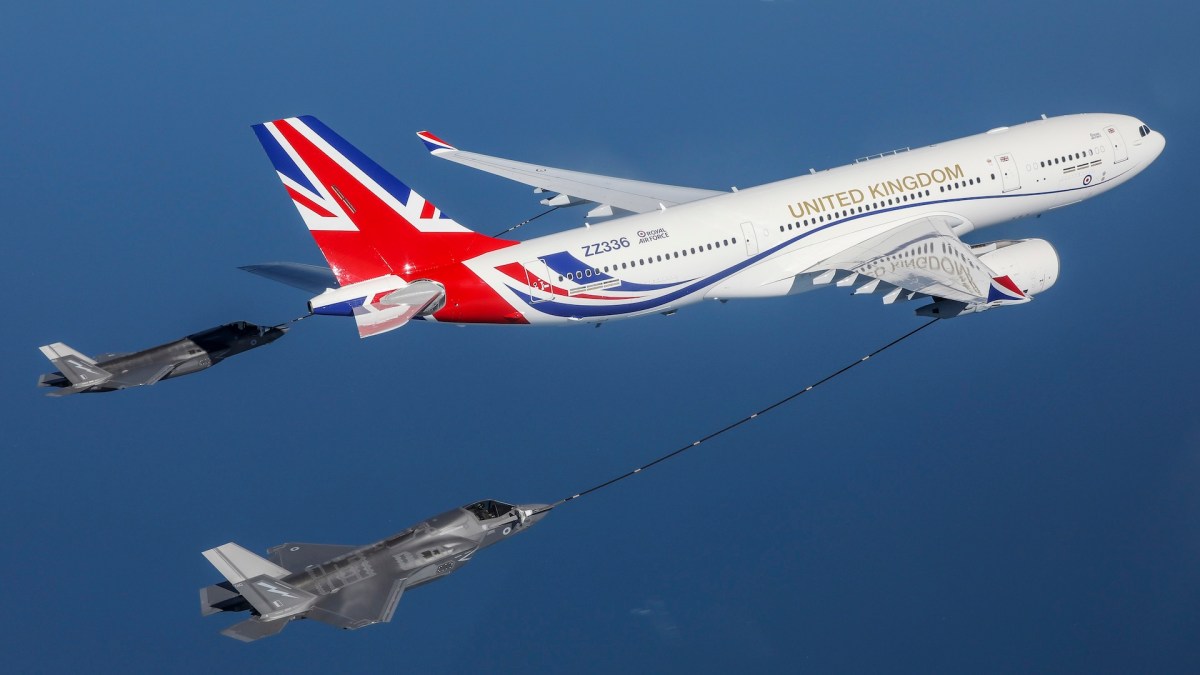
Since the fuel is stored in existing tanks, the Voyager’s cabin is still available to accommodate up to 291 passengers and the cargo hold for freight. One Voyager, serial ZZ336, nicknamed Vespina , is modified for long-range VIP transport but still functions as a fully capable tanker.
A video showing Voyager ZZ336 refueling RAF and German Eurofighter Typhoons during the enhanced Air Policing mission in Romania:
Up to 14 Voyagers are available to the RAF under the current arrangement.
The future of those aircraft is now one of the key questions surrounding Britain’s planned boom capability.
One possibility would be to modify some of the existing Voyagers, installing a boom system in the rear fuselage. The baseline Airbus’ A330 MRTT design already incorporates provision for a flying boom. At the time the United Kingdom ordered its Voyagers, boom refueling was not considered essential, so the capability was deleted to save weight, complexity, and cost — a decision which was to prove very shortsighted.
Such a conversion, however, would involve engineering, certification, ownership, and contractual considerations, particularly given that the RAF does not directly own the Voyager fleet.
Britain could also decide that modifying the existing aircraft is not worthwhile. The current Voyager private-finance arrangement runs until 2035, by which point the airframes will be considerably older. Rather than investing heavily in aircraft approaching the end of their contracted service period, the government could opt to acquire new A330 MRTTs or another tanker type equipped with a boom from the outset.
With refueling boom extended, a Republic of Singapore Air Force A330 MRTT leads a formation flight alongside a U.S. Air Force F-16C assigned to the 36th Fighter Squadron, Osan Air Base, Republic of Korea, two RSAF F-15SGs, and a Royal Thai Air Force F-16 during Exercise Cope Tiger 23. U.S. Air Force courtesy photo
Another, more remote possibility could involve a podded boom arrangement , a concept that has been around for a while now , but which is gaining traction with the U.S. Air Force as it weighs options for future tanker capabilities .
It remains unclear, however, whether a podded boom would offer the performance and integration characteristics required for Tempest and the RAF’s wider fleet. There is also a question about what platform it could be installed on.
A rendering of the Tempest future combat jet. BAE Systems BAE Systems
At the same time, TWZ has previously highlighted how drones equipped with buddy stores could operate in a hub-and-spoke model, ferrying fuel from tankers positioned outside the threat envelope to aircraft operating at the tactical edge. This could be another option that might gain traction as the U.K. Ministry of Defense increasingly looks to unlock the potential of uncrewed capabilities , but must also be considered less likely, especially as a primary solution.
There is also a potential requirement for the tankers themselves to be capable of receiving fuel. Equipping a tanker with a receiver system would allow tanker-to-tanker refueling, extending the flexibility and reach of the RAF’s future air-to-air refueling force during long-range operations. Other A330 MRTT operators already benefit from this feature.
A Republic of Singapore Air Force Airbus A330 MRTT refuels a Royal Australian Air Force KC-30A MRTT during combined training at RAAF Base Darwin in Australia. Australian Department of Defense Republic of Singapore Air Force
While Tempest is providing the immediate catalyst, a refueling boom capability would also close an increasingly conspicuous gap in the RAF’s tanker force. The service is acquiring and operating an increasing number of aircraft built around the boom standard while relying on a tanker fleet configured around the alternative hose-and-drogue system.
Whether Britain modifies its existing Voyagers, replaces them, or adopts another solution entirely could become an important part of the RAF’s long-term force structure as the Tempest program advances.
Contact the author: thomas@thewarzone.com
Comments couldn’t be loaded. Please refresh the page.
发布于美国东部时间2026年9月3日下午12:32
英国正朝着为皇家空军 (RAF) 添加空中加油能力的方向发展,这一需求很大程度上是由未来“暴风雨”战斗机推动的,该战斗机正在全球作战空中计划 (GCAP) 下开发。
英国国防大臣卢克·波拉德在回复反对党议员本·奥贝斯-杰克蒂的书面质询中确认,英国皇家空军现有的探管式空中加油能力最终将与硬管式空中加油系统相辅相成。此举将使英国拥有自主为配备美制硬管式加油接口的飞机(包括“暴风”战斗机)进行空中加油的能力,同时也将提升与其他北约及盟国空军的互操作性。
2026年3月,一架英国皇家空军台风FGR4战斗机伴随一架“旅行者”加油机进行快速反应警戒训练。版权所有 © 英国皇家空军
波拉德表示:“英国皇家空军目前使用探管式空中加油系统,并将在此基础上开发硬管式空中加油系统。这将确保我们未来英国皇家空军机队拥有自主的空中加油能力,从而增强与北约盟国和伙伴国的互操作性。”
一位部长首次确认皇家空军加油机将配备Boom系统,但具体时间和方式目前仍未确定。这仍然意义重大,因为这是政府而非皇家空军单方面宣布的。 pic.twitter.com/esRN7NVoPy — Gabriele Molinelli (@Gabriel64869839) September 2, 2026
一位部长首次确认皇家空军加油机将配备Boom系统,但具体时间和方式目前仍未确定。这仍然意义重大,因为这一消息是由政府而非皇家空军自身发布的。pic.twitter.com/esRN7NVoPy
此前,英国皇家空军一位高级官员在7月份曾表示,该军种已经在研究如何满足这一要求。
据《简氏防务周刊》报道,一位官员在伦敦举行的空军力量协会全球航空航天首脑会议上表示:“目前英国没有配备吊杆式加油机的飞机。全球空中交通管制行动(GCAP)提出了吊杆式加油机的需求,所以我们必须解决这个问题,这也是我们目前正在研究的重点。” 他还表示:“我确信,在某个时候,我们必须找到为自己的作战飞机提供自主吊杆式加油能力的方法。”
这项要求尤为重要,因为GCAP的“暴风”战斗机设计采用机身安装的伸缩式空中加油接口。与英国皇家空军现役“旅行者”加油机使用的探管式加油方式不同,伸缩式空中加油采用刚性伸缩式加油管,由机上操作员操控插入受油机的加油接口。
在联合远程打击训练中,一架英国皇家空军的“旅行者”加油机正在为一架西班牙海军的EAV-8B“鹞”II战斗机进行空中加油。(美国海军供图)
吊杆式加油系统的主要优势之一是其更高的燃油输送速率。这使得它对于需要快速补充大量燃油的大型飞机和战斗机来说尤为有用,从而减少了飞机在加油机上停留的时间。
然而,“暴风”战斗机并非唯一依赖伸缩式接收机的英国皇家空军飞机。英国皇家空军目前已装备多款配备伸缩式接收机的飞机,包括P-8A“海神”海上巡逻机、RC-135W“铆钉”联合侦察机和C-17A“环球霸王III”运输机。E-7A“楔尾”预警机也采用伸缩式接收机,而即将服役的英国皇家空军F-35A机队将为该部队增添另一款重要的伸缩式接收机。
2026年5月,首架楔尾式战斗机(Wedgetail)在苏格兰洛西茅斯皇家空军基地下水,该机将服役于英国皇家空军。版权所有
目前,英国皇家空军没有配备吊杆式加油机来支援他们。
其主要加油机队由空客A330多用途加油运输机(MRTT)“旅行者”型飞机组成,这些飞机由空中加油机联盟运营,并通过私人融资计划租赁给英国皇家空军。与世界各地许多A330 MRTT运营商不同,这些运营商购买的飞机都配备了伸缩式加油管,而英国的“旅行者”型飞机则完全采用软管式加油方式。
Voyager K2 配备两套翼下安装的 Cobham 905E 软管式加油装置。K3 则增加了第三个加油点,即位于飞机尾部的 Cobham 805E 机身加油装置(FRU)。后者比翼下安装的加油装置提供更高的燃油输送速率。
这是从A400M运输机的驾驶舱内拍摄的画面,当时一架KC3“旅行者”加油机正在通过机身加油装置进行空中加油。版权所有。
由于燃料储存在现有油箱中,Voyager号的客舱仍然可以容纳多达291名乘客,货舱则可以装载货物。其中一架Voyager号,序列号为ZZ336,绰号为“Vespina”,经过改装用于远程VIP运输,但仍然具备完整的油轮运输能力。
一段视频显示,在罗马尼亚执行加强型空中警戒任务期间,Voyager ZZ336 为英国皇家空军和德国的欧洲台风战斗机进行空中加油:
根据目前的安排,英国皇家空军最多可使用 14 架 Voyager 飞机。
这些飞机的未来如今已成为英国计划中的空中加油能力的关键问题之一。
一种可能的方案是对部分现有的“旅行者”飞机进行改装,在后机身安装吊杆式加油系统。空客A330 MRTT的基本设计已经预留了吊杆式加油装置。英国订购“旅行者”飞机时,吊杆式加油功能并未被视为必要,因此为了减轻重量、简化结构和降低成本,取消了这项功能——事实证明,这是一个非常短视的决定。
然而,这样的改造将涉及工程、认证、所有权和合同方面的考虑,特别是考虑到英国皇家空军并不直接拥有 Voyager 机队。
英国也可能认为改装现有飞机并不划算。目前的“旅行者”私人融资计划将于2035年到期,届时这些飞机的机体将相当老旧。与其在即将到期的飞机上投入巨资,政府或许可以选择直接采购全新的A330 MRTT或其他配备伸缩臂的加油机。
在“应对猛虎23”联合军演中,一架新加坡空军A330 MRTT飞机伸出加油管,与一架隶属于韩国乌山空军基地第36战斗机中队的美国空军F-16C战斗机、两架新加坡空军F-15SG战斗机以及一架泰国皇家空军F-16战斗机组成编队飞行。(美国空军供图)
另一种可能性较小,可能涉及吊舱式加油装置,这个概念已经存在一段时间了,但随着美国空军权衡未来加油机能力的各种选择,它正逐渐受到重视。
然而,目前尚不清楚吊舱式吊臂能否满足“暴风雨”战斗机以及英国皇家空军其他机型所需的性能和集成特性。此外,它究竟可以安装在哪个平台上也是个问题。
“暴风雨”未来战斗机的效果图。英国航空航天系统公司(BAE Systems)
与此同时,TWZ此前曾强调,配备伙伴燃料箱的无人机可以采用枢纽辐射式模式运行,将燃料从位于威胁范围之外的油轮运送到战术前沿作战的飞机。随着英国国防部日益重视释放无人作战能力的潜力,这或许会成为另一种可行的选择,但作为主要解决方案的可能性仍然较低。
此外,加油机本身也可能需要具备接收燃料的能力。为加油机配备接收系统将实现加油机之间的空中加油,从而增强英国皇家空军未来空中加油力量在远程作战中的灵活性和作战范围。其他A330 MRTT运营商已经受益于这项功能。
在澳大利亚达尔文皇家空军基地进行的联合训练中,一架新加坡空军的空客A330 MRTT加油机正在为一架澳大利亚皇家空军的KC-30A MRTT加油机进行空中加油。澳大利亚国防部 新加坡空军
尽管“暴风雨”战斗机的出现带来了直接的推动作用,但加油吊杆能力也将弥补英国皇家空军加油机部队日益明显的短板。目前,英国皇家空军正在采购和运营越来越多的采用吊杆标准的飞机,而其加油机队却仍然依赖于采用软管和锥套系统的加油机。
随着“暴风雨”战斗机计划的推进,英国是会改造现有的“旅行者”战斗机、更换现有“旅行者”战斗机,还是会完全采用其他解决方案,都可能成为英国皇家空军长期部队结构的重要组成部分。
联系作者:thomas@thewarzone.com
评论加载失败,请刷新页面。