The Shadowy World Of Submarine And Ship-Launched Torpedo Countermeasures潜艇和舰载鱼雷对抗措施的神秘世界
Surviving below the waves relies primarily on stealth, but if detected, countermeasures may be your only shot of keeping out of a watery grave.
新闻视频
Updated May 15, 2020 1:02 PM EDT
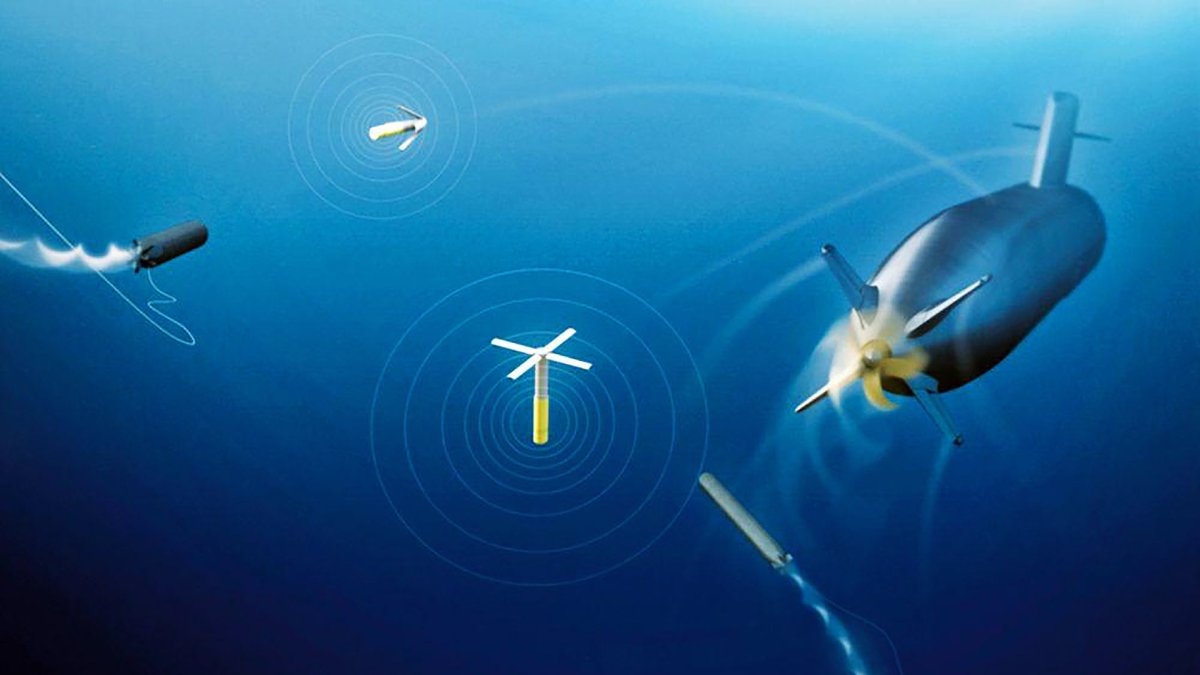
Historically speaking, torpedo countermeasures have been a tool used to buy time for a ship or submarine trying to escape an attack, but 21st-century naval technology is changing the way they are used. Today, countermeasures can be used as a defensive device or as a distraction that opens up an opportunity to attack. So, let’s take a dive into this shadowy world, starting with the four basic types of torpedo countermeasures: maskers, jammers, decoys, and anti-torpedo devices, as well as their differences and how they are tactically employed.
Broadband passive sonar systems found on modern submarines identify a target by contrasting the broadband energy signal-to-noise ratio (SNR) with quieter background noise. This contrast is displayed as different shades or colors on the sonar screen forming traces that waterfall down from the top. Broadband acoustic masking devices that interfere with a sonar’s ability to differentiate background noise from a contact, like the Naval Acoustic Electromechanical ( NAE ) Beacon Mk 3, are the simplest of torpedo countermeasures.
This saltwater activated masker is ejected from the submarine and a float is released that tethers the device to a specific depth. A thermal battery powers its motor and electronics, which create the broadband noise. This produces a loud acoustic signature that spans the spectrum of a broadband sonar system, effectively raising background noise above a target’s SNR, “wiping” the sonar operator’s display in one solid color with no contrast. As such, they cannot delineate targets from the noise.
Maskers have a short operational time and grow quieter as they lose power. It is common to deploy multiple maskers with different start time delays. This gives the evading submarine more time before the masking field expires. They are not effective against most modern torpedoes, such as the Russian UGST or the Black Shark . This is because maskers will cover a submarine’s evasion maneuver from the opponent’s broadband sonar system, but will not reliably hide a submarine from the torpedo’s active or narrowband sonar search modes.
With this in mind, Russia’s Vist-E torpedo decoy is a five-inch, 30-pound acoustic countermeasure that combines broadband noise masking with active sonar jamming and torpedo active reproduction. In other words, it can simulate a submarine’s own narrowband acoustic signature, but has a relatively short battery life of less than 10 minutes. Overall, the Vist-E is less capable than modern NATO decoys, but when used in groups, it can create a field of confusion that will hamper most torpedoes.
Vist-E., Rosoboronexport
Submarine Scutter ( SUBSCUT ) and Launched Expendable Scutter (LESCUT) are reactive decoys built by Ultra Electronics Ocean Systems and Rafael of Israel. SUBSCUT is pre-loaded into internal signal launchers or external launchers—launch tubes that house the countermeasure devices, and can be automatically deployed upon torpedo detection.
The decoy will hover between a depth of 10 and 300 meters listening for the incoming torpedo. A torpedo’s active sonar is analyzed by the decoy and classified. SUBSCUT customizes its own acoustic decoy transmission to the specific type of incoming torpedo, including the Doppler effect . Doppler effect is important to deceiving torpedo logic because it is one of the many checks the torpedo circuits can make during target verification. When the internal battery runs out, the decoy erases its software and sinks. LESCUT is the surface ship counterpart to SUBSCUT and is launched with a rocket motor from a chaff tube topside into the water.
The Submarine Countermeasure Acoustic Device ( SCAD 102 ) is used by the Royal Navy’s ballistic missile submarines and the Astute class of nuclear fast attack submarines (SSNs). This four-inch diameter, self-contained, internally-mounted torpedo countermeasure has the multirole capability. It is mission programmed before launch and is capable of jamming and decoying next-generation torpedoes, such as the Mk 48 Advanced Capability (ADCAP).
Sonar Jammers, such as the United States Navy’s Acoustic Device Countermeasure (ADC) Mk 4 Mod 1, an expendable 6.25-inch diameter, 120-pound (54.4kg) countermeasure, produce wide range tones designed to confuse a torpedo detection logic with a large number of false targets. This triggers a target verification algorithm within the torpedo’s homing logic and restarts it continuously with multiple new targets every second. This result is the torpedo circling the jammer verifying targets that do not exist while the actual submarine exits the search area.
LESCUT, SUBSCUT, SCAD, (ADC) Mk4 Mod1, Ultra Electronics
Most modern torpedoes, such as the Royal Navy’s Spearfish , have modes to defeat this kind of jammer and older less capable torpedoes can use guidance commands sent over the long trailing wires connected to the launching submarine to reset the torpedo’s search mode. However, this latter method requires direct input from the submarine’s fire control system operators.
In February 2019, the United States awarded a contract to develop a 3-inch version of the ADC Mk 4, called the ADC Mk 5. This will decrease the operational cost of the ADC program due to each device being stored within the submarine pressure hull instead of externally. An external ADC has a 12-year replacement lifespan, but only a two-year operational life after it is installed into the external mount.
Phase three of this contract explores the feasibility of automated underwater vehicles deploying torpedo countermeasures. This gives the attacking submarine more tactical flexibility because he can prepare the battlespace before an attack with numerous automated mobile decoys that move away from the submarine’s position. Testing of the system is taking place on naval ranges off the coast of Washington, California, Virginia, and at the Atlantic Undersea Test and Evaluation Center (AUTEC) in the Bahamas.
To respond to the “countermeasure homing” abilities of modern torpedoes, such as target verification and frequency discrimination, Leonardo has created the C303/S for submarines and C310 for surface ships. C303/S is a 12-barrel, external, pneumatic countermeasure launcher that shoots a 3.7-foot-long, 33-pound, three-inch diameter stationary jammer, and a five-inch Mobile Target Emulator (decoy).
The jammer is supported by a floating buoy that deploys a cable submerging the jammer to its most effective depth for the environment. The Mobile Target Emulator (MTE) will move away from the jammer responding to the incoming torpedo’s active pings as if it is a valid return. The doppler of the moving decoy and high SNR response is sufficient to lure the weapon away for a short time. When the weapon realizes it is following a decoy it is likely to return to the jammer and not the target. The C303/S launcher can be manually or automatically fired upon torpedo detection. The system will give a recommended evasion course that moves away from the mobile decoy.
Ultra Electronics is developing the Next Generation Countermeasure ( NGCM ). This 3-inch device can be internally launched and will swim away from the launching platform and provide tactical information via an acoustic communication link and updates between ships and submarines in the battlespace. The NGCM will act as an autonomous full-duplex mode acoustic communication link and torpedo jammer or decoy if, necessary.
The 3-inch Swimmer Mk 2 device is in development, it provides more tactical capabilities and can be launched externally. This gives submarine commanders more tactical options. Devices such as the NGCM expand sonar detection range, act as guards against counter-attack, and can provide broadband masking while the submarine repositions itself.
Towed decoys are common on most warships. Even the battleship USS Iowa deployed the AN/SLQ-25 Nixie system. Towed decoys employ both a broadband masker that generate more noise energy than the target ship and an active pulse transmitter that returns a torpedo’s active sonar ping at two to three times more amplitude than received. This attracts the torpedo to the towed decoy where it will circle until it runs out of energy. This is a better option than expendable countermeasures because if power is applied to the towed decoy, it will run continuously and can be reused.
Towed Nixie decoy system aboard the USS Iowa . , USN
Expendable countermeasures have seawater batteries that last between six and 45 minutes. Modern towed decoys can also act as torpedo early-warning sensors and alert the towing vessel of incoming weapons before their hull-mounted sensors detect them.
Ultra Electronics has created the Type 2070 surface ship torpedo defense (SSTD) system. This next-generation torpedo countermeasure employs both active and passive methods that reliably decoy and destroy incoming torpedoes. Details as to how the Type 2070 does its job remain highly classified.
SSTD., Ultra Electronics
Russia’s Paket-E/NK anti-torpedo system is designed to engage torpedoes or submarines inside 800 meters. This fast-reacting countermeasure consists of an externally mounted rotary launcher of eight intercept devices, a Paket-E control system, and a Paket-AE sonar set. The system can automatically alert on an incoming torpedo, calculate its path and launch a torpedo disabling anti-torpedo. It provides ships with unique anti-submarine and anti-torpedo capability. This point defense approach is employed if traditional evasion is unsuccessful.
Rafael’s Torbuster is a mobile decoy that is launched from an external launcher. It mimics the incoming weapon’s active sonar creating a false target. The system will calculate the torpedoes range and when it reaches the closest point of approach, it self-detonates a charge capable of damaging or destroying any nearby weapon.
The evolution of weapons and defenses have counteracted each other since the beginning of warfare. From sword and shield to radar and jammer, military science has parried each new technology with an appropriate response. Since the 1980s the torpedoes have been the dominant ship killer in naval warfare, leaving the target with little choice but to run the weapon out of energy. Today’s anti-torpedo technology, such as Russia’s Paket-E/NK close-in anti-torpedo torpedo, Israel’s Torbuster , and the United States Anti-Torpedo Torpedo Compact Rapid Attack Weapons program ( ATT CRAW ), are making conventional torpedoes obsolete.
For the first time, naval weapons platforms have an active option against submerged attacks. They can counter-fire on incoming torpedoes rather than rely on deception and evasion as the only method of survival. This provides navies with new offensive opportunities to press an attack when they would normally be forced to maneuver away.
21st Century naval combat will look much different than that of the previous century. New weapons systems like the U.S. Navy’s Hyper Velocity Projectiles (HVP) and laser turrets will favor the aggressive captains. A shift towards offensive operations has occurred and commanders who recognize these new capabilities will be rewarded.
Aaron Amick is a retired U.S. Navy submarine sonarman. He served in both Atlantic and Pacific Oceans on 688 Los Angles Class Fast Attack and Ohio class ballistic missile submarines. He has published two audiobooks on Cold War-era submarines, Akula SSN Project 971 Sub Brief and USS Nautilus SSN-571 Sub Brief . Now, Aaron manages a small Patreon page and contributes to The War Zone.
Contact the editor: Tyler@thedrive.com
Comments couldn’t be loaded. Please refresh the page.
更新于美国东部时间2020年5月15日下午1:02
从历史上看,鱼雷对抗措施一直是为试图逃脱攻击的舰船或潜艇争取时间的工具,但21世纪的海军技术正在改变其使用方式。如今,对抗措施既可以作为防御手段,也可以作为干扰敌方、创造攻击机会的手段。那么,让我们深入了解一下这个神秘的世界,首先从四种基本的鱼雷对抗措施入手:掩蔽器、干扰器、诱饵和反鱼雷装置,以及它们之间的区别和战术运用。
现代潜艇上配备的宽带被动声呐系统通过对比宽带能量信噪比(SNR)与较弱的背景噪声来识别目标。这种对比在声呐屏幕上以不同的色调或颜色显示,形成从顶部向下延伸的轨迹。干扰声呐区分背景噪声和目标噪声能力的宽带声学掩蔽装置,例如海军声学机电(NAE)Beacon Mk 3,是最简单的鱼雷对抗措施。
这种海水激活掩蔽器从潜艇中弹出,并释放一个浮标将其系在特定深度。热电池为其电机和电子元件供电,产生宽带噪声。这会产生一个响亮的声学特征,覆盖宽带声呐系统的频谱,有效地将背景噪声提升到目标信噪比之上,使声呐操作员的显示屏变成单一的纯色,没有任何对比度。因此,他们无法从噪声中分辨出目标。
掩蔽器的工作时间很短,而且随着功率的降低,噪音也会逐渐减小。通常会部署多个掩蔽器,并设置不同的启动延迟时间。这样可以给规避潜艇更多的时间,避免掩蔽场失效。掩蔽器对大多数现代鱼雷无效,例如俄罗斯的UGST或黑鲨鱼雷。这是因为掩蔽器可以掩护潜艇规避动作,使其免受敌方宽带声呐系统的探测,但无法有效地使潜艇躲避鱼雷的主动声呐或窄带声呐搜索。
鉴于此,俄罗斯的Vist-E鱼雷诱饵是一种5英寸、30磅重的声学对抗装置,它结合了宽带噪声掩蔽、主动声呐干扰和鱼雷主动模拟功能。换句话说,它可以模拟潜艇自身的窄带声学特征,但电池续航时间相对较短,不足10分钟。总体而言,Vist-E的性能不如现代北约诱饵,但成组使用时,它可以制造出干扰场,从而干扰大多数鱼雷。
Vist-E.,俄罗斯国防出口公司
潜艇干扰诱饵(SUBSCUT)和发射式一次性干扰诱饵(LESCUT)是由美国Ultra Electronics Ocean Systems公司和以色列Rafael公司联合研制的反应式诱饵。SUBSCUT可预先装入内部信号发射器或外部发射器——这些发射器是容纳干扰装置的发射管,一旦探测到鱼雷即可自动部署。
诱饵会在10米至300米的深度范围内悬停,监听来袭鱼雷。诱饵会分析并识别鱼雷的主动声呐信号。SUBSCUT会根据来袭鱼雷的具体类型定制自身的声学诱饵发射,包括多普勒效应。多普勒效应对于欺骗鱼雷的逻辑至关重要,因为它是鱼雷电路在目标验证过程中可以进行的众多检查之一。当内部电池耗尽时,诱饵会清除其软件并下沉。LESCUT是SUBSCUT的水面舰艇版本,它通过火箭发动机从水面箔条发射管发射到水中。
潜艇对抗声学装置(SCAD 102)由英国皇家海军的弹道导弹潜艇和机敏级核动力攻击潜艇(SSN)使用。这种直径四英寸、独立式、内置安装的鱼雷对抗装置具有多用途能力。它在发射前进行任务编程,能够干扰和诱骗下一代鱼雷,例如Mk 48先进能力(ADCAP)鱼雷。
声呐干扰器,例如美国海军的声学对抗装置(ADC)Mk 4 Mod 1,是一种一次性使用的直径6.25英寸、重120磅(54.4公斤)的干扰装置,它能发出宽频声波,旨在用大量虚假目标干扰鱼雷探测逻辑。这会触发鱼雷自导逻辑中的目标验证算法,并使其每秒不断重启,每次都产生多个新目标。最终结果是,鱼雷绕着干扰器盘旋,验证着并不存在的目标,而真正的潜艇却已驶出搜索区域。
LESCUT、SUBSCUT、SCAD、(ADC) Mk4 Mod1、Ultra Electronics
大多数现代鱼雷,例如英国皇家海军的“矛鱼”鱼雷,都具备对抗此类干扰器的模式;而较老旧、性能较差的鱼雷则可以通过连接在发射潜艇上的长拖曳导线接收制导指令来重置鱼雷的搜索模式。然而,后一种方法需要潜艇火控系统操作员的直接输入。
2019年2月,美国授予一份合同,开发3英寸口径的ADC Mk 4型声呐,称为ADC Mk 5。由于每个声呐装置都安装在潜艇耐压壳体内,而非外部,这将降低声呐项目的运行成本。外部声呐装置的更换寿命为12年,但安装到外部支架后,其使用寿命仅为两年。
该合同的第三阶段旨在探索部署鱼雷对抗措施的自动化水下航行器的可行性。这将赋予攻击潜艇更大的战术灵活性,因为它可以在攻击前利用大量可远离潜艇位置的自动化移动诱饵来准备战场。该系统的测试正在华盛顿州、加利福尼亚州、弗吉尼亚州沿海的海军靶场以及巴哈马群岛的大西洋水下测试与评估中心(AUTEC)进行。
为了应对现代鱼雷的“反制制导”能力,例如目标验证和频率识别,莱昂纳多公司研发了用于潜艇的C303/S和用于水面舰艇的C310。C303/S是一款12管外置气动式反制发射器,可发射一枚长3.7英尺、重33磅、直径3英寸的固定式干扰弹和一枚5英寸移动目标模拟器(诱饵)。
干扰器由一个浮标支撑,该浮标通过释放缆绳将干扰器下沉到最适合该环境的深度。移动目标模拟器(MTE)会响应来袭鱼雷的主动信号,如同收到有效回弹一般,并远离干扰器。移动诱饵的多普勒效应和高信噪比足以在短时间内引诱鱼雷偏离目标。当鱼雷意识到它正在追踪诱饵时,很可能会返回干扰器而不是目标。C303/S发射器可在探测到鱼雷后手动或自动发射。系统会给出建议的规避路线,使其远离移动诱饵。
Ultra Electronics公司正在研发下一代对抗装置(NGCM)。这款3英寸装置可进行内部发射,发射后可脱离发射平台,并通过声学通信链路在战场上的舰艇和潜艇之间提供战术信息和更新。NGCM可作为自主全双工模式声学通信链路,必要时还可作为鱼雷干扰器或诱饵。
3英寸的Swimmer Mk 2型声呐装置正在研发中,它具备更强的战术能力,并且可以从外部发射。这为潜艇指挥官提供了更多战术选择。诸如NGCM之类的装置可以扩展声呐探测范围,起到防御反击的作用,并能在潜艇重新定位时提供宽带掩蔽。
拖曳式诱饵在大多数军舰上都很常见。就连战列舰“爱荷华”号也部署了AN/SLQ-25“尼克西”系统。拖曳式诱饵利用宽带掩蔽器产生比目标舰艇更高的噪声能量,并配备主动脉冲发射器,以比接收到的声呐脉冲两到三倍的幅度将其反射回来。这会将鱼雷吸引到拖曳式诱饵附近,鱼雷会绕着诱饵盘旋直至能量耗尽。与消耗性对抗措施相比,拖曳式诱饵更胜一筹,因为只要通电,它就能持续运行并可重复使用。
在爱荷华号战列舰上安装了拖曳式尼克西诱饵系统。
消耗性反制措施配备海水电池,续航时间为6至45分钟。现代拖曳式诱饵还可以作为鱼雷预警传感器,在拖船的船体传感器探测到来袭武器之前,向拖船发出警报。
Ultra Electronics公司研发了2070型水面舰艇鱼雷防御系统(SSTD)。这种新一代鱼雷对抗系统采用主动和被动相结合的方式,能够可靠地诱骗并摧毁来袭鱼雷。2070型系统的具体工作原理仍属高度机密。
SSTD.,Ultra Electronics
俄罗斯的“Paket-E/NK”反鱼雷系统旨在拦截800米以内的鱼雷或潜艇。这套快速反应的对抗系统由一个外挂式旋转发射器(可发射八枚拦截装置)、一套“Paket-E”控制系统和一套“Paket-AE”声呐装置组成。该系统能够自动探测来袭鱼雷,计算其路径并发射反鱼雷装置使其失效。它为舰艇提供了独特的反潜和反鱼雷能力。当传统的规避手段失效时,便会采用这种近程防御方式。
拉斐尔公司的“鱼雷克星”(Torbuster)是一种由外部发射器发射的移动诱饵。它模拟来袭武器的主动声呐,制造虚假目标。该系统会计算鱼雷的射程,并在接近目标时引爆自身,其内部的爆炸装置足以损坏或摧毁附近的任何武器。
自战争伊始,武器和防御技术的发展就一直相互制衡。从刀剑盾牌到雷达干扰器,军事科学始终以相应的应对措施来应对每一项新技术。自20世纪80年代以来,鱼雷一直是海战中主要的舰艇杀手,目标舰艇几乎别无选择,只能耗尽其能量。而如今的反鱼雷技术,例如俄罗斯的“Paket-E/NK”近程反鱼雷、以色列的“Torbuster”以及美国的“反鱼雷鱼雷紧凑型快速攻击武器”(ATT CRAW)项目,正使传统鱼雷逐渐被淘汰。
海军武器平台首次拥有了主动防御水下攻击的手段。它们可以对来袭鱼雷进行反击,而不再仅仅依赖欺骗和规避来求生。这为海军提供了新的进攻机会,使它们能够在通常被迫规避的情况下发起攻击。
21世纪的海战将与上个世纪截然不同。诸如美国海军的超高速炮弹(HVP)和激光炮塔等新型武器系统将有利于那些积极进取的舰长。进攻性作战模式已经出现转变,能够把握这些新能力的指挥官将会获得回报。
亚伦·阿米克是美国海军退役潜艇声纳兵。他曾在大西洋和太平洋服役,先后在洛杉矶级快速攻击潜艇(688型)和俄亥俄级弹道导弹潜艇上服役。他出版了两本关于冷战时期潜艇的有声读物:《阿库拉号核潜艇971项目简报》和《鹦鹉螺号核潜艇571项目简报》。如今,亚伦运营着一个小型Patreon页面,并为《战区》网站撰稿。
联系编辑:Tyler@thedrive.com
评论加载失败,请刷新页面。