First USAF F-15EX To Be Based In Japan Departs Boeing’s St. Louis Plant首架将驻扎在日本的美国空军F-15EX战斗机从波音圣路易斯工厂起飞
The first F-15EX bound for the Japanese base comes as the program grapples with future sustainment concerns. The first F-15EX bound for the Japanese base comes as the program grapples with future sustainment concerns.
Published Sep 3, 2026 2:00 PM EDT
U.S. Air Force photo by Senior Airman Melany Bermudez
The first F-15EX Eagle II destined for permanent assignment at Kadena Air Base in Okinawa departed Boeing’s St. Louis, Missouri, facility on August 28, 2026. The aircraft left St. Louis for the 142nd Wing at Portland Air National Guard Base , Oregon, where it will undergo final staging and integration preparations before its eventual deployment to the sprawling Okinawa installation it will call home. The Oregon unit is acting as a coordination and preperation unit for the 18th Wing, a function you can read more about in our interview with the wing’s commander.
A first F-15EX Eagle II designated for Kadena Air Base, Japan, taxis at Boeing’s St. Louis facility. U.S. Air Force photo by Senior Airman Melany Bermudez
This departure represents a critical, long-awaited milestone for the 18th Wing, which has been working toward the permanent stationing of the service’s most advanced Eagle variant to replace its now-withdrawn F-15C/D fleet . The arrival of the F-15EX in Japan, expected to begin in fiscal year 2027, which begins on October 1, 2026, will be a central pillar in the Air Force’s modernization of tactical airpower in the Indo-Pacific region .
EXciting progress for F-15EX! We've delivered the 22nd F-15EX to the @usairforce . The aircraft will be the first F-15EX destined for @KadenaAirBase in Japan. pic.twitter.com/RlrTKuCCFl — Boeing Defense (@BoeingDefense) September 3, 2026
EXciting progress for F-15EX! We've delivered the 22nd F-15EX to the @usairforce . The aircraft will be the first F-15EX destined for @KadenaAirBase in Japan. pic.twitter.com/RlrTKuCCFl
“This is an important next step toward bringing the F-15EX home to Kadena,” said Brig. Gen. John Gallemore, 18th Wing commander, in an Air Force release . “Our team is ready to welcome the F-15EX, and this is another milestone that brings us closer to putting this capability in the hands of the airmen who will fly, maintain and employ it from Japan.”
The first F-15EX for Kadena Air Base, Japan, at Boeing’s St. Louis facility last month. U.S. Air Force photo by Senior Airman Melany Bermudez
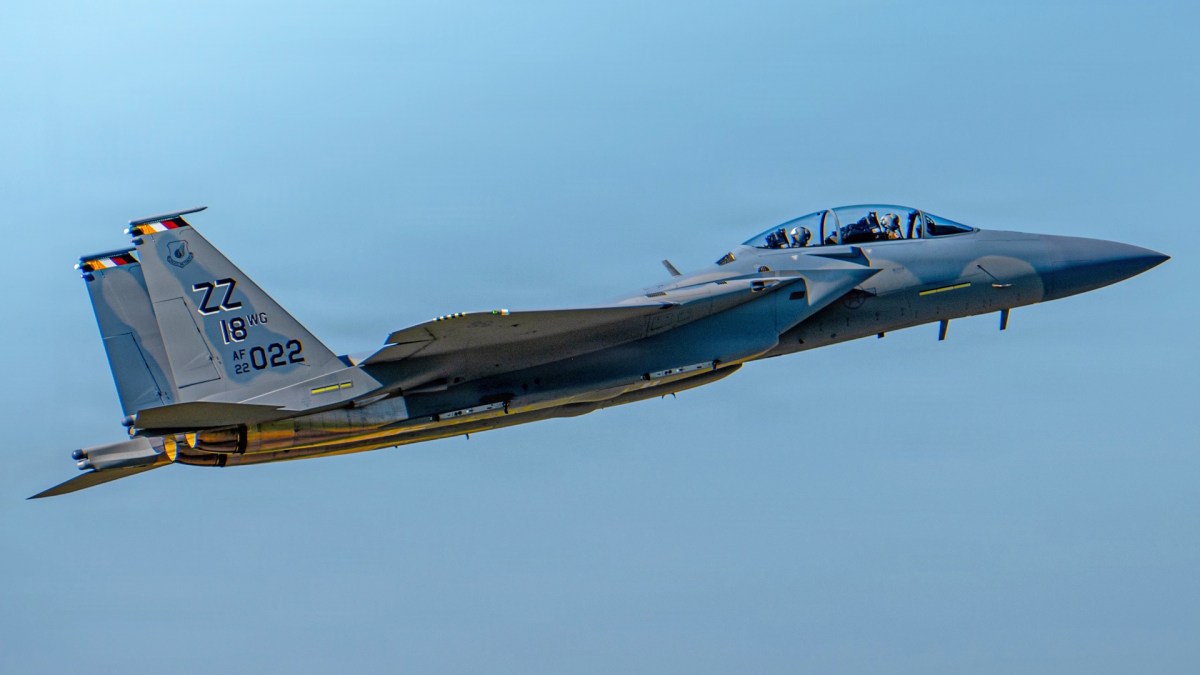
The first F-15EX for Kadena’s 18th Wing, serial 22-0022, was noted flying test sorties from St. Louis in early August, initially in primer paint. By the middle of the month its was flying with its full livery, including the famous “ZZ” tail code.
View this post on Instagram
The F-15EX is a significant jump in capability over the legacy Eagles. With modernized avionics, flight controls, an expanded electronic warfare suite, and increased weapons carriage — as well as potentially new and longer-reaching weapons — the jet is well-suited to operating in the vast Western Pacific. As Kadena prepares for the permanent arrival, the 18th Wing plans to integrate the EX with regional allies, including the Japan Air Self-Defense Force, building upon existing bilateral training exercises.
A U.S. Air Force F-15EX Eagle II and F-15E Strike Eagles assigned to 85th Test and Evaluation Squadron, Eglin Air Force Base, Florida, land at Kadena Air Base in June 2026. U.S. Air Force photo by Airman 1st Class Gracelyn Hess
Two active-duty squadrons of F-15EXs are set to be established at Kadena , taking the place of units previously based there that had flown F-15Cs. The Air Force has been deploying F-15Es, F-22s and other fighters to the base on a rotational basis to fill the gap in the meantime.
The F-15EX will give U.S. forces in the Indo-Pacific a high-capacity platform that complements the fifth-generation F-22 and F-35. With its ability to carry large air-to-air and air-to-surface payloads, the Eagle II can serve as a long-range “ missile truck ,” extending the reach and firepower of stealth aircraft operating closer to contested airspace. Its open-architecture systems also allow it to incorporate new sensors, weapons, and electronic warfare capabilities more readily than the aging F-15C/D fleet.
The first F-15EX designated for Kadena Air Base, Japan, is photographed at Boeing’s St. Louis facility, on August 28, 2026. U.S. Air Force photo by Senior Airman Melany Bermudez
The aircraft’s value is also tied to its role in networked operations. Exercises such as Valiant Shield have demonstrated how the F-15EX can work with uncrewed aircraft like the MQ-28 Ghost Bat , pointing toward mixed formations in which crewed fighters provide weapons, sensing, and command-and-control capacity for autonomous wingmen. Operating from strategic locations such as Kadena, the Eagle II could help the Air Force generate more combat power across the vast Pacific while reducing the burden on its limited number of stealth fighters.
A U.S. Air Force F-15EX Eagle II accompanies an MQ-28 Ghost Bat during the U.S.-led Valiant Shield 26 military exercise. PACAF
Kadena will become the second Air Force location with combat-coded F-15EX aircraft, following the Oregon Air National Guard’s 142nd Wing.
The Air Force has previously announced plans to stand up National Guard F-15EX squadrons in California, Louisiana , and Michigan . Most recently, the Air Force announced plans to put F-15EX fighters at Seymour Johnson Air Force Base, North Carolina, to replace older F-15E Strike Eagle jets that will move to Whiteman Air Force Base, Missouri .
While the movement of this first Kadena-bound F-15EX is a positive step, the wider Eagle II program is currently navigating some issues. According to a new Pentagon selected acquisition report released in August, the Air Force’s decision to aggressively expand its F-15EX fleet from 129 to 267 jets — intended to recapitalize the older F-15E force — has introduced substantial cost and schedule uncertainties that officials are now scrambling to manage.
The first F-15EX designated for Kadena Air Base, Japan, taxis at Boeing’s St. Louis facility, before departing for Portland Air National Guard Base, Oregon. U.S. Air Force photo by Senior Airman Melany Bermudez
The report warns that the extended acquisition strategy, which shifted from eight production lots to 12, will require Boeing to execute a “major technical refresh” to combat diminishing manufacturing sources and material shortages. As systems like the radar, mission computer, and engines face potential obsolescence over the now-lengthened production timeline, the service faces what the report characterizes as a “significant redesign effort.” Program managers are planning to mitigate these risks by integrating upgrades through operational flight program releases scheduled between 2031 and 2035, a strategy they describe as a “structured, risk-reduced pathway” to avoid production line gaps.
Compounding these technical challenges are tangible production delays, largely stemming from a labor strike at the St. Louis plant from August to November 2025. The report notes that these are “unrecoverable delays,” forcing a cascading schedule slip. While Boeing was contracted to deliver all 12 jets from Lot 3 by early 2026, the company will only be able to field half of those by the end of the year. This has directly impacted the timeline for the Kadena deployment, which was originally envisioned for earlier in 2026, and has left the Air Force relying on “bridging strategies” and rotations to cover operational requirements until the Eagle IIs can fully stand up in Okinawa.
The first F-15EX for Kadena Air Base, Japan, flies en route to Portland Air National Guard Base, Oregon, after departing Boeing’s St. Louis facility, on August 28, 2026. U.S. Air Force photo by Senior Airman Melany Bermudez
The Pentagon is now moving toward an aggressive production ramp-up, tasking Boeing to hit a rate of two jets per month. Keeping the F-15EX schedule on track will be a challenge, however, requiring successfully navigating ongoing parts shortages for critical systems, all while balancing the needs of foreign military sales customers who are also integrated into the supply chain.
For the 18th Wing, the arrival of the first F-15EX will bring a major advance in capabilities in a part of the world that needs them badly. At the same time, the program’s overall trajectory suggests that the wider transition to the new Eagle will come with some complex logistical and industrial challenges.
Contact the author: thomas@thewarzone.com
Comments couldn’t be loaded. Please refresh the page.
发布于美国东部时间2026年9月3日下午2:00
美国空军照片由高级飞行员 Melany Bermudez 拍摄
首架即将永久部署在冲绳嘉手纳空军基地的F-15EX“鹰II”战斗机于2026年8月28日从波音公司位于密苏里州圣路易斯的工厂起飞。这架飞机离开圣路易斯前往位于俄勒冈州波特兰空军国民警卫队基地的第142联队,在那里它将进行最后的部署和整合准备工作,之后才会最终部署到它未来的驻地——位于冲绳的庞大基地。俄勒冈州的这支部队将作为第18联队的协调和准备单位,您可以在我们对该联队指挥官的采访中了解更多相关信息。
一架首架交付日本嘉手纳空军基地的F-15EX“鹰II”战斗机在波音公司位于圣路易斯的工厂滑行。美国空军高级飞行员梅拉尼·贝尔穆德斯摄
此次部署对于第18联队而言是一个至关重要且期待已久的里程碑。该联队一直致力于将空军最先进的F-15EX战机永久部署到日本,以取代现已退役的F-15C/D机队。F-15EX预计将于2027财年开始交付日本,该财年从2026年10月1日开始。F-15EX的到来将成为美国空军在印太地区战术空中力量现代化建设的核心支柱。
F-15EX项目取得激动人心的进展!我们已向美国空军交付了第22架F-15EX。这架飞机将是首架部署在日本嘉手纳空军基地的F-15EX。 pic.twitter.com/RlrTKuCCFl — 波音防务 (@BoeingDefense) 2026年9月3日
F-15EX项目取得激动人心的进展!我们已向美国空军交付了第22架F-15EX。这架飞机将是首架部署在日本嘉手纳空军基地的F-15EX。 pic.twitter.com/RlrTKuCCFl
“这是将F-15EX战机带回嘉手纳空军基地的重要一步,”第18联队指挥官约翰·加勒莫尔准将在空军发布的新闻稿中表示。“我们的团队已准备好迎接F-15EX,这是我们向将这项能力交付给在日本驾驶、维护和使用该战机的空军人员迈出的又一个里程碑。”
上个月,首架交付给日本嘉手纳空军基地的F-15EX战斗机在波音公司位于圣路易斯的工厂交付。美国空军高级飞行员梅拉尼·贝尔穆德斯摄
嘉手纳空军基地第18联队的首架F-15EX战斗机,序列号22-0022,于8月初在圣路易斯进行试飞,当时机身仍涂有底漆。到8月中旬,它已完成全套涂装,包括著名的“ZZ”尾翼代码。
在 Instagram 上查看此帖子
F-15EX 的性能相比传统的“鹰”式战斗机有了显著提升。凭借现代化的航电系统、飞行控制系统、增强的电子战套件和更大的武器挂载能力——以及潜在的新型远程武器——这款战机非常适合在广袤的西太平洋地区作战。随着嘉手纳空军基地为 F-15EX 的永久部署做准备,第 18 联队计划将 F-15EX 与包括日本航空自卫队在内的地区盟友进行整合,并在现有双边训练演习的基础上进一步加强合作。
2026年6月,隶属于佛罗里达州埃格林空军基地第85测试评估中队的美国空军F-15EX“鹰II”战斗机和F-15E“攻击鹰”战斗机在嘉手纳空军基地降落。美国空军一等兵格雷斯琳·赫斯摄。
两个现役F-15EX中队即将落户嘉手纳空军基地,取代此前驻扎在那里的F-15C部队。在此期间,空军一直轮换向该基地部署F-15E、F-22和其他战斗机,以填补空缺。
F-15EX 将为驻印太地区的美国部队提供一个高容量平台,与第五代 F-22 和 F-35 形成互补。凭借其携带大型空空和空地有效载荷的能力,“鹰 II”可以作为远程“导弹卡车”,扩展在敌对空域附近作战的隐形战机的作战范围和火力。其开放式架构系统也使其能够比老旧的 F-15C/D 机队更便捷地集成新型传感器、武器和电子战能力。
2026年8月28日,首架交付日本嘉手纳空军基地的F-15EX战斗机在波音公司位于圣路易斯的工厂内被拍摄到。照片由美国空军高级飞行员梅拉尼·贝尔穆德斯拍摄。
该机的价值也与其在网络化作战中的作用息息相关。“英勇之盾”等演习已证明F-15EX能够与MQ-28“幽灵蝙蝠”等无人机协同作战,预示着未来将出现混合编队,其中有人驾驶战斗机为无人僚机提供武器、传感和指挥控制能力。从嘉手纳等战略要地起飞,“鹰II”战斗机可以帮助美国空军在广袤的太平洋地区提升作战能力,同时减轻其数量有限的隐形战斗机的负担。
在由美国主导的“勇敢之盾26”军事演习中,一架美国空军F-15EX“鹰II”战斗机伴随一架MQ-28“幽灵蝙蝠”无人机飞行。太平洋空军
继俄勒冈州空中国民警卫队第 142 联队之后,嘉手纳空军基地将成为第二个拥有作战型 F-15EX 飞机的空军基地。
美国空军此前已宣布计划在加利福尼亚州、路易斯安那州和密歇根州组建国民警卫队F-15EX战斗机中队。最近,空军又宣布计划将F-15EX战斗机部署到北卡罗来纳州的西摩·约翰逊空军基地,以取代即将调往密苏里州怀特曼空军基地的老旧F-15E“攻击鹰”战斗机。
虽然首架运往嘉手纳空军基地的F-15EX战机的交付是一个积极的进展,但更广泛的“鹰II”项目目前仍面临一些问题。根据五角大楼8月份发布的一份新的采购报告,空军决定大幅扩充其F-15EX机队,从129架增加到267架——旨在更新老旧的F-15E机队——这一决定带来了巨大的成本和进度不确定性,相关官员目前正努力应对这些问题。
首架交付日本嘉手纳空军基地的F-15EX战斗机在波音公司位于圣路易斯的工厂滑行,准备飞往俄勒冈州波特兰空军国民警卫队基地。美国空军高级飞行员梅拉尼·贝尔穆德斯摄
报告警告称,由于生产批次从八个增加到十二个,波音公司需要进行“重大技术升级”,以应对日益减少的制造资源和材料短缺问题。随着雷达、任务计算机和发动机等系统在延长的生产周期内面临潜在的过时风险,军方将面临报告中所说的“重大重新设计工作”。项目经理计划通过在2031年至2035年间分阶段实施飞行计划来整合升级,从而降低这些风险。他们将这一策略描述为“结构化、风险降低的途径”,以避免生产线出现断档。
除了上述技术挑战之外,实际的生产延误也雪上加霜,这主要是由于2025年8月至11月圣路易斯工厂的劳工罢工造成的。报告指出,这些延误“无法挽回”,导致整个生产计划出现连锁反应。尽管波音公司与第三批次签订了合同,承诺在2026年初交付全部12架战机,但到年底该公司只能交付其中的一半。这直接影响了原计划于2026年初部署到嘉手纳空军基地的时间表,使得空军不得不依靠“过渡策略”和轮换部署来满足作战需求,直到“鹰II”战机能够在冲绳全面投入使用。
2026年8月28日,首架交付日本嘉手纳空军基地的F-15EX战斗机从波音公司位于圣路易斯的工厂起飞,飞往俄勒冈州波特兰空军国民警卫队基地。美国空军高级飞行员梅拉尼·贝尔穆德斯摄
五角大楼目前正积极推进F-15EX的生产加速计划,要求波音公司达到每月两架战机的交付速度。然而,要确保F-15EX的交付进度按计划进行将是一项挑战,这需要成功应对关键系统零部件持续短缺的问题,同时还要兼顾同样身处供应链中的外国军售客户的需求。
对于第18联队而言,首架F-15EX的到来将极大地提升该地区(亟需此类能力的地区)的作战能力。与此同时,该项目的整体发展轨迹表明,向新型“鹰”式战斗机的全面过渡将面临一些复杂的后勤和工业挑战。
联系作者:thomas@thewarzone.com
评论加载失败,请刷新页面。