Three exercises that pushed counter–UAS from prototype to proven三个演习推动反无人机系统从原型发展成为成熟技术
Architecture that linked sensors, C2, RF effects, and lasers into a distributed c-UAS kill chain.
新闻视频
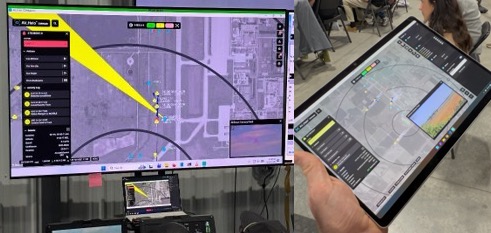
Halo_Shield command center on a screen (left) and on a tablet (right). (Photo provided by AV.)
Modern uncrewed aerial systems (UAS) have turned airspace defense into a fast-moving, asymmetric contest. Low-cost, high-impact options for attacking critical infrastructure and high-value assets have shown that traditional, radar-centric point defenses struggle to keep pace. Protecting our defense infrastructure and assets has evolved into an asymmetric warfare exercise, where sub-$1,000 systems collapse traditional air superiority and create vulnerabilities to our sensor networks, bases, and personnel.
AV’s Halo_Shield is designed for this environment: a modular, distributed counter-UAS (C-UAS) architecture that fuses passive and active sensor data, and distills them into a coherent command-and-control (C2) picture in AV_Halo software. Halo_Shield is installed as Tiles – integrated, resilient kill chains across domains, incorporating tactical effectors and sensors. The architecture offers earlier detection and reduces risk versus point defenses reliant on single modes. LOCUST High Energy Laser System.
Over three major Defense Department exercises: T-REX 25-2, TWIX 2026, and T-REX 2026, Halo_Shield has moved from promising prototype to proven warfighting system, demonstrating complete kill-chain performance in demanding, operationally realistic environments.
T-REX 25-2: Proving Halo_Shield in the field
The T‑REX 25‑2 Technology Readiness Experimentation event at Camp Atterbury, Indiana, evaluated how ready the Halo_Shield architecture was for real‑world base defense against UAS threats. T‑REX is a DoW and National Guard campaign run with Task Force RAPTR to rapidly assess emerging systems in realistic conditions.
It focused on four questions: whether Halo_Shield could fuse multiple, passive sensors into a single common operating picture (COP), operate in contested environments, contribute to multilayer base defense, and be produced and sustained realistically.
Halo_Shield served as a software‑driven, multi‑sensor tracking and fusion platform that combined Walaris AirScout (acoustic, optical), Squarehead Discovair (acoustic), AV Titan SV (passive RF), and cooperative feeds, fusing them into tracks displayed in the COP. For T‑REX 25‑2 it was deployed as a vehicle‑mounted, multi‑server Terrestrial Tile. The event challenged Halo_Shield using exercises from simple “red air” – simulated enemies – flights, to more complex maneuvers and limited swarm activities. This combined live Group 1–3 UAS flights with suitability measurements and operator feedback mapped to detailed objectives.
Halo_Shield successfully fused multiple inputs, enabling passive detection of small drones and fast visual confirmation without heavy manual effort. It could be powered on and operational in about 15 minutes, with more complex configurations adding only 15–20 minutes including software setup. The system ran with near‑100 percent uptime, with no software crashes or hardware failures.
We demonstrated interoperability via rapid integration of the exercise’s OMNI messaging format, enabling participation in the Passive Multi‑Spectral Air Surveillance Kill Chains (PMASKC) architecture and Ninja Fusion/TRAX environment. Overall, T‑REX 25‑2 showed Halo_Shield to be a technically solid, highly interoperable fusion and C2 platform with a strong early concept for distributed base defense.
TWIX 2026: Interoperability and agility
TWIX 2026 at Sumter, SC, was an event uniting the U.S. Air Force, MITRE, DHS, the National Guard, and industry including AV. We undertook TWIX as an interoperability trial: pre‑deploying Halo_Shield, defining deployment requirements, collecting real‑world sensor data, demonstrating layered multi‑sensor/multi‑effector defense, and validating interoperability.
At TWIX, Halo_Shield delivered layered defense through overlapping sensors, central control of offensive and defensive tools with clear status and threat views (using AV’s PUMA LE ISR), robust communications, integrated acoustic, radar and RF sensors with built‑in health checks, and secure, standards‑aligned data sharing via UDL and partner specifications. It did not operate in isolation; it contributed to a broader C2 picture and showed it can be dropped into complex environments and “speak the same language” as other systems.
LOCUST High Energy Laser System. (Photo provided by AV.)
Pre‑integration allowed full deployment, networking, configuration, and operation by day one. Remote nodes were repositioned and reconfigured with minimal downtime, demonstrating agility essential for expeditionary operations and rapid base defense. TWIX also tested human and system resilience: range outages, weather and changing coordination demands forced rapid adaptation.
TWIX also surfaced actionable improvements: making Halo_Shield more plug‑and‑play, reducing setup variability, improving tuning and fusion, and refining displays and user flows so new operators can understand and act quickly under pressure. These lessons directly inform how AV now designs, deploys, and operates Halo_Shield.
AV’s Puma LE with Intelligence, Surveillance and Reconnaissance (ISR) capabilities. (Photo provided by AV.)
T-REX 2026: Full kill-chain performance at Grand Forks
T-REX 2026 at Grand Forks AFB was the most demanding Halo_Shield test to date. In addition to AV’s own AV_Halo, Argus Perimeter Security, Titan RF C-UAS and Locust high-energy laser (HEL) platforms, we integrated Squarehead Acoustic Sensors, Axis EO/IR cameras, Walaris AirScout, and SRC Gryphon active radars into an operational C-UAS defense architecture.
Across multiple days of vignettes, the AV team combined RF effects and HEL engagements against Group 1 and Group 2 UAS, measuring full kill-chain performance under real-world network, safety, and operational constraints.
Launch-to-detection time in trials was less than a minute, detection-to-ID and cue to kill a few seconds each. Halo_Shield defeated “easy” UAS quickly, achieved repeated kills against Group 2 platforms, neutralized a five-ship swarm in short order, and even defeated a hovering UAS before its formal release. These proved Halo_Shield’s Terrestrial and Sentinel tile operations.
Celestial and Aerial Tiles were tested live. AV_Halo CORTEX and Puma ISR supported left-of-launch detection by identifying potential launch sites and pilot teams, and monitoring runway sectors for pre-launch activity.
A major highlight was the first ever high-energy laser firing at Grand Forks AFB. Halo_Shield served as the C2 for LOCUST laser engagements, performing cue from fused track, weapons pairing and scheduling assignment, and commander confirmation under strict safety oversight. Historically, laser firings had required external support. At T-REX 2026, AV_Halo COMMAND successfully took that role.
Qualitative feedback matched the technical results: evaluators concluded Halo_Shield did well and delivered on its promise. This sets up the opportunity to continue to develop scenarios and strengthen future installs and exercises.
See Halo_Shield in action
Across T-REX 25-2, TWIX 2026, and T-REX 2026, Halo_Shield proved itself as a robust, interoperable, multi-sensor fusion and C2 platform for modern airspace defense. It delivered rapid deployment, near-continuous uptime, scalable architecture, deep interoperability, and a modular tile-based concept that supports distributed, resilient kill chains across domains.
For acquisition leaders and operators seeking a field-proven, near-term solution for integrated C-UAS and airspace defense, we invite you to see Halo_Shield operate live at Grand Forks on our website . You can sit in front of the multi-screen COP, watch detections stream in, tracks fuse, and decisions accelerate, and see how modular tiles, passive sensors, and advanced C2 can redefine airspace defense. Engage with the AV team, and help shape what comes next.
Stephen Lloyd is a senior aerospace and defense leader with nearly four decades of federal service, including 33+ years with the Federal Aviation Administration supporting the National Airspace System and defense-adjacent missions. He served in critical roles such as Director for Safety within the FAA Air Traffic Organization, where he led enterprise Safety Management System initiatives spanning risk management, assurance, and operational response. Following federal service, Lloyd transitioned to industry, advising government and private-sector UAS and aviation programs before joining AV. As Senior Director, he leads advanced transportation and airspace solutions teams supporting defense and civilian applications, bringing deep expertise in air traffic systems, safety, and mission-critical operations to AV initiatives.
Halo_Shield指挥中心在屏幕上(左)和平板电脑上(右)的显示界面。(照片由AV提供。)
现代无人机系统(UAS)已将空域防御转变为一场快速变化且不对称的对抗。低成本、高影响力的攻击手段,例如攻击关键基础设施和高价值资产,表明传统的以雷达为中心的点防御系统难以跟上步伐。保护我们的国防基础设施和资产已演变为一场不对称战争,其中成本低于1000美元的系统就能瓦解传统的空中优势,并使我们传感器网络、基地和人员面临风险。
AV公司的Halo_Shield系统专为此环境而设计:它是一种模块化、分布式的反无人机系统(C-UAS)架构,能够融合被动和主动传感器数据,并将其提炼成AV_Halo软件中连贯的指挥控制(C2)图像。Halo_Shield以Tiles的形式安装——跨域集成、高弹性的杀伤链,整合了战术效应器和传感器。与依赖单一模式的点防御系统相比,该架构能够更早地探测目标,并降低风险。例如,LOCUST高能激光系统。
在国防部的三次重大演习:T-REX 25-2、TWIX 2026 和 T-REX 2026 中,Halo_Shield 已从有前途的原型发展成为成熟的作战系统,在要求苛刻、作战现实的环境中展示了完整的杀伤链性能。
T-REX 25-2:实战验证 Halo_Shield 的性能
在印第安纳州阿特伯里营地举行的 T-REX 25-2 技术准备度试验活动,评估了 Halo_Shield 架构在应对无人机系统 (UAS) 威胁的实际基地防御方面的准备程度。T-REX 是美国国防部和国民警卫队与 RAPTR 特遣部队合作开展的一项活动,旨在快速评估新兴系统在真实环境下的性能。
它重点关注四个问题:Halo_Shield 能否将多个被动传感器融合到一个通用作战图 (COP) 中,能否在对抗环境中运行,能否为多层基地防御做出贡献,以及能否以现实的方式生产和维护。
Halo_Shield 是一个软件驱动的多传感器跟踪与融合平台,它整合了 Walaris AirScout(声学、光学)、Squarehead Discovair(声学)、AV Titan SV(被动射频)以及协同通信数据,并将这些数据融合为显示在作战指挥中心 (COP) 上的跟踪轨迹。在 T-REX 25-2 演习中,它被部署为车载多服务器地面终端系统。此次演习通过一系列演练对 Halo_Shield 进行了挑战,演练内容涵盖了从简单的“红方”(模拟敌方)飞行到更复杂的机动和有限的集群活动。演习结合了 1-3 级无人机实战飞行、适用性测量以及操作员反馈,并根据详细的目标进行了调整。
Halo_Shield成功融合了多种输入信号,无需大量人工干预即可实现对小型无人机的被动检测和快速视觉确认。该系统可在约15分钟内完成开机并投入运行,更复杂的配置(包括软件设置)也仅需额外15-20分钟。系统运行时间接近100%,未出现任何软件崩溃或硬件故障。
我们通过快速集成演习的OMNI消息格式,展示了其互操作性,从而能够参与被动多光谱空中监视杀伤链(PMASKC)架构和Ninja Fusion/TRAX环境。总体而言,T-REX 25-2演习表明Halo_Shield是一个技术可靠、互操作性强的融合与指挥控制平台,并具备强大的分布式基地防御早期概念。
TWIX 2026:互操作性和敏捷性
2026 年在南卡罗来纳州萨姆特举行的 TWIX 活动汇集了美国空军、MITRE 公司、国土安全部、国民警卫队以及包括 AV 公司在内的业界人士。我们开展 TWIX 活动是为了进行互操作性试验:预先部署 Halo_Shield 系统,确定部署要求,收集真实世界的传感器数据,演示分层多传感器/多效应器防御,并验证互操作性。
在 TWIX 大会上,Halo_Shield 通过重叠的传感器实现了分层防御,集中控制攻防工具并提供清晰的状态和威胁视图(使用 AV 的 PUMA LE ISR),同时还具备强大的通信能力、集成的声学、雷达和射频传感器以及内置的健康检查功能,并通过 UDL 和合作伙伴规范实现了安全且符合标准的数据共享。它并非独立运行,而是为更广泛的指挥控制 (C2) 态势感知做出了贡献,并证明其能够部署到复杂的环境中,并与其他系统“使用相同的语言”。
LOCUST高能激光系统。(照片由AV提供。)
预集成使得系统在第一天即可完成全面部署、联网、配置和运行。远程节点的重新定位和重新配置最大限度地减少了停机时间,展现了远征作战和快速基地防御所必需的敏捷性。TWIX 还测试了人员和系统的韧性:靶场中断、天气状况和不断变化的协调需求迫使系统迅速做出调整。
TWIX 还提出了切实可行的改进方案:使 Halo_Shield 更易于即插即用,减少设置差异,改进调谐和融合,并优化显示和用户流程,以便新操作员能够在压力下快速理解和操作。这些经验教训直接指导着 AV 公司目前如何设计、部署和运行 Halo_Shield。
AV公司的Puma LE具备情报、监视和侦察(ISR)能力。(照片由AV公司提供。)
T-REX 2026:在格兰德福克斯进行完整的杀戮链演示
在格兰德福克斯空军基地进行的 T-REX 2026 演习是迄今为止对 Halo_Shield 系统要求最高的测试。除了 AV 公司自有的 AV_Halo、Argus Perimeter Security、Titan RF C-UAS 和 Locust 高能激光 (HEL) 平台外,我们还将 Squarehead 声学传感器、Axis EO/IR 摄像机、Walaris AirScout 和 SRC Gryphon 主动雷达集成到一套可运行的 C-UAS 防御架构中。
在多天的模拟演练中,AV 团队将射频效应和 HEL 对抗 1 组和 2 组无人机系统相结合,在真实世界的网络、安全和操作限制下测量完整的杀伤链性能。
试验中,Halo_Shield从发射到探测的时间不到一分钟,从探测到识别目标以及发出击杀信号的时间均仅需几秒钟。Halo_Shield能够快速击败“简单”的无人机系统,多次击杀第二组平台,短时间内消灭五艘无人机组成的集群,甚至在正式部署前就将其击落。这些结果证明了Halo_Shield在地面和哨兵区域作战中的有效性。
天体和空中探测瓦片已进行实测。AV_Halo CORTEX 和 Puma ISR 通过识别潜在发射场和试飞团队,并监控跑道扇区以进行发射前活动,从而支持发射前探测。
此次演习的一大亮点是格兰德福克斯空军基地首次进行的高能激光射击。Halo_Shield 系统作为 LOCUST 激光交战的指挥控制系统,负责根据融合跟踪数据进行指令指示、武器配对和调度分配,并在严格的安全监督下由指挥官确认。以往的激光射击都需要外部支持。在 T-REX 2026 演习中,AV_Halo COMMAND 系统成功承担了这一角色。
定性反馈与技术结果相符:评估人员认为 Halo_Shield 表现出色,实现了预期目标。这为继续开发演练场景、加强未来的部署和演习奠定了基础。
观看 Halo_Shield 的实际演示
在 T-REX 25-2、TWIX 2026 和 T-REX 2026 演习中,Halo_Shield 系统被证明是一个强大、可互操作的多传感器融合和指挥控制平台,适用于现代空域防御。它具备快速部署、近乎持续运行、可扩展架构、深度互操作性以及模块化瓦片式设计等优点,支持跨域分布式、高弹性的打击链。
对于寻求经过实战验证、可立即投入使用的集成式反无人机系统 (C-UAS) 和空域防御解决方案的采购负责人和操作人员,我们诚邀您访问我们的网站,在格兰德福克斯现场观看 Halo_Shield 的运行演示。您可以坐在多屏作战指挥中心 (COP) 前,观看实时探测数据、目标跟踪和决策过程,并了解模块化组件、被动传感器和先进的指挥控制系统如何重新定义空域防御。与无人机团队互动交流,共同塑造未来发展方向。
斯蒂芬·劳埃德是一位资深的航空航天和国防领导者,拥有近四十年的联邦政府服务经验,其中包括在联邦航空管理局 (FAA) 工作超过 33 年,负责支持国家空域系统和国防相关任务。他曾担任 FAA 空中交通管制机构安全主管等关键职务,领导企业安全管理系统项目,涵盖风险管理、保障和运行响应。离开联邦政府后,劳埃德转战业界,为政府和私营部门的无人机系统 (UAS) 和航空项目提供咨询服务,之后加入 AV 公司。作为高级总监,他领导着先进的交通和空域解决方案团队,为国防和民用应用提供支持,并将他在空中交通系统、安全和关键任务运行方面的深厚专业知识带入 AV 的各项计划中。