Polish defense show lures global players amid record spending spree波兰国防展吸引全球企业参与,创纪录的支出热潮
Warsaw is teeing up a number of large-scale defense acquisitions, with European companies seeking to capitalize on Poland's improved EU relations.
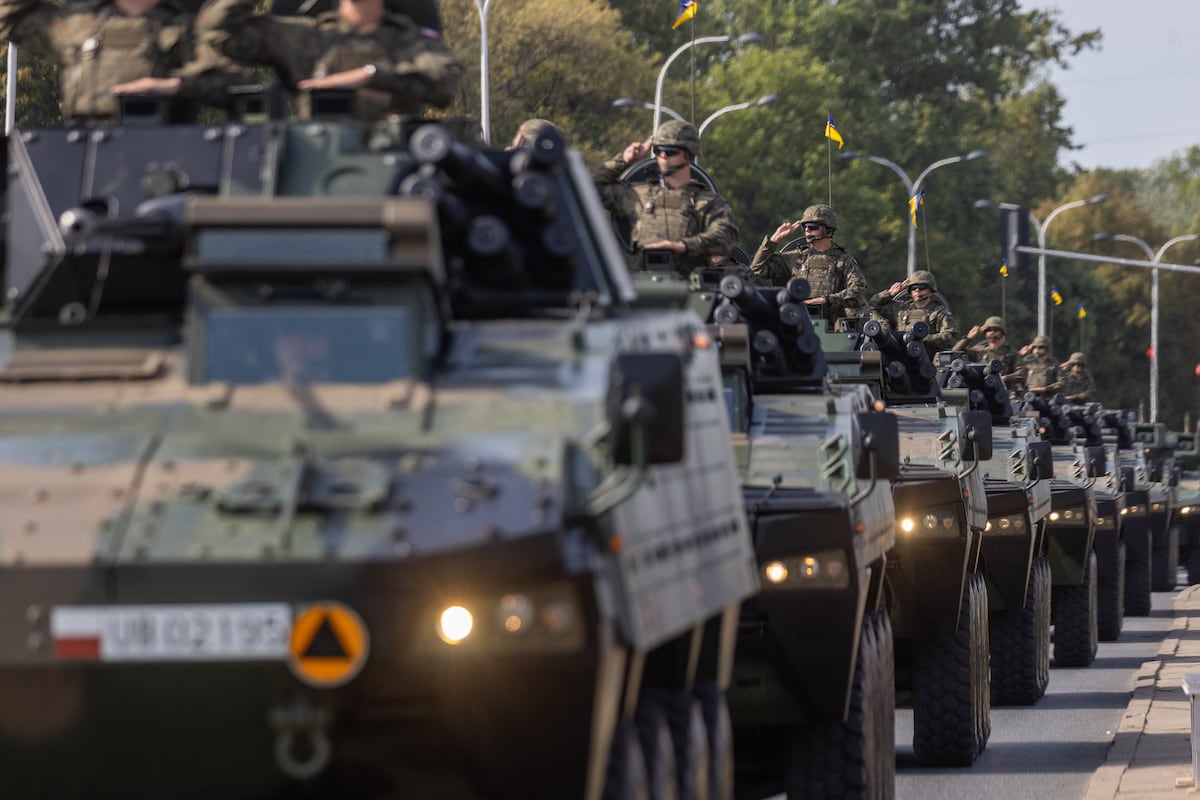
WARSAW, Poland — Last October’s general election triggered a change in government in Poland, but it has not dented Warsaw’s appetite for new weapons. As Russia’s invasion of Ukraine continues to drive Poland’s military modernization efforts, domestic and foreign defense companies are gearing to promote their products at the upcoming MSPO show in Kielce.
Over the past years, the event, scheduled to run between Sept. 3 and 6, has established itself as a leading trade show in the region. Since February 2022, when the Russian military launched a full-scale invasion of Ukraine, allies along NATO’s eastern flank have replied by boosting their defense budgets. Poland has led the way, aiming to spend about PLN 160 billion (US$41.5 billion), or some 4.2 percent of the country’s GDP, on its armed forces this year.
Speaking on Aug. 15 at a military parade in Warsaw, Polish Prime Minister Donald Tusk said his centrist government’s goal is to develop “one of the largest European militaries.”
“We must promise today to our compatriots, but also to the soldiers of the Polish Armed Forces, that we will build a most modern military … because today, innovation is power,” Tusk said during the event.
The nation’s record-high 2024 military expenditure is to be financed from the ministry’s budget, but also from the Armed Forces Support Fund, a financial instrument designed to fund purchases of new weapons and gear.
In 2025, Poland could further expand its defense budget which, if Warsaw spends the earmarked funds this year, could place Poland this year above all other NATO member states in terms of spending as a share of GDP.
In a July 4 statement, which made a thinly veiled reference to an increasingly belligerent Russia, the Polish Ministry of Defence said: “Next year, we plan to increase the budget for the military by 10 percent, which is an element of a long-term national security strategy, aiming to strengthen our armed forces in the face of the current geopolitical challenges.”
Tomasz Smura, the program director and management board member at the Warsaw-based Casimir Pulaski Foundation, told Defense News the government is continuing a number of programs launched by the previous administration, buying gear from U.S. and South Korean companies. However, there is also a noticeable intensification in activities by European groups who hope the change in power could pave the way for more contracts, he said.
“Since the change in government, Poland’s relations with Germany and France have noticeably improved, so it is natural that defense companies from these countries are demonstrating an increased interest in cooperating with Poland’s defense industry on joint projects,” Smura said. “Warsaw is planning to buy new submarines, fighter jets, but also various vehicles for the Polish land forces. This brings a number of opportunities for foreign manufacturers.”
The ministry is preparing to launch a number of acquisitions for the country’s air, naval, and land forces. Some of the potential purchases include:
A further 32 fighter jets for the Air Force, with officials in Warsaw mulling plans to acquire more fifth-generation jets on top of the already ordered 32 F-35s. Also in the running is the Eurofighter Typhoon and Boeing’s F-15EX, according to local observers;
New training helicopters and ship-based helos to replace the Polish Armed Forces’ outdated SW-4 Puszczyk and Kaman SH-2G Seasprite aircraft, respectively;
More combat and surveillance unmanned aerial vehicles (UAVs) for the military’s dedicated Drone Force, a new group within the armed forces;
Three to four new submarines for the country’s Navy to boost its operational capacities in the Baltic Sea. Last year, the Polish ministry’s Armament Agency announced that 11 entities supplied their initial bids as part of a market consultation process. These included companies from Germany, France, Italy, Spain, South Korea, and the U.K.
Tusk’s government, which came to power in December 2023, has inked a number of major deals to buy weapons from the United States and South Korea, but also from Polish defense industry players.
Most of the large contracts this year went to U.S. manufacturers. These include the $10 billion contract to buy 96 Boeing AH-64E Apache attack helicopters from July, the $2.5 billion deal from February to acquire Northrop Grumman’s Integrated Battle Command System , or IBCS, to synchronize Poland’s air- and missile-defense weapons under development, and the $1 billion deal from May to purchase four aerostat-based early warning radar systems from the United States.
Last May, the ministry also inked an executive deal to buy 72 K239 Chunmoo multi-barreled missile launchers from South Korea’s Hanwha Aerospace for some $1.6 billion. The latter deal was widely treated as a sign that Tusk’s cabinet will keep buying weapons under the framework contracts inherited from the previous government, covering FA-50 light attack aircraft, K9 howitzers , K2 Black Panther tanks, and Chunmoo launchers.
Jaroslaw Adamowski is the Poland correspondent for Defense News.
波兰华沙——去年10月的大选导致波兰政府更迭,但这并未削弱华沙对新型武器的需求。随着俄罗斯入侵乌克兰持续推动波兰的军事现代化进程,国内外国防企业正积极准备在即将于凯尔采举行的MSPO防务展上推广其产品。
过去几年,这项定于9月3日至6日举行的活动已成为该地区领先的贸易展会。自2022年2月俄罗斯军队全面入侵乌克兰以来,北约东翼盟国纷纷增加国防预算作为回应。波兰走在前列,计划今年在武装部队上投入约1600亿兹罗提(约合415亿美元),相当于该国GDP的4.2%。
8月15日,波兰总理唐纳德·图斯克在华沙举行的阅兵式上发表讲话时表示,他的中间派政府的目标是发展“欧洲最大的军队之一”。
“今天,我们必须向我们的同胞,也向波兰武装部队的士兵承诺,我们将建设一支最现代化的军队……因为在今天,创新就是力量,”图斯克在活动中说道。
该国 2024 年创纪录的军费开支将由国防部预算以及武装部队支援基金(一种旨在为购买新武器和装备提供资金的金融工具)提供资金。
到 2025 年,波兰可能会进一步扩大其国防预算。如果华沙今年花掉这笔专项资金,那么波兰今年的国防开支占 GDP 的比例可能会超过所有其他北约成员国。
波兰国防部在7月4日发表声明,其中隐晦地提到了日益好战的俄罗斯,声明称:“明年,我们计划将军费预算增加10%,这是长期国家安全战略的一部分,旨在加强我们的武装力量,以应对当前的地缘政治挑战。”
位于华沙的卡西米尔·普拉斯基基金会项目主管兼管理委员会成员托马斯·斯穆拉告诉《防务新闻》,政府正在延续前任政府启动的多项计划,从美国和韩国公司采购装备。但他表示,欧洲集团的活动也明显加强,他们希望政权更迭能为他们带来更多合同。
斯穆拉表示:“自政府更迭以来,波兰与德国和法国的关系显著改善,因此,来自这些国家的国防企业对与波兰国防工业开展联合项目表现出越来越浓厚的兴趣也就不足为奇了。华沙计划为波兰陆军采购新型潜艇、战斗机以及各种车辆。这为外国制造商带来了诸多机遇。”
该部正准备为国家空军、海军和陆军启动一系列采购计划。部分潜在采购项目包括:
据当地观察人士透露,华沙官员正在考虑在已订购的32架F-35战斗机的基础上,再采购32架第五代战斗机。此外,欧洲台风战斗机和波音公司的F-15EX也在竞标之列。
新型训练直升机和舰载直升机将分别取代波兰武装部队老旧的SW-4“普什奇克”和卡曼SH-2G“海妖”直升机;
为军队专门的无人机部队(武装部队内的一个新单位)采购更多作战和侦察无人机;
波兰海军计划建造三到四艘新型潜艇,以提升其在波罗的海的作战能力。去年,波兰国防部军备局宣布,共有11家实体提交了初步投标书,作为市场咨询流程的一部分。这些实体包括来自德国、法国、意大利、西班牙、韩国和英国的公司。
图斯克政府于 2023 年 12 月上台,已签署多项重大协议,从美国和韩国以及波兰国防工业企业购买武器。
今年大部分大额合同都给了美国制造商。其中包括7月份签订的价值100亿美元的购买96架波音AH-64E“阿帕奇”攻击直升机的合同;2月份签订的价值25亿美元的购买诺斯罗普·格鲁曼公司综合作战指挥系统(IBCS)的合同,用于协调波兰正在研发的防空和导弹防御武器;以及5月份签订的价值10亿美元的从美国购买四套系留气球预警雷达系统的合同。
去年五月,国防部还签署了一份执行协议,以约16亿美元的价格从韩国韩华航天公司购买72套K239“天武”多管导弹发射装置。后一项协议被广泛视为图斯克内阁将继续根据从前任政府继承的框架合同购买武器的信号,这些合同涵盖FA-50轻型攻击机、K9榴弹炮、K2“黑豹”坦克和“天武”导弹发射装置。
Jaroslaw Adamowski 是《防务新闻》驻波兰记者。