As Iran threatens Israel, Tehran’s missile program remains in question伊朗威胁以色列之际,德黑兰的导弹计划仍然存疑。
A new report suggests one of Iran's advanced missiles is far less accurate than previously thought.
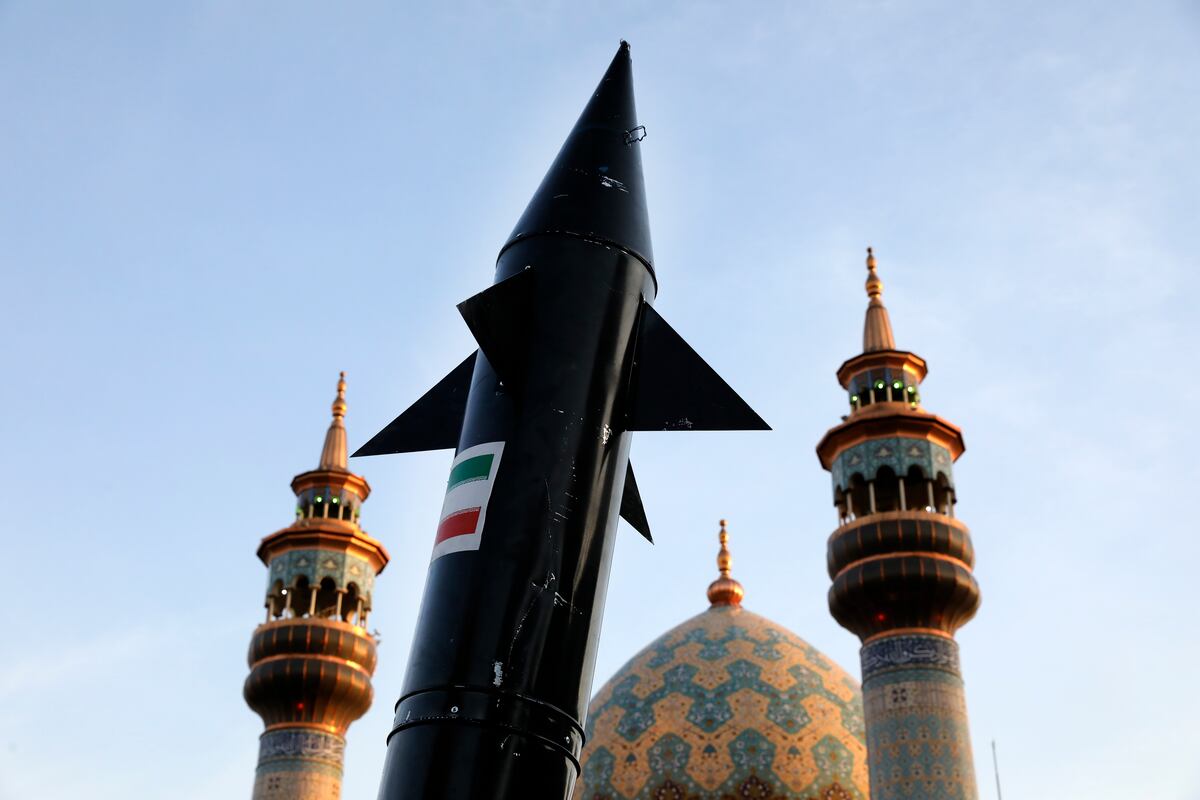
DUBAI, United Arab Emirates — As Iran threatens to attack Israel over the assassination of a Hamas leader in the Iranian capital , its long-vaunted missile program offers one of the few ways for Tehran to strike back directly, but questions loom over just how much of a danger it poses.
The program was behind Iran’s unprecedented drone-and-missile assault on Israel in April, when Iran became the first nation to launch such a barrage since Iraqi dictator Saddam Hussein lobbed Scud missiles at Israel in the 1991 Gulf War .
But few of the Iranian projectiles reached their targets . Many were shot down by a U.S.-led coalition, while others apparently failed at launch or crashed while in flight. Even those that reached Israel appeared to miss their marks.
Now, a new report by experts shared exclusively with The Associated Press suggests one of Tehran’s most advanced missiles is far less accurate than previously thought.
The April assault showed "some ability to strike Israel,” said Sam Lair, a research associate at the James Martin Center for Nonproliferation Studies who worked on the analysis. But "if I were supreme leader, I would probably be a little disappointed.”
If Iranian missiles are not able to hit targets precisely “that recasts their role,” Lair added. “They’re no longer as valuable for conducting conventional military operations. They may be more valuable simply as terror weapons.”
As an example, he recalled the harassing missile fire seen on cities in the Iran-Iraq war in the 1980s, when Iran could fire a variety of missiles at a large city and hope some got through.
Iran has repeatedly said it will retaliate for the killing of Ismail Haniyeh . Israel is widely suspected of carrying out the assassination, though it has not claimed it.
The Iranian mission to the United Nations did not respond to a request for comment. But Supreme Leader Ayatollah Ali Khamenei tacitly acknowledged the country's failure to strike anything of importance in Israel.
“Debates by the other party about how many missiles were fired, how many of them hit the target and how many didn’t, these are of secondary importance,” Khamenei said. “The main issue is the emergence of the Iranian nation” and the Iranian military "in an important international arena. This is what matters.”
A fusillade of missiles and drones
Retaliation had been expected for days after a suspected Israeli strike on April 1 hit an Iranian diplomatic compound in Damascus, Syria, killing two Iranian generals and five officers, as well as a member of the Lebanese Shiite militia Hezbollah.
Footage aired on state television showed that Iran's April 13 assault began with Revolutionary Guard commander Gen. Hossein Salami speaking by telephone with Brig. Gen. Amir Ali Hajizadeh, the commander of the Guard’s aerospace division.
“Start the ‘True Promise’ operation against Zionist regime’s bases,” he ordered.
As the missiles headed skyward, people across Iran stopped what they were doing and pointed their mobile phones at the launch noise from their cars and the balconies of their homes. Videos analyzed by the AP showed multiple launch sites, including on the outskirts of Arak, Hamadan, Isfahan, Kermanshah, Shiraz, Tabriz and Tehran.
Grainy footage later released through pro-Iranian military social media accounts showed missiles thundering off truck-based mobile launchers. Iran’s bomb-carrying Shahed drones, widely used by Russia in its war on Ukraine , leaped off metal stands, their engines whirring like lawnmowers through the night sky. Some were launched by pickup trucks racing down runways.
An Israeli Iron Dome air defense system intercepts missiles fired from Iran on April 14, 2024. (Tomer Neuberg/AP)
The triangle-shaped drones went first, taking hours to reach their targets. Then came the Paveh cruise missiles, taking a shorter time, and finally the Emad, Ghadr and Kheibar Shekan ballistic missiles, which needed only minutes, according to an analysis by the Wisconsin Project on Nuclear Arms Control. Drones and missiles also came from Yemen, likely fired by the Iranian-backed Houthi rebels.
Israeli officials estimated that Iran launched 170 drones, 30 cruise missiles and 120 ballistic missiles. In Jordan, an AP journalist filmed what appeared to be a ballistic missile being intercepted above the Earth’s atmosphere, likely by an Israeli Arrow 3 missile, with the blast radiating out like a circle.
The U.S., the United Kingdom, France and Jordan all shot down incoming fire. The Americans claimed to have downed 80 bomb-carrying drones and at least six ballistic missiles. Israeli missile defenses were also activated, though their initial claim of intercepting 99% of the projectiles appeared to be an exaggeration.
The attack “was very clearly not something symbolic and not something trying to avoid damage,” said Fabian Hinz, a missile expert and research fellow at the International Institute for Strategic Studies who studies Iran. It was “a major attempt to overcome Israeli defenses.”
U.S. officials, who spoke on condition of anonymity to discuss intelligence matters, told the AP they assessed that 50% of the Iranian missiles failed at launch or crashed before reaching their target.
Strike on air base suggests poor accuracy
In the aftermath, analysts at the James Martin Center for Nonproliferation Studies examined the strike on the Nevatim Air Base some 40 miles south of Jerusalem in the Negev Desert. The center’s experts have long studied Iran and its ballistic missile program.
The base came into immediate focus after the suspected Israeli strike on the Iranian diplomatic mission in Syria. Iran's ambassador to Syria, Hossein Akbari, claimed that the strike was conducted by Israeli F-35Is, which are based at Nevatim.
The air base also figured into Iranian military propaganda. Iranian state television aired footage in February of a Revolutionary Guard test that targeted a mock-up resembling F-35I hangars at Nevatim. Ballistic missiles, including some of the kinds used in the April attack on Israel, destroyed the mock-up.
In the attack, at least four Iranian missiles struck Nevatim, as seen in satellite images and footage released by the Israeli military.
The only debris found in the area — collected from the Dead Sea — suggests Iran used Emad missiles to target Nevatim, the analysts said. The liquid-fueled Emad, or “pillar” in Farsi, is a variant of Iran’s Shahab-3 missile built from a North Korean design with a reported range of 1,240 miles. That indicates the Emads were likely fired from the Shiraz area, which is within the estimated limits of the missile’s likely capabilities, the analysts said.
Based on Iran's focus on the F-35I, the James Martin analysts assumed the likely target point for the Iranian fire would be a cluster of aircraft hangars. The position also serves as a near-central point within the Nevatim base itself.
That offers “a much more valuable target" than just "poking holes in the runway,” Lair said. But none of the Iranian missiles directly hit those hangars.
A missile system is shown off during a parade in Iran on April 18, 2023. (Vahid Salemi/AP)
Assuming Iran targeted the hangars, the James Martin analysts measured the distance between the hangars and the impact zones of the missiles. That gave an average of about 0.75 miles for the “circular error probable” — a measurement used by experts to determine a weapon’s accuracy based on the radius of a circle that encompasses 50% of where the missiles landed.
That’s far worse than a 1,640-foot error circle first estimated by experts for the Emad. After a U.N. weapons ban on Iran ended in 2020 , Iran separately advertised the Emad to potential international buyers as having a 164-foot circle — a figure that is in line with top missile specifications for systems deployed elsewhere, said Hinz, the IISS missile expert.
The results from April's attack were nowhere near that precise.
"This means the Emad is much less accurate than previous estimates indicated," Lair said. “This indicates the Iranians are a generation behind where previous assessments thought they were in accuracy."
The poor performance may be attributable to electronic warfare measures designed to confuse the missile’s guidance system, as well as potential sabotage, poor missile design and the distances involved in the attack.
In the past, Iranian threats to retaliate against Israel generally took the form of either attacks by Iranian-backed forces in the Mideast or assaults aimed at Israeli targets elsewhere, such as embassies or tourists aboard.
Geography limits the options for a direct Iranian military attack. Iran shares no border with Israel, and the two countries are some 620 miles apart at the shortest distance.
Iran’s air force has an aging fleet led by F-14 Tomcats and Mikoyan MiG-29 fighter jets from the Cold War, but they would be no match for Israel's F-35Is and its air defenses. That means Iran again would need to rely on missiles and long-range drones.
It could also enlist help from allied militias such as Lebanon’s Hezbollah and Yemen’s Houthi rebels to overwhelm Israel’s defenses. Israel and Hezbollah exchanged heavy fire on Aug. 25.
Always present in the background is the risk that Tehran could develop a nuclear weapon, a threat that Iranian officials have repeated in recent months. While Iran insists its nuclear program is peaceful, Western intelligence agencies and the International Atomic Energy Agency say Tehran had an organized military nuclear program until 2003.
U.S. intelligence agencies said in a report in July that Iran has “undertaken activities that better position it to produce a nuclear device, if it chooses to do so.” However, building a weapon and miniaturizing it to put on a ballistic missile could take years.
“Iran has the largest inventory of ballistic missiles in the region and continues to emphasize improving the accuracy, lethality and reliability of these systems,” the report from the director of national intelligence said. “Iran probably is incorporating lessons learned" from the April attack.
Associated Press writers Lolita C. Baldor in Washington and Nasser Karimi and Amir Vahdat in Tehran, Iran, contributed to this report.
The Associated Press receives support for nuclear security coverage from the Carnegie Corporation of New York and Outrider Foundation . The AP is solely responsible for all content.
阿联酋迪拜——伊朗威胁要对以色列发动袭击,以报复哈马斯领导人在伊朗首都遇刺身亡。伊朗长期以来吹嘘的导弹计划是德黑兰直接反击的少数几种方式之一,但人们不禁要问,它究竟能构成多大的危险。
该计划是伊朗在 4 月份对以色列发动史无前例的无人机和导弹袭击的幕后推手。当时,伊朗成为自 1991 年海湾战争中伊拉克独裁者萨达姆·侯赛因向以色列发射飞毛腿导弹以来,第一个发动此类袭击的国家。
但伊朗发射的导弹鲜有击中目标。许多被美国领导的联军击落,其余的则显然在发射时失败或在飞行途中坠毁。即使是那些落入以色列境内的导弹,似乎也未能命中目标。
现在,一份由专家撰写并独家提供给美联社的新报告显示,德黑兰最先进的导弹之一的精度远低于之前的预期。
参与分析的詹姆斯·马丁防扩散研究中心研究员萨姆·莱尔表示,4月份的袭击“展现了打击以色列的一定能力”。但他补充说,“如果我是最高领导人,我可能会有点失望。”
莱尔补充说,如果伊朗导弹无法精确打击目标,“这将改变它们的角色”。“它们在执行常规军事行动方面不再那么有价值。它们作为恐怖武器的价值可能更大。”
他举例说,在 20 世纪 80 年代的两伊战争中,伊朗向城市发射了各种导弹,希望其中一些能够击中目标,以此来骚扰城市。
伊朗多次表示将对伊斯梅尔·哈尼亚遇害事件进行报复。以色列被广泛怀疑是此次暗杀事件的幕后黑手,但以色列并未承认对此负责。
伊朗常驻联合国代表团未回应置评请求。但最高领袖阿亚图拉·阿里·哈梅内伊已默认伊朗未能对以色列发动任何重大袭击。
哈梅内伊说:“对方争论发射了多少枚导弹,有多少枚击中目标,有多少枚没有击中目标,这些都是次要的。主要问题是伊朗民族和伊朗军队在重要的国际舞台上亮相。这才是最重要的。”
导弹和无人机的密集攻击
4月1日,疑似以色列发动空袭,袭击了位于叙利亚大马士革的伊朗外交机构,造成两名伊朗将军和五名军官以及一名黎巴嫩什叶派民兵组织真主党成员丧生。此后数日,人们一直预期伊朗会进行报复。
国家电视台播出的画面显示,伊朗4月13日的袭击始于革命卫队司令侯赛因·萨拉米将军与革命卫队航空航天师司令阿米尔·阿里·哈吉扎德准将通电话。
“对犹太复国主义政权的基地发起‘真正承诺’行动,”他下令道。
导弹升空之际,伊朗各地民众纷纷停下手中的事,从车里或自家阳台上举起手机,对准发射声。美联社分析的视频显示,发射地点不止一处,包括阿拉克、哈马丹、伊斯法罕、克尔曼沙赫、设拉子、大不里士和德黑兰的郊区。
随后,亲伊朗军方社交媒体账号发布的模糊视频显示,导弹从卡车上的移动发射车上呼啸而出。伊朗的“沙赫德”无人机(俄罗斯在对乌克兰战争中广泛使用)从金属支架上跃下,引擎在夜空中发出如同割草机般的轰鸣声。其中一些无人机是由在跑道上疾驰的皮卡车发射的。
2024年4月14日,以色列“铁穹”防空系统拦截了伊朗发射的导弹。(Tomer Neuberg/AP)
三角形无人机率先出击,耗时数小时才抵达目标。随后发射的是“铺路”(Paveh)巡航导弹,耗时较短;最后发射的是“埃马德”(Emad)、“加德尔”(Ghadr)和“海巴尔·谢坎”(Kheibar Shekan)弹道导弹,根据威斯康星州核军控项目的分析,这些导弹仅需几分钟即可完成打击。无人机和导弹也来自也门,很可能是由伊朗支持的胡塞武装发射的。
以色列官员估计,伊朗发射了170架无人机、30枚巡航导弹和120枚弹道导弹。在约旦,一名美联社记者拍摄到一枚疑似弹道导弹在大气层外被拦截的画面,拦截者很可能是以色列的“箭-3”导弹,爆炸产生的冲击波呈圆形向外扩散。
美国、英国、法国和约旦都击落了来袭的火力。美国声称击落了80架携带炸弹的无人机和至少6枚弹道导弹。以色列的导弹防御系统也启动了,但他们最初声称拦截了99%的导弹,这似乎有些夸大其词。
“这次袭击显然不是象征性的,也不是为了避免造成损失,”研究伊朗问题的国际战略研究所导弹专家兼研究员法比安·欣茨说,“这是一次试图突破以色列防御系统的重大尝试。”
不愿透露姓名的美国官员告诉美联社,他们评估认为,伊朗发射的导弹中有 50% 在发射时失败或在到达目标前坠毁。
对空军基地的袭击表明其命中率不高
事后,詹姆斯·马丁防扩散研究中心的分析人士对位于内盖夫沙漠、耶路撒冷以南约40英里的内瓦蒂姆空军基地的袭击事件进行了调查。该中心的专家长期研究伊朗及其弹道导弹计划。
在疑似以色列袭击伊朗驻叙利亚外交机构后,该基地立即成为关注焦点。伊朗驻叙利亚大使侯赛因·阿克巴里声称,此次袭击是由驻扎在内瓦蒂姆空军基地的以色列F-35I战斗机实施的。
该空军基地也出现在伊朗军方的宣传中。伊朗国家电视台在2月份播放了一段视频,显示革命卫队在内瓦提姆空军基地进行了一次导弹试验,目标是一个类似F-35I战斗机机库的模型。弹道导弹摧毁了这个模型,其中一些导弹与4月份袭击以色列时使用的导弹类型相同。
从以色列军方发布的卫星图像和视频中可以看出,至少有四枚伊朗导弹击中了内瓦蒂姆。
分析人士称,在死海收集到的唯一碎片表明,伊朗使用了“埃马德”(Emad)导弹袭击了内瓦提姆(Nevatim)。“埃马德”导弹(波斯语意为“柱子”)是伊朗“沙哈布-3”(Shahab-3)导弹的改进型,该导弹基于朝鲜的设计,据报道射程为1240英里(约2000公里)。分析人士表示,这表明“埃马德”导弹很可能是从设拉子地区发射的,这符合该导弹的射程范围。
鉴于伊朗重点关注F-35I战机,詹姆斯·马丁公司的分析师推测,伊朗炮火的可能目标是一组飞机库。该位置也位于内瓦蒂姆空军基地中心附近。
莱尔说,这比仅仅“在跑道上打洞”更有价值。但没有一枚伊朗导弹直接击中这些机库。
2023年4月18日,伊朗举行阅兵式,展示导弹系统。(Vahid Salemi/AP)
假设伊朗以机库为目标,詹姆斯·马丁公司的分析师测量了机库与导弹落点之间的距离。这得出的“圆概率误差”平均值约为0.75英里——专家们使用这种测量方法,根据包含导弹落点50%的圆的半径来确定武器的精度。
这比专家最初估计的“埃马德”导弹1640英尺的误差圆还要糟糕得多。国际战略研究所(IISS)导弹专家欣茨表示,在联合国对伊朗的武器禁令于2020年解除后,伊朗曾单独向潜在的国际买家宣传“埃马德”导弹的误差圆为164英尺——这一数字与部署在其他地区的顶级导弹系统的性能指标相符。
四月份袭击事件的结果远没有那么精确。
莱尔说:“这意味着埃马德的准确性远低于之前的估计。这表明伊朗人在准确性方面比之前的评估落后了一代。”
导弹性能不佳可能是由于旨在干扰导弹制导系统的电子战措施、潜在的破坏行为、导弹设计缺陷以及攻击距离等原因造成的。
过去,伊朗威胁要对以色列进行报复,通常表现为伊朗支持的武装力量在中东发动袭击,或者袭击以色列在其他地方的目标,例如大使馆或海外游客。
地理位置限制了伊朗直接发动军事攻击的选择。伊朗与以色列没有接壤,两国最短距离相距约620英里。
伊朗空军的机队老旧,主要装备冷战时期的F-14“雄猫”战斗机和米格-29战斗机,但它们根本无法与以色列的F-35I战斗机及其防空系统匹敌。这意味着伊朗将再次不得不依赖导弹和远程无人机。
它还可以寻求黎巴嫩真主党和也门胡塞武装等盟友民兵的帮助,以突破以色列的防御。8月25日,以色列和真主党发生激烈交火。
始终存在的隐患是德黑兰可能发展核武器的风险,伊朗官员近几个月来也反复提及这一威胁。尽管伊朗坚称其核计划是和平的,但西方情报机构和国际原子能机构表示,德黑兰在2003年之前一直拥有有组织的军事核计划。
美国情报机构在7月份的一份报告中称,伊朗“已采取一些活动,使其更有能力制造核装置(如果伊朗选择这样做的话)”。然而,制造核武器并将其小型化以便装载到弹道导弹上可能需要数年时间。
国家情报总监的报告指出,“伊朗拥有该地区规模最大的弹道导弹库存,并持续致力于提升这些系统的精度、杀伤力和可靠性。”报告还称,“伊朗可能正在吸取”四月份袭击事件的教训。
美联社驻华盛顿记者洛丽塔·C·巴尔多尔以及驻伊朗德黑兰记者纳赛尔·卡里米和阿米尔·瓦赫达特对本报道亦有贡献。
美联社的核安全报道得到了纽约卡内基基金会和Outrider基金会的支持。美联社对所有内容负全部责任。