What lessons did the US Army learn from the Gaza aid pier mission?美国陆军从加沙援助码头任务中吸取了哪些教训?
The service dealt with a wild combination of turbulent weather, security threats and sweeping personnel restrictions.
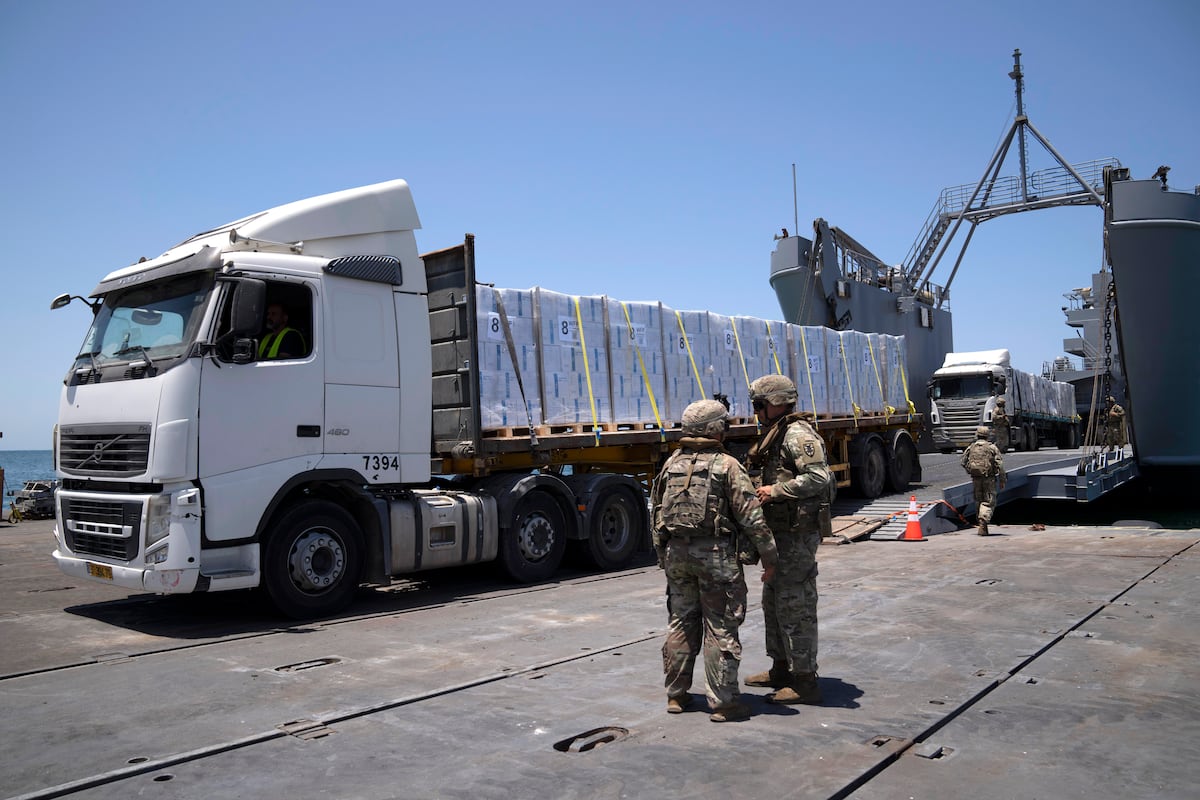
It was their most challenging mission.
U.S. Army soldiers in the 7th Transportation Brigade had previously set up a pier during training and in exercises overseas but never had dealt with the wild combination of turbulent weather , security threats and sweeping personnel restrictions that surrounded the Gaza humanitarian aid project .
Designed as a temporary solution to get badly needed food and supplies to desperate Palestinians, the so-called Joint Logistics Over-the-Shore system, or JLOTS, faced a series of setbacks over the spring and summer. It managed to send more than 20 million tons of aid ashore for people in Gaza facing famine during the Israel-Hamas war .
Service members struggled with what Col. Sam Miller, who was commander during the project, called the biggest “organizational leadership challenge” he had ever experienced.
Speaking to The Associated Press after much of the unit returned home, Miller said the Army learned a number of lessons during the four-month mission. It began when President Joe Biden’s announced in his State of the Union speech in March that the pier would be built and lasted through July 17, when the Pentagon formally declared that the mission was over and the pier was being permanently dismantled .
The Army is reviewing the $230 million pier operation and what it learned from the experience. One of the takeaways, according to a senior Army official, is that the unit needs to train under more challenging conditions to be better prepared for bad weather and other security issues it faced . The official spoke on condition of anonymity because assessments of the pier project have not been publicly released.
In a report released this week , the inspector general for the U.S. Agency for International Development said Biden ordered the pier’s construction even as USAID staffers expressed concerns that it would be difficult and undercut a push to persuade Israel to open “more efficient” land crossings to get food into Gaza.
The Defense Department said the pier “achieved its goal of providing an additive means of delivering high volumes of humanitarian aid to the people of Gaza to help address the acute humanitarian crisis.” The U.S. military knew from the outset “there would be challenges as part of this in this complex emergency,” the statement added.
The Biden administration had set a goal of the U.S. sea route and pier providing food to feed 1.5 million people for 90 days. It fell short, bringing in enough to feed about 450,000 people for a month before shutting down, the USAID inspector general's report said.
The Defense Department’s watchdog also is doing an evaluation of the project.
Army soldiers often must conduct their exercises under difficult conditions designed to replicate war. Learning from the Gaza project — which was the first time the Army set up a pier in actual combat conditions — leaders say they need to find ways to make the training even more challenging.
One of the biggest difficulties of the Gaza pier mission was that no U.S. troops could step ashore — a requirement set by Biden. Instead, U.S service members were scattered across a floating city of more than 20 ships and platforms miles offshore that had to have food, water, beds, medical care and communications.
Every day, said Miller, there were as many as 1,000 trips that troops and other personnel made from ship to boat to pier to port and back.
“We were moving personnel around the sea and up to the Trident pier on a constant basis,” Miller said. “And every day, there was probably about a thousand movements taking place, which is quite challenging, especially when you have sea conditions that you have to manage.”
Military leaders, he said, had to plan three or four days ahead to ensure they had everything they needed because the trip from the pier to their “safe haven” at Israel's port of Ashdod was about 30 nautical miles.
The trip over and back could take up to 12 hours, in part because the Army had to sail about 5 miles out to sea between Ashdod and the pier to stay a safe distance from shore as they passed Gaza City, Miller said.
Normally, Miller said, when the Army establishes a pier, the unit sets up a command onshore, making it much easier to store and access supplies and equipment or gather troops to lay out orders for the day.
Communication difficulties
While his command headquarters was on the U.S. military ship Roy P. Benavidez, Miller said he was constantly moving with his key aides to the various ships and the pier.
“I slept and ate on every platform out there,” he said.
The U.S. Army official concurred a lot of unexpected logistical issues came up that a pier operation may not usually include.
U.S. Army soldiers stand at the U.S.-built floating pier backdropped by the Gaza coast Tuesday, June 25, 2024. (Leo Correa/AP)
Because the ships had to use the Ashdod port and a number of civilian workers under terms of the mission, contracts had to be negotiated and written. Agreements had to be worked out so vessels could dock, and workers needed to be hired for tasks that troops couldn't do, including moving aid onto the shore.
Communications were a struggle.
“Some of our systems on the watercraft can be somewhat slower with bandwidth, and you’re not able to get up to the classified level,” Miller said.
He said he used a huge spreadsheet to keep track of all the ships and floating platforms, hundreds of personnel and the movement of millions of tons of aid from Cyprus to the Gaza shore.
When bad weather broke the pier apart , they had to set up ways to get the pieces moved to Ashdod and repaired. Over time, he said, they were able to hire more tugs to help move sections of the pier more quickly.
Some of the pier’s biggest problems — including the initial reluctance of aid agencies to distribute supplies throughout Gaza and later safety concerns from the violence — may not apply in other operations where troops may be quickly setting up a pier to get military forces ashore for an assault or disaster response.
“There’s tons of training value and experience that every one of the soldiers, sailors and others got out of this,” Miller said. "There’s going to be other places in the world that may have similar things, but they won’t be as tough as the things that we just went through.”
When the time comes, he said, “we’re going to be much better at doing this type of thing.”
One bit of information could have given the military a better heads-up about the heavy seas that would routinely hammer the pier. Turns out, said the Army official, there was a Gaza surf club, and its headquarters was near where they built the pier.
That “may be an indicator that the waves there were big,” the official said.
AP writers Tara Copp and Ellen Knickmeyer in Washington contributed.
这是他们最具挑战性的任务。
美国陆军第 7 运输旅的士兵此前曾在海外训练和演习中搭建过码头,但从未遇到过加沙人道主义援助项目所面临的恶劣天气、安全威胁和广泛的人员限制等复杂情况。
联合岸上后勤系统(JLOTS)旨在为急需食品和物资的巴勒斯坦人提供临时解决方案,但在今年春夏两季遭遇了一系列挫折。尽管如此,该系统仍成功地向加沙地带遭受饥荒的人们运送了超过2000万吨的援助物资。
服役人员面临着萨姆·米勒上校(该项目的指挥官)所说的他所经历过的最大“组织领导挑战”。
在部队大部分人员返回家园后,米勒接受美联社采访时表示,陆军在为期四个月的任务中吸取了许多经验教训。这项任务始于今年3月,当时乔·拜登总统在国情咨文中宣布将修建这座码头,一直持续到7月17日,五角大楼正式宣布任务结束,码头将被永久拆除。
陆军正在审查耗资2.3亿美元的码头运营情况以及从中吸取的经验教训。一位陆军高级官员表示,其中一项重要经验是,该部队需要在更具挑战性的条件下进行训练,以便更好地应对恶劣天气和其他安全问题。这位官员要求匿名,因为码头项目的评估结果尚未公开。
美国国际开发署监察长在本周发布的一份报告中表示,尽管美国国际开发署工作人员担心修建该码头会很困难,并会削弱说服以色列开放“更高效”的陆路口岸向加沙运送食品的努力,但拜登仍然下令修建该码头。
美国国防部表示,该码头“实现了其目标,即为向加沙人民运送大量人道主义援助物资提供了一种补充途径,以帮助应对严峻的人道主义危机”。声明还补充说,美军从一开始就知道“在这种复杂的紧急情况下,这项工作必然会面临挑战”。
拜登政府曾设定目标,利用美国海上航线和码头为150万人提供90天的粮食。但美国国际开发署监察长报告称,实际并未达到目标,在关闭之前,运送的粮食仅够约45万人食用一个月。
国防部监察机构也在对该项目进行评估。
陆军士兵经常需要在模拟战争的艰苦条件下进行演习。从加沙项目(这是陆军首次在实际作战条件下搭建码头)中吸取教训后,领导层表示,他们需要找到方法使训练更具挑战性。
加沙码头行动最大的困难之一是美军士兵无法登陆——这是拜登提出的要求。取而代之的是,美军人员分散在距离海岸数英里的20多艘舰船和平台上,组成了一座漂浮的城市,这些舰船和平台必须具备食物、水、床位、医疗和通讯等基本需求。
米勒说,每天,部队和其他人员要从船上到小艇,再到码头,再到港口,往返多达 1000 次。
米勒说:“我们不断地在海上和三叉戟码头之间调动人员。每天大概有上千次这样的调动,这相当具有挑战性,尤其是在还要应对各种海况的情况下。”
他说,军方领导人必须提前三四天做好计划,以确保他们拥有所需的一切,因为从码头到他们在以色列阿什杜德港的“安全港”的航程大约有 30 海里。
米勒说,往返行程可能需要长达 12 个小时,部分原因是军队必须在阿什杜德和码头之间航行约 5 英里,以便在经过加沙城时与海岸保持安全距离。
米勒说,通常情况下,当陆军建立一个码头时,部队会在岸上设立指挥部,这样就更容易储存和获取补给品和设备,或者召集部队来下达当天的命令。
沟通困难
米勒说,虽然他的指挥总部设在美国军舰罗伊·P·贝纳维德斯号上,但他经常与他的主要助手们一起前往各个船只和码头。
他说:“我几乎在所有平台上都睡过觉、吃过饭。”
美国陆军官员也承认,码头作业中出现了许多意想不到的后勤问题,而这些问题通常是不会发生的。
2024年6月25日星期二,美国陆军士兵站在美国建造的浮动码头上,背景是加沙海岸。(Leo Correa/AP)
由于任务规定船只必须使用阿什杜德港,并且需要雇用一些平民工人,因此必须协商并拟定合同。必须达成协议以确保船只能够靠岸,并且需要雇用工人来完成部队无法完成的任务,包括将援助物资运送到岸上。
沟通十分困难。
“我们水上交通工具上的一些系统带宽可能比较慢,无法达到保密级别,”米勒说。
他说,他使用一个巨大的电子表格来跟踪所有船只和浮动平台、数百名人员以及数百万吨援助物资从塞浦路斯运往加沙海岸的情况。
恶劣天气导致码头坍塌后,他们不得不设法将残骸运到阿什杜德进行维修。他说,随着时间的推移,他们能够雇佣更多的拖船来更快地运送码头的各个部分。
码头的一些最大问题——包括援助机构最初不愿向加沙各地分发物资,以及后来暴力事件带来的安全隐患——可能并不适用于其他行动,在这些行动中,部队可能会迅速搭建码头,以便让军事力量登陆进行突袭或灾难应对。
米勒说:“这次行动让每一位士兵、水手和其他人员都获得了宝贵的训练经验。世界上其他地方或许也会发生类似的事情,但肯定不会像我们刚刚经历的那样艰难。”
他说,时机成熟时,“我们会更好地做好这类事情。”
一条信息本可以让军方更好地预知经常冲击码头的巨浪。这位陆军官员说,原来加沙有个冲浪俱乐部,而且它的总部就在码头附近。
这位官员表示,“这可能表明那里的海浪很大”。
美联社驻华盛顿记者塔拉·科普和艾伦·尼克迈耶对此文亦有贡献。