How US Army combat medics are preparing for an Indo-Pacific fight美国陆军战斗医护人员如何为印太地区的战斗做好准备
Distance, contested air, communication disruptions, weather and limited evacuation platforms could greatly impact timely access to medical care.
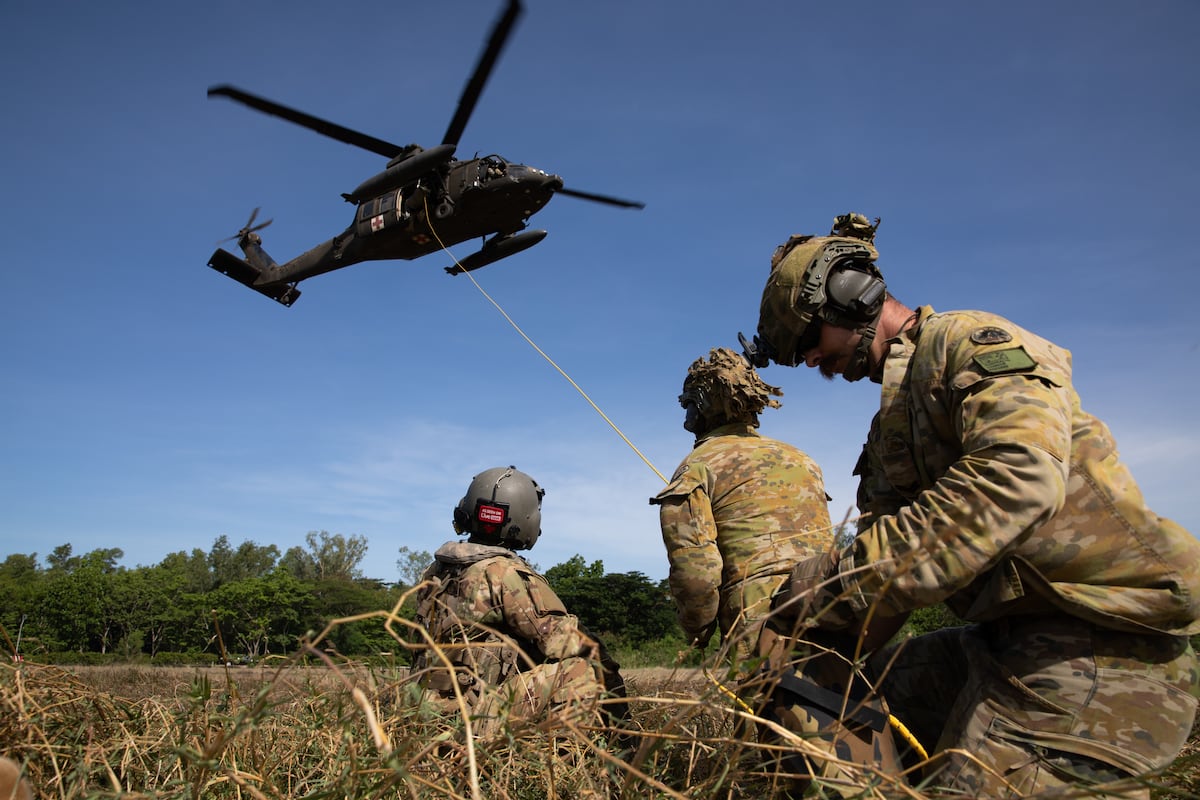
HONOLULU — As the U.S. Army prepares for a possible fight in the Indo-Pacific theater, combat medical teams are seeing vast differences in what treating wounded personnel in the region would entail compared to recent conflicts .
Looking back at previous wars, such as Iraq and Afghanistan, the U.S. military in 2009 implemented a “Golden Hour” standard, which requires medical care and evacuation to a surgical facility to occur within 60 minutes of a traumatic combat injury.
In the Indo-Pacific , that might not be feasible.
Army Lt. Col. Lauren Hamlin, commander of Veterinary Readiness Activity, Hawaii , told Military Times that the region’s distance, contested air and sea lines of communication, weather and limited evacuation platforms could greatly impact timely patient movement and access to surgical care.
Prior to possible evacuation, these challenges necessitate prolonged field care, forward surgical stabilization and medical support for patients, Hamlin said.
“Therefore, the priority in the Pacific is building resilient medical capabilities, both personnel and equipment, that can operate effectively in austere, distributed and contested environments,” Hamlin added.
In a medical care demonstration with the 18th Theater Medical Command at the 2026 Land Forces of the Pacific Symposium and Exposition in Hawaii this month, Hamlin detailed how the Army’s health care system has become more modular for decision making compared to past conflicts.
“Look at battles back in Vietnam, like the old, huge MASH,” she said. “That’s really not the model. They want to have lots of options.”
In the Indo-Pacific, the problem set is different. Medical teams have various locations where they need to be able to set up shop, which requires different capabilities for different islands or spaces, Hamlin said. Commanders, meanwhile, need to have various options to make decisions based on the location’s risk level, she added.
Hamlin listed distance, island geography, limited infrastructure, contested logistics and delayed evacuation timelines as difficulties posed by the region, each of which will cause combat medics to find ways to mitigate challenges creatively.
Solutions include realistic prolonged care training, forward-positioned capability, interoperability with joint and partner forces and cross-training medical teams to “do more with limited manpower and equipment,” Hamlin said.
The battlefields of Iraq and Afghanistan saw the survival rate of combat wounded climb significantly to around 92%, according to the Army , making it the highest rate in the history of warfare.
The increased number of soldiers surviving injuries has been attributed to better training, the advancement of Army medicine and the “Golden Hour” policy , despite dealing with unique injuries from new variations of weaponry such as landmines or improvised explosive devices, or IEDs.
During the simulation, Hamlin noted that it would be more accurate to compare a fight in the Indo-Pacific theater to that of World War II, rather than counterinsurgency operations seen in Iraq and Afghanistan.
“We’re not having isolated incidents. We’re not having rockets shot at us from 20 miles away [where insurgents are], just kind of hoping to hit something,” she said. “This is more like army on army, so I would argue it would be a very different injury rate.”
Another complication, according to Hamlin, is air superiority. Unlike during the Global War on Terror, medical teams will likely be unable to move a patient to higher levels of care without immense threat.
Hamlin said the combat medical community needs to come up with creative solutions to withstand the patient backload before being able to move wounded to another facility.
One of those explored solutions has come in the form of joining veterinary services with human care, Hamlin said, as the community is “worried that that’s all that’s going to be” available in the expansive Indo-Pacific region.
As unmanned systems become increasingly advanced and integrated within militaries across the globe, autonomy is shifting how the military retrieves and transports casualties.
Drones pose a risk to patient evacuations, Hamlin said, and in turn increase the need for autonomous patient evacuation capabilities in the future.
Hamlin told Military Times that unmanned aircraft systems can improve situational awareness, deliver blood or medical supplies and support triage across dispersed casualty sites.
In a mass casualty scenario, for instance, drones can assist combat medics with moving critical supplies faster than ground assets and reduce the risk to manned platforms in contested areas.
Unlike in Europe — specifically Ukraine — the Pacific poses a unique challenge in that there is no scenario in which a medical unit would place patients on a train or drive them out for evacuation, Hamlin said during the demo. The ability for prolonged care is a necessity, considering the Pacific’s reliance on air and boats for transport.
Combat medics operate on a mock patient in a Forward Resuscitative Surgical Detachment tent during a demonstration at LANPAC on May 13, 2026. (Military Times)
At LANPAC, the 8th Forward Resuscitative and Surgical Detachment demonstrated a care simulation on a cut suit in what would serve as a surgical unit aboard a vessel.
“We model this on a vessel because that would be the evac route,” Hamlin said. “You would have to use boats or ships to move patients because we’re not sure if we’re going to be able to fly them out in mass.”
To carry patients, the team has been utilizing autonomous small multipurpose equipment transports, or SMETs, uncrewed, eight-wheeled robotic combat vehicles guided with a remote control, Staff Sgt. William Dean, detachment sergeant of the 8th FRSD, said during the demo.
Alongside the SMETs, medical personnel are experimenting using other products that allow them to input grid coordinates to move patients to specific locations, like Ukraine has been doing. This development, Dean said, would be a “huge win.”
Ukraine’s military, which has increasingly used unmanned systems in frontline combat, has also been ramping up the use of unmanned ground vehicles in high-risk areas for casualty evacuations to remove the exposure of medical teams to hostile fire.
The team is also looking into telemedicine-enabled systems, autonomous resupply and medical decision tools supported by artificial intelligence, Hamlin told Military Times, with the goal of increasing reach, reducing personnel risk and sustaining care when movement is delayed or dangerous.
Cristina Stassis is a reporter covering stories surrounding the defense industry, national security, military/veteran affairs and more. She previously worked as an editorial fellow for Defense News in 2024 where she assisted the newsroom in breaking news across Sightline Media Group.
檀香山——随着美国陆军为可能在印太地区发生的战斗做准备,战斗医疗队发现,在该地区治疗受伤人员与最近的冲突相比存在巨大差异。
回顾以往的战争,例如伊拉克战争和阿富汗战争,美国军方在 2009 年实施了“黄金一小时”标准,要求在遭受创伤性战斗伤害后 60 分钟内进行医疗救治并送往外科手术机构。
在印度洋-太平洋地区,这可能不可行。
夏威夷兽医战备活动指挥官、陆军中校劳伦·哈姆林告诉《军事时报》,该地区的距离、空中和海上交通线的争议、天气以及有限的撤离平台可能会严重影响患者的及时转移和获得外科手术护理。
哈姆林表示,在可能的撤离之前,这些挑战需要对患者进行长时间的现场护理、前线外科稳定和医疗支持。
“因此,太平洋地区的首要任务是建立具有韧性的医疗能力,包括人员和设备,使其能够在条件艰苦、分散和充满冲突的环境中有效运作,”哈姆林补充道。
本月在夏威夷举行的 2026 年太平洋陆军研讨会暨展览会上,哈姆林与第 18 战区医疗司令部进行了一次医疗护理演示,详细介绍了与过去的冲突相比,陆军的医疗保健系统如何变得更加模块化,以便于决策。
“看看越南战争时期的战斗,比如以前那种规模庞大的野战医院,”她说。“那真的不是现在的模式。他们想要有很多选择。”
哈姆林表示,在印太地区,问题有所不同。医疗队需要在不同的地点设立医疗站,这就要求他们在不同的岛屿或地区具备不同的能力。她补充说,与此同时,指挥官也需要有多种选择,以便根据不同地点的风险等级做出决策。
哈姆林列举了该地区面临的诸多困难,包括距离遥远、岛屿地理环境、基础设施有限、后勤保障紧张以及撤离时间延误等,这些都将迫使战地医护人员创造性地寻找应对挑战的方法。
哈姆林表示,解决方案包括开展切实可行的长期护理培训、前沿部署能力、与联合部队和伙伴部队的互操作性以及对医疗团队进行交叉培训,以便“在人力和设备有限的情况下做更多的事情”。
据美国陆军统计,伊拉克和阿富汗战场上战斗伤员的存活率显著上升至约 92%,这是战争史上最高的存活率。
士兵伤后幸存人数的增加归功于更好的训练、军队医疗的进步以及“黄金一小时”政策,尽管他们要应对由地雷或简易爆炸装置(IED)等新型武器造成的独特伤害。
在模拟过程中,哈姆林指出,将印太地区的战斗与第二次世界大战的战斗进行比较会更加准确,而不是与伊拉克和阿富汗的反叛乱行动进行比较。
“我们遇到的不是孤立事件。也不是20英里外(叛乱分子所在的地方)有人朝我们发射火箭弹,然后漫无目的地乱射,”她说。“这更像是军队之间的对抗,所以我认为伤亡率会截然不同。”
哈姆林指出,另一个复杂因素是空中优势。与全球反恐战争时期不同,医疗队很可能无法在不面临巨大威胁的情况下将病人转移到更高等级的医疗机构。
哈姆林表示,战地医疗界需要想出创造性的办法来应对积压的病人,才能将伤员转移到其他医疗机构。
哈姆林表示,探索的解决方案之一是将兽医服务与人类护理结合起来,因为社区“担心在广阔的印度-太平洋地区,可能就只有这些服务了”。
随着无人系统日益先进并被全球各国军队广泛采用,自主性正在改变军队营救和运送伤员的方式。
哈姆林表示,无人机对病人疏散构成风险,反过来又增加了未来对自主病人疏散能力的需求。
哈姆林告诉《军事时报》,无人机系统可以提高态势感知能力,运送血液或医疗用品,并支持分散伤员现场的分类救治。
例如,在发生大规模伤亡事件时,无人机可以协助战斗医护人员比地面力量更快地运送关键物资,并降低在冲突地区有人驾驶平台面临的风险。
哈姆林在演示中指出,与欧洲(尤其是乌克兰)不同,太平洋地区面临着独特的挑战,因为医疗队无法将病人送上火车或驱车撤离。考虑到太平洋地区依赖空运和海运进行运输,提供长期护理的能力至关重要。
2026年5月13日,在LANPAC演习期间,战斗医护人员在前线复苏外科分遣队帐篷内对模拟病人进行手术。(军事时报)
在 LANPAC 上,第 8 前线复苏和外科分队在船上模拟外科手术单元的切割服上进行了护理模拟。
“我们以船只为模型进行模拟,因为这将是撤离路线,”哈姆林说。“你必须使用船只来运送病人,因为我们不确定是否能够大规模地用飞机运送他们。”
第 8 野战救护分遣队分遣队军士长威廉·迪恩在演示中表示,为了运送病人,该团队一直在使用自主小型多用途设备运输车(SMET),这是一种无人驾驶的八轮机器人战斗车辆,由遥控器引导。
除了SMET系统之外,医务人员还在试验其他产品,这些产品允许他们输入网格坐标,将病人转移到特定位置,就像乌克兰的做法一样。迪恩表示,这项进展将是“巨大的胜利”。
乌克兰军队越来越多地在前线作战中使用无人系统,并且一直在高风险地区加大无人地面车辆的使用,用于伤员撤离,以避免医疗队暴露在敌方火力之下。
哈姆林告诉《军事时报》,该团队还在研究远程医疗系统、自主补给和人工智能支持的医疗决策工具,目标是在行动延误或危险时扩大覆盖范围、降低人员风险并维持医疗服务。
克里斯蒂娜·斯塔西斯是一位记者,主要报道国防工业、国家安全、军事/退伍军人事务等领域的新闻。她曾于2024年在《防务新闻》担任编辑助理,协助Sightline媒体集团旗下新闻编辑室处理突发新闻。