Autonomous vehicle safety operators debunk misconceptions that they ‘sit there and do nothing’自动驾驶汽车安全操作员驳斥了他们“坐在那里什么也不做”的误解
Learning left-hand drive and giving feedback on the vehicle’s performance are just a few of the responsibilities of a safety driver.
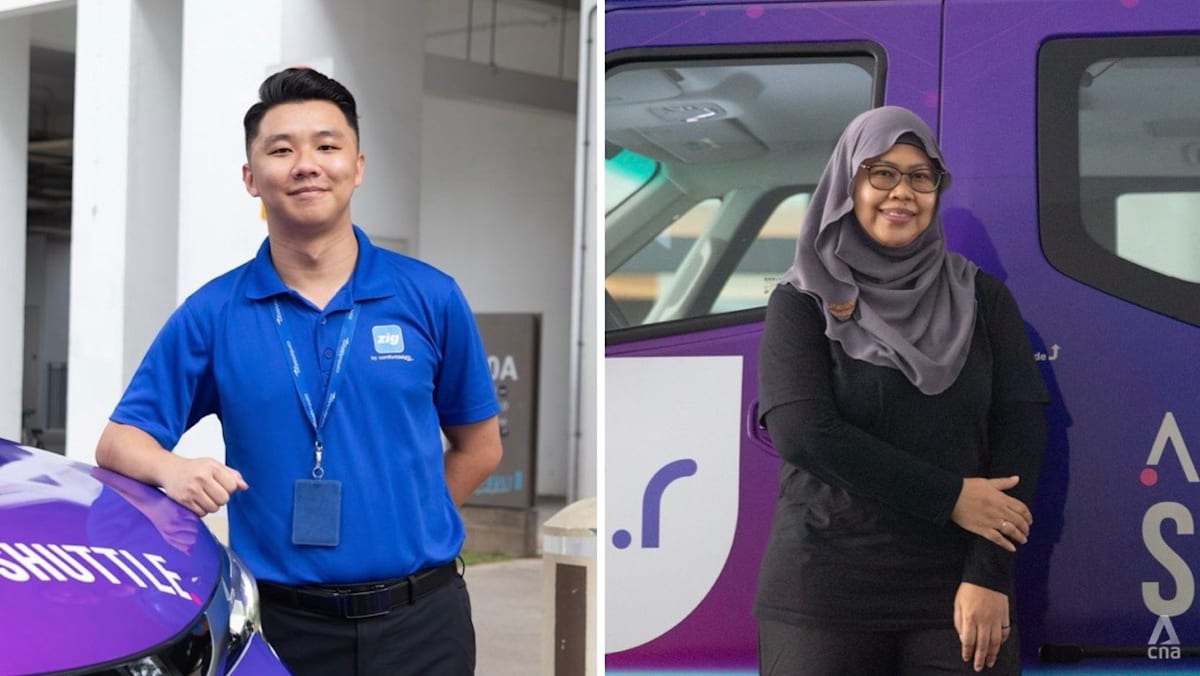
Learning left-hand drive and giving feedback on the vehicle’s performance are just a few of the responsibilities of a safety driver.
Autonomous vehicle safety operators Sherman Seng (left) and Sarah Ahmad. (Photos: CNA/Mak Jia Kee)
This audio is generated by an AI tool.
SINGAPORE: Step into an autonomous vehicle (AV) and it might be confusing to still see a driver behind the wheel.
Since the vehicle is self-driven, passengers sometimes ask what Ms Sarah Ahmad does as a safety driver.
“There are those who actually say ‘wow, your job is so simple, you just sit there and do nothing, and you can sleep … even retirees, or even if you don’t have a driving licence, you can do it’,” said the 45-year-old, who is part of Grab’s AV trial in Punggol.
The mother-of-four told CNA that these sentiments could not be further from the truth.
CNA Games Guess Word Crack the word, one row at a time Buzzword Create words using the given letters Mini Sudoku Tiny puzzle, mighty brain teaser Mini Crossword Small grid, big challenge Word Search Spot as many words as you can Show More Show Less “You have to be on higher alert as compared to when you are holding on to the steering wheel, because now you're supervising the vehicle, so you have to make sure that if the car suddenly moves to the right, you need to take note of all the things that are happening,” she said. “It's as though you are a driving instructor, and the vehicle is the student.” Besides having a driving licence, she had to also learn to operate a left-hand drive, as the AVs are from China. “At any point you need to take over, you still have to drive,” she said. Safety driver in ComfortDelGro's Punggol AV trial Sherman Seng, 24, said: “My passengers often think that it's a driverless vehicle, so I just sit there and do nothing. “That’s not the case, because we have to maintain concentration almost all the time. The concentration part is there so that we are able to prevent unforeseeable events.” AVs are a fast-emerging industry in Singapore, with pilots running for several years. Both Grab and ComfortDelGro partnered with Chinese autonomous-driving technology firms WeRide and Pony.ai respectively to roll out autonomous shuttle services in Punggol. The initiatives began with testing and community trials before Grab-WeRide opened rides to the public in April , followed by ComfortDelGro-Pony.ai in June . Grab said in July that it would pilot an on-demand AV service in Punggol in the next few months that will allow riders to book an AV to travel directly between select pick-up and drop-off points. It also said in September that it would be expanding its AV fleet from 10 to 50 in the next six months and broadening its AV service coverage within Punggol . A Bill tabled in parliament earlier this month proposed to extend the existing regulatory sandbox for AV deployments on roads to Dec 31, 2028. This is to ensure that ongoing AV deployments can continue uninterrupted until a "more holistic legislation" is implemented, said the transport ministry.
“You have to be on higher alert as compared to when you are holding on to the steering wheel, because now you're supervising the vehicle, so you have to make sure that if the car suddenly moves to the right, you need to take note of all the things that are happening,” she said.
“It's as though you are a driving instructor, and the vehicle is the student.”
Besides having a driving licence, she had to also learn to operate a left-hand drive, as the AVs are from China.
“At any point you need to take over, you still have to drive,” she said.
Safety driver in ComfortDelGro's Punggol AV trial Sherman Seng, 24, said: “My passengers often think that it's a driverless vehicle, so I just sit there and do nothing.
“That’s not the case, because we have to maintain concentration almost all the time. The concentration part is there so that we are able to prevent unforeseeable events.”
AVs are a fast-emerging industry in Singapore, with pilots running for several years.
Both Grab and ComfortDelGro partnered with Chinese autonomous-driving technology firms WeRide and Pony.ai respectively to roll out autonomous shuttle services in Punggol.
The initiatives began with testing and community trials before Grab-WeRide opened rides to the public in April , followed by ComfortDelGro-Pony.ai in June .
Grab said in July that it would pilot an on-demand AV service in Punggol in the next few months that will allow riders to book an AV to travel directly between select pick-up and drop-off points.
It also said in September that it would be expanding its AV fleet from 10 to 50 in the next six months and broadening its AV service coverage within Punggol .
A Bill tabled in parliament earlier this month proposed to extend the existing regulatory sandbox for AV deployments on roads to Dec 31, 2028. This is to ensure that ongoing AV deployments can continue uninterrupted until a "more holistic legislation" is implemented, said the transport ministry.
Sarah Ahmad, a safety driver, in an autonomous vehicle near Punggol Coast Mall on Sep 11, 2026. (Photo: CNA/Mak Jia Kee)
TRAINING FOR THE JOB
Ms Sarah had been driving private-hire vehicles under Grab for three years before the company asked her last year if she wanted to join its new AV initiative.
While she had not heard of AVs in Singapore at that time, she had a general interest in new technologies and agreed to make the leap.
Training started in November, when she had to learn to drive a car on left-hand drive. The least intuitive part of training was when she had to let go of the wheel and allow the car to go on “auto mode”.
“Suddenly, they said that you cannot touch (the steering wheel), you just leave it alone, put your hands on your lap, and then that's it,” she said.
“So when the car moves, I want to hold onto it; it's just a natural reaction … so that required adjustment.”
Over time, she realised that being a safety driver required anticipation and alertness that normal driving did not prepare her for.
“The alertness is actually super, super high … you have to be even more alert because you're not holding on; you do not know whether it's going to stop, whether it's going to move,” she said.
“You need to be alert so that if anything happens, then you can actually interject.”
Mr Seng said that he wanted to join ComfortDelGro as his father is a taxi driver, but decided to join the company’s AV service Zig Driverless in March as he was “drawn in” by the nascent AV industry.
Training took place in two phases – a month in Singapore that was spent both driving the car manually and in auto mode, followed by three weeks in Guangzhou, China, where the AV industry is more mature.
“During my training in China, they actually pushed me to my limits,” said Mr Seng.
He trained in unfamiliar road conditions with pedestrians walking across the road and motorcycles driving at him “at high speed” to test his reflexes and decision-making.
“Most of the things I've learned in Singapore, I was able to bring over to China,” he said.
Mr Sherman Seng, a safety driver, in an autonomous vehicle along Northshore Drive on Sep 11, 2026. (Photo: CNA/Mak Jia Kee)
A typical day for both safety drivers begins with inspecting their vehicles, ensuring that all sensors and cameras are not blocked or faulty.
They will then drive it manually to leave the parking spot, before turning on "auto mode", with their hands off the wheel.
Other than rides with passengers, they also do familiarisation rides so the vehicles can “get used” to the Punggol area.
Ms Sarah said that during testing, she also gives feedback that would help improve future rides. For example, she said that earlier this year, she gave feedback that the AV braked too harshly when approaching a red light.
This led to changes where the vehicle would travel slightly slower when approaching traffic lights, such that any braking, if needed, would not feel too harsh.
She may also be required to take over manually if there are any incidents on the road. One instance was when a traffic marshal waved for the AV to proceed past some road works, but the vehicle could not “understand” what the hand motion meant.
“There was a space for it to move, just that it didn't move because there was somebody at the front,” she said. “So I had no choice – manually take over.”
The cars have also stopped on the roads for creatures as small as squirrels, monitor lizards and chickens.
Mr Seng said that once a chicken crossed the road and stopped in front of the AV, causing a “stand-off” between both.
“It is not willing to take the risk, so my AV actually waited for the chicken to cross the road,” he said.
An autonomous shuttle pick-up point at Punggol Coast Mall on Sep 11, 2026. (Photo: CNA/Mak Jia Kee)
LOOKING TO THE FUTURE
Then-Acting Transport Minister Jeffrey Siow said in an interview last year that safety drivers would be needed on AVs in the short term, but that their longer-term role would “depend on how the industry evolves”.
When asked how they felt about helping to refine a system that may make their roles redundant, Mr Seng said that as the technology evolves, he is confident that more opportunities in the AV industry will open up.
“We can branch out to become remote operators, or take on leadership roles, where we can be either team leaders or trainers, so I am confident that we won’t run out of jobs so fast,” he said.
Such operators can take over an AV from a remote location like company headquarters and drive it to safety.
Ms Sarah said that safety drivers will be around for the foreseeable future as they are needed to map out new areas in Singapore, beyond Punggol.
“We definitely need a lot of safety operators,” she said. “It's very far into the future where it can be totally driverless all over the place.”
She said that many backend roles exist within the AV industry, such as in maintenance, mapping and vehicle testing.
The Ministry of Transport in July introduced a manpower transition package for taxi and private hire car drivers in partnership with the Manpower Ministry, the National Trades Union Congress, ComfortDelGro and Grab.
Part of the package is a career conversion programme for AV specialists that will equip drivers with skills to enter roles in the AV sector, including safety drivers, remote operators and fleet management positions.
Mr William Tan has worked as a fleet manager at Zig Driverless since October last year, when he made the switch from an operations support role in the company.
The 42-year-old monitors the fleet of AVs and is in close communication with the safety driver. Where there were more “system hiccups” in the early days of AV deployment, they have had fewer over time.
He is also tasked with taking charge if the AV runs into incidents, such as an accident, to ensure all parties are safe and if the vehicle needs to be towed or driven back.
For example, Mr Tan was at the scene in January when an AV collided with a road divider .
He also speaks regularly with AI firm Pony.ai, where he gives them feedback and updates on how the vehicles performed, as well as areas for improvement.
“Sometimes they are able to resolve it immediately, or they might have to on their back end for a few days,” he said.
He added that the AV industry is “growing very fast and very well” and there is a pipeline for safety operators to join his ranks.
“I look forward to the day (when) we are able to remove our safety operators from the vehicle and let the vehicle run autonomously by itself,” he said.
Get our pick of top stories and thought-provoking articles in your inbox
Stay updated with notifications for breaking news and our best stories
Join our channel for the top reads for the day on your preferred chat app
学习左舵驾驶和对车辆性能提供反馈只是安全驾驶员的部分职责。
自动驾驶汽车安全操作员 Sherman Seng(左)和 Sarah Ahmad。(图片:CNA/Mak Jia Kee)
这段音频由人工智能工具生成。
新加坡:坐进一辆自动驾驶汽车(AV)后,看到方向盘后面仍然有一位驾驶员,可能会让人感到困惑。
由于车辆是自动驾驶的,乘客有时会问萨拉·艾哈迈德女士作为安全驾驶员是做什么的。
“有些人会说‘哇,你的工作真简单,你只要坐在那里什么都不用做,还可以睡觉……即使是退休人员,或者即使你没有驾照,你也可以做’,”这位 45 岁的男子说道,他参与了 Grab 在榜鹅的自动驾驶汽车试验。
这位四个孩子的母亲告诉亚洲新闻台,这些说法与事实完全不符。
CNA游戏 猜词游戏 逐行破解单词 流行词游戏 用给定的字母组成单词 迷你数独 小谜题,脑力挑战 迷你填字游戏 小方格,大挑战 单词搜索 尽可能多地找出单词 显示更多 显示更少 “与握着方向盘相比,你必须更加警惕,因为现在你要监控车辆,所以如果汽车突然向右移动,你必须注意所有正在发生的事情,”她说。“这就像你是驾驶教练,而车辆是学生。” 除了拥有驾驶执照外,她还必须学习驾驶左舵车,因为自动驾驶汽车来自中国。“在任何时候你需要接管车辆,你仍然必须驾驶,”她说。康福德高集团榜鹅自动驾驶汽车试验的安全驾驶员,24岁的谢尔曼·森(Sherman Seng)说:“我的乘客经常以为这是一辆无人驾驶汽车,所以我只是坐在那里什么也不做。但事实并非如此,因为我们几乎必须时刻保持专注。保持专注是为了能够预防不可预见的事件。”自动驾驶汽车(AV)在新加坡是一个快速发展的新兴行业,相关试点项目已运行数年。Grab 和 ComfortDelGro 分别与中国自动驾驶技术公司 WeRide 和 Pony.ai 合作,在榜鹅推出自动驾驶接驳车服务。这些项目最初进行了测试和社区试点,之后 Grab-WeRide 于 4 月向公众开放,ComfortDelGro-Pony.ai 则于 6 月跟进。Grab 在 7 月表示,将在未来几个月内在榜鹅试点一项按需自动驾驶汽车服务,乘客可以预订自动驾驶汽车直接往返于指定的上下车点之间。Grab 还在 9 月表示,将在未来六个月内将其自动驾驶汽车车队从 10 辆扩大到 50 辆,并扩大其在榜鹅的自动驾驶汽车服务覆盖范围。本月早些时候,一项提交国会的法案提议将现有的自动驾驶汽车道路部署监管沙盒期限延长至 2028 年 12 月 31 日,以确保正在进行的自动驾驶汽车部署能够持续进行,不受干扰。交通部表示,直到实施“更全面的立法”为止。
“与握着方向盘时相比,你必须更加警惕,因为现在你要监控车辆,所以你必须确保如果汽车突然向右移动,你需要注意正在发生的一切,”她说。
“这就好比你是驾驶教练,而车辆是学员一样。”
除了要有驾驶执照外,她还必须学习驾驶左舵车,因为这些自动驾驶汽车来自中国。
“无论何时需要接管,你仍然要开车,”她说。
ComfortDelGro 榜鹅自动驾驶汽车试验的安全驾驶员 24 岁的 Sherman Seng 说:“我的乘客经常认为这是一辆无人驾驶汽车,所以我只是坐在那里什么也不做。”
“并非如此,因为我们必须几乎时刻保持专注。保持专注是为了能够预防不可预见的事件发生。”
自动驾驶汽车是新加坡一个快速发展的新兴产业,试点项目已经运行了好几年。
Grab 和 ComfortDelGro 分别与中国自动驾驶技术公司 WeRide 和 Pony.ai 合作,在榜鹅推出自动驾驶班车服务。
这些举措首先进行了测试和社区试验,之后 Grab-WeRide 于 4 月向公众开放了乘车服务,随后 ComfortDelGro-Pony.ai 于 6 月也开放了乘车服务。
Grab 在 7 月份表示,将在未来几个月内在榜鹅试行按需自动驾驶汽车服务,乘客可以预订自动驾驶汽车直接往返于指定的上车点和下车点之间。
该公司还在 9 月份表示,将在未来六个月内将其自动驾驶汽车车队从 10 辆扩大到 50 辆,并扩大其在榜鹅的自动驾驶汽车服务覆盖范围。
本月初提交议会的一项法案提议将现有的自动驾驶汽车道路部署监管沙盒期限延长至2028年12月31日。交通部表示,这是为了确保正在进行的自动驾驶汽车部署能够持续进行而不中断,直到实施“更全面的立法”。
2026年9月11日,安全驾驶员莎拉·艾哈迈德(Sarah Ahmad)在榜鹅海岸购物中心附近驾驶自动驾驶汽车。(图片:CNA/麦嘉琪)
工作培训
萨拉女士在 Grab 担任私人出租车司机三年后,该公司去年询问她是否愿意加入其新的自动驾驶汽车计划。
虽然当时她在新加坡还没有听说过自动驾驶汽车,但她对新技术一直很感兴趣,所以同意尝试一下。
训练从11月开始,当时她必须学习驾驶左舵车。训练中最难的部分是她必须放开方向盘,让汽车进入“自动模式”。
“突然,他们说你不能碰(方向盘),你只要别碰它,把手放在腿上,就行了,”她说。
“所以当车子开动的时候,我就想抓住它;这是一种自然反应……所以需要做出调整。”
随着时间的推移,她意识到,安全驾驶员需要具备预判能力和警觉性,而普通驾驶并不能让她做好充分的准备。
“警觉性真的非常非常高……你必须更加警觉,因为你没有抓着它;你不知道它会不会停下来,会不会继续移动,”她说。
“你需要保持警惕,这样如果发生任何事情,你才能及时介入。”
Seng先生表示,他想加入康福德高集团是因为他的父亲是一名出租车司机,但他在3月份决定加入该公司的自动驾驶汽车服务Zig Driverless,因为他被新兴的自动驾驶汽车行业“吸引”了。
培训分两个阶段进行——先在新加坡进行一个月的培训,期间既练习手动驾驶,也练习自动驾驶;然后在中国广州进行三周的培训,那里的自动驾驶汽车行业更加成熟。
“在中国接受训练期间,他们真的把我逼到了极限,”Seng先生说。
他模拟不熟悉的道路状况进行训练,行人会穿过马路,摩托车会“高速”向他驶来,以此测试他的反应能力和决策能力。
他说:“我在新加坡学到的大部分东西,我都能带到中国去。”
2026年9月11日,安全驾驶员谢尔曼·森先生驾驶自动驾驶汽车行驶在北岸大道上。(图片:CNA/麦嘉基)
安全驾驶员的一天通常从检查车辆开始,确保所有传感器和摄像头都没有被遮挡或出现故障。
然后他们会手动驾驶车辆驶离停车位,之后再将双手离开方向盘,开启“自动模式”。
除了载客行驶外,他们还会进行熟悉性行驶,以便车辆能够“适应”榜鹅地区。
萨拉女士表示,在测试过程中,她也会提供反馈意见,以帮助改进未来的试驾体验。例如,她说今年早些时候,她曾反馈自动驾驶汽车在接近红灯时刹车过于猛烈。
这导致车辆在接近交通信号灯时行驶速度略微降低,以便在需要刹车时不会感觉太生硬。
如果路上发生任何意外情况,她可能还需要手动接管车辆。例如,有一次交通管理员挥手示意自动驾驶汽车通过道路施工区域,但车辆却无法“理解”手势的含义。
“那里有移动的空间,只是因为前面有人挡着,所以它动不了,”她说。“所以我别无选择,只能手动接管。”
汽车甚至会为了像松鼠、巨蜥和鸡这样的小动物而停下来。
Seng先生说,有一次一只鸡过马路停在AV前面,导致两者之间发生了“对峙”。
“它不愿意冒险,所以我的自动驾驶汽车实际上是等着鸡过马路,”他说。
2026年9月11日,榜鹅海岸购物中心设立了无人接驳巴士上车点。(图片:CNA/麦嘉琪)
展望未来
时任代理交通部长萧国强去年在一次采访中表示,短期内自动驾驶汽车需要安全驾驶员,但他们的长期作用将“取决于行业的发展”。
当被问及对于帮助完善一个可能使他们的角色变得多余的系统有何感想时,Seng 先生表示,随着技术的进步,他相信 AV 行业将会出现更多机会。
他说:“我们可以拓展业务范围,成为远程操作员,或者担任领导角色,比如团队领导或培训师,所以我相信我们不会那么快就找不到工作。”
此类操作员可以从公司总部等远程位置接管自动驾驶汽车,并将其驾驶到安全地点。
莎拉女士表示,在可预见的未来,安全驾驶员仍将继续存在,因为除了榜鹅以外,新加坡还需要他们来勘察新的区域。
“我们肯定需要很多安全员,”她说。“要实现完全无人驾驶,那还遥遥无期。”
她表示,自动驾驶汽车行业内存在许多后端岗位,例如维护、地图绘制和车辆测试。
交通部于7月联合人力部、全国职工总会、康福德高集团和Grab,为出租车和私召车司机推出了一项人力转型方案。
该计划的一部分是为自动驾驶汽车专家提供的职业转型计划,旨在使驾驶员掌握进入自动驾驶汽车行业所需的技能,包括安全驾驶员、远程操作员和车队管理职位。
William Tan 先生自去年 10 月起担任 Zig Driverless 的车队经理,此前他一直在该公司担任运营支持职务。
这位42岁的负责人负责监控自动驾驶车队,并与安全驾驶员保持密切联系。在自动驾驶汽车部署初期,系统故障较多,但随着时间的推移,故障越来越少。
如果自动驾驶汽车发生事故等意外情况,他还负责指挥,以确保所有相关人员的安全,以及是否需要将车辆拖走或开回原位。
例如,今年一月,一辆自动驾驶汽车撞上道路隔离带时,谭先生就在现场。
他还定期与人工智能公司 Pony.ai 交流,向他们提供车辆性能的反馈和最新信息,以及需要改进的方面。
他说:“有时候他们能够立即解决问题,或者他们可能需要花几天时间在后台解决。”
他还补充说,AV行业“发展非常迅速且前景良好”,并且有充足的人才储备加入安全操作员的行列。
他说:“我期待着有一天,我们可以将安全员从车上撤走,让车辆自主运行。”
订阅我们的邮件,即可获取精选热点新闻和引人深思的文章。
订阅通知,第一时间获取突发新闻和精彩报道。
加入我们的频道,即可在您常用的聊天应用上获取当日热门文章。