Veteran Navy Pilot Shares 10 Interesting Things About Flying Seahawk Helicopters海军老飞行员分享驾驶海鹰直升机的10件趣事
With thousands of hours flying naval H-60 variants, we get the bottom line on some of the unique aspects of flying the hugely popular helicopter.
Updated Dec 1, 2019 6:05 AM EST
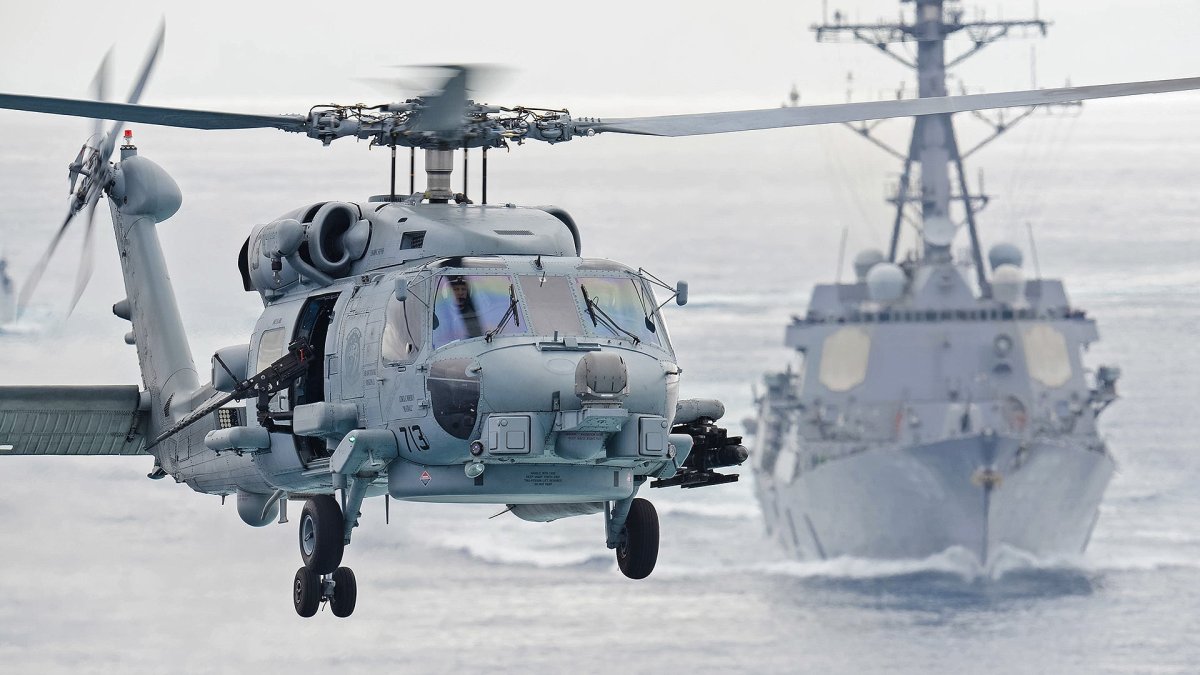
The vast majority of helicopters currently operated by the U.S. Navy are either MH-60R or MH-60S variants of the Seahawk airfram e, which is a marinized derivative of the UH-60 Blackhawk . These two variants of the Seahawk replaced three previous H-60 airframes in naval service, the SH-60B, SH-60F, and HH-60H. With thousands of hours at the controls of Seahawk helicopters, here are ten interesting facts and impressions based on my experience about flying these iconic aircraft, some of which you may have never heard before.
#1: The Seahawk is a really fun bird to fly
Powered by the GE T700 series of engines, the Seahawk has excellent power margins with extremely rapid transient power response. That’s a convoluted way of saying when you tell the bird to give you more power, it does so quickly. It’s also extremely agile for a helicopter of its size and features an advanced, but user-friendly autopilot system with both barometric and radar altimeter hold functions, which are very useful for long-duration flights at night over water.
The first time I flew in an SH-60F, I was amazed at how responsive the aircraft was, but also how stable it was. It was far easier to control than the much smaller TH-57 trainer version of the Bell Jet Ranger I learned on and presented itself as the perfect blend of power, responsiveness, and stability.
#2: The Seahawk is an extremely safe aircraft
Aviators love to fly aircraft at the limits of the performance envelope. It’s exhilarating to see what pilot and machine are capable of when approaching the extremes of human and mechanical performance. With that said, I always felt very safe operating the Seahawk at or near the operational limits of the airframe.
One of the reasons the Seahawk was such a safe bird to fly was by the time the Navy started flight testing the SH-60B in 1979, the Army, which had started flight testing the UH-60 in the mid-1970s, had already ironed out most of the serious problems with the airframe. By the time I started flying Seahawks in 1994, virtually every systemic mechanical defect had been identified and fixed. In terms of safety, it was truly a mature airframe.
Between 1994 and 2005, I flew just under 3,000 hours in Seahawks. During that time, the only systemic problem that manifested across the Seahawk fleet was a spate of engine rollbacks as a result of the introduction of Digital Electronic Control Units (DECU) for the engines in the mid to late 1990s. An engine rollback is where the Power Control Lever (PCL) is set to full forward, meaning the engine is trimmed to provide full power if required, but in response to a faulty signal from the DECU, the engine abruptly rolls back to an idle power setting. This was a bug of the DECU control system that was quickly identified and fixed, but still hit a number of engines in a relatively short amount of time.
As originally built, the Seahawk engines were equipped with an Engine Control Unit (ECU) that was purely a hydro mechanical control system. Every pilot input from the cockpit to the engine was transmitted via a contact switch, cable, or some other type of electrical or mechanical linkage to the ECU, which in turn governed the engine via analog mechanical inputs. The physical linkages and governing system were very effective, reliable, and safe, but were not fuel efficient and were maintenance intensive. The replacement of the ECU with the DECU was intended to improve fuel efficiency and overall reliability while reducing maintenance requirements. Eventually this was the case, but when first introduced, a number of DECU equipped engines malfunctioned. I was one of the guys who pulled a short straw and wound up flying a DECU equipped engine that suffered an in flight rollback.
It happened just off the coast of Egypt in 1997. I had a full load of internal cargo and passengers, flying into Cairo West in Egypt, a military airport that served as the hub for Operation Bright Star, a semi-annual multinational training event. Two minutes after takeoff, one of the engines suffered a DECU failure and rolled back to flight idle. The other engine had more than enough power for us to keep flying until the carrier could clear the fixed-wing aircraft out of the landing area and give us a clear deck. We executed a bit of a “rolling landing” to minimize the power required for recovery.
When all was said and done, the most remarkable aspect of the emergency was how calm it was. That’s the luxury of having robust engines that churn out a lot of excess power when required.
Seahawk making its approach to the carrier deck., USN
#3: The Seahawk is amazingly adaptable
The H-60 is an incredibly versatile airframe and Seahawk pilots have to stay proficient on a wide variety of missions. With the SH-60F optimized for ASW missions and the HH-60H optimized for Special Operations (SPECOPS) support, the training requirements seemed to play out on an endless loop. During 2003, in the space of a few months, I flew missions that included supporting Navy SEALS overland in Iraq, with a four-pack of AGM-114 Hellfire missiles on the port side pylon and a .50 caliber machine gun hanging out the starboard cabin door, standing Combat Search and Rescue (CSAR) strip alert, doing search and rescue missions over land and over water, carrying passengers and cargo to and from ship, and dropping torpedoes onto submerged practice targets. There was definitely never a dull day flying Seahawks, as there was always something challenging to train to or do.
HH-60H and SH-60F on deck., USN
#4: Older Seahawks were not built with night vision in mind
Night flying was challenging in the SH-60B and SH-60F because as-built, they were not night vision goggle (NVG) compatible. These two airframes went into production before NVGs were widely available in the fleet, and as a result, the engine instrument panel lights, as well as the warning and caution light panels in the cockpit, were illuminated with amber and red lights instead of NVG friendly blue or green lights.
For the readers who haven’t experienced this, early generation NVGs were susceptible to “blooming out” if yellow or red light came into the field of view. Even a small red light source could completely obscure the field of vision on these earlier model NVGs. To remedy this issue, the Navy issued NVG compatible “glare kits” that were essentially tinted glass panels that could be velcroed over the warning and caution light panel at night to make those lights somewhat NVG compatible.
Flying formation on NVGs in these airframes was also challenging since the standard navigation lights were installed, and were not NVG compatible. As a workaround to this problem, we attached green chemlights at various points around the airframe. While not optimal, this solution did provide for adequate visual reference to enable safe formation flight at night.
In contrast to the SH-60B and SH-60F, the HH-60H was built from the ground up with NVG compatibility in mind. All the instrument displays, as well as the warning and caution lights, were inherently NVG compatible so there was no light blooming in the NVGs. Additionally, the formation lights were NVG compatible as well, which made night formation flying much easier.
Seahawk through night vision., USN
#5: The Seahawk flew higher than its authorized service ceiling
Flying any helicopter at high altitude is an interesting experience, and while the Seahawk has nowhere near the high altitude performance of the CH-47 Chinook , it still can fly a lot higher than the authorized service ceiling of 10,000 feet. Because the H-60 does not have an onboard oxygen system, the Navy limits the maximum altitude to 10,000 feet above sea level as a safety measure, but when flying a lightly loaded Seahawk with no cargo or passengers, and something less than a full load of gas, you can easily get up to 15,000 feet.
At that altitude, the helicopter is sluggish and wallows, so you have to be very careful with control inputs. The engines work fine, but the air is not dense enough to give the rotor blades much “bite”. To be clear, I don’t recommend exceeding any operational or safety limit for any reason, but the fact is, almost every Naval Aviator I knew did so on occasion, usually with good reason.
A view of an earlier generation Seahawk cockpit. , USN
In one instance, we were headed to the Persian Gulf in January of 2003 aboard the USS Kitty Hawk (CV-63). One of the civilian contractors on the ship had a heart attack and we needed to immediately get him ashore to a hospital. We flew him into Phuket, Thailand, but the carrier was under orders to proceed at best possible speed. So, after we launched heading north and east into Thailand, the ship continued south and west through the Indian Ocean.
We dropped off our medical passenger in Phuket and immediately flew back towards the open ocean, hoping to get in touch with the carrier as soon as possible. The navigation equipment we were using was line-of-sight and at 10,000 feet we were not picking up any signal. The carrier was simply too far away. So, I kept climbing in increments of 500 feet, and eventually, at 14,500 feet we picked up the beacon and rode it home to the carrier, gradually descending all the way.
At that altitude, the helicopter was sluggish and slow to respond, but it was still controllable and safe. Given that my ship and squadron were headed off to a potential conflict zone, I felt like I was justified in exceeding altitude limits in order to get the aircraft and crew back aboard.
#6: The Seahawk does not hover in a level attitude
The normal no wind hover attitude for the SH-60B, SH-60F, and HH-60H was four to five degrees nose up and two to three degrees left wing down. This is slightly disorienting at first. It’s an odd sight picture, so Seahawk pilots quickly learn to incorporate peripheral vision and instrument scan to pick up any drift and establish a steady hover.
The glass cockpit of the next generation Seahawk, the MH-60S, as it hovers near USS Theodore Roosevelt’s island superstructure. , USN
#7: Flying the H-60 without hydraulic boost is not a pleasurable experience
On a regular basis, both in the simulator and the aircraft, we trained to respond to two loss of control emergencies, loss of hydraulic boost and loss of Stability Augmentation System (SAS). In the H-60 control system, the pilot inputs through the cyclic and collective are hydraulically boosted before being applied to the rotating and stationary swashplates at the main rotor head. Some smaller helicopters don’t need any hydraulic boost. Some larger helicopters, like the CH-53 , are impossible to fly without hydraulic boost. But the Seahawk was right in that sweet spot, where it was possible, but very difficult to fly the aircraft without hydraulic boost. Since this was such a difficult emergency to control, we practiced dealing with it on a regular basis.
Extended flight with hydraulic boost off was simply impossible. Flying the H-60 in boost off mode, especially in a hover, was physically exhausting. With a starboard crosswind, it took 75 pounds of left pedal force to maintain a directionally stable hover. The key was to establish a semi-stable hover as quickly as possible, then land as fast as you could because the longer you stayed in the hover, the more physically demanding it became. 75 pounds of force isn’t a lot, but the requirement to apply that force never goes away. Reducing that force at all will cause the nose of the aircraft to yaw back to the right. That’s just the requirement to control nose yaw with the left pedal. The cyclic and collective inputs are also unboosted.
An MH-60S flaring before touching down on the carrier., USN
The Seahawk was an incredibly responsive and agile aircraft, in some ways perhaps too responsive. The SAS function essentially “dampened” both the pilot inputs to the control system and external environmental inputs, like wind gusts. Whenever SAS was engaged, the aircraft was more stable. If the SAS function failed, the aircraft was still flightworthy, it just required that the pilot at controls make virtually continuous control inputs via both directional pedals, the collective, and the cyclic.
We often practiced hydraulic boost and SAS failures simultaneously in order to familiarize pilots with how difficult it was to fly under these conditions, and how imperative it was to land as soon as possible. We only practiced this compound, dual emergency in optimal conditions, during daylight, over land, on top of a large, smooth landing area—either a dedicated helicopter landing spot or a smooth grassy field.
SH-60F coming in hot., USN
#8: The Seahawk cannot refuel in-flight via refueling probe
Several land-based variants of the H-60, like the US Air Force HH-60G Pave Hawk, have in-flight refueling probes where they can get topped off in flight by a C-130 tanker. This is very useful in terms of mission planning as it provides significant operational flexibility. In contrast, Navy Seahawks do not have inflight refueling capability other than Hover In Flight Refuel (HIFR) , which is mostly used to extend time on station if the ship’s landing area is fouled with cargo. HIFR doesn’t appreciably extend mission range, either.
With the recent advent of in-flight refuelable E-2D Hawkeyes , every aircraft in the carrier air wing except the MH-60R and MH-60S are now capable of in-flight refueling. That makes fuel planning the first step of every at sea flight for Seahawks.
SH-60F head-on. , USN
In the case of the SH-60F, the Navy addressed this at least partially by giving it a massive fuel capacity, with a 590 gallon main tank, 105 gallon permanently installed internal auxiliary tank, and a standard configuration of a single 120 gallon external drop tank, resulting in a total max fuel load of 815 gallons, or approximately 5,500 pounds of gas.
In normal ops, we’d burn about 1,000 pounds an hour, so we would regularly operate with a 5.5 hour endurance at takeoff. In lieu of the permanently installed internal auxiliary tank on the SH-60F, the MH-60S is configured to take removable internal auxiliary tanks as required. This makes internal cargo and passenger operations in the MH-60S much more convenient if the internal auxiliary fuel tanks are not installed. Because the MH-60R has such extensive internal mission equipment, it is unable to take internal auxiliary fuel tanks, but has hardpoints and plumbing for two external drop tanks.
In any case, running out of gas in a helicopter over land is not nearly as exciting as running out of gas in a helicopter over the ocean, so normal practice at sea was to get gas at every ship we landed on, regardless of our final destination.
MH-60R hover in-flight refueling., USN
#9: Most the Seahawks have an odd tailwheel placement
The SH-60B, SH-60F, and HH-60H had a very odd tailwheel placement, located just aft of the main cabin. The MH-60R was also produced with that tailwheel placement. Shipboard landings, especially on smaller surface combatants , place a significant amount of stress on the airframe. Positioning the tailwheel closer to the rotor head reduces the stress on the tail boom. The MH-60S, however, has its tailwheel located in the same place as the Army and Air Force H-60s, at the far aft end of the airframe.
One of the advantages of having a tailwheel located just aft of the main cabin was, it yielded an incredibly tight turning radius, which is very useful for ground crews using tugs to maneuver the helicopter on congested flight decks. Some Naval Aviators are apparently still struggling to master the correspondingly larger radius of turn associated with a long tailwheel placement.
MH-60S with its traditional Blackhawk tailwheel seen during vertical replenishment operations., USN
#10: Seahawk has become a jack of all trades, but one, at least yet
While the H-60 is now the one size fits all solution to every Navy helicopter mission except airborne minesweeping, which is still the sole purview of the relatively small and chronically overtasked MH-53 fleet , it didn’t start out that way. The first H-60 variant the Navy procured was the SH-60B, which replaced the SH-2 Seasprite as the anti-submarine warfare (ASW) helicopter operating off of US Navy surface combatants in the Light Airborne Multi-Purpose System (LAMPS) role. It was several years later, in the mid-1980s, that the Navy started investigating replacements for the carrier-based SH-3 Sea King fleet. Eventually, the SH-60F was selected as the ASW helicopter operating off of carriers and was procured en masse starting in the late 1980s.
The SH-60F and the venerable Sea King it replaced. , USN
The SH-60B was designed as an over the horizon extension of the surface ship’s surveillance sensors. The primary sensor it carried was a surface search radar. Operating at altitudes up to 10,000 feet, the SH-60B could surveil thousands of square miles of the ocean’s surface and instantly transmit that data back to the surface ship. In contrast, the SH-60F was designed to provide inner zone defense against submarines for the carrier and was equipped with a powerful dipping sonar that could track submarines and provide targeting data for air or surface-launched torpedoes. Both versions of the Seahawk also carried expendable sonobuoys, which detect and track submarines by passive and active sonar sensors.
After the early success of the SH-60B and SH-60F Seahawks, the Navy expanded the model even further by procuring the HH-60H for Naval Special Warfare (NSW) support starting in the early 1990s. By the mid-1990s the Navy decided to divest itself of all legacy rotary wing airframes, including the UH-1 Huey, the SH-2 Seasprite, the SH-3 Sea King, and the CH-46 Sea Knight.
As far as the next generation of Seahawks, the MH-60R is equipped with cutting edge surveillance and data transmission capability. Even though the MH-60R is based on an airframe design that is quickly approaching the half-century mark in age, its mission equipment is brand new, making it the most technologically advanced Anti-Submarine Warfare (ASW) and Anti-Surface Warfare (ASuW) helicopter in the world today. It is equipped with a dizzying array of advanced sensors and weapons that enable it to search, locate, track, and engage targets above and below the sea surface.
Like its SH-60B predecessor, everything the MH-60R detects is immediately transmitted back to the ship via the Common Data Link (CDL) Hawklink. That data is collected by a variety of sensors including the AAS-44 Forward-Looking Infrared (FLIR), the APS-147 multi-mode radar with Synthetic Aperture Radar (SAR) imaging and periscope detection modes, the AQS-22 Airborne Low Frequency Sonar (ALFS) , and the ALQ-210 Electronic Support Measures (ESM) system for passive detection, location ,and identification of RF emitters. In addition to the onboard sensors, the MH-60R can also carry expendable sonobuoys for detecting and tracking submarines. Finally, in addition to all the sensors, the MH-60 packs a powerful punch with the ability to carry lightweight torpedoes , Hellfire missiles , and door-mounted machine guns.
MH-60R “Romeos” in formation., Sikorsky
In contrast to the ASW and ASuW mission of the MH-60R, the MH-60S is essentially a flying truck, with the ability to carry cargo both internally or externally via sling load . With a secondary mission of Search and Rescue (SAR), the MH-60S has plenty of internal room to carry rescue swimmers and medical personnel. In a design nod to supporting special operations, the MH-60S was built with the same dedicated door gunner window stations that the Army H-60 Blackhawks have, so the cargo doors on both sides can be used to onload and offload personnel at the same time door gunners are laying down suppressing fire via the window stations.
Overall, the MH-60S has much less advanced equipment than the MH-60R, but it does have one very unique and highly advanced piece of equipment, the Airborne Laser Mine Detection System (ALMDS). Along with its logistic and SAR roles, the MH-60S was also originally intended to replace the MH-53 Sea Dragon in its role as an airborne minesweeper, pulling a sled that detected, disabled, or detonated mines. Unfortunately, the minesweeping equipment that the MH-53 operated with ease was just too big for the MH-60S and other towed solutions have not panned out, so instead of using towed equipment, the MH-60S uses the ALMDS to perform the mine detection part of the mission.
ALMDS fitted on an MH-60S., USN
It’s been 40 years since the Navy made the first test flight of an SH-60B in 1979 and the Seahawk remains a great aircraft to this day. With the fleet full of new build advanced MH-60R and MH-60S types, it will be around for at least another 20 years, and probably much longer.
Contact the editor: Tyler@thedrive.com
Comments couldn’t be loaded. Please refresh the page.
更新于美国东部时间2019年12月1日上午6:05
目前美国海军使用的绝大多数直升机都是“海鹰”系列直升机的MH-60R或MH-60S型号,而“海鹰”系列直升机又是UH-60“黑鹰”的舰载衍生机型。这两种型号的“海鹰”取代了之前海军服役的三种H-60机型:SH-60B、SH-60F和HH-60H。我驾驶“海鹰”直升机累计飞行了数千小时,以下是我根据自身飞行经验总结的十个关于这些标志性飞机的有趣事实和感想,其中一些你可能从未听说过。
#1:海鹰是一种非常有趣的飞行器。
海鹰直升机搭载GE T700系列发动机,拥有卓越的动力储备和极快的瞬态动力响应。简单来说,就是当你发出增加动力的指令时,它会迅速响应。对于同尺寸的直升机而言,它的机动性也极其出色,并配备了先进且易于使用的自动驾驶系统,该系统具备气压高度计和雷达高度计双重保持功能,这对于夜间水面长时间飞行非常实用。
我第一次乘坐SH-60F时,就被它的操控响应速度和稳定性深深震撼。它比我之前学习飞行的贝尔喷气游骑兵TH-57教练机要容易操控得多,堪称动力、响应速度和稳定性的完美结合。
#2:海鹰是一款极其安全的飞机。
飞行员喜欢驾驶飞机挑战性能极限。当飞行员和飞机接近人类和机械性能的极限时,那种感觉令人兴奋。话虽如此,我始终觉得在海鹰飞机接近或达到其性能极限时非常安全。
海鹰直升机飞行安全性极高的原因之一是,当海军于1979年开始对SH-60B进行飞行测试时,陆军早在20世纪70年代中期就开始对UH-60进行飞行测试,并已解决了该机型的大部分严重问题。到我1994年开始驾驶海鹰直升机时,几乎所有系统性的机械缺陷都已被发现并修复。就安全性而言,它确实是一款非常成熟的机型。
1994年至2005年间,我驾驶海鹰直升机飞行了近3000小时。在此期间,海鹰机队唯一出现的系统性问题是,由于20世纪90年代中后期引入了数字电子控制单元(DECU),导致发动机频繁出现怠速回落现象。发动机怠速回落是指动力控制杆(PCL)处于全开位置,这意味着发动机已调整至可提供全功率输出,但由于DECU发出错误信号,发动机突然回落至怠速功率设置。这是DECU控制系统的一个缺陷,很快就被发现并修复,但仍然在相对较短的时间内影响了相当数量的发动机。
最初设计的“海鹰”战斗机发动机配备的是一个纯液压机械控制系统——发动机控制单元(ECU)。飞行员从驾驶舱向发动机发出的所有指令都通过触点开关、电缆或其他类型的电气或机械连接传输到ECU,ECU再通过模拟机械输入来控制发动机。这种物理连接和控制系统非常有效、可靠且安全,但燃油效率低下且维护成本高。用DECU取代ECU的目的是为了提高燃油效率和整体可靠性,同时降低维护需求。最终目标得以实现,但在DECU刚推出时,一些配备DECU的发动机出现了故障。我就是其中之一,不幸抽到了下下签,驾驶的这架配备DECU的飞机在飞行中发生了滑行。
事情发生在1997年埃及近海。当时我驾驶的飞机满载内部货物和乘客,飞往埃及开罗西机场。开罗西机场是军用机场,也是“明亮之星行动”(Operation Bright Star)的枢纽机场,这是一项每半年举行一次的多国联合训练活动。起飞两分钟后,其中一台发动机的DECU(动力控制单元)发生故障,滑行至怠速状态。另一台发动机动力充足,足以让我们继续飞行,直到航母将这架固定翼飞机从着陆区清空,腾出空位。为了尽量减少恢复着陆所需的动力,我们采取了一种“滑行着陆”的方式。
总而言之,这次紧急情况最令人惊讶的是现场异常平静。这得益于拥有动力强劲、必要时能输出大量额外动力的发动机。
“海鹰”号正在接近航母甲板。(美国海军)
#3:海鹰队拥有惊人的适应能力
H-60 是一款用途极其广泛的机型,海鹰飞行员必须熟练掌握各种任务。SH-60F 专为反潜作战 (ASW) 任务优化,而 HH-60H 则专为特种作战 (SPECOPS) 支援而优化,因此训练要求似乎永无止境。2003 年,短短几个月内,我执行的任务包括:在伊拉克陆地上支援海军海豹突击队,当时左舷挂架上挂载了四枚 AGM-114 地狱火导弹,右舷舱门外伸出一挺 .50 口径机枪;保持战斗搜救 (CSAR) 警戒;执行陆地和水上搜救任务;往返舰船运送乘客和货物;以及向水下训练目标投掷鱼雷。驾驶海鹰直升机绝不会感到枯燥乏味,因为总有充满挑战性的训练或任务需要完成。
甲板上停放着HH-60H和SH-60F直升机,美国海军
#4:老款海鹰队球衣的设计并没有考虑到夜视功能。
SH-60B 和 SH-60F 的夜间飞行极具挑战性,因为它们出厂时并未配备夜视镜 (NVG)。这两款机型投入生产时,夜视镜尚未在机队中广泛普及,因此,发动机仪表盘指示灯以及驾驶舱内的警告灯和警示灯均采用琥珀色和红色灯光,而非夜视镜适用的蓝色或绿色灯光。
对于没有亲身经历过的读者,早期夜视镜如果视野中出现黄色或红色光线,就会出现“光晕”。即使是很小的红色光源,也会完全遮蔽早期夜视镜的视野。为了解决这个问题,海军配发了与夜视镜兼容的“防眩光套件”,本质上是一些有色玻璃面板,可以在夜间用魔术贴将其覆盖在警示灯面板上,使这些灯在一定程度上与夜视镜兼容。
在这些机型上使用夜视镜进行编队飞行也极具挑战性,因为这些机型安装的是标准导航灯,而这些导航灯与夜视镜不兼容。为了解决这个问题,我们在机身周围的不同位置安装了绿色化学发光棒。虽然这并非最佳方案,但该方案确实提供了足够的视觉参考,从而确保了夜间编队飞行的安全。
与SH-60B和SH-60F不同,HH-60H从设计之初就充分考虑了与夜视镜的兼容性。所有仪表显示器以及警告灯和警示灯都与夜视镜兼容,因此不会出现夜视镜光晕现象。此外,编队灯也与夜视镜兼容,这大大简化了夜间编队飞行。
通过夜视仪观察海鹰。美国海军
#5:海鹰战机飞行高度超过了其核定的使用高度
在高空驾驶任何直升机都是一种有趣的体验,虽然海鹰直升机的高空性能远不及CH-47“支奴干”直升机,但它的飞行高度仍然远超10,000英尺的法定飞行高度上限。由于H-60没有机载氧气系统,海军出于安全考虑将其最大飞行高度限制在海平面以上10,000英尺,但如果驾驶的是轻载的海鹰直升机,没有载货或乘客,并且燃油量也低于满载,则可以轻松飞到15,000英尺的高度。
在那个高度,直升机行动迟缓,机身摇晃,所以操控时必须格外小心。发动机运转正常,但空气密度不足,旋翼无法获得足够的抓地力。需要说明的是,我并不建议出于任何原因超越任何操作或安全限制,但事实上,我认识的几乎所有海军飞行员都偶尔会这样做,而且通常都有充分的理由。
早期海鹰战斗机驾驶舱的景象。(美国海军)
有一次,2003年1月,我们乘坐“小鹰”号航空母舰(CV-63)前往波斯湾。舰上的一名平民承包商突发心脏病,我们需要立即将他送上岸送往医院。我们用飞机将他送到了泰国普吉岛,但航母接到命令要以最快的速度继续航行。因此,在我们起飞向北偏东进入泰国后,航母继续向南偏西穿越印度洋。
我们在普吉岛放下了医疗乘客,立即飞回公海,希望能尽快与承运人取得联系。我们使用的导航设备是视距导航,在10000英尺的高度上,我们收不到任何信号。承运人距离我们实在太远了。于是,我每次爬升500英尺,最终在14500英尺的高度接收到了信标信号,然后借助信标信号返回承运人处,一路缓慢下降。
在那个高度,直升机反应迟缓,操控性也较差,但仍然可控且安全。考虑到我的舰艇和中队正前往潜在的冲突地区,我觉得为了让飞机和机组人员安全返回舰上,我有理由突破高度限制。
#6:海鹰不会保持水平姿态。
SH-60B、SH-60F 和 HH-60H 在无风状态下的正常悬停姿态是机头上仰 4 到 5 度,左翼下倾 2 到 3 度。这种姿态起初会让人略感不适应。由于视野较为特殊,海鹰飞行员需要迅速学会运用周边视觉和仪表扫描来捕捉任何漂移,从而建立稳定的悬停姿态。
下一代海鹰直升机MH-60S的玻璃座舱,正悬停在“西奥多·罗斯福”号航空母舰的舰岛上层建筑附近。(美国海军)
#7:驾驶没有液压助力的H-60直升机可不是什么愉快的体验。
我们定期在模拟器和飞机上进行训练,以应对两种失控紧急情况:液压助力失效和稳定性增强系统(SAS)失效。在H-60的控制系统中,飞行员通过周期变距杆和总距杆输入的指令会先经过液压助力,然后再传递到主旋翼头的旋转和固定斜盘上。一些小型直升机不需要液压助力。而一些大型直升机,例如CH-53,如果没有液压助力就无法飞行。但海鹰直升机恰好处于一个微妙的平衡点,虽然没有液压助力也能飞行,但难度极大。由于这种紧急情况难以控制,我们定期进行应对训练。
关闭液压助力后,长时间飞行根本不可能。驾驶H-60在关闭助力模式下飞行,尤其是在悬停状态下,会非常消耗体力。在右舷侧风的情况下,需要用左脚蹬施加75磅的力才能保持方向稳定的悬停。关键在于尽快建立半稳定的悬停状态,然后尽快着陆,因为悬停时间越长,对体力的要求就越高。75磅的力虽然不大,但必须持续施加这个力。稍微减小这个力就会导致机头向右偏航。这仅仅是因为需要用左脚蹬来控制机头偏航。此外,周期杆和总距杆的输入也处于关闭状态。
一架MH-60S直升机在航母着陆前发射照明弹。(美国海军)
海鹰战机反应极其灵敏,在某些方面甚至过于灵敏。SAS功能本质上是“抑制”飞行员对控制系统的输入以及外部环境输入,例如阵风。启用SAS功能后,飞机的稳定性会更高。即使SAS功能失效,飞机仍然可以飞行,只是飞行员需要通过方向舵、总距杆和周期杆进行几乎持续不断的控制输入。
我们经常进行液压助力和SAS系统同时失效的演练,目的是让飞行员熟悉在这种情况下飞行有多么困难,以及尽快着陆有多么重要。我们只在最佳条件下,于白天,在陆地上,在一块宽阔平坦的着陆区(可以是专用直升机停机坪,也可以是平坦的草地)进行这种复合型双重紧急情况的演练。
SH-60F 猛烈袭来,美国海军
#8:海鹰战机无法通过空中加油探管进行空中加油。
H-60的几种陆基改进型,例如美国空军的HH-60G“铺路鹰”,都配备了空中加油探管,可以接受C-130加油机的空中加油。这对于任务规划来说非常有用,因为它提供了显著的作战灵活性。相比之下,海军的“海鹰”直升机除了悬停空中加油(HIFR)之外,没有其他空中加油能力。HIFR主要用于在舰载机着陆区被货物堵塞时延长任务停留时间,而且也无法显著延长航程。
随着近期可进行空中加油的E-2D“鹰眼”预警机的出现,除MH-60R和MH-60S之外,航母舰载机联队中的所有飞机现在都具备了空中加油能力。这使得燃油规划成为“海鹰”战机每次海上飞行的第一步。
SH-60F 正面照。,美国海军
以 SH-60F 为例,海军至少部分地解决了这个问题,为其配备了巨大的燃料容量,包括一个 590 加仑的主油箱、一个 105 加仑的永久安装的内部辅助油箱,以及一个标准的 120 加仑外部副油箱,从而实现了 815 加仑的最大燃料装载量,或大约 5,500 磅汽油。
在正常作战情况下,我们每小时大约消耗1000磅燃油,因此起飞后的续航时间通常为5.5小时。与SH-60F固定安装的内部辅助油箱不同,MH-60S可根据需要加装可拆卸的内部辅助油箱。这使得在不安装内部辅助油箱的情况下,MH-60S的内部货物和乘客运输作业更加便捷。由于MH-60R内部搭载了大量任务设备,因此无法加装内部辅助油箱,但它配备了两个外挂点和管路,可用于挂载两个外部副油箱。
总之,直升机在陆地上没油远不如直升机在海洋上没油那么刺激,所以海上通常的做法是,无论最终目的地是哪里,每到一个船上都会加油。
MH-60R悬停空中加油,美国海军
#9:大多数海鹰队的飞机尾轮位置都很奇特
SH-60B、SH-60F 和 HH-60H 的尾轮位置非常特殊,位于主座舱后方。MH-60R 也采用了这种尾轮位置。舰载起降,尤其是在小型水面作战舰艇上,会对机身造成相当大的压力。将尾轮靠近旋翼头可以降低尾梁的压力。然而,MH-60S 的尾轮位置与陆军和空军的 H-60 系列相同,位于机身尾部。
尾轮位于主舱后方的一大优势在于其极小的转弯半径,这对于使用牵引车在拥挤的飞行甲板上操控直升机的地勤人员来说非常有用。一些海军飞行员显然仍在努力适应尾轮位置较长所带来的较大转弯半径。
MH-60S直升机配备传统的黑鹰尾轮,正在执行垂直补给任务。(美国海军)
#10:海鹰已经成了万事通,但至少目前为止,他只擅长一项。
虽然H-60如今已成为海军除空中扫雷任务之外所有直升机任务的万能解决方案(空中扫雷任务仍由规模相对较小且长期超负荷运转的MH-53机队独家承担),但它并非一开始就如此。海军采购的首款H-60衍生机型是SH-60B,它取代了SH-2“海妖”(Seasprite),成为美国海军水面作战舰艇上执行轻型空中多用途系统(LAMPS)任务的反潜作战(ASW)直升机。几年后,在20世纪80年代中期,海军开始寻找替代舰载SH-3“海王”(Sea King)机队的机型。最终,SH-60F被选中作为舰载反潜作战直升机,并从20世纪80年代末开始大规模采购。
SH-60F及其取代的久经沙场的“海王”直升机。(美国海军)
SH-60B的设计初衷是作为水面舰艇监视传感器的超视距延伸。它搭载的主要传感器是水面搜索雷达。SH-60B可在高达10,000英尺(约3,000米)的高度运行,监视数千平方英里(约340平方公里)的海面,并将数据即时传输回水面舰艇。相比之下,SH-60F的设计目的是为航母提供近海区域反潜防御,它配备了强大的吊放式声呐,可以追踪潜艇并为空射或水面发射的鱼雷提供目标数据。两种型号的“海鹰”直升机都携带一次性声呐浮标,这些浮标利用被动和主动声呐传感器探测和追踪潜艇。
在SH-60B和SH-60F“海鹰”直升机早期取得成功后,海军进一步扩大了该型号的规模,从20世纪90年代初开始采购HH-60H用于海军特种作战(NSW)支援。到20世纪90年代中期,海军决定淘汰所有老旧的旋翼机,包括UH-1“休伊”、SH-2“海妖”、SH-3“海王”和CH-46“海骑士”。
就下一代海鹰直升机而言,MH-60R配备了尖端的监视和数据传输能力。尽管MH-60R基于一款已接近半个世纪历史的机身设计,但其任务设备却是全新的,使其成为当今世界上技术最先进的反潜和反水面作战直升机。它配备了种类繁多的先进传感器和武器,使其能够搜索、定位、跟踪和打击海面上下的目标。
与前身SH-60B一样,MH-60R探测到的所有信息都会立即通过通用数据链(CDL)“鹰链”(Hawklink)传输回舰艇。这些数据由多种传感器收集,包括AAS-44前视红外(FLIR)雷达、具备合成孔径雷达(SAR)成像和潜望镜探测模式的APS-147多模式雷达、AQS-22机载低频声呐(ALFS)以及用于被动探测、定位和识别射频发射器的ALQ-210电子支援措施(ESM)系统。除了机载传感器外,MH-60R还可以携带一次性声呐浮标,用于探测和跟踪潜艇。最后,除了上述所有传感器外,MH-60还拥有强大的火力,能够携带轻型鱼雷、地狱火导弹和舱门机枪。
MH-60R“罗密欧”编队,西科斯基
与MH-60R的反潜和反水面作战任务不同,MH-60S本质上是一辆飞行卡车,能够通过吊挂方式进行内部或外部货物运输。MH-60S还承担着搜救(SAR)的辅助任务,其内部空间充足,足以搭载救援游泳员和医务人员。为了更好地支持特种作战,MH-60S采用了与陆军H-60黑鹰直升机相同的专用舱门机枪手窗口站,因此两侧的货舱门可以同时用于人员上下机,而舱门机枪手则可以通过窗口站进行火力压制。
总体而言,MH-60S 的装备远不如 MH-60R 先进,但它却拥有一项非常独特且高度先进的装备——机载激光扫雷系统 (ALMDS)。除了后勤和搜救任务外,MH-60S 最初的设计用途还包括取代 MH-53 海龙直升机,执行空中扫雷任务,拖曳扫雷车来探测、拆除或引爆水雷。然而,MH-53 能够轻松操作的扫雷设备对于 MH-60S 来说体积过大,而其他拖曳式解决方案也未能成功,因此 MH-60S 最终放弃了拖曳式设备,转而使用 ALMDS 来执行扫雷任务。
美国海军MH-60S直升机上安装了ALMDS系统。
自1979年海军首次试飞SH-60B“海鹰”直升机以来,已经过去了40年,“海鹰”至今仍然是一款优秀的飞机。随着海军机队中大量新型先进的MH-60R和MH-60S型直升机的服役,SH-60B至少还能再服役20年,甚至可能更久。
联系编辑:Tyler@thedrive.com
评论加载失败,请刷新页面。