The B-52 Almost Got An Ahead Of Its Time Air-Launched Ballistic Missile Named SkyboltB-52轰炸机差点就配备了一款名为“天箭”(Skybolt)的超前于时代的空射弹道导弹。
Air-launched ballistic missiles are back in vogue now, so it's worth remembering that the Air Force was looking to adopt one more than 50 years ago.
新闻视频
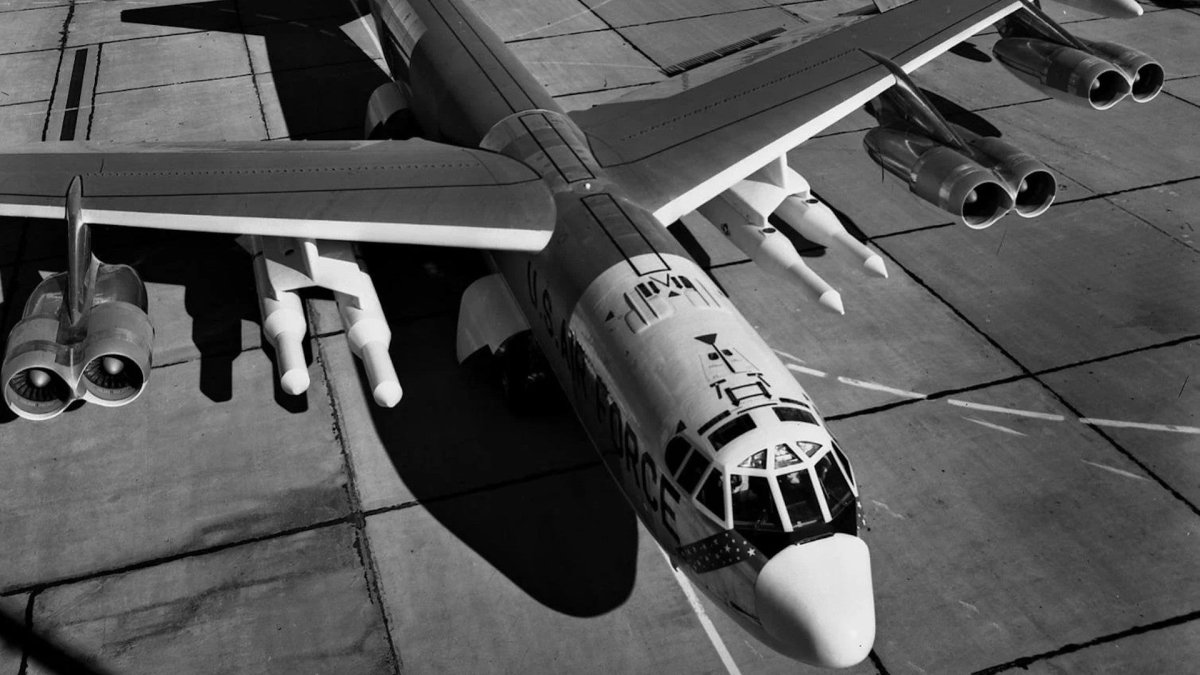
By Joseph Trevithick
Updated Jan 23, 2020 1:13 PM EST
Interest in air-launched ballistic missiles has seen something of a renaissance around the world in recent years, notably in Russia , China , and Israel . At the same time, the U.S. Air Force is in the process of developing new, large, long-range, air-launched hypersonic weapons for its B-52 bombers that have similar general form factors to more traditional air-launched ballistic missile designs. However, the concept is nothing new and Air Force was planning to adopt a nuclear-tipped air-launched ballistic missile, known as the Skybolt, as a payload for its B-52s more than 50 years ago.
In 1959, the Douglas Aircraft company won the U.S. Air Force’s first contract, worth $3 million at the time, or nearly $26.4 million today, to conduct an initial design study for Skybolt , which was originally known simply as Weapon System 138A , or WS-138A. Douglas subsequently subcontracted with Northrop, Aerojet, and General Electric to develop the guidance system, rocket motor, and reentry vehicle for the weapon, respectively.
The Air Force had first begun laying the groundwork for Skybolt after the U.S. Navy began the development of the Polaris submarine-launched ballistic missile in 1956. There were fears within the former service that Polaris would obviate the need for strategic bombers, compounded by separate and growing concerns about the expanding capabilities and general density of Soviet air defenses.
In 1957, the Air Force had initiated its first foray into the development of an air-launched ballistic missile as part of the Weapon System 199 program , or WS-199. Under WS-199, in November 1958, a modified B-47 Stratojet bomber successfully launched an experimental air-launched ballistic missile test article called Bold Orion , which the Martin company had designed, for the first time. The next month, another B-47 fired a two-stage Bold Orion prototype. Days after that test, a B-58 Hustler bomber conducted the first launch a different prototype design from Convair and Lockheed, known as High Virgo . McDonnell also built a missile for WS-199, the Alpha Draco , but it was never air-launched.
A Bold Orion missile, an immediate predecessor to the Skybolt, mounted on a B-47 bomber., via spaceline.org
High Virgo suffered a number of failures during testing between 1958 and 1959, largely due to its guidance and communications systems, and never flew farther than 310 miles, according to a report the Federation of American Scientists published in 2019. Bold Orion, however, successfully completed 11 of 12 test launches and the two-stage version demonstrated a maximum range of over 990 miles.
The WS-138A program leveraged the experience gained during these experiments in the development of Skybolt, which the Air Force subsequently also designated GAM-87A. In February 1960, the Air Force authorized another $32 million, or around $281.1 million today’s dollars, for Douglas to move beyond the design stage and actually begin building prototype weapons.
Douglas’ final Skybolt design was a two-stage ballistic missile, similar in broad concept to the Bold Orion. The weapon was more than 38 feet long with its aerodynamic tail cap and 35 inches in diameter. This actually made it shorter than North American’s GAM-77A Hound Dog air-launched cruise missile, which the Air Force had already put into service in 1960 as an interim standoff weapon for the B-52 ahead of the introduction of the GAM-87A.
After launch, the GAM-87A’s tail cap would fall away and the first stage rocket motor would ignite, boosting it into a ballistic trajectory. That stage would then fall away and the second stage would take over with rocket motor with “a gimballed nozzle allowing it to maneuver in the upper reaches of the atmosphere and the vacuum of space where control surfaces cannot function,” according to the Federation of American Scientists’ report . An inertial guidance system would steer the weapon toward the target.
The GAM-87A’s primary armament was originally going to be single W47 thermonuclear warhead , the same one used on Polaris, but this was eventually changed to a W59 , the same warhead on the Minuteman silo-launched intercontinental ballistic missile. The Air Force’s desired maximum range for Skybolt was approximately 1,150 miles, with an apogee around 300 miles high.
Reaching a peak speed of Mach 15, the missile would have been able to cover this distance in just 12 minutes, according to the Federation of American Scientists . The weapon’s range and speed would have allowed B-52s to strike deep into Soviet territory, while also reducing the bombers’ vulnerability to hostile fighter jets and surface-to-air missiles. Being able to strike quickly and from multiple and unpredictable vectors at once offered significant advantages over ground-based ballistic missiles in fixed emplacements or silos . This was also true of the submarine-launched Polaris.
The United Kingdom, which was facing similar concerns about the vulnerability of its strategic bombers, had asked to and was allowed to join the Skybolt program in 1960. The Avro Vulcan , one of the Royal Air Force’s three so-called “V bombers,” the others being the Handley Page Victor and the Vickers Valiant , was chosen to be the primary launch platform. The Victor and a modified Vickers VC10 airliner , which the Royal Air Force also operated as an aerial refueling tanker, were also considered as possible GAM-87A carriers, according to V Force – The History of Britain’s Airborne Deterrent .
However, despite the clear interest and commitment of both the U.S. Air Force and the U.K. Royal Air Force, Skybolt quickly ran into technical difficulties and setbacks. In 1959, the Air Force had already canceled work on a more powerful B-58B Hustler variant, which was initially expected to be the primary launch platform for the GAM-87A, shifting focus to integrating the weapon on the B-52. Beyond the missile itself, Douglas needed to develop a new, specialized heavyweight pylon so the B-52 could carry two Skybolts under each wing, as well as loading equipment large enough to handle the weapons.
A schematic of the special wing pylon for the B-52, which could carry two Skybolt missiles., Douglas
The special trailing for positioning two missiles underneath the pylon in order to load them, with an operator shown giving a sense of the scale of the system., Douglas
The Skybolt “program office asserted [the weapon] was ‘the most complex ballistic missile system ever to be developed by the United States’ due to the difficulty of launching the missile from a moving platform, the need to integrate the missile with the aircraft to in order to know its launch position precisely, and the need to operate in environments that could subject the missile to shock, vibrations, and rapidly changing conditions,” according to the Federation of American Scientists . “President Kennedy himself even stated that the system was ‘the most sophisticated weapon imaginable,’ involving ‘the kind of engineering that’s been beyond us.'”
The first five flight tests failed in some fashion or another. In the first test in January 1962, the second-stage motor failed to ignite and the first-stage motor didn’t work in the second attempt. An electrical failure scuttled the third test and a data link failed during the fourth launch, precluding the collection of telemetry data to determine whether the missile had performed as intended. The fifth test launch, the first to actually involve a missile with a functioning guidance system, experienced failures with the weapon’s gas generator and hydraulic subsystem “causing flight to end prematurely,” according to an official, now-declassified internal Air Force history .
The sixth launch, which took place on Dec. 22, 1962, was successful, but only saw the weapon fly out to a range of 800 miles, 350 miles short of the Air Force’s desired maximum range. By that point, under the new U.S.-military wide designation system that had gone into effect that year, Skybolt had gotten redesignated from GAM-87A to AGM-48A.
Faced with the prospect of rising costs, including more than $1 billion in 1960s dollars to buy over one thousand of the missiles, and delays, then-Secretary of Defense Robert McNamara killed the program the very next day. He also said he felt that air-launched ballistic missiles offered “ no unique capability ,” especially over Polaris. By the end of the month, the Air Force had stopped all work on Skybolt.
This quickly caused a crisis with the United Kingdom, which had canceled its own Blue Streak nuclear-armed air-launched ballistic missile program, as well as plans for an upgraded Blue Steel II standoff missile in favor of Skybolt. The country had also decided to begin retiring its American-supplied Thor ground-launched intermediate-range ballistic missiles. Skybolt was to form the core of the U.K.’s nuclear deterrent capabilities for years to come. The U.S. government subsequently agreed to supply Polaris missiles, which the Royal Navy would employ from its new Resolution class ballistic missile submarines.
For the Air Force, the decision was certainly a rebuke, but the impact was decidedly less extreme. The service did still have the Hound Dog, by that point redesignated the AGM-28A, which would remain in service until 1976. Despite McNamara’s dismissal of the air-launched ballistic missile as a basic concept and his clear support for Polaris, strategic bombers never went away. In the 1970s, the B-52 also gained a new nuclear missile, the AGM-69A Short Range Attack Missile (SRAM), as well, to help reduce its vulnerability to hostile air defenses.
Had the time come, Air Force B-52s would have flown to their targets, at low levels to help further mask their approach, attacking air defense sites with SRAMs along the way. You can read more about the AGM-69A in this past War Zone piece . This eventually gave way to more modern air-launched cruise missiles, such as the AGM-86B and AGM-129 Air-Launched Cruise Missile. At present, the AGM-86B is the only nuclear weapon the B-52 is authorized to carry , though it is expected to gain a new stealthy air-launched and nuclear-armed cruise missile in the coming years.
The U.S. military did briefly return to the air-launched ballistic missile concept in the early 1970s, going so far as to conduct a successful test involving the launch of an LGM-30 Minuteman intercontinental ballistic missile, typically fired from a silo, from a C-5 Galaxy transport aircraft over the Pacific Ocean in 1974. The launch concept involved releasing the missile out of the back of the massive airlifter, after which a set of parachute oriented the missile into a near-vertical launch position. The missile’s main rocket motor then fired, carrying it to an apogee of 20,000 feet, before it fell into the sea below.
The United States ultimately abandoned its air-launched Minuteman plans for good during negotiations with the Soviet Union over the Strategic Arms Limitation Talks (SALT) treaty. However, the U.S. military has continued to use a similar procedure to launch ballistic missile surrogates from C-17 airlifters in support of missile defense system tests.
As it stands now, the B-52 is still set to become a major launch platform for oversized weapons once again, but, at least for the moment, the plan is for these to have conventional warheads. Last year, one of these bombers conducted its first flight with a test article being used in the development of the AGM-183A Air-launched Rapid Response Weapon, or ARRW. This weapon looks very much like an air-launched ballistic missile, but has a hypersonic boost-glide vehicle as a payload that is capable of maneuvering inside the atmosphere at extreme speeds. The Air Force is looking to integrate other boost-glide vehicles, as well as air-breathing hypersonic missiles onto the B-52 in the future and is in the process of developing new heavyweight pylons to better accommodate these and other very large weapons in the future.
Other countries have also been seizing on the concept and have put their own weapons into service, or appear to be getting close to that goal. Russia says it has deployed a limited number of Kh-47M2 Kinzhal air-launched ballistic missiles, a derivative of the ground-launched Iskander-M, as well as modified MiG-31K aircraft to launch them. China has also shown off its H-6N bomber, which is specifically designed to carry oversized payloads, possibly including the DF-21D air-launched ballistic missile and the WZ-8 high-speed reconnaissance drone. Companies in Israel are developing Rampage and Rocks , which are smaller air-launched ballistic missiles intended for fighter jet-sized aircraft.
So, more than five decades after Skybolt’s inglorious end, not only has the B-52 endured, the Air Force is now closer than ever to actually fielding similarly large, long-range weapons that use rocket boosters on the bombers. Other countries are now moving in the same direction, showing that Douglas’ air-launched ballistic missile was, in many ways, ahead of its time.
Contact the author: joe@thedrive.com
Comments couldn’t be loaded. Please refresh the page.
作者:约瑟夫·特雷维西克
更新于美国东部时间2020年1月23日下午1:13。
近年来,世界各地对空射弹道导弹的兴趣有所复苏,尤其是在俄罗斯、中国和以色列。与此同时,美国空军正在为其B-52轰炸机研发新型大型远程空射高超音速武器,其外形与传统的空射弹道导弹设计类似。然而,这一概念并非全新,早在50多年前,美国空军就计划为其B-52轰炸机配备一种名为“天箭”(Skybolt)的核弹头空射弹道导弹。
1959年,道格拉斯飞机公司赢得了美国空军的第一份合同,当时价值300万美元,相当于今天的近2640万美元,用于对“天箭”(Skybolt)进行初步设计研究。“天箭”最初被称为138A型武器系统,或WS-138A。随后,道格拉斯公司分别与诺斯罗普公司、Aerojet公司和通用电气公司签订分包合同,由这三家公司分别开发该武器的制导系统、火箭发动机和再入飞行器。
1956年,美国海军开始研发北极星潜射弹道导弹后,美国空军便开始着手研发“天箭”导弹。当时,美国空军内部有人担心北极星导弹会使战略轰炸机失去必要性,此外,苏联防空系统能力和密度的不断提升也加剧了这种担忧。
1957年,美国空军启动了武器系统199(WS-199)计划,首次尝试研发空射弹道导弹。1958年11月,在WS-199计划下,一架改装的B-47“同温层喷气”轰炸机成功发射了由马丁公司设计的名为“大胆猎户座”(Bold Orion)的实验性空射弹道导弹。次月,另一架B-47轰炸机发射了一枚两级“大胆猎户座”原型导弹。几天后,一架B-58“盗贼”轰炸机首次发射了由康维尔和洛克希德公司联合设计的另一种原型导弹,名为“高处女座”(High Virgo)。麦克唐纳公司也为WS-199计划制造了一款名为“阿尔法天龙”(Alpha Draco)的导弹,但该导弹从未进行过空射。
图片来自spaceline.org,展示了一枚“大胆猎户座”(Bold Orion)导弹,它是“天箭”(Skybolt)导弹的直接前身,挂载在一架B-47轰炸机上。
根据美国科学家联盟 2019 年发布的一份报告,高处女座飞船在 1958 年至 1959 年的测试中遭遇了多次失败,主要原因是其制导和通信系统存在问题,而且从未飞行超过 310 英里。然而,大胆猎户座飞船成功完成了 12 次测试发射中的 11 次,其两级版本展示了超过 990 英里的最大射程。
WS-138A项目充分利用了这些实验中积累的经验,开发出了“天箭”(Skybolt)导弹,空军随后也将其命名为GAM-87A。1960年2月,空军批准了3200万美元(相当于今天的约2.811亿美元)的拨款,用于道格拉斯公司推进项目,使其超越设计阶段,开始实际制造原型武器。
道格拉斯公司最终设计的“天箭”(Skybolt)导弹是一款两级弹道导弹,其总体概念与“大胆猎户座”(Bold Orion)导弹类似。该导弹连同其气动尾翼总长超过38英尺(约11.6米),直径为35英寸(约89厘米)。这实际上比北美航空公司的GAM-77A“猎犬”(Hound Dog)空射巡航导弹要短,而美国空军早在1960年就已将GAM-77A投入使用,作为B-52轰炸机在GAM-87A导弹服役前的过渡性防区外武器。
发射后,GAM-87A的尾盖会脱落,第一级火箭发动机点火,将其推入弹道轨道。随后第一级脱落,第二级接替其工作,第二级火箭发动机配备“万向节喷嘴,使其能够在大气层上层和太空真空等控制面无法发挥作用的区域进行机动”,美国科学家联盟的报告如此描述。惯性制导系统将引导该武器飞向目标。
GAM-87A的主要武器最初计划是一枚W47型热核弹头,与北极星导弹使用的弹头相同,但最终改为W59型弹头,与民兵洲际弹道导弹使用的弹头相同。空军期望“天箭”导弹的最大射程约为1150英里,最高点约为300英里。
据美国科学家联盟称,该导弹最高速度可达15马赫,仅需12分钟即可飞越这段距离。其射程和速度将使B-52轰炸机能够深入苏联腹地进行打击,同时降低轰炸机遭受敌方战斗机和地对空导弹攻击的风险。与部署在固定阵地或发射井中的陆基弹道导弹相比,能够快速且同时从多个不可预测的方向发起攻击具有显著优势。潜射北极星导弹也具备同样的优势。
英国当时也面临着战略轰炸机脆弱性的类似担忧,因此在1960年申请并获准加入“天箭”(Skybolt)计划。皇家空军的三款“V”型轰炸机之一——阿弗罗火神(Avro Vulcan)轰炸机(另外两款是汉德利·佩奇胜利者(Handley Page Victor)和维克斯勇士(Vickers Valiant))被选为主要发射平台。据《V部队——英国空中威慑的历史》(V Force – The History of Britain's Airborne Deterrent)一书记载,胜利者轰炸机和一架改装的维克斯VC10客机(皇家空军也将其用作空中加油机)也被考虑作为GAM-87A导弹的载体。
然而,尽管美国空军和英国皇家空军都表现出了浓厚的兴趣和坚定的决心,但“天箭”(Skybolt)导弹很快就遇到了技术难题和挫折。1959年,美国空军已经取消了更强大的B-58B“盗贼”(Hustler)轰炸机的研发工作,该机最初被设想为GAM-87A导弹的主要发射平台,转而将重点放在将该武器集成到B-52轰炸机上。除了导弹本身,道格拉斯公司还需要开发一种新型的专用重型挂架,以便B-52轰炸机能够在每侧机翼下挂载两枚“天箭”导弹,并配备足够大的装载设备来处理这些武器。
B-52轰炸机特殊机翼挂架的示意图,该挂架可携带两枚“天箭”(Skybolt)导弹。(道格拉斯公司)
图中展示了用于将两枚导弹放置在挂架下方以便装载的特殊拖曳装置,一名操作员正在演示该系统的规模。(道格拉斯)
据美国科学家联盟称,“天箭”(Skybolt)项目办公室声称,由于从移动平台上发射导弹的难度、需要将导弹与飞机集成以精确掌握其发射位置,以及需要在可能使导弹遭受冲击、振动和快速变化的环境中进行操作,因此该武器是“美国有史以来开发的最复杂的弹道导弹系统”。“肯尼迪总统本人甚至表示,该系统是‘你能想象到的最精密的武器’,涉及‘我们以前无法企及的工程技术’。”
前五次飞行测试均以失败告终。1962年1月的第一次测试中,第二级发动机未能点火;第二次测试中,第一级发动机也未能正常工作。第三次测试因电气故障而中止;第四次发射时,数据链路发生故障,导致无法收集遥测数据以确定导弹是否按预期运行。第五次测试发射是首次使用配备正常工作制导系统的导弹进行的发射,但根据一份现已解密的空军内部官方历史记载,该导弹的燃气发生器和液压子系统出现故障,“导致飞行提前结束”。
第六次发射于1962年12月22日进行,虽然成功,但该武器的射程仅为800英里,比空军预期的最大射程少了350英里。当时,根据当年生效的新的美军通用命名系统,“天箭”(Skybolt)导弹已从GAM-87A重新命名为AGM-48A。
面对不断上涨的成本(仅购买一千多枚导弹就需要超过10亿美元,以20世纪60年代的美元计算)以及延误,时任国防部长罗伯特·麦克纳马拉在第二天就叫停了该项目。他还表示,他认为空射弹道导弹“并不具备独特的作战能力”,尤其是在北极星导弹系统之上。到月底,空军已停止了所有“天箭”(Skybolt)导弹的研发工作。
这迅速引发了与英国的危机。英国此前已取消了其“蓝条纹”(Blue Streak)核弹头空射弹道导弹项目,以及升级版“蓝钢II”(Blue Steel II)防区外导弹的计划,转而选择“天箭”(Skybolt)导弹。英国还决定开始退役其从美国获得的“雷神”(Thor)陆基中程弹道导弹。“天箭”导弹将在未来数年内构成英国核威慑能力的核心。随后,美国政府同意向英国皇家海军提供“北极星”(Polaris)导弹,英国皇家海军将从其新型“决心”(Resolution)级弹道导弹潜艇上部署这些导弹。
对空军而言,这一决定无疑是一种否定,但其影响远没有那么严重。空军仍然拥有“猎犬”导弹,当时已更名为AGM-28A,并一直服役到1976年。尽管麦克纳马拉对空射弹道导弹的基本概念不屑一顾,并明确支持“北极星”导弹系统,但战略轰炸机从未真正退出历史舞台。20世纪70年代,B-52轰炸机还配备了一种新型核导弹——AGM-69A短程攻击导弹(SRAM),以降低其遭受敌方防空系统攻击的风险。
如果时机成熟,空军的B-52轰炸机将低空飞行,以进一步掩护其接近目标,并沿途使用SRAM导弹攻击防空设施。您可以在之前的《战区》文章中了解更多关于AGM-69A的信息。后来,这种导弹逐渐被更现代化的空射巡航导弹所取代,例如AGM-86B和AGM-129空射巡航导弹。目前,AGM-86B是B-52唯一获准携带的核武器,但预计未来几年它将配备一种新型的隐形空射核巡航导弹。
20世纪70年代初,美军曾短暂地重拾空射弹道导弹的概念,甚至在1974年成功进行了一次试验:从一架C-5“银河”运输机上,在太平洋上空发射了一枚通常从发射井发射的LGM-30“民兵”洲际弹道导弹。发射方案是将导弹从这架巨型运输机的尾部释放,随后一组降落伞将导弹调整到近乎垂直的发射位置。导弹的主火箭发动机点火,将其送至20000英尺(约6100米)的顶点,然后落入下方的海域。
在与苏联就战略武器限制条约(SALT)进行谈判期间,美国最终彻底放弃了空射“民兵”导弹计划。然而,美军仍然继续采用类似程序,利用C-17运输机发射弹道导弹模拟物,以支持导弹防御系统的测试。
目前来看,B-52轰炸机仍将再次成为大型武器的主要发射平台,但至少就目前而言,这些武器计划搭载的是常规弹头。去年,其中一架B-52轰炸机进行了首次飞行,搭载的测试样品用于AGM-183A空射快速反应武器(ARRW)的研发。这种武器外形酷似空射弹道导弹,但其有效载荷为高超音速助推滑翔飞行器,能够在大气层内以极高的速度进行机动飞行。美国空军计划未来将其他助推滑翔飞行器以及吸气式高超音速导弹集成到B-52轰炸机上,并正在研发新型重型挂架,以便更好地适配这些以及其他大型武器。
其他国家也纷纷效仿这一概念,并已将相关武器投入使用,或似乎正朝着这一目标迈进。俄罗斯表示,已部署少量Kh-47M2“匕首”(Kinzhal)空射弹道导弹,该导弹是陆基“伊斯坎德尔-M”(Iskander-M)导弹的衍生型号,并已改装米格-31K战斗机用于发射该导弹。中国也展示了其H-6N轰炸机,该机专为携带超大型有效载荷而设计,可能包括DF-21D空射弹道导弹和WZ-8高速侦察无人机。以色列公司正在研发“横冲直撞”(Rampage)和“岩石”(Rocks)两种小型空射弹道导弹,用于战斗机大小的飞机。
因此,在“天箭”导弹惨遭淘汰五十多年后,B-52轰炸机不仅幸存了下来,而且美国空军现在比以往任何时候都更接近于真正部署类似的大型远程武器,这些武器将使用火箭助推器搭载在轰炸机上。其他国家也正朝着同样的方向发展,这表明道格拉斯公司研发的空射弹道导弹在很多方面都超越了时代。
联系作者:joe@thedrive.com
评论加载失败,请刷新页面。