The History Of American Presidents Flying Aboard Doomsday Planes美国总统乘坐末日飞机的历史
We explore the relationship between presidents and the Air Force's flying command posts that are meant to carry them into Armageddon.
Updated Jun 1, 2021 9:05 PM EDT
One of America’s most closely guarded secrets is the procedure to ensure the survival of the president and his or her senior defense advisors in the event of a national emergency. Until the advent of nuclear weapons, this was easily accomplished by means of secure basement-level rooms at the White House and the Pentagon . Soviet acquisition of “the bomb” changed this calculus, necessitating the relocation of the president and his advisors to long-term facilities outside of Washington DC, such as the Alternate National Military Command Center at Raven Rock, Maryland. As nuclear weapons became more powerful, the increasing vulnerability of even these bunkers reduced their value to America’s post-crisis Continuity of Government (CoG) program.
Two options enhanced this survivability equation: airborne and shipborne command posts . In July 1960 Strategic Air Command (SAC) evaluated the use of five Boeing KC-135As as backups to the SAC underground command post at Offutt Air Force Base in Nebraska. This test proved successful, and on February 1, 1961, SAC began 24/7 Looking Glass airborne alert, so named because it mirrored the capabilities of SAC’s primary command post. At the same time, the Air Force recommended a similarly configured KC-135 be stationed at Andrews Air Force Base in Maryland as a National Emergency Airborne Command Post (NEACP) for the president and his advisors. The Navy suggested using the modified cruiser USS Northampton located in the Chesapeake Bay as a National Emergency Command Post Afloat (NECPA).
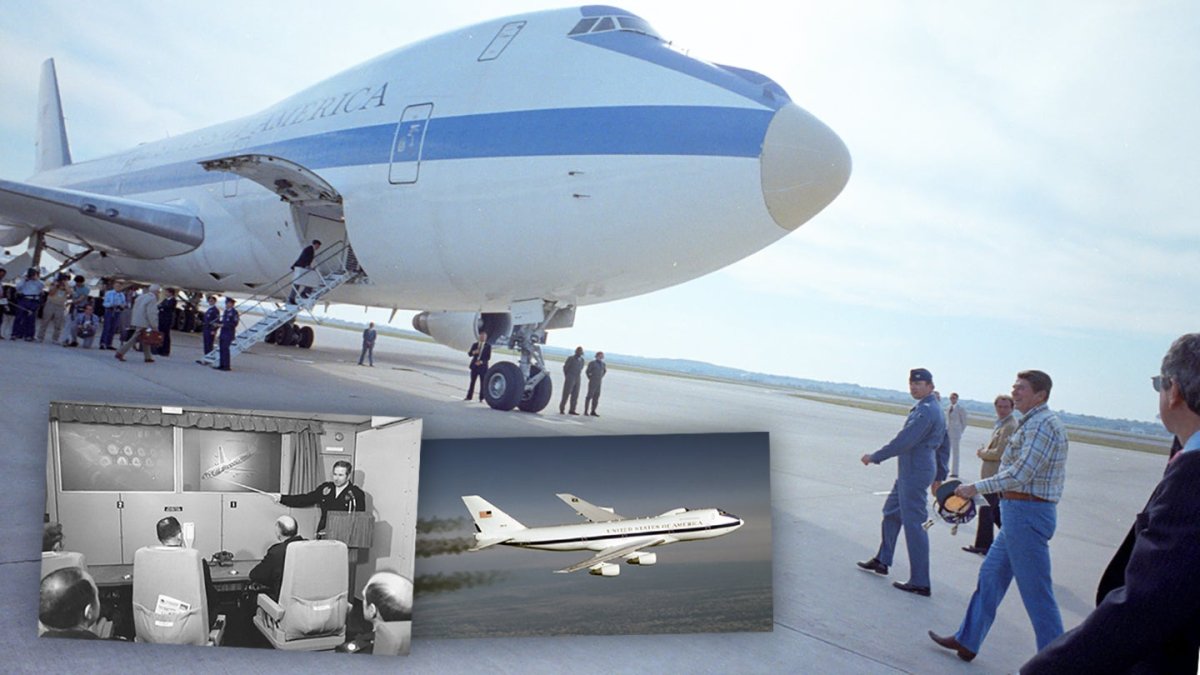
An E-4B flying over the Capital., US National Archives
NEACP operations began on February 19, 1962 with three KC-135A airborne command post aircraft assigned to the Night Watch program. One KC-135A, manned by a Joint Alternate Command Element battle staff (known by their static “back-end” call sign Silver Dollar), was on 24/7 alert and could be launched within 15 minutes. A second KC-135A was on a one-hour alert. The third jet was used for training when it wasn’t undergoing maintenance.
A Silver Dollar KC-135A., Photo by Frank MacSorley via Stephen Miller
Acquisition of KC-135Bs equipped with turbofan engines, receiver air refueling capability , and enhanced communication gear resulted in the March 1966 delivery of three replacement NEACP EC-135Js. The USS Northampton assumed NECPA duties in March 1962, augmented the following year with the USS Wright . By 1964, one ship was on alert at all times. The battle staff included 17 officers and 22 enlisted personnel. You can read all about these obscure but fascinating ships in this past War Zone feature .
USS Wright with its deck refitted into an antenna farm for the NECPA mission., US Navy
Surprisingly, there is no record of any NEACP inspection visits—let alone flights—by either President John F. Kennedy or Lyndon B. Johnson. Indeed, the very first presidential NEACP flight took place on May 11, 1969, when Richard M. Nixon flew from Homestead Air Force Base in Florida back to Andrews on an EC-135J. Among those accompanying Nixon on the two-hour and eight-minute, 900 nautical mile flight were his assistant for national security affairs Henry Kissinger, advisors H. R. “Bob” Haldeman and John Ehrlichman, press secretary Ron Ziegler, military aide Air Force Colonel James Hughes, U.S. Army Major General Charles Myer (a signals and communications expert), Air Force One pilot Lieutenant Colonel Ralph Albertazzie, Nixon’s physician Dr. Walter Tkach, and Secret Service agents Ronald Pontius and Arthur Godfrey.
Considering the absence of windows, the presence of a 15-member battle staff, and the paucity of “executive seats,” the flight must have been uncomfortable and claustrophobic, to say the least. Haldeman recorded the experience in his journal :
Came back to DC on the Airborne Command Post—and they staged a briefing and a test exercise. Pretty scary. They went through the whole intelligence + operational briefings—with interruptions, etc. to make it realistic. Exercise proved to P. that when the Russians appear to be launching an attack our options are pretty limited + our retaliatory strike power is pretty weak. Fascinating plane—with command room set up—all kinds of communications, display boards, rear projection, etc. Took P. a while to get into the thing (his mind was on the peace plan) but he finally did—and was quite interested. Asked a lot of questions re: our nuclear capability—and kill results. Obviously worried about the lightly tossed-about millions of deaths.
Came back to DC on the Airborne Command Post—and they staged a briefing and a test exercise. Pretty scary. They went through the whole intelligence + operational briefings—with interruptions, etc. to make it realistic. Exercise proved to P. that when the Russians appear to be launching an attack our options are pretty limited + our retaliatory strike power is pretty weak.
Fascinating plane—with command room set up—all kinds of communications, display boards, rear projection, etc. Took P. a while to get into the thing (his mind was on the peace plan) but he finally did—and was quite interested. Asked a lot of questions re: our nuclear capability—and kill results. Obviously worried about the lightly tossed-about millions of deaths.
An EC-135J NEACP. , Author’s Collection
Nonetheless, press reaction was negative to the very notion of the president surviving a nuclear strike while the nation floundered in devastation. In an April 1974 Washington Monthly article “ Nixon’s Flying Füherbunker ,” Mary Meehan quoted Arkansas Senator William Fulbright’s 1972 lament that if Americans heard “that danger was threatening the country [and] the President and all his staff…boarded a plane and [had] taken off and left the United States to whatever fate it may suffer … I am sure that in England, during World War II, when Churchill was standing there, trying to encourage his people to resist, it would have been a strange sight if he had taken off in a plane instead.” Meehan continued, saying that after a nuclear exchange killed 80% of the American population, “…your Commander-in-Chief will be flying around above the wreckage, getting even with the Russians and making plans for the next generation of peace.” It is hard to disentangle the media hatred of Nixon from the issue of presidential survival, but other critics wondered if there was a need for the Secretary of the Treasury to survive in order to collect income taxes in a post-apocalyptic hell and the Post Master General to register the millions of dead.
The EC-135J NEACPs were arguably only second-generation systems, vulnerable to electromagnetic pulse (EMP), as well as having inadequate crew space, limited computational and data storage facilities, and outdated communication suite technology. Planning for a replacement Advanced Airborne Command Post (AABNCP) began in the early 1960s.
SAC originally wanted a fleet of Lockheed ‘EC-5s’, but the airplane’s troubled production and political considerations resulted instead in the selection of Boeing’s 747. In addition, SAC intended that the E-4A (later modified to E-4B standards ) would replace both the entire Looking Glass EC-135C and Night Watch NEACP EC-135J fleet based at Andrews on a one-to-one basis.
An E-4A., Lindsay Peacock
In 1971, then-Secretary of Defense Melvin Laird directed the procurement of seven E-4s, with the planned first delivery in 1975. Three of these would be delivered as part of Phase I, Block I as E-4As, with the fourth delivery as an E-4B under Phase I, Block II. Options for the remaining three jets would be exercised contingent upon satisfactory completion of initial operational testing and evaluation (OT&E).
On July 28, 1975, then-Secretary of Defense James Schlesinger, under President Gerald Ford, eliminated the seventh planned jet, and, due to excessive cost overruns, deferred any decision on the remaining two unbuilt jets until FY79. One month later, Schlesinger articulated specific duty assignments for the four extant E-4s:
One airborne 24/7 for SAC’s Commander-in-Chief (CINCSAC)
One on ground “hot alert” (crisis or increased defense condition—DEFCON) for NEACP
One flight crew and battle staff trainer
Obviously, these plans were unrealistic, especially the 24/7 CINCSAC mission (it was not clear if this was a replacement for the Looking Glass or if this was CINCSAC’s dedicated alert jet). Moreover, the “common” requirements meant that all E-4s would have to be configured for both the SAC and NEACP missions.
A presentation underway in the briefing room aboard the E-4A., National Archives, Still Pictures Branch, RG 342B, box 30
Jimmy Carter was the first president to fly aboard an E-4 NEACP on February 11, 1977, some three weeks after his inauguration. During the 1-hour, 33-minute flight covering some 500 nautical miles from Andrews to Warner Robins Air Force Base in Georgia, Carter and Georgia Senator Sam Nunn were briefed on the NEACP mission and capabilities by U.S. Air Force Brigadier General Anderson W. Atkinson, the Joint Chiefs of Staff Deputy Director for National Military Command System (NMCS). Three days later, Carter directed then-Secretary of Defense Harold Brown to cancel all remaining E-4 orders claiming they were expensive and unnecessary. Carter had made clear that, in the event of a nuclear attack on the United States, he would remain in Washington DC, and allow Vice President Walter Mondale to assume the presidential mantle after becoming airborne in the NEACP at DEFCON 2. However, gallant and patriotic this might seem, Soviet SS-N-6 Serbs fired from Yankee class boomers would reach the White House in six to 10 minutes, making this a meaningless gesture.
Presidential Daily Diary, Jimmy Carter Library
Of the seven original E-4s, one was canceled under Ford, two under Carter, and four remain operational today. And no, the E-4 doesn’t sit alert with one (or all four) engines running. At normal alert locations such as Offutt or Grissom Air Force Base (now Grissom Air Reserve Base) in Indiana, facilities are in place that obviate the need for power-on alert. At remote locations, leaving one engine running is an option.
Ronald Reagan was the second president to fly aboard an E-4 on November 15, 1981, from Kelly Air Force Base in Texas to Andrews. As with Carter, he received a briefing by Lieutenant General Philip C. Gast on the communications systems linking the NEACP with the National Military Command Center at the Pentagon and the ANMCC at Raven Rock. He spent the balance of the flight working alone in a forward cabin. Interestingly, the entry for November 15 is missing from the presidential Daily Diary file at the Reagan Library, so the full details of the flight and its manifest are not known.
Reagan about to board an E-4A. , Ronald Reagan Presidential Library
In February 1982, then-Deputy Secretary of Defense Frank C. Carlucci invited Vice President George H. W. Bush to participate in the Ivy League command post exercise by flying in the NECAP, but Bush declined. There is no record of Bush flying in the E-4B NEACP while president, nor is there any record of his successor William J. Clinton doing so prior to the August 23, 1990, introduction into service of the Boeing VC-25A, which duplicated some of the NEACP’s command and control functions. In 1994, the E-4B NEACP was renamed the National Airborne Operations Center (NAOC), with its duties expanded to include support of Federal Emergency Management Agency (FEMA) responses to natural disasters and other non-nuclear crises.
In the absence of declassified official documents, it appears that under an extreme crisis, such as a nuclear or biochemical attack on the entire United States, the President and his NCA advisors would not become airborne in the traditional VC-25A, popularly referred to as Air Force One, but would instead relocate to the E-4B NAOC. This was apparently contradicted during the 9/11 attack on the World Trade Center and Pentagon in 2001, when President George W. Bush remained aboard a VC-25A after stopping briefly at Offutt, where one E-4B was ready for his immediate use. Another E-4B was caught on camera launching out of Andrews right after the attacks , resulting in a rash of conspiracy theories , and yet another one was shortly airborne over the Midwest.
Rare photo of an E-4B next to a VC-25A. , Andrew Dwight
One can assume that Bush and his advisors determined that he did not require the full services of the NAOC and could continue using his VC-25A. This proved unwise, as there were reportedly significant constraints on the VC-25A’s communications that would have been alleviated by the E-4B’s suite.
Official records have not indicated that Presidents Barack H. Obama, Donald J. Trump, or newly elected Joseph R. Biden have flown in the NAOC. With the future of the E-4 up for grabs in the proposed Survivable Airborne Operations Center (SAOC), Biden or his successor may be the first to fly in the next generation of airborne command posts.
Robert S Hopkins, III, flew the RC-135S and RC-135X as a copilot from 1987-1990. In 1989, he was part of the crew that flew the first operational reconnaissance mission of the RC-135X, for which they became the first RC-135 crew to receive the General Jerome F “Jerry” O’Malley Award for the best reconnaissance crew in the Air Force. Hopkins has written extensively about the Cobra Ball and other RC-135 operations.
Contact the editor: Tyler@thedrive.com
Comments couldn’t be loaded. Please refresh the page.
更新于美国东部时间2021年6月1日晚上9:05
美国严守的秘密之一是确保总统及其高级国防顾问在国家紧急状态下安全无虞的程序。在核武器出现之前,白宫和五角大楼的地下室安全密室足以轻松实现这一目标。苏联获得原子弹改变了这一局面,迫使总统及其顾问迁往华盛顿特区以外的长期设施,例如位于马里兰州雷文罗克的备用国家军事指挥中心。随着核武器威力的不断增强,即使是这些掩体也日益脆弱,降低了它们对美国危机后政府连续性计划的价值。
两种方案增强了这种生存能力:空中和舰载指挥所。1960年7月,战略空军司令部(SAC)评估了使用五架波音KC-135A作为内布拉斯加州奥弗特空军基地SAC地下指挥所的备用方案。测试成功,1961年2月1日,SAC启动了全天候“镜面行动”(Looking Glass)空中警戒,之所以这样命名,是因为它模拟了SAC主指挥所的能力。与此同时,空军建议在马里兰州安德鲁斯空军基地部署一架配置类似的KC-135,作为总统及其顾问的国家紧急空中指挥所(NEACP)。海军则建议使用位于切萨皮克湾的改装巡洋舰“北安普顿”号作为国家海上紧急指挥所(NECPA)。
一架E-4B预警机飞越美国首都上空。(美国国家档案馆)
NEACP行动于1962年2月19日启动,最初配备了三架KC-135A空中指挥所飞机,隶属于“夜间守望”计划。其中一架KC-135A由联合备用指挥部作战参谋人员(其固定“后端”呼号为“银元”)操作,全天候24小时待命,可在15分钟内起飞。第二架KC-135A则保持一小时待命状态。第三架飞机在非维护期间用于训练。
一架银元级KC-135A加油机,照片由弗兰克·麦克索利拍摄,经斯蒂芬·米勒授权使用。
1966年3月,美国海军接收了三架配备涡扇发动机、空中加油能力和增强型通信设备的KC-135B加油机,作为NEACP的替代舰艇。北安普顿号巡洋舰于1962年3月开始执行NECPA任务,次年,赖特号巡洋舰加入其中。到1964年,NECPA始终保持一艘舰艇处于警戒状态。作战参谋部包括17名军官和22名士兵。您可以在之前的“战区”专题报道中了解这些鲜为人知却又引人入胜的舰艇的全部故事。
美国海军“赖特”号驱逐舰的甲板被改装成天线阵列,用于NECPA任务。
令人惊讶的是,没有任何记录表明约翰·F·肯尼迪总统或林登·B·约翰逊总统曾视察过全国有色人种协进会(NEACP),更不用说乘坐飞机了。事实上,NEACP的首次总统飞行发生在1969年5月11日,当时理查德·M·尼克松乘坐EC-135J飞机从佛罗里达州的霍姆斯特德空军基地飞回安德鲁斯空军基地。陪同尼克松完成这趟耗时2小时8分钟、航程900海里的飞行的人员包括:国家安全事务助理亨利·基辛格、顾问H·R·“鲍勃”·霍尔德曼和约翰·埃利希曼、新闻秘书罗恩·齐格勒、军事助理空军上校詹姆斯·休斯、美国陆军少将查尔斯·迈耶(信号与通信专家)、空军一号飞行员拉尔夫·阿尔伯塔齐中校、尼克松的医生沃尔特·特卡奇博士,以及特勤局特工罗纳德·庞蒂乌斯和亚瑟·戈弗雷。
考虑到机舱内没有窗户,还有15名作战人员,以及“行政座位”的匮乏,这次飞行想必十分不舒适,令人感到幽闭恐惧。霍尔德曼在他的日记中记录了这段经历:
乘坐空中指挥所返回华盛顿特区后,他们安排了一次简报和演习。相当吓人。他们完整地进行了情报和作战简报——为了模拟真实情况,还穿插了一些干扰等等。演习向P.证明,当俄罗斯人似乎要发动攻击时,我们的选择非常有限,而且我们的反击能力也相当薄弱。那架飞机很吸引人——指挥室的配置一应俱全——各种通讯设备、显示屏、后投影等等。P.花了一段时间才适应(他当时满脑子都是和平计划),但他最终还是适应了——而且非常感兴趣。他问了很多关于我们核能力和杀伤效果的问题。显然,他很担心那些被轻描淡写地提及的数百万人死亡。
回到华盛顿特区的空降指挥所后,他们举行了一次简报会和演习。相当吓人。他们完整地演练了一遍情报和作战简报——期间还穿插了一些干扰等等,以模拟真实情况。演习向P证明,当俄罗斯人似乎要发动攻击时,我们的选择非常有限,而且我们的反击能力也相当薄弱。
这架飞机真令人着迷——指挥室的布置一应俱全——各种通讯设备、显示屏、后投影仪等等。P先生花了点时间才进入状态(他当时满脑子都是和平计划),但他最终还是进入了状态,而且非常感兴趣。他问了很多关于我们核能力和杀伤效果的问题。显然,他对那些被轻描淡写地提及的数百万人的死亡感到担忧。
一架 EC-135J NEACP。,作者收藏
然而,媒体对总统在国家遭受核打击、国家陷入一片废墟之际还能幸存下来的想法持否定态度。1974年4月,《华盛顿月刊》发表了一篇题为《尼克松的飞行元首地堡》的文章,玛丽·米汉引用了阿肯色州参议员威廉·富布赖特1972年的哀叹:如果美国人听说“危险正威胁着国家,而总统和他的所有幕僚……却登上了一架飞机,扬长而去,把美国留给了它可能遭受的任何命运……我确信,在二战期间的英国,当丘吉尔站在那里,试图鼓励他的人民抵抗时,如果他却乘飞机离开了,那将是多么奇怪的景象。”米汉继续说道,在核战争导致80%的美国人口丧生之后,“……你们的总司令将驾驶飞机在废墟上空盘旋,向苏联人复仇,并为下一代的和平制定计划。”很难将媒体对尼克松的仇恨与总统的生存问题分开,但其他批评人士质疑,在世界末日后的地狱中,财政部长是否还需要活下来才能征收所得税,邮政局长是否还需要活下来才能登记数百万死者。
EC-135J NEACP 系统可以说是第二代系统,易受电磁脉冲 (EMP) 攻击,而且机组人员空间不足,计算和数据存储设施有限,通信套件技术也已过时。因此,早在 20 世纪 60 年代初,就启动了先进空中指挥所 (AABNCP) 的研发计划。
战略空军司令部最初想要一支洛克希德“EC-5”机队,但由于该飞机生产困难以及政治因素,最终选择了波音747。此外,战略空军司令部还计划用E-4A(后来改进为E-4B标准)一对一地替换驻扎在安德鲁斯空军基地的全部“镜中世界”EC-135C和“夜巡”NEACP EC-135J机队。
一名 E-4A。林赛·皮科克
1971年,时任国防部长梅尔文·莱尔德指示采购7架E-4预警机,计划于1975年首次交付。其中3架将作为第一阶段第一批次(Block I)交付,型号为E-4A;第4架将作为第一阶段第二批次(Block II)交付,型号为E-4B。剩余3架飞机的购买选择权将取决于初始作战测试和评估(OT&E)的顺利完成情况。
1975年7月28日,时任国防部长詹姆斯·施莱辛格在杰拉尔德·福特总统的领导下,取消了第七架计划中的喷气式飞机项目,并由于成本严重超支,将剩余两架未建造的喷气式飞机的最终决定推迟到1979财年。一个月后,施莱辛格明确了现存四架E-4飞机的具体任务分配:
为战略空军司令部总司令 (CINCSAC) 提供全天候空中支援
NEACP 的一项地面“热警报”(危机或更高防御状态——DEFCON)
一名飞行机组人员和作战参谋训练员
显然,这些计划并不现实,尤其是全天候执行战略空军司令部(CINCSAC)任务的要求(尚不清楚这是否是为了取代“镜子”预警机,还是作为战略空军司令部的专用警戒飞机)。此外,“通用”要求意味着所有E-4预警机都必须配置成能够执行战略空军司令部(SAC)和新英格兰空军司令部(NEACP)的任务。
E-4A飞机简报室内正在进行演示。(美国国家档案馆,静态图片部,RG 342B,第30盒)
1977年2月11日,吉米·卡特就职约三周后,成为首位乘坐E-4 NEACP飞机的美国总统。在从安德鲁斯空军基地飞往佐治亚州华纳罗宾斯空军基地的1小时33分钟航程中,卡特和佐治亚州参议员萨姆·纳恩听取了美国空军准将、参谋长联席会议国家军事指挥系统(NMCS)副主任安德森·W·阿特金森关于NEACP任务和性能的简报。三天后,卡特指示时任国防部长哈罗德·布朗取消所有剩余的E-4订单,声称这些飞机价格昂贵且没有必要。卡特曾明确表示,如果美国遭受核攻击,他将留在华盛顿特区,让副总统沃尔特·蒙代尔在二级战备状态(DEFCON 2)下乘坐国家原子能控制计划(NEACP)的飞机升空后接任总统职务。然而,尽管这看起来英勇爱国,但苏联从“扬基”级轰炸机上发射的SS-N-6“塞尔维亚”导弹只需6到10分钟就能抵达白宫,这使得这一姿态毫无意义。
吉米·卡特总统每日日记,吉米·卡特图书馆
最初的七架E-4预警机中,一架在福特总统时期被取消,两架在卡特总统时期被取消,如今仍有四架在服役。而且,E-4预警机并非在保持一个(或全部四个)发动机运转的情况下处于警戒状态。在奥弗特空军基地或印第安纳州的格里索姆空军基地(现为格里索姆空军预备役基地)等常规警戒地点,相关设施足以应对警戒状态下的通电需求。而在偏远地区,保持一个发动机运转也是一种选择。
1981年11月15日,罗纳德·里根成为第二位乘坐E-4飞机从德克萨斯州凯利空军基地飞往安德鲁斯空军基地的美国总统。与卡特总统一样,他听取了菲利普·C·加斯特中将关于连接全国有色人种协进会(NEACP)与五角大楼国家军事指挥中心以及雷文岩陆军海军医疗中心(ANMCC)的通信系统的简报。飞行剩余时间,他独自在前舱工作。值得注意的是,里根图书馆的总统每日日记档案中缺少11月15日的记录,因此此次飞行的全部细节和乘客名单无从知晓。
里根即将登上E-4A飞机。(罗纳德·里根总统图书馆)
1982年2月,时任国防部副部长弗兰克·C·卡卢奇邀请副总统乔治·H·W·布什乘坐E-4B NEACP飞机参加常春藤联盟指挥所演习,但布什婉拒了邀请。没有记录显示布什在任总统期间曾乘坐过E-4B NEACP飞机,也没有记录显示他的继任者威廉·J·克林顿在1990年8月23日波音VC-25A飞机服役之前曾乘坐过该飞机。VC-25A飞机承担了NEACP的部分指挥控制功能。1994年,E-4B NEACP更名为国家空中作战中心(NAOC),其职责范围扩大,包括支持联邦紧急事务管理局(FEMA)应对自然灾害和其他非核危机。
在缺乏解密官方文件的情况下,似乎在极端危机情况下,例如美国遭受核或生化袭击,总统及其国家安全顾问不会乘坐传统的VC-25A(俗称“空军一号”),而是会转移到E-4B NAOC预警机。然而,2001年9·11事件中,乔治·W·布什总统在短暂停留奥弗特空军基地后,仍然乘坐VC-25A,而奥弗特空军基地的一架E-4B预警机已准备就绪,可供他立即使用。这一说法显然与上述说法相悖。袭击发生后,另一架E-4B被拍到从安德鲁斯空军基地起飞,引发了一系列阴谋论。此外,还有一架E-4B很快升空飞越美国中西部地区。
罕见的E-4B飞机与VC-25A飞机的合影。——安德鲁·德怀特
可以推测,布什及其顾问认为他不需要NAOC的全部服务,可以继续使用他的VC-25A。事实证明,这种想法并不明智,因为据报道VC-25A的通信存在诸多限制,而E-4B的通信套件本可以缓解这些问题。
官方记录显示,巴拉克·H·奥巴马、唐纳德·J·特朗普或新当选的约瑟夫·R·拜登总统均未曾乘坐过NAOC。鉴于拟建的“可生存空中作战中心”(SAOC)中E-4预警机的未来归属尚未确定,拜登或其继任者或许会成为首位乘坐下一代空中指挥所的总统。
罗伯特·S·霍普金斯三世于1987年至1990年间担任RC-135S和RC-135X的副驾驶。1989年,他所在的机组执行了RC-135X的首次作战侦察任务,并因此成为首批荣获杰罗姆·F·“杰里”·奥马利将军奖(空军最佳侦察机组奖)的RC-135机组。霍普金斯曾撰写大量关于“眼镜蛇舞会”及其他RC-135作战行动的文章。
联系编辑:Tyler@thedrive.com
评论加载失败,请刷新页面。