Nukes, Nubs And Coners: The Unique Social Hierarchy Aboard A Nuclear Submarine核弹、潜艇兵和潜艇兵:核潜艇上独特的社会等级制度
Getting assigned to your first sub doesn't make you a submariner and once you become one you'll find yourself in a social structure unlike any other.
Updated Jun 16, 2020 2:54 PM EDT
Living in a machine with over 100 sailors requires a person to be flexible socially and sometimes physically. I spent two decades on United States Navy submarines performing sonar duties among eccentric personalities in incredibly stressful situations. When sailors report to their first submarine, they are joining a work culture unlike any other. Surrounded by crew members busily moving about tight spaces and narrow walkways, announcements over the circuit boxes, roving watchstanders, equipment humming to 400hz fans, it can be anxiety-inducing to any sailor.
That is why every new crewmember starts as a NUB. But, if they work hard and learn the systems, they will earn their dolphins and become a member of another entirely unique subculture within the grander social hierarchy that exists within the confines of the submerged tube they call home for months on end.
Here’s is what is expected of a new crew member and a bit about the various ‘unique’ groups of people aboard the submarine, one of which the NUB will find themselves an integral part of once they get minted a submariner.
A new crewmember is a Non-Useful Body, or NUB. He or she uses our limited supply of space, water, food, and oxygen. They are not welcome, but BUPERS (Bureau of Personnel) keeps sending them. The NUB is easily identifiable as he will be the only crewman wearing a command ball cap with the ship’s name and no Dolphins symbol on the front. They have their qualification card in their rear pocket at all times and had better have a small notebook in their hand for studying. They do not have movie privileges unless they are a “Hot Runner.” Hot Runner refers to a torpedo self-starting despite the fact it hasn’t been launched yet. Very dangerous, but Submariners like that kind of initiative in the NUB.
A sailor washes down the USS Washington (SSN-787)., USN
Everyone, officer or enlisted, is a NUB when they report to their first submarine. They are treated with contempt. In the case of the officer, it’s respectful contempt, sir. The NUB is expected to qualify in submarines within 12 months. This can be extended a few months if there are outside circumstances that delay qualification opportunities.
Qualification on a U.S. submarine is a formal process completed in phases. The first phase introduces all the major systems around the boat. This orientation phase is purposefully designed to ease the NUB through the culture shock of living inside a machine the Navy sends to submerge in the ocean for weeks on end. This introduces the NUB to their fellow crewman, one watch station at a time. This first impression will affect how difficult their qualification path is because the crew decides if you are to become a submariner or not. They must earn their confidence. They must prove that they can perform emergency actions without direction and with confidence during a ‘casualty,’ when something goes wrong.
A sailor mans the main console of the ship’s Ballast Control Panel on board the nuclear-powered ballistic missile submarine USS Pennsylvania (SSBN-735), USN
Phase two of submarine qualification is the most difficult. It requires detailed knowledge of every system on the boat, from the nuclear powerplant, to ventilation, to electrical and hydraulic systems, to simple atmosphere scrubbing and gravity drains. The Non-Useful Body must memorize every system, be able to draw it from memory on command, and know the initial actions they must perform if a causality occurs to that system. Even if it’s not their assigned equipment, they must know how to prevent a failure from cascading into a major casualty that could be catastrophic for the boat.
Phase three of submarine qualification is the most physically demanding. This is the walkthrough phase. The NUB will walk through every level of every compartment one at a time with a qualified crewman. During this tour, they may be dressed in full protective gear like a Fire Fighting Equipment (FFE) asbestos bodysuit and wearing breathing protection. This physical discomfort compounded with an oral interview answering detailed system-specific operational questions simulates a small, but important amount of stress compared to what they would endure during a real casualty situation.
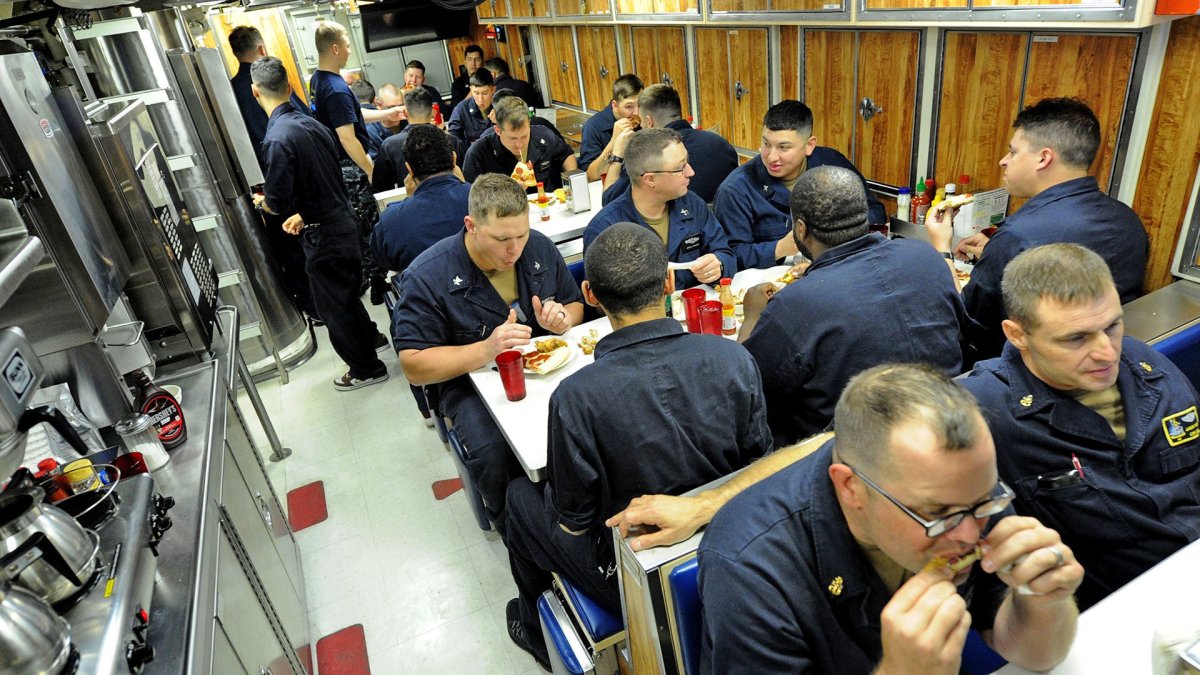
Sailors assigned to USS Indiana (SSN-789) eat dinner in the crew’s mess while underway., USN
Phase four is ‘The Board.’ This is the end phase of the submarine qualification and is more difficult to schedule than it is to pass. The NUB must find at least three submarine qualified crewmen who have three to five hours of off-watch time at the same time to be part of an oral interview board. There must be at least one submarine qualified officer, one senior enlisted man, and one system expert on the Board.
It is customary for the qualifying crewman to bring a small snack to the Board. Usually, there is a bowl of Jolly Rancher hard candies, but I have seen a cook make a full dessert platter with pastries and a cake. The Board members can’t ask hard questions when they are enjoying some sugary treats!
A sailor checks a radar display while another studies a chart inside the control room of the USS Florida ( SSGN -728)., USN
If a Board interview is failed, a crew member can reschedule a second board when they are ready. He or she is only restricted by the time constraints of the qualification schedule. If they fail a second board they may be removed from submarine service, but this is very rare. Good submariners can be built if given enough time by the crew to help them. I have seen both enlisted and officers wash out of the submarine qualification program and in each of those cases it was for the better. It very possibly saved their lives and ensured the safety of our ship.
The final phase is a one-on-one interview with the Executive Officer and the Commanding Officer. Every submarine qualified sailor is awarded their dolphins with the full confidence and trust of the submarine Captain. By this time, the crewman has earned the respect of their shipmates and demonstrated that they know the basics to keep the submarine in fighting shape, no matter the circumstances.
U.S. Navy Master Chief Jeffrey Bottoms, chief of the boat for the USS Rhode Island , far left; Navy Cmdr. Robert J. Clark, commanding officer for the Rhode Island, and Navy Lt. Cmdr. Paul Pampuro, far right, watch as Navy Petty Officer 3rd Class William Corring speaks at a ceremony in the Rhode Island crew’s mess as the submarine patrols in the Atlantic Ocean, Aug. 16, 2010. Corring received his Dolphin pin during the ceremony., USN
After achieving the approval of the crew and getting one’s dolphins, they get categorized into one of two groups—Nukes and Coners.
Crewmen who work in the engine room are called Nukes. They are made up of high school graduates who loved Star Trek so much they decided to role-play their science fiction fantasy in real life. Incredibly smart and able to digest volumes of information in a short time, these mystical figures often whisper of powerband constraints and millirems amongst themselves. They use math so much in their daily routine they ran out of numbers and added some Latin letters to their measurement logs. They are best avoided at mealtime and are given their own table in the crew’s mess next to the Chief Petty Officers.
Nukes come in three varieties:
The Reactor Operator is likely the stereotypical 90-pound geek who maintains a World of Warcraft account despite being underway for 10 months of the year. He’s wiry, lanky, and a little jittery from energy drinks. Despite his excitement, he is the smoothest Reactor Operator in the nuclear program and can catch a power spike like he’s dimming the bedroom lights next to his waifu body pillow.
Nukes studying one of the boat’s systems., USN
The Nuclear Electrician is the most chameleon-like and may be difficult to spot in a crew photo. He often has average height and build allowing him to blend in with the ‘Coners’ if left unchallenged. He gives himself away by always having a Sudoku puzzle book tucked inside his poopy suit and a faint odor of ozone follows him around.
The Nuclear Mechanic is the protector and enforcer of the engine room. These sailors are often very large compared to their fellow Nukes. They have oil-stained fingers and faded blue poopy suits that have seen more underway time than was intended. They eat at the Nuke table in the crew’s mess with gusto, filling their frames with enough carbs to make it through the next six hours in the hot engine room.
Life in the engine room is routine at sea. No matter what the mission or our deployment location they serve one purpose: Push the Cone.
Coners live in the Cone. That’s any space forward of the engine room. They make up the rest of the crew. A grab bag of cultures and backgrounds, from small-town USA to big city living, the Cone represents a microcosm of the United States’ young men and women. This mix of people come together at the needs of the Navy and perform well despite their differences.
Submariners scan the horizon through periscopes aboard the fast attack submarine USS Santa Fe (SSN-763) searching for contacts during a transit of the Pacific Ocean., USN
The Radioman is the most elusive of the Coners. He spends his time locked in his ‘Radio Shack’ both off watch and on. This limited access space offers a small amount of privacy not seen anywhere else outside the Captain’s stateroom. From this room, messages are dispatched around the boat. Radiomen are the gatekeepers of all message traffic from the most sensitive top-secret orders to routine personal messages. No matter what is happening or planned, the Radiomen know about it first.
The Quartermaster , or “QM,” could be mistaken for a militant artist with his bandolier of colored pencils and erasers. He is the ‘Keeper of the Chart.’ Hunched over a plotting table for six hours at a time, he is constantly calculating and verifying the ship’s position.
Off watch, they are preparing charts for the next day or next mission. A modern, Neo-QM has turned in his colored pencils for a tablet pc and paper charts for their digital replacement, but their fixation for geolocating and browsing rules of the aquatic road remains a constant.
Plotting a course aboard Virginia class nuclear fast attack submarine USS Texas . , USN
Sonarmen , sometimes referred to as “shower techs” or “sonar girls,” are the most eccentric of the crew zoo. In a world where every evolution from flushing the toilet to firing up the kettle has a written procedure, the sonarman works in the most liberal and creative of environments.
Sonar is a talent-based skill that varies from sailor to sailor and some of the best are also some of the most unstable personalities to be awarded a secret clearance. They are most likely encountered in or near the shower as they have an affinity for bathing underway.
Missile Technicians , “MTs,” are the stewards of ‘Sherwood Forest.’ Rising between levels in the missile compartment, 24 large orange trunks fill the nuclear ballistic submarine like an apocalyptic orchard. MTs rove around the ballistic missile tubes checking temperatures and pressures, ensuring their precious reentry vehicles and the nuclear warheads nested inside them are very comfortable.
The watertight hatch that separates the rest of the boat from ‘Sherwood Forest.”, USN
Auxillarymen , or an “A-Ganger,” is a hostile creature and the natural predator of the sonarman. A combination of ‘Nuke Waste,’ a sailor who failed nuclear power school, and a backyard diesel mechanic, the A-Ganger is the gruffest, foul-mouthed sailor onboard any United States Navy vessel. They are responsible for scrubbing the atmosphere clean, managing the waste tanks, and keeping the sweet Fairbanks Morse diesel engine running smoothly. They appear to be a less evolved Nuclear Mechanic whose smell is as rank as their language.
The Torpedoman can always be found in the torpedo room. Both on watch and off watch, the torpedo room is the crew’s social center on an attack submarine. A master of small arms and heavy explosives, the Torpedoman is the weapons master of the crew. They are always cleaning rifles and polishing the torpedo tubes to a new level of brass brightness. They are often found in pairs due to their reader-worker routines, checklist and grease pencil in hand. If you find yourself in the torpedo room, look for the most heavily armed person there and that is your Torpedoman.
Torpedomen conduct maintenance on small arms in the torpedo room aboard the Los Angeles class attack submarine USS Helena (SSN-725). , USN
The Cooks , or Mess Specialists, are the most liked persons of the submarine crew. They dish out 1,000 calories of happiness every six hours, every day and keep the crew fueled.
While every crewman has their watch team and circle of friends, everyone knows the cooks. Clad in very distinctive white chefs outfits and paper hats, they manage to serve up chow with a smile and light banter to keep morale up.
Anyone who has spent time at sea respects the cook.
Cooking ng up some pancakes on a Los Angeles class fast attack submarine. , UNS
Yeomen are crewmen with a very specific skill. They can type. Commonly found in the ‘Yeomen Shack’ hunched over a keyboard like Schroeder on the piano or in the torpedo room yammering about how they don’t have to stand watch because they work so much. The Yeoman is the Executive Officer’s right hand and has a chest full of Navy Achievement Medals to prove it. He or she processes the paperwork bureaucracy that keeps the Navy afloat and flowing in the right direction.
Doc , the submarine’s Corpsman, also known as the “Pecker Checker,” keeps everyone healthy or at least can identify when someone is not. From dispensing the Navy’s universal cure, Motrin, to the ‘morale check’ (a slap on the crotch), the Doc makes sure everyone has absorbed enough radiation for evolutionary mutation and is ready to stand watch.
Master Chief Hospital Corpsman David Peterson administers a flu vaccine to Machinist’s Mate 1st Class Kyle Leoard aboard the Los Angeles -class fast attack submarine USS Cheyenne (SSN 773)., USN
This is the American Submarine crew. On their own, they may be goofy and socially awkward, but as a crew, this band of misfits becomes the best warfighters I have ever had the honor of serving with.
Life on board a submarine is rewarding because it is a demonstration of what a diverse group of people can achieve under incredibly difficult conditions.
The crew of the Los Angeles fast class attack submarine USS Louisville (SSN-724) circa 2004. , USN
Aaron Amick is a retired U.S. Navy submarine sonarman. He served in both Atlantic and Pacific Oceans on 688 Los Angles class fast attack and Ohio class ballistic missile submarines. He has published two audiobooks on Cold War-era submarines, Akula SSN Project 971 Sub Brief and USS Nautilus SSN-571 Sub Brief . Now, Aaron manages a small Patreon page and contributes to The War Zone.
Contact the editor: Tyler@thedrive.com
Comments couldn’t be loaded. Please refresh the page.
更新于美国东部时间2020年6月16日下午2:54
生活在一艘拥有百余名水兵的潜艇上,需要具备极强的社交能力,有时甚至需要一定的体能。我曾在美国海军潜艇上服役二十年,在压力巨大的环境下,与形形色色的船员一起执行声呐任务。当水兵们第一次登上潜艇时,他们就融入了一种独一无二的工作文化。周围是忙碌穿梭于狭小空间和狭窄通道的船员,配电箱里不断传来的广播声,巡逻的值班人员,以及400赫兹风扇嗡嗡作响的设备,这一切都足以让任何水兵感到焦虑。
这就是为什么每个新船员最初都是新手。但是,如果他们努力工作并学习系统,他们就能赢得海豚徽章,并成为这个庞大社会等级制度中另一个完全独特的亚文化群体的一员。这个亚文化群体存在于他们常年居住的水下管道内,形成了一个庞大的社会等级体系。
以下是对新船员的期望,以及关于潜艇上各种“独特”人群的一些信息,其中 NUB 一旦成为潜艇兵,就会发现自己是其中一个群体的组成部分。
新来的船员被称为“无用之物”(Non-Useful Body,简称NUB)。他们会占用我们有限的空间、水、食物和氧气。他们并不受欢迎,但人事局(BUPERS)却不断地把他们送来。NUB很容易辨认,因为他们是唯一戴着印有舰名但没有海豚标志的指挥帽的船员。他们的资格证必须始终放在后口袋里,最好手里还拿着一个小笔记本以便学习。除非是“热启动者”(Hot Runner),否则他们没有看电影的特权。“热启动者”指的是鱼雷在尚未发射的情况下自行启动。这非常危险,但潜艇兵喜欢NUB身上这种主动性。
一名水兵正在冲洗“华盛顿”号核潜艇(SSN-787)。
无论军官还是士兵,在首次到潜艇报到时,都会被视为新兵(NUB)。他们会受到轻视。如果是军官,那也只是恭敬的轻视,称呼为“长官”。新兵需要在12个月内获得潜艇资格。如果遇到外部情况导致资格认证机会延迟,这个期限可以延长几个月。
在美国潜艇上进行资格认证是一个分阶段完成的正式过程。第一阶段介绍潜艇上的所有主要系统。这个适应阶段旨在帮助新兵克服在海军派往深海连续数周潜航的潜艇上生活的文化冲击。新兵将逐步熟悉其他艇员,每次轮换一个值班岗位。这第一印象将影响他们资格认证的难度,因为最终是否能成为一名潜艇兵取决于艇员的判断。他们必须赢得艇员的信任。他们必须证明自己能够在发生“事故”(即出现故障)时,无需指示且自信地采取紧急行动。
一名水兵正在美国海军核动力弹道导弹潜艇“宾夕法尼亚”号(SSBN-735)上操作舰载压载控制面板的主控台。
潜艇资格认证的第二阶段最为艰难。它要求对艇上所有系统都了如指掌,从核动力装置、通风系统、电气和液压系统,到简单的空气净化和重力排水系统,无一例外。非作战人员必须熟记每个系统,能够根据指令立即调出相关信息,并且知道一旦某个系统出现故障,他们必须采取哪些初步措施。即使故障并非由他们负责,他们也必须知道如何防止故障蔓延成可能对潜艇造成灾难性后果的重大事故。
潜艇资格认证的第三阶段是体能要求最高的阶段,即实操阶段。受训人员(NUB)将与一名合格的艇员一起,逐层巡视每个舱室。巡视期间,他们可能需要穿戴全套防护装备,例如消防服(FFE)石棉防护服和呼吸防护设备。这种身体上的不适,再加上需要回答有关系统操作的详细面试问题,模拟了他们在真实事故情况下可能承受的压力,虽然程度不大,但却十分重要。
隶属于“印第安纳”号核潜艇(SSN-789)的水兵们在航行途中于船员餐厅用餐。
第四阶段是“面试”。这是潜艇资格认证的最后阶段,安排面试比通过面试本身更难。海军潜艇训练委员会(NUB)必须找到至少三名具备潜艇资格的艇员,他们必须同时拥有三到五个小时的非值班时间,组成面试委员会。面试委员会成员必须至少包括一名具备潜艇资格的军官、一名高级士官和一名系统专家。
按照惯例,通过资格审查的船员会带些小点心去参加委员会。通常是一碗Jolly Rancher硬糖,但我见过厨师准备一整盘甜点,里面有糕点和蛋糕。委员会成员们一边享用甜食,一边就问不出什么尖锐的问题了!
在“佛罗里达”号核潜艇(SSGN-728)的控制室内,一名水兵正在查看雷达显示屏,另一名水兵则在研究海图。
如果潜艇兵第一次面试失败,可以在准备就绪后重新安排第二次面试。他们唯一受限的只是资格认证时间表的限制。如果第二次面试仍然失败,他们可能会被解除潜艇兵役,但这非常罕见。只要船员给予足够的时间帮助他们,就能培养出优秀的潜艇兵。我见过一些士兵和军官被淘汰出潜艇兵资格认证项目,而对他们来说,这反而是一件好事。这很可能挽救了他们的生命,也确保了我们潜艇的安全。
最后阶段是与执行官和指挥官进行一对一面试。每位合格的潜艇水兵都会获得潜艇艇长的充分信任,并被授予潜艇艇长的海豚徽章。此时,这名水兵已经赢得了战友的尊重,并证明他们掌握了在任何情况下都能保持潜艇战斗力的基本技能。
2010年8月16日,在罗德岛号潜艇于大西洋巡逻期间,美国海军“罗德岛”号艇长杰弗里·博顿斯(左一)、“罗德岛”号艇长罗伯特·J·克拉克海军中校和保罗·潘普罗海军中校(右一)正在艇员餐厅观看海军三级士官威廉·科林在仪式上发言。科林在仪式上获颁海豚徽章。
在获得船员的认可并获得自己的海豚后,它们会被分为两类——核能者和圆顶者。
在机舱工作的船员被称为“核兵”。他们都是高中毕业生,酷爱《星际迷航》,于是决定在现实生活中扮演科幻角色。这些神秘人物极其聪明,能在短时间内消化大量信息,他们经常私下讨论能量带限制和毫雷姆之类的概念。由于日常工作中大量使用数学,他们甚至用完了数字,只好在测量记录中添加了一些拉丁字母。最好在用餐时间避开他们,他们在船员餐厅里有一张单独的桌子,就在高级士官旁边。
核武器有三种类型:
反应堆操作员很可能就是那种典型的体重只有90磅(约41公斤)的宅男,一年中有十个月都在玩《魔兽世界》,却依然保持着自己的游戏账号。他身材瘦削,略显单薄,而且因为喝能量饮料而有点神经质。尽管他情绪激动,但他却是核计划中最沉着冷静的反应堆操作员,能够轻松应对电力波动,就像调暗卧室里抱枕旁的灯光一样自然。
美国海军核动力部门正在研究该舰艇的某个系统。
核电工最像变色龙,在船员合照里很难找到他。他通常身材中等,身高体型也一般,如果没人注意,很容易混入“角卫”之中。不过,他总会在脏兮兮的防护服里藏着一本数独谜题书,而且身上还散发着淡淡的臭氧味,这些都暴露了他的身份。
核动力机械师是机舱的守护者和执法者。与其他核动力技师相比,这些水手通常体型庞大。他们的手指沾满了油污,身穿褪色的蓝色防护服,显然经历了比预期更长的航行时间。他们在船员餐厅的核动力专用餐桌上狼吞虎咽地吃着饭,摄入足够的碳水化合物,以支撑他们在闷热的机舱里度过接下来的六个小时。
海上机舱里的生活是例行公事。无论任务是什么,部署地点在哪里,它们都只有一个目的:推动圆锥体。
“圆锥舱”里住着“圆锥体”成员。“圆锥体”指的是机舱前方的任何空间。他们构成了其余的船员。“圆锥体”成员来自五湖四海,文化背景各异,从美国小镇到大城市,形形色色,宛如美国青年男女的缩影。为了海军的需要,这些人聚集在一起,尽管彼此存在差异,却都能出色地完成任务。
在穿越太平洋期间,美国海军“圣菲”号快速攻击潜艇(SSN-763)上的潜艇兵们正通过潜望镜扫描海平线,寻找目标。
无线电员是康纳家族中最神秘莫测的人。无论值班还是休息,他都把自己锁在“无线电小屋”里。这个出入受限的空间提供了一丝隐私,这种隐私在船长室之外的任何其他地方都找不到。船上的所有信息都是从这里发出的。从最敏感的绝密命令到日常的私人信息,无线电员都是所有信息传递的把关人。无论发生什么或计划什么,无线电员总是最先知道。
军需官,简称“QM”,肩上挎着一串彩色铅笔和橡皮擦,乍一看像个军事艺术家。他是“海图守护者”。他常常弓着背,一连六个小时伏在绘图桌前,不停地计算和核实船只的位置。
值班之余,他们会为第二天或下一次任务准备海图。现代的“新航海员”(Neo-QM)已经用平板电脑取代了彩色铅笔,用电子海图取代了纸质海图,但他们对地理定位和水上航行规则的执着却丝毫未减。
在弗吉尼亚级核动力快速攻击潜艇“德克萨斯”号上规划航线。
声呐兵,有时也被称为“淋浴技师”或“声呐女郎”,是船员中最古怪的一群。在这个从冲马桶到烧水都按部就班、有固定流程的世界里,声呐兵却在最自由、最具创造性的环境中工作。
声呐是一项天赋技能,因水手而异,一些最优秀的水手同时也是性格最不稳定的,却被授予了秘密安全许可。他们最有可能在淋浴间或附近出现,因为他们似乎很喜欢在航行途中洗澡。
导弹技师(简称“MT”)是“舍伍德森林”的守护者。在导弹舱内,24根巨大的橙色树干如同末日果园般遍布整艘弹道导弹核潜艇。MT们在弹道导弹发射管周围巡视,检查温度和压力,确保他们珍贵的再入飞行器及其内部的核弹头处于最佳状态。
将船体其他部分与“舍伍德森林”号隔开的水密舱口。(美国海军)
辅助兵,或称“A-Ganger”,是一种敌对生物,也是声呐兵的天敌。A-Ganger一词源于“核废料”(Nuke Waste),指的是核动力学校不及格的水兵,以及一个业余柴油机修理工。他们是美国海军舰艇上最粗鲁、满口脏话的水兵。他们的职责包括净化大气、管理废料罐,以及确保费尔班克斯-莫尔斯柴油发动机运转顺畅。他们看起来像是进化程度较低的核动力机械师,身上的气味和他们的语言一样令人作呕。
鱼雷兵总能在鱼雷舱里找到。无论值班还是休息,鱼雷舱都是攻击型潜艇上船员的社交中心。鱼雷兵精通轻武器和重型炸药,是艇上的武器专家。他们总是擦拭步枪,把鱼雷发射管擦得锃亮。由于他们习惯于阅读和工作,所以经常成双成对地出现,手里拿着检查清单和油性笔。如果你碰巧在鱼雷舱里,找到装备最齐全的人,那就是你的鱼雷兵。
在洛杉矶级攻击型核潜艇“海伦娜”号(SSN-725)的鱼雷舱内,鱼雷兵正在对小型武器进行维护。
炊事员,或者说伙食专家,是潜艇上最受欢迎的人。他们每天每隔六小时就提供1000卡路里的“快乐”,让船员们精力充沛。
虽然每位船员都有自己的值班小组和朋友圈,但所有人都认识厨师。他们身着极具特色的白色厨师服,头戴纸帽,总是面带微笑,轻松地与船员们聊天,为大家烹制美味佳肴,鼓舞士气。
凡是在海上待过的人,都会尊敬厨师。
在洛杉矶级快速攻击潜艇上煎薄饼。
文书是拥有特殊技能的船员。他们会打字。人们经常能在“文书小屋”里看到他们,像施罗德弹钢琴一样弓着背敲键盘;或者在鱼雷舱里喋喋不休地抱怨自己工作繁忙,不用值班。文书是执行官的得力助手,胸前挂满了海军功勋奖章,足以证明这一点。他们负责处理繁琐的文书工作,确保海军正常运转,步入正轨。
潜艇上的医务兵“医生”,人称“小弟弟检查员”,负责保障所有人的健康,或者至少能看出谁身体不舒服。从分发海军的万能药布洛芬,到“士气检查”(拍一下裆部),医生确保每个人都吸收了足够的辐射进行进化突变,并随时准备值班。
美国海军“夏延”号快速攻击潜艇(SSN 773)上,海军军医长戴维·彼得森正在为一级机械师凯尔·利奥德接种流感疫苗。
这就是美国潜艇艇员。他们单独来看或许有些滑稽,社交能力也欠佳,但作为一个团队,这群格格不入的人却成为了我曾有幸并肩作战的最优秀的战士。
潜艇上的生活很有意义,因为它展现了不同背景的人在极其困难的条件下能够取得怎样的成就。
2004年左右,洛杉矶级快速攻击潜艇“路易斯维尔”号(SSN-724)的艇员合影。
亚伦·阿米克是美国海军退役潜艇声纳兵。他曾在大西洋和太平洋服役,先后在洛杉矶级快速攻击潜艇(688型)和俄亥俄级弹道导弹潜艇上服役。他出版了两本关于冷战时期潜艇的有声读物:《阿库拉号核潜艇971项目简报》和《鹦鹉螺号核潜艇571项目简报》。如今,亚伦运营着一个小型Patreon页面,并为《战区》网站撰稿。
联系编辑:Tyler@thedrive.com
评论加载失败,请刷新页面。