In the South China Sea, it’s ‘meet the new boss, same as the old boss’在南海,情况是“新老板上任,老老板依旧”。
Tensions are mounting in the South China Sea as the U.S. doubles down on hardline Trump-era China policies.
WASHINGTON — The new Biden administration has been reversing many of the Trump administration’s policies in areas such as immigration and energy, but when it comes to confronting China’s actions in the South China Sea , at the highest levels of power the song remains the same.
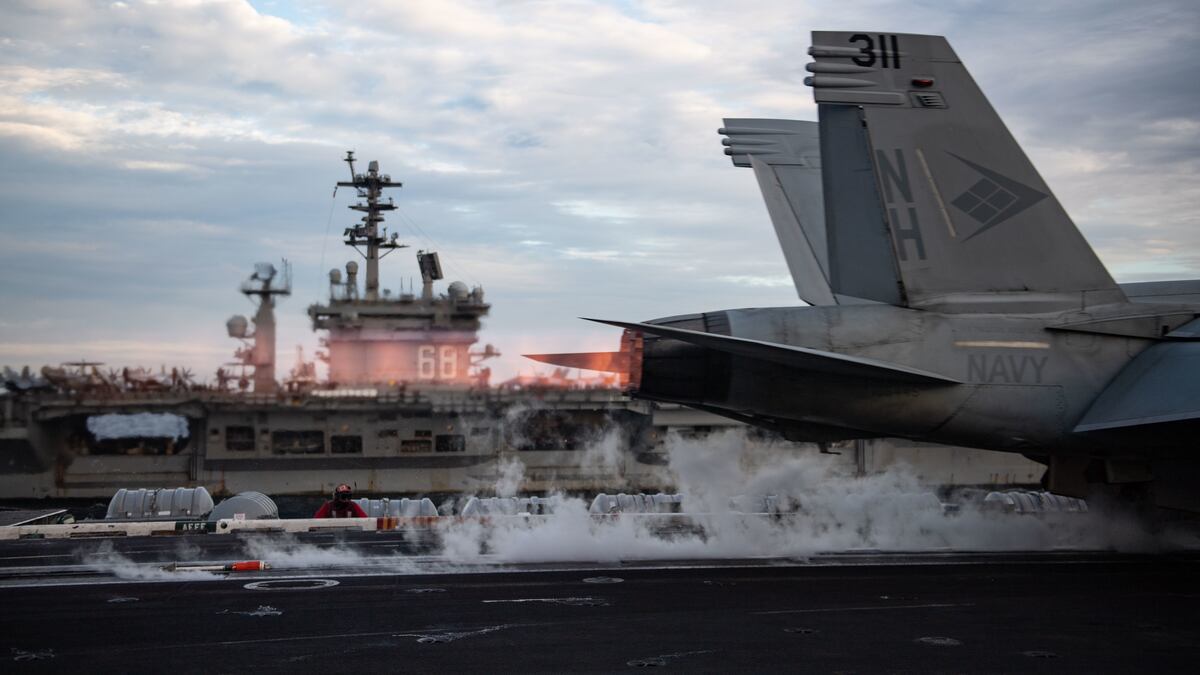
In its opening weeks, the Biden administration has signaled it will continue many of the Trump administration’s hardline policies toward China . And it has not backed off heavy naval presence in the Indo-Pacific region, after a U.S. ship conducted “freedom of navigation operation” (FONOP) earlier this month. Then Feb. 9 the Navy announced that two carriers were operating together in the hotly disputed South China Sea .
The destroyer John S. McCain transited the Taiwan Strait Feb. 4 , which China denounced as a provocation, and the following day the McCain performed a FONOP challenging competing claims in the disputed Paracel Islands, a patrol that was accompanied by what experts noted was an extraordinarily detailed explanation.
On Feb. 9, China’s Foreign Ministry slammed the Navy’s two-carrier exercise in the South China Sea , saying it was “not conducive to peace and stability in the region,” and that China would “work together with regional countries to safeguard peace and stability in the South China Sea.”
Just 21 days into Biden’s presidency, and with a remarkably small sample size, the emerging policy on China looks nearly indistinguishable from the Trump policy, which has led many China watchers to believe that a policy of strategic competition with Beijing — in the maritime realm and beyond — is here for the long term. Or at least for Biden’s.
“What we’re seeing across the board is a new administration that isn’t going to throw it out of the playbook of the last four years and that accepts sort of the logic of prioritizing China and competition towards Beijing,” said Eric Sayers, a vice president at Beacon Global Strategies and a former Asia hand at the Senate Armed Services Command and at U.S. Indo-Pacific Command.
“They’re saying, ‘Hey, we’re going to have our own grammar, we’re going to do things a bit different and put our priorities in different places,’ but at the same time they haven’t backed off from some of the areas that that their skeptics said they would.
“There is continuity in the South China Sea, but it’s its continuity of the Trump approach, not a return of the Obama approach.”
Critics have argued that the Obama administration failed to take stronger measures to oppose China’s increasingly aggressive stance in the South China Sea, and was slow to react as China began building military bases on disputed features there.
But Biden’s approach appears more assertive. In the wake of the McCain’s FONOP in the Paracels, the Japan-based U.S. 7th Fleet released a detailed statement Feb. 5, specifically calling out a Chinese claim that dates to 1996 and would extend China’s territorial sea out to the features there. By extension, this logic would grant them most of the infamous-yet-ambiguous “nine-dash-line” claim seeking expanded rights.
“Unlawful and sweeping maritime claims in the South China Sea pose a serious threat to the freedom of the sea, including freedoms of navigation and overflight, free trade and unimpeded commerce, and freedom of economic opportunity for South China Sea littoral nations,” the 7th Fleet statement said.
China has never fully articulated what rights it claims in the South China Sea.
China’s Parcaels claim led to a violent clash with Vietnam in 1974 that left China in de facto control of the features, though it has remained contested ever since. That claim almost certainly infringes on Vietnam’s rightful exclusive economic zone, which, under the UN Convention on the Law of the Sea, extends 200 miles, said Bryan Clark, a senior fellow at Hudson Institute and former senior aid to the chief of naval operations.
“What they’ve been trying to do is argue that the Paracels are an extension of China and, therefore, allow you to draw a straight line around the features,” Clark said. “So, this essentially supports their argument about the nine-dash line, because the Paracel’s are south of Hainan Island. Essentially, you’ve got this extension of Chinese sovereignty well into the South China Sea as a result of drawing a straight line from the Paracels to Hainan to the Chinese mainland. And then it’s the same thing on the other end of the Chinese coast, which infringes on the [exclusive economic zone] that rightfully belongs to Vietnam.”
In response to the McCain FONOP, a spokesman for China’s Ministry of Foreign Affairs offered a muted response, saying China monitored the operations, and called on the United States to have a more constructive role in the region.
“China will continue to stay on high alert and is ready to respond to all threats and provocations at any time, and will resolutely safeguard its national sovereignty and territorial integrity,” said Wang Wenbin, the spokesperson. “We hope the U.S. side will play a constructive role for regional peace and stability, rather than the opposite.”
In this April 12, 2018 photo, Chinese President Xi Jinping speaks after reviewing the Chinese People's Liberation Army Navy fleet in the South China Sea. Xi is calling on the PLAN to better prepare for combat, amid tensions over Taiwan and the South China Sea. Xi told a meeting of top military leaders Saturday, Jan. 5, 2019, that the 3-million-strong PLA needs to prepare for a “comprehensive military struggle from a new starting point,” according to state media reports. (Li Gang/Xinhua via AP)
The competition continues
Despite radically different positions on a range of national security issues, when it comes to the China relationship, Presidents Joe Biden and Donald Trump have charted similar courses thus far.
Both Biden and new Secretary of State Antony Blinken have signaled the need for some cooperation, particularly on tackling climate change. But the Biden administration has also held the line on the 2020 decision by Secretary of State Mike Pompeo to formally reject China’s expansive claims in the South China Sea and has backed Pompeo’s late-hour determination that China’s actions against Uighur Muslims in Xinjiang province constituted genocide.
During calls with counterparts in Vietnam and the Philippines, new Secretary of State Antony Blinken made clear the U.S. was not backing off its rejection of excessive Chinese claims of maritime rights and that the U.S. was committed to maintaining a rules-based order in the South China Sea.
In a State Department readout of a Jan. 27 call between Blinken and Philippines Secretary of Foreign Affairs Teodoro Locsin, Blinken said the United States rejected China’s maritime claims in the South China Sea “to the extent they exceed the maritime zones that China is permitted to claim under international law as reflected in the 1982 Law of the Sea Convention,” according to a statement from State spokesman Ned Price.
“Secretary Blinken pledged to stand with Southeast Asian claimants in the face of PRC pressure,” the statement reads.
It also made clear the U.S. would defend against attacks on Philippines military or government assets.
“Secretary Blinken stressed the importance of the Mutual Defense Treaty for the security of both nations, and its clear application to armed attacks against the Philippine armed forces, public vessels, or aircraft in the Pacific, which includes the South China Sea,” the statement reads.
The direct language and restating of U.S. policy so early in the Biden White House was a deliberate signal that there has been no significant shift in policy with the new team, said Bonnie Glaser, who leads the China Power Project at Center for Strategic and International Studies.
“It is essentially a restatement of Trump policy, articulated by Pompeo in mid-2018 and mid-2020,” Glaser said. “It reaffirms that the Mutual Defense Treaty applies to the South China Sea and that the U.S. opposes Chinese maritime claims that are inconsistent with UNCLOS.
“The fact that U.S. policy was stated very clearly within the first week of the Biden administration demonstrates U.S. commitment to alliances and U.S. willingness to push back against Chinese actions in the South China Sea that undermine the interests of the U.S. and its allies and partners.”
The guided-missile destroyers USS Sterett (DDG 104) and USS John S. McCain (DDG 56) transit the South China Sea on Feb. 9, 2021. The Nimitz and Theodore Roosevelt Carrier Strike Groups are conducting dual-carrier operations in the Indo-Pacific in support of maritime security operations and theater security cooperation efforts. (MC3 Cheyenne Geletka/Navy)
Realigning priorities?
What remains unclear is how that will impact Defense Department acquisitions priorities going forward.
On Feb. 4, Secretary of Defense Lloyd Austin launched a force-wide posture review to address if the military has the right capabilities in the right places to address the threats the country faces. And in comments Feb. 10 at the Pentagon, Biden said Austin had ordered a China task force to ensure the DoD is pursuing the right concepts and technologies.
“Today I was briefed on a new DoD-wide China task force that Secretary Austin is standing up to look at our strategy, operational concepts technology and force posture and so much more,” Biden said. He added that the task force would map out the course that would incorporate allies and partners and a whole-of-government approach to meet the China challenge.
There have been some clues as to what the administration is thinking coming in the door. In response to a question about the Trump administration’s late-hour force structure assessment, new Deputy Secretary of Defense Kathleen Hicks said she was inclined to support many, but not all, of the themes in the assessment.
“There’s some really interesting operational themes that I’m attracted to,” Hicks said. “There’s a focus on increasing use of autonomy. There’s a focus on dispersal of forces and there’s a focus on growing the number of small surface combatants relative to today.”
Hicks’ discussion of “dispersal of forces” is seemingly a reference to the Navy’s plans to fight in a more spread-out manner, using sensors on unmanned autonomous platforms linked to manned platforms to push capabilities to more places for less money than it would cost to spread those sensors around on manned platforms.
That likely means the Navy’s networking effort, Project Overmatch, upon which the whole concept depends will go forward. By extension, the broader Air Force-led Combined Joint All-Domain Command and Control network will likely be a priority as well.
She also pointed to increasing investments in small surface combatants, which is another means of starting to reduce the cost of spreading around significant capabilities for less money.
The next-generation Constellation-class Frigate was awarded last April to Fincantieri and its Wisconsin shipyard Marinette Marine.
It is unclear if hypersonic missiles, a key Trump-era priority aimed at giving the military the ability to rapidly strike Chinese targets at extremely long ranges, will endure as a priority in the Biden administration.
‘A little tougher than what I thought’
But to date, national security-minded conservatives have welcomed the Biden team’s embrace of many of the Trump administration’s hardline China positions.
In his confirmation hearing, Blinken drew some distinctions between his views on the China relationship and the Trump administrations’ but largely said he agreed with many of the steps the previous White House took, including the recent declaration that China was engaged in genocide against the Uighur population in Xinjiang. The response seemed to catch Sen. Lindsey Graham, R-South Carolina, off guard.
“You do agree?” a seemingly surprised Graham asked, adding haltingly that “we’re on a good start here. So, this … Really, I … I just very much appreciate that.”
Sailors aboard the aircraft carrier Theodore Roosevelt watch the warship John Finn approach for a replenishment-at-sea earlier this month. TR and its strike group entered the South China Sea on Saturday, Jan. 23, 2021. (Mass Communication Specialist 1st Class Chris Cavagnaro/Navy)
In the highest-level to date interaction between the U.S. and China since the new administration took office, Blinken released a statement saying the U.S. was not backing down on China’s destabilizing role in the region.
“Secretary Blinken stressed the United States will continue to stand up for human rights and democratic values, including in Xinjiang, Tibet, and Hong Kong, and pressed China to join the international community in condemning the military coup in Burma,” Price’s statement read.
For its part, China released a statement saying it wanted the U.S. to “uphold the spirit of no conflict, no confrontation, mutual respect and win-win cooperation, focus on cooperation and manage differences, so as to push forward the healthy and stable development of bilateral relations.”
Seth Cropsey, a Reagan and George H.W. Bush-era DoD official who is now a senior fellow at the conservative Hudson Institute, said that so far Biden’s policies have been encouraging.
“They are a little tougher than what I thought I was going to see,” Cropsey said. “For example, I don’t think that any of Taiwan’s representatives to Washington had been invited to attend the inauguration and Biden did that. They have said that they’re going to continue to arm sales to Taiwan … and we don’t know that that means but it’s a positive thing to say.”
Cropsey said holding off on high-level engagements with China until consulting with allies in the region was a smart move, and he was impressed with Blinken’s upholding of Pompeo’s determination that China was committing genocide against the Uighur population in Xinjiang and the continuation of naval activity in the South China Sea.
“Look, it’s impossible to tell where this is going to lead and whether it is the keel of the Biden administration policy, but it looks encouraging so far.”
David B. Larter was the naval warfare reporter for Defense News.
华盛顿——拜登新政府在移民和能源等领域推翻了特朗普政府的许多政策,但在应对中国在南海的行动方面,最高权力层面的立场依然如故。
拜登政府上任伊始便已表明,将继续推行特朗普政府对华强硬政策。本月初,美国军舰在印太地区开展“航行自由行动”(FONOP)后,拜登政府并未减少在该地区强大的海军存在。随后,美国海军于2月9日宣布,两艘航母正在争议激烈的南海海域协同作战。
2月4日,驱逐舰约翰·S·麦凯恩号穿越台湾海峡,中国谴责此举为挑衅。第二天,麦凯恩号在有争议的西沙群岛执行了航行自由行动,挑战了相互竞争的主权声索。专家指出,此次巡逻附带了一份极其详细的说明。
2月9日,中国外交部抨击了韩国海军在南海举行的双航母演习,称其“不利于地区和平稳定”,并表示中国将“同地区国家共同维护南海和平稳定”。
拜登就任总统仅21天,样本量也相当有限,但其对华政策的初步形成与特朗普时期的政策几乎如出一辙,这让许多中国问题观察家相信,与北京在海洋及其他领域展开战略竞争的政策将长期存在。至少在拜登的任期内是如此。
“我们看到的是,新政府不会放弃过去四年的政策,而是接受了优先考虑中国和与北京竞争的逻辑,”Beacon Global Strategies 副总裁、前参议院军事司令部和美国印太司令部亚洲事务专家埃里克·塞耶斯 (Eric Sayers) 说。
“他们说,‘嘿,我们要有自己的语法,我们要做一些不同的事情,把我们的优先事项放在不同的地方’,但与此同时,他们并没有像怀疑者所说的那样,在某些领域退缩。
“南海问题上存在着延续性,但这种延续性体现的是特朗普的做法,而不是奥巴马做法的回归。”
批评人士认为,奥巴马政府未能采取更有力的措施来反对中国在南海日益咄咄逼人的立场,并且对中国开始在争议岛礁上修建军事基地反应迟缓。
但拜登的策略似乎更为强硬。在“麦凯恩”号航母在西沙群岛执行航行自由行动后,驻日美军第七舰队于2月5日发表详细声明,明确指出中国早在1996年就提出的领土主张,该主张将中国的领海延伸至西沙群岛。按照这种逻辑,中国将获得臭名昭著却又含义模糊的“九段线”的大部分主权,从而寻求扩大其领土权利。
美国第七舰队在一份声明中表示:“南海非法且范围广泛的海洋主张对海洋自由构成严重威胁,包括航行和飞越自由、自由贸易和畅通无阻的商业活动,以及南海沿岸国家的经济机会自由。”
中国从未完整阐明其在南海主张的权利。
中国对帕尔凯尔斯群岛的主权声索导致1974年与越南爆发暴力冲突,使中国实际上控制了这些岛礁,但此后双方一直存在争议。哈德逊研究所高级研究员、前海军作战部长高级助理布莱恩·克拉克表示,中国的主权声索几乎肯定侵犯了越南合法的专属经济区,根据《联合国海洋法公约》,越南的专属经济区延伸至200海里。
克拉克说:“他们一直试图论证西沙群岛是中国领土的延伸,因此可以以此为界,在这些岛屿周围画一条直线。这实际上支持了他们关于九段线的论点,因为西沙群岛位于海南岛以南。本质上,通过从西沙群岛到海南岛再到中国大陆画一条直线,就相当于将中国的主权延伸到了南海。而在中国海岸线的另一端,情况也是如此,这侵犯了本应属于越南的专属经济区。”
针对麦凯恩的“航行自由行动”,中国外交部发言人做出了较为温和的回应,称中国正在监督这些行动,并呼吁美国在该地区发挥更具建设性的作用。
中国外交部发言人汪文斌表示:“中方将继续保持高度戒备,随时应对一切威胁和挑衅,坚决捍卫国家主权和领土完整。我们希望美方为地区和平稳定发挥建设性作用,而不是相反。”
这张摄于2018年4月12日的照片显示,中国国家主席习近平在南海检阅中国人民解放军海军舰队后发表讲话。在台湾和南海局势紧张之际,习近平呼吁解放军海军加强战备。据官方媒体报道,习近平在2019年1月5日(星期六)召开的高级军事领导人会议上表示,拥有300万兵力的解放军需要“从新的起点出发,做好全面军事斗争的准备”。(李刚/新华社 via AP)
比赛仍在继续。
尽管在诸多国家安全问题上立场截然不同,但在对华关系方面,乔·拜登总统和唐纳德·特朗普总统迄今为止都采取了类似的路线。
拜登和新任国务卿安东尼·布林肯都曾表示需要开展一些合作,尤其是在应对气候变化方面。但拜登政府也坚持国务卿迈克·蓬佩奥2020年作出的决定,即正式驳斥中国在南海的扩张性主张,并支持蓬佩奥在最后时刻作出的认定,即中国在新疆对维吾尔族穆斯林的行动构成种族灭绝。
在与越南和菲律宾的同行通话时,新任国务卿安东尼·布林肯明确表示,美国不会放弃对中国过度海洋权利主张的拒绝,美国致力于维护南海基于规则的秩序。
据美国国务院发言人内德·普莱斯发表的声明,在1月27日布林肯与菲律宾外交部长特奥多罗·洛钦通话的美国国务院新闻稿中,布林肯表示,美国拒绝中国在南海的海洋主张,“因为这些主张超出了1982年《联合国海洋法公约》所反映的国际法允许中国主张的海洋区域”。
声明中写道:“布林肯国务卿承诺,面对中华人民共和国的压力,她将与东南亚声索方站在一起。”
声明还明确表示,美国将捍卫菲律宾的军事或政府资产免受攻击。
声明中写道:“布林肯部长强调了共同防御条约对两国安全的重要性,以及该条约明确适用于在太平洋地区(包括南海)对菲律宾武装部队、公共船只或飞机的武装袭击。”
战略与国际研究中心中国实力项目负责人葛来仪表示,拜登入主白宫后不久就使用直接的语言重申美国政策,这是一个刻意发出的信号,即新团队的政策没有发生重大变化。
格拉泽说:“这本质上是对特朗普政策的重申,蓬佩奥在2018年中期和2020年中期也阐述过这一政策。它重申了《共同防御条约》适用于南海,并且美国反对中国与《联合国海洋法公约》不符的海洋主张。”
“拜登政府上任第一周就非常明确地阐述了美国的政策,这表明美国致力于维护联盟关系,并愿意反击中国在南海损害美国及其盟友和伙伴利益的行为。”
2021年2月9日,导弹驱逐舰“斯特雷特”号(DDG 104)和“约翰·S·麦凯恩”号(DDG 56)穿越南海。“尼米兹”号和“西奥多·罗斯福”号航母打击群正在印太地区执行双航母联合行动,以支持海上安全行动和战区安全合作。(海军三级军士长夏安·格莱特卡/海军)
重新调整优先事项?
目前尚不清楚这将如何影响国防部未来的采购重点。
2月4日,国防部长劳埃德·奥斯汀启动了一项全军态势评估,旨在评估美军是否在关键位置拥有应对国家所面临威胁的必要能力。2月10日,拜登在五角大楼发表讲话时表示,奥斯汀已下令成立一个对华工作组,以确保国防部正在推进正确的理念和技术。
拜登说:“今天我听取了关于奥斯汀部长正在组建的国防部下属中国问题特别工作组的简报,该工作组将审视我们的战略、作战概念、技术、兵力部署等等。” 他补充说,该工作组将制定应对中国挑战的路线图,其中将包括盟友和伙伴,并采取全政府统筹的方式。
一些迹象表明,本届政府的想法正在酝酿之中。在被问及特朗普政府在最后时刻发布的兵力结构评估报告时,新任国防部副部长凯瑟琳·希克斯表示,她倾向于支持评估报告中的许多观点,但并非全部。
希克斯说:“有一些非常有趣的作战主题很吸引我。比如,重点是提高自主作战能力,重点是分散兵力,以及增加小型水面作战舰艇的数量(相对于目前而言)。”
希克斯对“兵力分散”的讨论似乎是指海军计划以更分散的方式作战,利用无人自主平台上的传感器与有人平台连接,以比在有人平台上分散这些传感器更低的成本将作战能力扩展到更多地方。
这很可能意味着海军的“超强匹配计划”(Project Overmatch)——整个概念赖以存在的网络工程——将会继续推进。由此推断,由空军主导的更广泛的联合全域指挥与控制网络也可能成为优先事项。
她还指出,加大对小型水面作战舰艇的投资是另一种降低成本、以更少的钱获得强大作战能力的方法。
下一代星座级护卫舰于去年四月授予芬坎蒂尼集团及其位于威斯康星州的造船厂马里内特海事公司。
目前尚不清楚高超音速导弹(特朗普时代的一项关键优先事项,旨在使美军能够快速打击超远距离的中国目标)是否会在拜登政府中继续作为优先事项。
“比我想象的要难一些。”
但迄今为止,注重国家安全的保守派人士对拜登团队采纳特朗普政府对华强硬立场表示欢迎。
在确认听证会上,布林肯阐述了他与特朗普政府在对华关系问题上的观点存在一些区别,但他总体上表示赞同前任白宫采取的许多措施,包括最近宣布中国在新疆对维吾尔族人实施种族灭绝。这一回应似乎令南卡罗来纳州共和党参议员林赛·格雷厄姆措手不及。
“你同意吗?”格雷厄姆似乎有些惊讶地问道,然后结结巴巴地补充道:“我们开局不错。所以,这……真的,我……我非常感激。”
本月初,水兵们在“西奥多·罗斯福”号航空母舰上注视着“约翰·芬”号军舰驶近进行海上补给。“西奥多·罗斯福”号及其打击群于2021年1月23日星期六进入南海。(海军一级大众传播专家克里斯·卡瓦尼亚罗摄)
在新政府上任以来美中两国迄今为止最高级别的互动中,布林肯发表声明称,美国不会在应对中国在该地区的破坏稳定作用上做出让步。
普莱斯的声明中写道:“布林肯国务卿强调,美国将继续捍卫人权和民主价值观,包括在新疆、西藏和香港,并敦促中国加入国际社会,谴责缅甸的军事政变。”
中国方面发表声明称,希望美方“秉持不冲突不对抗、相互尊重、合作共赢的精神,着眼合作、管控分歧,推动双边关系健康稳定发展”。
曾任里根和老布什时期国防部官员、现任保守派智库哈德逊研究所高级研究员的塞思·克罗普西表示,到目前为止,拜登的政策令人鼓舞。
克罗普西说:“他们比我想象的要强硬一些。例如,我认为台湾驻华盛顿的任何代表都没有被邀请参加就职典礼,而拜登却邀请了他们。他们表示将继续向台湾出售武器……我们不知道这意味着什么,但这总归是个积极的信号。”
克罗普西表示,在与该地区的盟友协商之前,暂缓与中国的高层接触是一个明智之举。他还对布林肯坚持蓬佩奥的立场表示赞赏,即中国正在对新疆的维吾尔族人实施种族灭绝,并在南海继续进行海军活动。
“你看,现在还无法预测这将走向何方,也无法确定这是否会成为拜登政府政策的基石,但就目前来看,情况令人鼓舞。”
大卫·B·拉特尔是《防务新闻》的海军作战记者。