Get To Know The Brutal Artillery Of The Revolutionary War了解美国独立战争中残酷的炮兵
The American Revolutionary War was one of the first conflicts fought with devastating cannons, howitzers, and mortars.
Updated Dec 1, 2019 5:55 AM EST
Happy birthday America! As we all celebrate July 4th in various ways today, it’s important to remember that our nation’s independence came at a high human cost on all sides. We wouldn’t be celebrating Independence Day without the sacrifices of colonists, tens of thousands of whom gave their lives in securing America’s independence from the British. Like any major conflict, the Revolutionary War was a testing ground for all manner of new weaponry and techniques designed to inflict heavy losses on enemy forces.
Recent advances in gunpowder meant that militia members and soldiers alike encountered massive new weapons in the field that would have seemed like dark magic to Colonial soldiers or militiamen who were serving in the armed forces for the first time and had not yet witnessed modern warfare firsthand. Crude forms of artillery had been used in Asia and Europe for a few hundred years, but the types of Napoleonic artillery unleashed during the Revolutionary War were capable of new feats of accuracy and lethality that previous designs couldn’t match. These truly revolutionary artillery weapons fell under three main categories: cannon, mortars, and howitzers.
Artillery reenactment at Yorktown Battlefield with cannon, foreground, and howitzers, background., Wikimedia Commons
Some archaeological evidence suggests that cannon were used as early as the 12th century by the Song Dynasty in China and parts of the Islamic World , although these early examples were crude, handheld devices which more resembled vases than the long-barreled cannon we think of today. Both handheld and mounted cannon designs continued to refine and develop around the world throughout the Medieval and Early Modern Periods, leading to the smoothbore, muzzle-loading cannon which saw use on both sides of the Revolutionary War battlefield.
These cannon were typically made of cast iron or occasionally bronze, and were loaded with a pre-made paper or cloth cartridge filled with gunpowder. Cannon were typically carried between battlefields by horse-drawn carriages and were mounted on a single two-wheeled axle or sometimes a four-wheeled cart which allowed them to be moved short distances and positioned by small crews. Effective range varied wildly among different Revolutionary War cannon, but typically maxed out around 1,000 yards.
The semi-mythical Molly Pitcher reloading a cannon after her husband was injured., Wikimedia Commons
Cannon are typically rated by the weight of their projectiles. The most commonly used cannon during the Revolutionary War were 3-pound “galloper” and the steadier 6-pound guns, although larger cannon up to 18 pounds saw use in some conflicts. The recoil from these guns would propel the cannon backward, further increasing the time it would take to reload and reset each gun. Typical artillery pieces with a crew of around ten men could fire cannon at an average of four times per minute . They fired a variety of projectiles including solid shot, explosive-filled cannon balls, large diameter grapeshot, smaller diameter cannister shot, various shrapnel shells, and chain shot.
A bag of grape shot would be separated in the barrel from its explosive charge by a metal disc the same diameter as the barrel’s bore., Wikimedia Commons
Chain shot and its more rigid variation, bar shot, consisted of two halves of a split cannon ball joined by either a chain or a solid metal bar. When fired, the two halves would spread open in flight and tumble or spin end-over-end, leaving a devastating path of destruction in its wildly inaccurate wake.
A typical 18th century chain shot, Wikimedia Commons
These kinetic projectiles were sometimes used as anti-personnel weapons of the most brutal kind, but were most often fired during naval warfare to snap the masts or sever the rigging of ships when fired by smaller Naval cannon variants like the carronade or the swivel gun .
After cannon, mortars were the next most commonly used artillery during the Revolutionary War. The principle behind both weapons is the same, but mortars feature a much shorter barrel and a higher angle of fire. Like the mortar weapons of today, these were mounted on a flatbed or frame and were fired at steep angles in order to fly easily over earthworks or other fortifications and rain down shrapnel on enemies. The maximum range for these mortars was somewhere in the neighborhood of 1,400 yards, although their effectiveness dropped sharply at around 700 yards.
A period howitzer on display at Yorktown Battlefield, Wikimedia Commons
Typical Revolutionary War mortars featured explosive shells ranging from four to 13 inches in diameter which were loaded directly into the barrel. Unlike cannon, however, these mortars were chambered, meaning the explosive charge was loaded into a separate chamber rather than in the muzzle along with the shell.
Another Revolutionary War variant of the cannon was the howitzer, whose barrels were much shorter in length but much larger in diameter than the cannon. In some ways, the Revolutionary War howitzer was a hybrid between the mortar and the cannon in terms of barrel size and length. Howitzers averaged around eight and 13 inches in diameter and around three feet in length. The typical effective range of these weapons was around 750 yards.
A Revolutionary War howitzer on display at Yorktown Battlefield, Wikimedia Commons
These chambered guns also fired explosive powder-filled shells with a timed fuse that was lit by the firing charge, and were much more maneuverable during battle thanks to their shorter barrel length.
Revolutionary War Artillery Tactics
These artillery weapons played a key role in the battlefield tactics of the Revolutionary War, but their effectiveness was limited by the time it took to load and fire them and their low-level of mobility. Because these weapons were so cumbersome, officers on both sides of the conflict would have to carefully place their artillery like chess pieces before a battle in an attempt to maximize their effectiveness. Errors in planning could, therefore, render these weapons useless during a battle.
Battlefield commanders had to make careful considerations about how to use their precious artillery. Enemy infantry could be targeted in order to inflict heavy losses, or enemy artillery could be targeted in order to protect one’s own infantry. Because these weapons were so hard to move, artillery would often change hands throughout a battle as infantry advanced and took ground. Enemy artillery was seen as something of a spoil of war and both sides routinely lost and gained artillery pieces throughout the conflict.
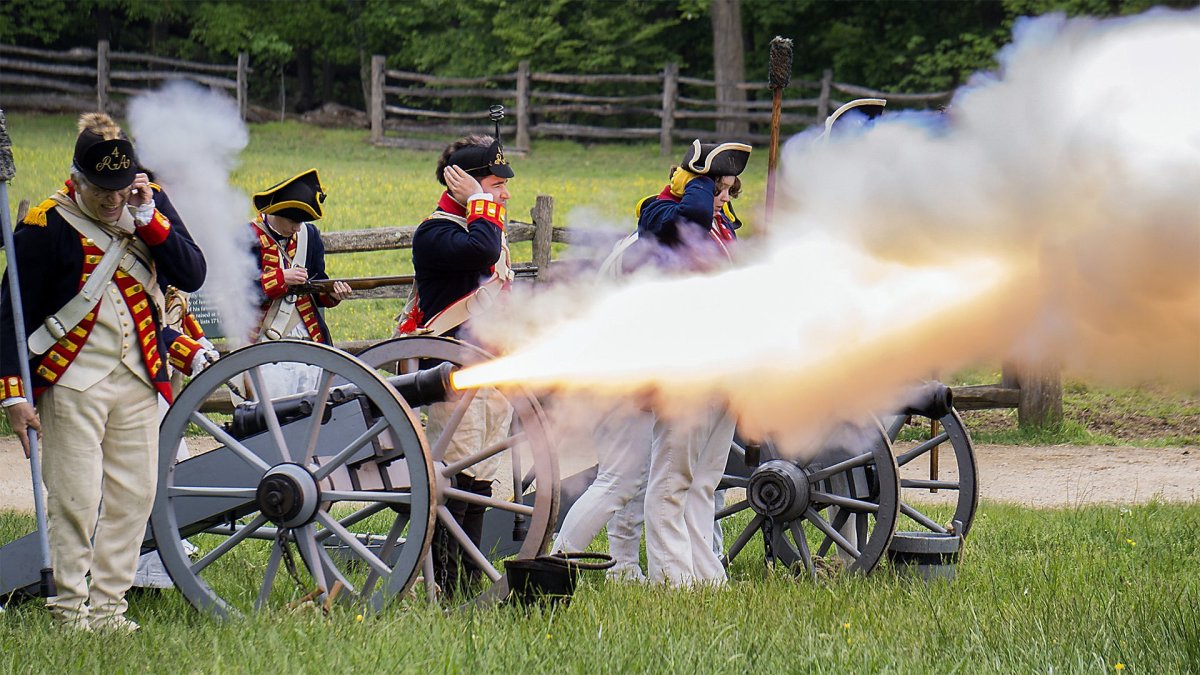
A reenactment of an artillery unit firing a cannon, NPS.gov
Artillery was most commonly placed in a single group called a grand battery in the center of an infantry line, but sometimes lined flanks or were spread at intervals among infantry lines. This artillery would lay down covering or destructive fire as enemy infantry advanced, altering their type of munition depending on battlefield conditions and tactics being employed.
When enemy soldiers were densely packed, solid shot was most often fired, aimed low in order to roll or skip across the ground and mow down entire columns of troops. One anecdote claims that 42 men were cut down by a single ball during a battle and there are dozens of accounts of cannonballs ripping limbs right off of infantrymen . Explosive shells or various types of small-diameter shot were more commonly used against stationary or fortified targets such as during the Siege of Yorktown or Battle of Trenton —some of the most pivotal victories for the Continental Army.
In terms of naval artillery tactics, the Siege of Yorktown was in many ways made possible due to the fact that French naval forces possessed heavier cannon which allowed them to fire heavier projectiles at the British. Both the British and the French fleets suffered heavy losses at the Battle of the Chesapeake, forcing the British Navy to retreat back to New York without reinforcing and resupplying their forces at Yorktown with fresh artillery.
The Battle of Trenton by Charles McBarron, 1775, Public domain
In 1776, John Adams famously wrote a letter to his wife Abigail remaking that America’s Independence Day “ought to be solemnized with Pomp and Parade, with shews, games, sports, guns, bells, bonfires and illuminations from one End of this continent to the other from this time forward forever more.” When you’re safely and responsibly celebrating with your own mortars and explosives this 4th of July, remember the sacrifices of the brave men and women who marched into battle against the British facing the devastating artillery of the era and the many generations of servicemembers who have done so against ever-more more powerful artillery in the centuries since.
Comments couldn’t be loaded. Please refresh the page.
更新于美国东部时间2019年12月1日凌晨5:55
美国生日快乐!今天,当我们以各种方式庆祝7月4日独立日之际,切勿忘记,我们国家的独立是以各方付出惨重的人员伤亡为代价的。如果没有殖民者的牺牲,我们今天就无法庆祝独立日。成千上万的殖民者为了确保美国摆脱英国的统治而献出了生命。如同任何重大冲突一样,独立战争也是各种新型武器和战术的试验场,这些武器和战术旨在给敌军造成重大伤亡。
火药技术的飞速发展使得民兵和正规军士兵在战场上遭遇了威力巨大的新型武器,对于那些初次入伍、尚未亲身经历过现代战争的殖民地士兵或民兵而言,这些武器简直如同魔法一般。虽然亚洲和欧洲已经使用简陋的火炮数百年,但拿破仑战争期间投入使用的火炮类型,其精准度和杀伤力都达到了前所未有的高度,这是以往的设计所无法比拟的。这些真正具有革命性的火炮武器主要分为三大类:加农炮、迫击炮和榴弹炮。
约克镇战场炮兵重演,前景为大炮,背景为榴弹炮。(图片来自维基共享资源)
一些考古证据表明,早在12世纪,中国宋朝和部分伊斯兰世界就已使用火炮,但这些早期火炮较为简陋,是手持式的,更像是花瓶,而非我们今天所见的长管火炮。在中世纪和近代早期,手持式和架设式火炮的设计在世界各地不断改进和发展,最终演变为滑膛前装式火炮,这种火炮在美国独立战争的战场上被交战双方广泛使用。
这些大炮通常由铸铁制成,偶尔也用青铜,装填预先制作好的纸质或布质炮弹,内装火药。大炮通常由马拉战车在战场间运输,安装在单轴双轮车或有时是四轮车上,这样便于小队人员短距离移动和部署。不同时期大炮的有效射程差异很大,但通常最大射程约为1000码。
半神话人物莫莉·皮彻在丈夫受伤后重新装填大炮。(图片来自维基共享资源)
火炮通常以其炮弹的重量来衡量威力。美国独立战争期间最常用的火炮是3磅“疾驰炮”和较为稳定的6磅炮,尽管在一些冲突中也使用了重达18磅的大型火炮。这些火炮的后坐力会使炮身向后移动,从而进一步增加了装填和重新调整炮位所需的时间。典型的火炮配备约10名炮手,平均每分钟可发射4发炮弹。它们发射的炮弹种类繁多,包括实心弹、装药炮弹、大直径葡萄弹、小直径霰弹、各种榴霰弹和链弹。
一袋葡萄弹会通过一个与枪膛直径相同的金属圆盘与枪管内的炸药隔开。(图片来自维基共享资源)
链弹及其更为刚性的变体——棒状弹,由两半炮弹组成,中间用链条或实心金属杆连接。发射时,两半炮弹会在飞行中展开,翻滚或旋转,在其极不精准的弹道轨迹上留下毁灭性的破坏痕迹。
一枚典型的18世纪链弹,图片来自维基共享资源
这些动能弹丸有时被用作最残酷的反人员武器,但最常用于海战中,用卡隆炮或旋回炮等较小的海军火炮发射,目的是折断桅杆或切断船只的索具。
在独立战争期间,迫击炮是仅次于大炮的第二大常用火炮。两种武器的原理相同,但迫击炮的炮管更短,射击角度更大。与现代迫击炮类似,这些迫击炮安装在平板或框架上,以陡峭的角度发射,以便轻松越过土方工事或其他防御工事,向敌人倾泻弹片。这些迫击炮的最大射程约为1400码,但其效能会在700码左右急剧下降。
约克镇战场上展出的一门老式榴弹炮,图片来自维基共享资源
典型的美国独立战争时期迫击炮使用直径4到13英寸的爆炸弹,这些炮弹直接装入炮膛。然而,与大炮不同的是,这些迫击炮采用的是膛室式设计,这意味着炸药是装入一个单独的膛室中,而不是像大炮那样与炮弹一起装入炮口。
美国独立战争时期,另一种火炮变体是榴弹炮。与普通火炮相比,榴弹炮的炮管长度短得多,但直径却大得多。从某种程度上说,就炮管尺寸和长度而言,独立战争时期的榴弹炮是迫击炮和普通火炮的混合体。榴弹炮的平均直径约为8到13英寸,长度约为3英尺。这些武器的典型有效射程约为750码。
图片来自维基共享资源,展示了一门在约克镇战场上展出的美国独立战争时期榴弹炮。
这些膛炮也发射装有爆炸性火药的炮弹,炮弹带有定时引信,由发射药点燃。由于炮管较短,因此在战斗中机动性更强。
美国独立战争炮兵战术
这些火炮在独立战争的战场战术中发挥了关键作用,但由于装填和发射耗时较长且机动性差,其效能受到限制。由于这些武器十分笨重,交战双方的军官都必须在战前像下棋一样精心部署火炮,以期最大限度地发挥其效用。因此,计划上的失误可能导致这些武器在战斗中完全失效。
战场指挥官必须谨慎考虑如何使用宝贵的火炮。既可以攻击敌方步兵以造成重大伤亡,也可以攻击敌方火炮以保护己方步兵。由于火炮难以移动,随着步兵推进和占领阵地,火炮往往会在战斗中易手。敌方火炮被视为战利品,双方在冲突中都会频繁地损失和获得火炮。
一场炮兵部队发射大炮的重现表演,NPS.gov
炮兵通常以大炮组的形式部署在步兵防线的中央,但有时也会部署在侧翼或分散在步兵防线之间。这些炮兵会在敌军步兵推进时提供掩护或火力压制,并根据战场情况和战术调整弹药类型。
当敌军密集排列时,通常使用实心弹,瞄准低空,让炮弹在地面上滚动或跳跃,从而扫射整列敌军。有一则轶事称,在一次战斗中,一颗炮弹就击倒了42名士兵;还有数十则记载,炮弹直接将步兵的四肢炸断。对于固定或设防目标,例如在约克镇围城战或特伦顿战役中——大陆军取得的一些最关键的胜利——则更常使用爆炸弹或各种小口径炮弹。
就海军炮兵战术而言,约克镇围城战之所以能够成功,很大程度上要归功于法国海军拥有更重型的火炮,这使他们能够向英军发射威力更大的炮弹。在切萨皮克湾海战中,英法双方舰队都遭受了惨重损失,迫使英国海军撤回纽约,而没有得到增援和补给,也就无法为驻守约克镇的部队提供新的炮兵火力。
查尔斯·麦克巴伦所绘《特伦顿战役》,1775年,公共领域
1776年,约翰·亚当斯曾写信给妻子阿比盖尔,信中他写道,美国的独立日“应当以盛大的仪式和游行来庆祝,从今往后,从这片大陆的一端到另一端,都要有表演、游戏、体育活动、鸣枪、鸣钟、燃放篝火和灯光秀。” 今年7月4日,当你安全负责地用自己的迫击炮和炸药庆祝独立日时,请记住那些勇敢的男女战士,他们曾冒着当时威力巨大的炮火与英国军队作战,也请记住此后几个世纪以来,一代又一代的军人,他们面对着威力日益强大的炮火,浴血奋战。
评论加载失败,请刷新页面。