Navy to purchase 30 MUSVs following at-sea testing海军将在海上测试后采购30艘多用途水下航行器(MUSV)。
The contracts come as the Navy expands its marketplace for unmanned systems and moves into the second phase of the MUSV program.
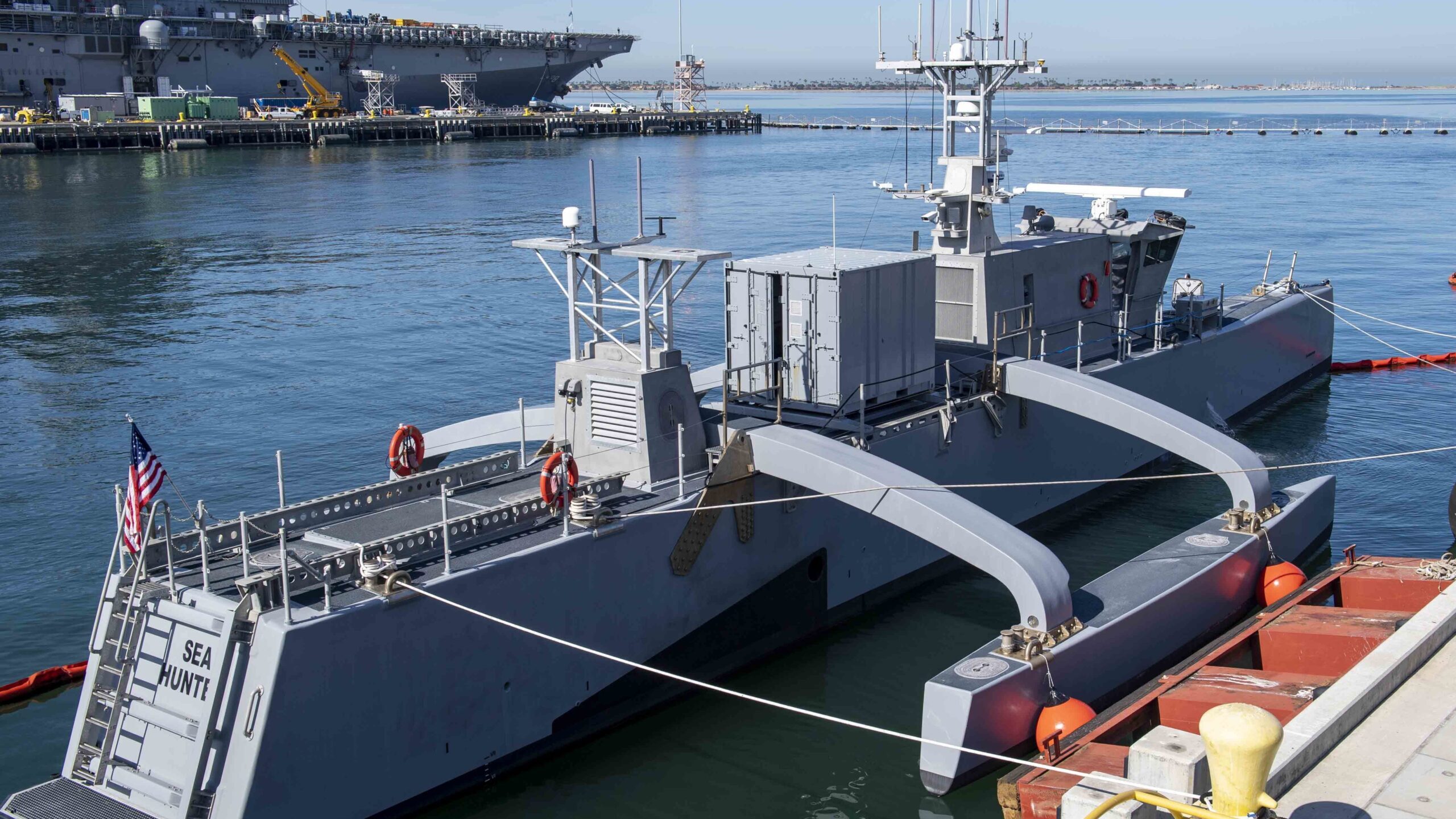
SAN DIEGO (May 13, 2022) – The medium-displacement unmanned surface vessel Sea Hunter sits pierside at Naval Base San Diego, during the Unmanned Surface Vessel Division (USDIV) One Establishment ceremony. (U.S. Navy photo by Mass Communication Specialist 2nd Class Kevin C. Leitner)
WASHINGTON — The Navy will purchase 30 medium unmanned surface vessels (MUSV) from three defense firms after successfully completing at-sea testing as part of the sea service’s novel MUSV marketplace.
The Navy announced today that Galliano Marine Services, Huntington Ingalls Industries (HII) and Saronic Technologies were each awarded contracts for 10 MUSVs, which also will be made available for purchase through the Navy’s marketplace for unmanned surface vessels. The companies are expected to begin deliveries to the service by the end of fiscal 2027, with each system costing roughly $40 million, according to the Navy.
Three other companies — Leidos, PacMar Technologies and Sea Machines — also successfully completed testing and will be added to the online marketplace for follow-on production agreements across the Department of Defense.
“Our warfighters don’t have time to wait on bureaucracy while our adversaries pace forward,” Acting Secretary of the Navy Hung Cao said today in a statement. “Our message to the defense industrial base is simple: build fast, deliver on time, and match the urgency of the threat. This MUSV award is a prime example of how we are streamlining acquisitions to ensure our Sailors and Marines have the capabilities they need to fight, win, and come home safe.”
The Navy launched the MUSV marketplace in March as part of a new procurement model to acquire production-ready, mission capable platforms already available. At the time, officials described the platform as the first iteration of a recurrent marketplace.
The Navy selected seven companies in May to participate in at-sea testing, which was expected to run from July through October. Birdon was among the companies selected, but did not successfully complete the demonstration, according to the Navy.
The six companies moving forward have also received $15 million and are now eligible for follow-on production contracts .
Bombardier Defense, your trusted, mission-focused partner
A commitment to long-term operational value.
At-sea testing included assessments of the vessel’s visibility and maritime awareness, its ability to complete a long-duration mission and its ability to navigate independently in accordance with the International Regulations for Preventing Collisions at Sea.
The awards comes as the Navy moves into Phase II of the MUSV program. On Sept. 23, the service published a solicitation for the subsequent phas e, which will integrate and test MUSVs to include additional options on the online marketplace.
T he Navy’s notice said it wants vessels no longer than 90 meters that can complete at least 10 days of unmanned operations. The notice also calls for a payload capacity of at least two standard 20-foot shipping containers, down from the Phase I requirement of two 40-foot containers.
Christopher Miller, Direct Reporting Portfolio Manager for robotic and autonomous systems (DRPM RAS), said all companies that successfully completed Phase I will transfer into the marketplace as part of Phase II and will be eligible for follow-on production agreements. Miller also said the Navy wants to “open the aperture” for new entrants and increase options for other services that may be interested in the capabilities.
“What I’m trying to do is also give more industry opportunities for companies that have something ready to go,” Miller told reporters today. “Obviously with Phase I, there were some more challenging requirements that they had to meet, and so I’m trying to back off of those so that I can have a healthy, competitive industrial base and really use that to help us identify near-term opportunities to meet our operational demands.”
Specifically, Miller said one of the lessons learned from Phase I is that increasing requirements for capabilities like speed can create production challenges for industry and affect vessel designs.
“I’m trying to actually find the sweet spot in the market where there is healthy competition and there’s opportunities, and we can have more things that potentially are dual use, both military and civilian,” Miller said.
According to Miller, the Navy is working in tandem with the Direct Reporting Portfolio Manager for autonomy (DRPM UxS) to expand the marketplace beyond MUSVs.
“We are also working in close coordination with DRPM UxS to expand the maritime marketplace hosted on drones.mil from solely the MUSV platform to include all appropriate surface vessels as well as those in the air, undersea, and counter-UxS domains,” Miller said.
圣地亚哥(2022年5月13日)——在圣地亚哥海军基地无人水面舰艇分队(USDIV)第一分队成立仪式上,中型排水量无人水面舰艇“海上猎人”号停靠在码头边。(美国海军二级大众传播专家凯文·C·莱特纳摄)
华盛顿——作为海军新型中型无人水面舰艇(MUSV)市场的一部分,海军在成功完成海上测试后,将从三家国防公司购买 30 艘 MUSV。
美国海军今日宣布,已分别与加利亚诺海事服务公司(Galliano Marine Services)、亨廷顿·英格尔斯工业公司(Huntington Ingalls Industries,简称HII)和萨罗尼克科技公司(Saronic Technologies)签订合同,为其建造10艘无人水面舰艇(MUSV)。这些舰艇也将通过海军的无人水面舰艇市场进行销售。海军方面表示,预计这三家公司将于2027财年末开始向海军交付舰艇,每套系统的成本约为4000万美元。
另外三家公司——Leidos、PacMar Technologies 和 Sea Machines——也成功完成了测试,并将被添加到国防部后续生产协议的在线市场中。
“我们的作战人员没有时间等待官僚主义的拖延,而我们的对手却在快速推进,”海军代理部长洪曹今天在一份声明中表示。“我们向国防工业界传达的信息很简单:快速建造,按时交付,并满足威胁的紧迫性。此次授予的MUSV项目就是一个绝佳的例子,它体现了我们如何简化采购流程,以确保我们的水兵和海军陆战队员拥有作战、取胜并安全回家所需的能力。”
美国海军于3月启动了MUSV(多用途舰艇)市场,这是其新采购模式的一部分,旨在采购已具备生产能力和作战能力的现成平台。当时,官员们将该平台描述为循环利用市场模式的首次迭代。
海军于5月份选定了七家公司参与海上测试,测试预计从7月持续到10月。伯顿公司是入选公司之一,但据海军方面称,该公司未能成功完成演示。
进入下一阶段的六家公司也获得了 1500 万美元,现在有资格获得后续的生产合同。
庞巴迪防务,您值得信赖、以任务为导向的合作伙伴
致力于实现长期运营价值。
海上测试包括对船舶的能见度和海上意识、完成长时间任务的能力以及根据《国际海上避碰规则》独立航行的能力进行评估。
此次授标正值海军进入多用途水下航行器(MUSV)项目第二阶段之际。9月23日,海军发布了后续阶段的招标公告,该阶段将整合并测试MUSV,并纳入更多在线市场选项。
海军的通知称,他们希望建造长度不超过90米、能够完成至少10天无人作业的舰艇。通知还要求有效载荷至少为两个标准20英尺集装箱,低于第一阶段要求的两个40英尺集装箱。
负责机器人和自主系统(DRPM RAS)的直接汇报项目经理克里斯托弗·米勒表示,所有成功完成第一阶段的公司都将进入第二阶段市场,并有资格签订后续生产协议。米勒还表示,海军希望为新进入者“敞开大门”,并为其他可能对相关能力感兴趣的军种提供更多选择。
“我正在努力为那些已经做好充分准备的公司提供更多行业机会,”米勒今天告诉记者。“显然,第一阶段有一些更具挑战性的要求需要他们满足,所以我正在尝试放宽这些要求,以便建立一个健康、具有竞争力的产业基础,并真正利用这一点来帮助我们找到满足近期运营需求的机会。”
具体来说,米勒表示,从第一阶段吸取的教训之一是,对速度等能力的不断提高要求可能会给行业带来生产挑战,并影响船舶设计。
“我正在努力寻找市场上的最佳平衡点,既要有健康的竞争,又要有机遇,这样我们才能拥有更多可能具有军民两用特性的产品,”米勒说。
据米勒称,海军正与自主系统直接报告组合经理(DRPM UxS)协同合作,将市场扩展到 MUSV 之外。
“我们还与 DRPM UxS 密切合作,将 drones.mil 上的海上市场从仅限 MUSV 平台扩展到包括所有合适的水面舰艇以及空中、水下和反 UxS 领域的舰艇,”米勒说。