Marines, Army deploying missile systems to Luzon Strait海军陆战队和陆军向吕宋海峡部署导弹系统
Segments of the training area where the systems will operate are less than 90 miles from Taiwan.
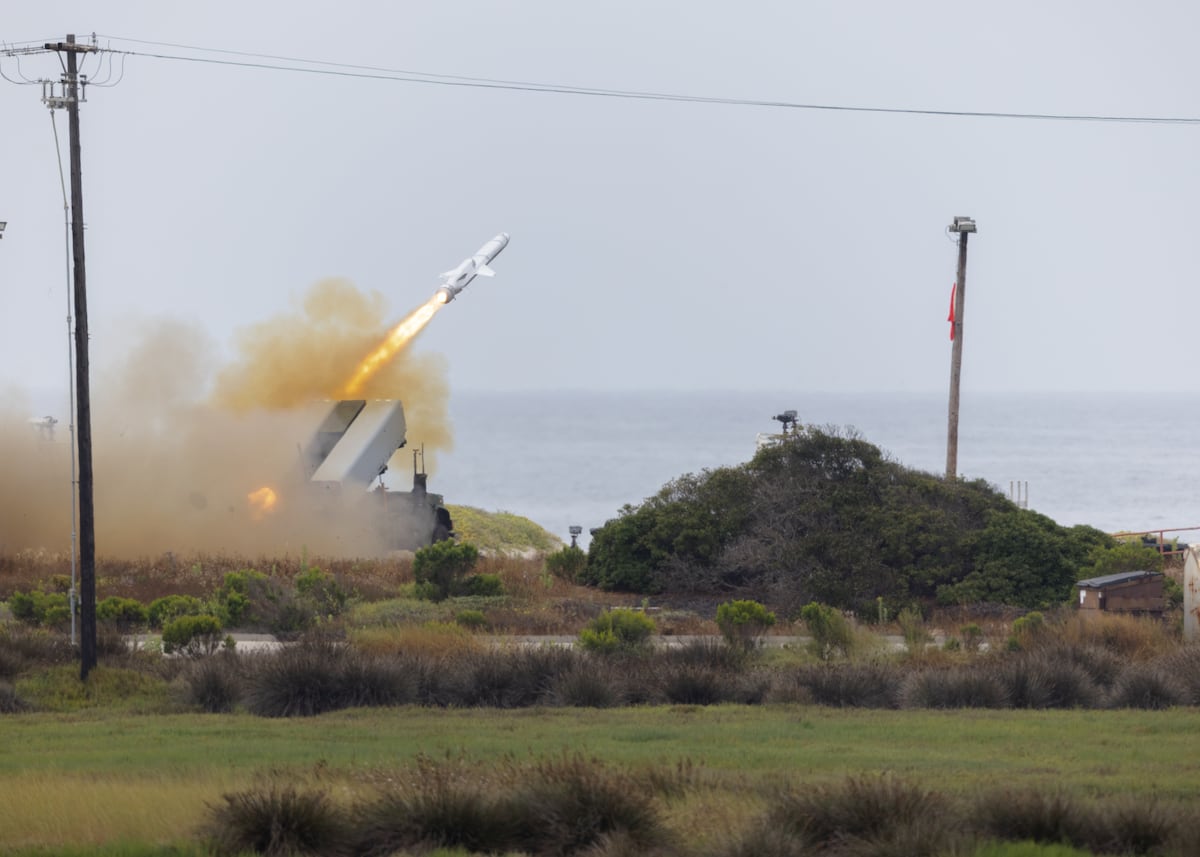
Marine Corps and Army missile systems are set to deploy to a key chokepoint in the Philippine Island chains for anti-ship drills during the military exercise known as KAMANDAG.
The unmanned, anti-ship Navy-Marine Expeditionary Ship Interdiction System, or NMESIS, and the Army’s High Mobility Rocket Artillery System will feature prominently in the exercise with their emplacement between Luzon and Taiwan, U.S. Naval Institute reported .
The 3rd Marine Littoral Regiment’s NMESIS is heading to Batanes, the northernmost portion of Philippine territory. The platform first reached the island of Basco and Batan for Balikatan 2025, a maritime security exercise.
That was the first time the Marines deployed the anti-ship missile to the Luzon Strait.
“The insertion of the NMESIS on Batan during Exercise Balikatan 25’s MKTSO was an achievement of a major milestone not just for 3rd MLR, but for the entire U.S. Marine Corps enterprise, signifying advancements in the service’s equipment fielding to employment timelines,” said Col. John G. Lehane, commanding officer of the 3rd Marine Littoral Regiment.
“In a matter of months, the NMESIS went from an experimental asset undergoing the rigorous initial operational testing and evaluation spearheaded by Marine Corps Systems Command and the program office, to a fully fielded weapon system capable of neutralizing the threat of adversarial vessels in contested littoral zones.”
Marine Rotational Force-Darwin will conduct corps-level command and control. The 3rd MLR will deploy their missile battery to Batanes using KC-130J transport aircraft, USNI reported .
“KAMANDAG 9 is a clear demonstration of the strength of the U.S.-Philippine alliance and our ironclad commitment to regional security and combined readiness,” said Col. Jason C. Armas, commanding officer of the MRF-D 25.3 MAGTF. “Training shoulder to shoulder with our Philippine Marine Corps partners isn’t just about building interoperability — it’s about forging trust in the crucible of shared hardship and preparing together to respond with speed and precision to any crisis, anywhere, anytime.”
The exercise is scheduled to run from May 26 to June 6 and will take place across the Philippine archipelago, including Luzon, Batanes, Tawi-Tawi and Palawan, according to a release .
Training events include maritime key terrain security operations, defensive counter-landing live-fire drills, littoral maneuver, amphibious operations and humanitarian assistance and disaster relief, according to the release .
Japanese and Korean forces are scheduled to conduct amphibious drills in the province of Palawan, which faces the South China Sea, a key area of control for any potential conflict with Beijing.
The Army HIMARs will be transported by the Armed Forces of the Philippines alongside the Marine anti-ship systems. The service deployed the launchers during Balikatan 2024.
The missile units will rehearse maritime strikes in the Luzon Strait. Those systems can cover the 250-kilometer-wide strait through fires and sensors, USNI reported .
The 3rd MLR used a network of ground-based sensors and drones across Batanes and the Babuyan Islands during previous exercises.
Those operations included the Philippine territory of Mavulis, less than 90 miles from Taiwan.
Todd South has written about crime, courts, government and the military for multiple publications since 2004 and was named a 2014 Pulitzer finalist for a co-written project on witness intimidation. Todd is a Marine veteran of the Iraq War.
在名为“卡曼达格”(KAMANDAG)的军事演习期间,海军陆战队和陆军的导弹系统将部署到菲律宾群岛的一个关键咽喉要道,进行反舰演习。
据美国海军学会报道,无人反舰海军陆战队远征舰艇拦截系统(NMESIS)和陆军高机动火箭炮系统将在演习中发挥重要作用,它们将被部署在吕宋岛和台湾之间。
美国海军陆战队第3近海团的NMESIS平台正前往菲律宾最北端的巴丹群岛。该平台此前已抵达巴斯科岛和巴丹岛,参加“肩并肩2025”海上安全演习。
那是海军陆战队首次在吕宋海峡部署反舰导弹。
“在‘肩并肩25’联合演习的MKTSO期间,NMESIS部署到巴坦岛不仅对第3海军陆战队近岸团而言是一个重要的里程碑,而且对整个美国海军陆战队来说也是一个重要的里程碑,标志着该部队装备部署到使用时间线的进步,”第3海军陆战队近岸团指挥官约翰·G·莱恩上校说。
“短短几个月内,NMESIS 就从海军陆战队系统司令部和项目办公室牵头进行严格的初始作战测试和评估的实验性资产,变成了能够消除敌对近岸区域敌方船只威胁的全面部署武器系统。”
据美国海军学会报道,驻达尔文海军陆战队轮换部队将进行军级指挥控制。第3海军陆战队远程侦察连将使用KC-130J运输机将其导弹连部署到巴丹群岛。
“KAMANDAG 9演习清晰地展现了美菲联盟的实力,以及我们对区域安全和联合战备的坚定承诺,”第25.3海军陆战队空地特遣部队(MRF-D 25.3 MAGTF)指挥官杰森·C·阿马斯上校表示。“与菲律宾海军陆战队伙伴并肩训练,不仅仅是为了提升互操作性,更是为了在共同的磨难中建立信任,并携手做好准备,随时随地快速精准地应对任何危机。”
根据一份新闻稿,此次演习计划于5月26日至6月6日举行,将在菲律宾群岛各地进行,包括吕宋岛、巴丹群岛、塔威塔威岛和巴拉望岛。
根据新闻稿,训练活动包括海上重点地形安全行动、防御性反登陆实弹演习、近岸机动、两栖作战以及人道主义援助和救灾。
日本和韩国军队计划在巴拉望省进行两栖演习,该省面向南海,是与北京发生潜在冲突的关键控制区域。
菲律宾武装部队将与海军陆战队的反舰系统一同运输陆军的HIMAR反舰导弹系统。该部队已在2024年“肩并肩”联合军演期间部署了这些发射装置。
据美国海军学会报道,导弹部队将在吕宋海峡进行海上打击演习。这些系统可以通过火力打击和传感器覆盖这条250公里宽的海峡。
在之前的演习中,第3海上陆战队使用了巴丹群岛和巴布延群岛的地面传感器和无人机网络。
这些行动包括菲律宾领土马武利斯,该地距离台湾不到 90 英里。
自2004年以来,托德·索斯为多家出版物撰写有关犯罪、法院、政府和军事方面的文章,并因与人合著的关于恐吓证人的文章入围2014年普利策奖决赛。托德是参加过伊拉克战争的海军陆战队老兵。