Ryan Aeronautical Had Big Plans for the Vertifan Jump Jet瑞安航空曾对Vertifan垂直起降喷气式飞机寄予厚望。
Company artwork shows proposals for vertical take-off and landing fighter jets, interceptors, sub hunters, and more.
新闻视频
By Joseph Trevithick
Updated Jul 3, 2020 4:22 AM EDT
While defense contractors can be shameless in trying to sell their products, they don’t always offer a complete vision of certain aspects of future warfare. But based on a collection of concept art, at the height of the Cold War, Ryan Aeronautical pitched their Vertifan jump jet as the future of air power.
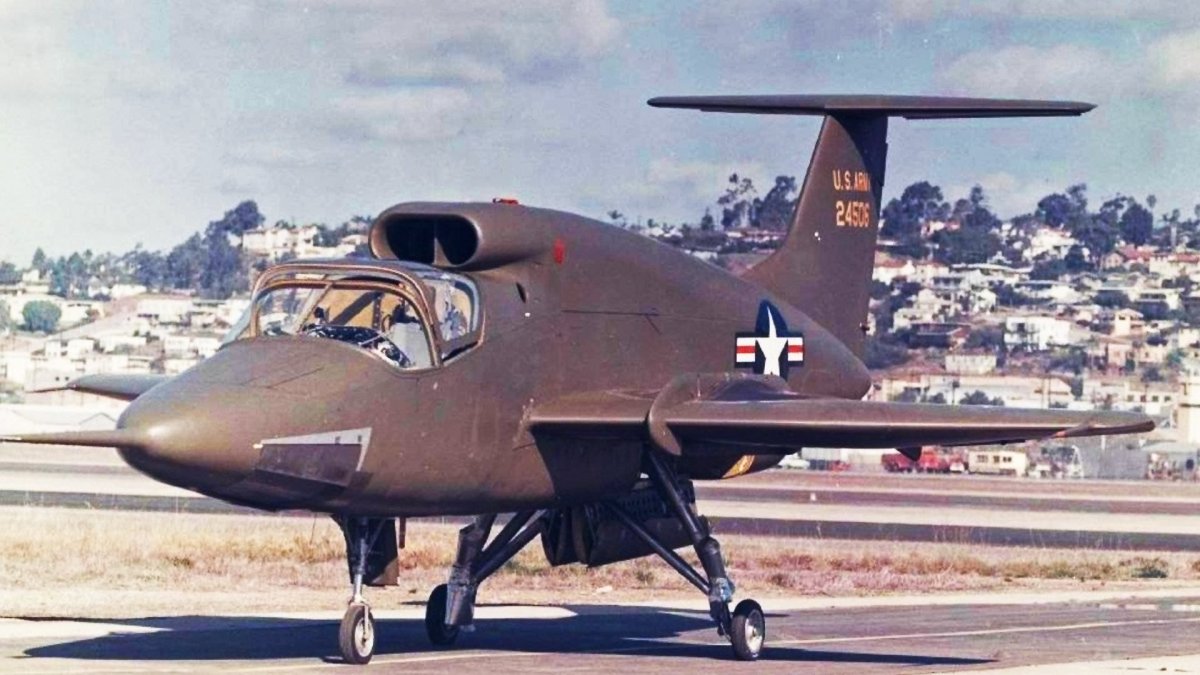
When Ryan’s experimental XV-5A Vertifan made its first flight On May 25, 1964, the California-based plane maker had already been at work on the concept for more than two years. The U.S. Army had only ordered two of the planes, but the firm envisioned the prototypes as the first step to building jump jet fighters for the U.S. Air Force and Navy, interceptors for the West German Luftwaffe, sub hunting patrol planes, and small counter-insurgency aircraft, all of which could take off and land vertically without the need for conventional runways.
By the end of the 1950s, the U.S. military and many of its allies had become interested in the idea of jump jets. Experience in World War II had shown that taking out runways could cripple an enemy’s air force without necessarily having to eliminate production lines or destroy individual aircraft. With the advent of nuclear weapons the United States realized it would be particularly easy for the Soviet Union to take out entire air bases with minimal effort.
The two Ryan XV-5A prototypes., Ryan Aeronautical via the SDASM Archives
This concern was even more pronounced for countries, such as West Germany, which sat right on the border of the Soviet Union and its Warsaw Pact allies. An aircraft that could take off and land vertically or otherwise operate without the need for large, conspicuous improved runway offered a possible way to keep forces safe and available for a counterattack during a future conflict involving atomic weaponry.
Various countries experimented with vertical take-off aircraft in different configurations. In its actual prototypes, Ryan’s Vertifan design involved separate jet engines and lift fans to achieve level and vertical flight respectively. However, the lift fans were not independently powered. When the pilot switched from level to vertical flight, a cut-off valve redirected the jet exhaust and used it to physically spin the fans.
Not surprisingly, Ryan’s art showcases these prototypes, with twin jet engines and lift fans in the wings and nose, which the company had crafted for the Army. Offering the ability to operate like a helicopter, but with the cruising speed of a fixed wing jet, the service wanted to explore their potential in both the close air support and rescue roles.
The COIN Vertifan., Ryan Aeronautical via the SDASM Archives
But Ryan didn’t expect stop there. Artworks depict a stubbier Vertifan specifically for counter-insurgency operations. The concept looks like a hybrid between the XV-5 and North American Rockwell’s OV-10 Bronco. Based on the art, this version would have involved a turbojet engine driving a pusher propeller in the tail, as well as providing the exhaust to drive the lift fans. In scenes that evoke a Southeast Asian setting—the U.S. military was becoming increasingly embroiled in Vietnam as Ryan continued to refine its prototypes—these aircraft carry rocket pods under their wings while operating from austere camps and attacking insurgent-controlled villages.
Vertifan fighter jets for the U.S. Air Force., Ryan Aeronautical via the SDASM Archives
Ryan had options for other services, too. One slide features a pair of potential Air Force fighter jets in a similar configuration to the XV-5. The aircraft in the foreground has two under-wing drop tanks and what appear to be four cannons. At the time, the service was still flying the F-100 Super Sabre fighter, which had a similar armament.
A U.S. Navy Vertifan refuels in mid-air., Ryan Aeronautical via the SDASM Archives
Another image shows an elongated Vertifan design in a Navy paint scheme flying along with A-4 Skyhawk attack aircraft and F-4 Phantom fighter jets. One of the A-4s is refueling the Vertifan in mid-air using a “buddy pod” system. It’s not entirely clear whether the proposed variant was a fighter, attack aircraft, spy plane, or electronic warfare platform – akin to the EA-3B and EKA-3B Skywarriors – since it carries no obvious weapons, but has pods or slipper tanks on its wings. There was also a larger anti-submarine warfare concept, which Ryan would likely have pitched to the Navy, too.
Ryan Aeronautical via the SDASM Archives
Then there’s a painted scene involving three West German Vertifans, all much longer than the XV-5 prototypes, with two sets of fans in the forward and rear fuselages. The port for a forward-firing cannon, such as the M61 Vulcan, is visible and the pointed nose looks perfect for an air intercept radar.
Luftwaffe Vertifan intereptors., Ryan Aeronautical via the SDASM Archives
It’s worth noting that at the time, the Luftwaffe was actively exploring zero-length launchers capable of blasting the F-104 interceptor into the air, as well as domestically produced dedicated jump jets such as the EWR VJ 101 . German firm VFW continued this work into the 1970s, ultimately developing the experimental VAK 191B . The German military did not put any of these designs into service.
The Vertifan itself ended in failure, suffering from reliability problems and intra-service rivalry . In April 1965, one of the two XV-5As was totally destroyed during a demonstration flight, which killed the pilot. The next year another accident claimed the life of a second test aviator. During an experiment with a rescue hoist system, a manikin representing an injured soldier had gotten caught in one of the lift fans, destabilizing the aircraft.
Ryan rebuilt the prototype with various improvements, leading to the XV-5B. Unfortunately, at the same time, the Army was losing a long-running bureaucratic battle with the Air Force over its right to fly fixed wing aircraft. The Air Force and its supporters ultimately managed to kill off the Army’s Vertifan program.
With no interest in using it themselves, the Air Force effectively doomed the project as a whole. Ryan never found buyers for any variant of the Vertifan. Instead, the U.S. Navy and Marine Corps focused on testing the British Hawker Siddeley P.1127 , which eventually led to the Marine’s adopting the AV8 Harrier jump jet in 1971.
Contact the author: joe@thedrive.com
Comments couldn’t be loaded. Please refresh the page.
作者:约瑟夫·特雷维西克
更新于美国东部时间2020年7月3日凌晨4:22
尽管国防承包商在推销产品时可能毫不掩饰,但他们并非总能全面展现未来战争的某些方面。然而,在冷战高峰时期,瑞安航空曾根据一系列概念图,将他们的垂直起降战斗机“Vertifan”宣传为未来空中力量的代表。
1964年5月25日,瑞安公司的实验型XV-5A“垂直起降”战斗机首飞成功。这家位于加利福尼亚的飞机制造商此前已为此概念研发了两年多。美国陆军当时只订购了两架,但该公司设想这些原型机是为美国空军和海军建造垂直起降战斗机、为西德空军建造拦截机、建造反潜巡逻机以及小型反叛乱飞机的第一步,所有这些飞机都无需传统跑道即可垂直起降。
到了20世纪50年代末,美国军方及其许多盟国开始对垂直起降战斗机产生兴趣。二战的经验表明,摧毁跑道就能重创敌方空军,而无需切断生产线或摧毁单架飞机。随着核武器的出现,美国意识到苏联将能以最小的努力摧毁整个空军基地。
两架瑞安XV-5A原型机,图片来自瑞安航空,经由SDASM档案馆提供。
对于像西德这样与苏联及其华沙条约盟国接壤的国家来说,这种担忧尤为突出。一种无需大型显眼跑道即可垂直起降或以其他方式运行的飞机,为在未来涉及原子武器的冲突中保障部队安全并随时准备反击提供了一种可能途径。
各国都曾试验过不同构型的垂直起降飞机。瑞安公司的Vertifan原型机采用了独立的喷气发动机和升力风扇,分别用于实现水平飞行和垂直飞行。然而,升力风扇并非独立供电。当飞行员从水平飞行切换到垂直飞行时,一个截止阀会改变喷气发动机的排气方向,并利用其动力驱动风扇旋转。
不出所料,瑞恩的艺术作品展示了这些原型机,它们配备了双喷气发动机,机翼和机头内装有升力风扇,这些都是该公司为陆军打造的。这些原型机具备直升机的操控能力,但巡航速度却与固定翼喷气式飞机相当。陆军希望探索它们在近距离空中支援和救援任务中的潜力。
COIN Vertifan,瑞安航空,图片来自SDASM档案馆
但瑞安的野心远不止于此。设计图描绘了一种更短小的垂直起降战斗机,专门用于反叛乱作战。该概念机看起来像是XV-5和北美洛克威尔OV-10“野马”的混合体。根据设计图,该版本将采用涡轮喷气发动机驱动尾部的推进式螺旋桨,同时发动机的废气也用于驱动升力风扇。在描绘东南亚场景的画面中——当时美军正日益深陷越南战争泥潭,而瑞安则不断改进其原型机——这些飞机在机翼下挂载火箭弹巢,从简陋的营地起飞,攻击叛乱分子控制的村庄。
美国空军的垂直起降战斗机。(图片来自 Ryan Aeronautical,经由 SDASM 档案馆提供)
瑞安还有其他选择。其中一张幻灯片展示了两架潜在的空军战斗机,其配置与XV-5类似。前景中的飞机有两个翼下副油箱,以及看似四门机炮的武器。当时,空军仍在服役F-100超级佩刀战斗机,其武器配置与之类似。
美国海军一架垂直起降战斗机正在进行空中加油。(图片来自瑞安航空,经由SDASM档案馆提供)
另一张图片显示,一架涂装海军涂装的加长型Vertifan垂直起降飞机正与A-4“天鹰”攻击机和F-4“鬼怪”战斗机一同飞行。其中一架A-4正在使用“伙伴吊舱”系统为Vertifan进行空中加油。由于该机型没有明显的武器装备,但机翼上挂载了吊舱或副油箱,因此目前尚不完全清楚该机型究竟是战斗机、攻击机、侦察机还是类似EA-3B和EKA-3B“空中战士”的电子战平台。此外,瑞安还曾向海军提出过一个更大的反潜作战概念方案。
Ryan Aeronautical via SDASM Archives
然后是一幅彩绘场景,描绘了三架西德垂直起降战斗机,它们都比XV-5原型机长得多,机身前后各有一组风扇。可以看到用于安装前射机炮(例如M61火神炮)的接口,尖锐的机头看起来非常适合安装空中拦截雷达。
德国空军垂直起降战斗机,图片来自 Ryan Aeronautical,经由 SDASM 档案馆提供。
值得注意的是,当时德国空军正在积极研发能够将F-104截击机发射升空的零长度发射器,以及国产的专用垂直起降战斗机,例如EWR VJ 101。德国VFW公司在20世纪70年代继续进行这项研究,最终开发出了实验型VAK 191B。但德国军方并未将这些设计投入使用。
Vertifan垂直起降机最终以失败告终,其可靠性问题和内部竞争是主要原因。1965年4月,两架XV-5A中的一架在演示飞行中完全损毁,飞行员不幸遇难。次年,另一起事故夺去了第二名试飞员的生命。在一次救援绞车系统试验中,一个模拟受伤士兵的人体模型被卷入其中一个升力风扇,导致飞机失去平衡。
瑞安对原型机进行了多项改进,最终研制出了XV-5B。然而不幸的是,与此同时,陆军与空军之间就固定翼飞机的飞行权展开了旷日持久的官僚斗争,陆军也因此处于劣势。最终,空军及其支持者成功地扼杀了陆军的垂直起降战斗机项目。
由于空军自身对使用该机型毫无兴趣,整个项目实际上就此夭折。瑞安公司始终未能为Vertifan的任何衍生机型找到买家。相反,美国海军和海军陆战队转而专注于测试英国霍克·西德利P.1127垂直起降战斗机,最终促使海军陆战队在1971年采用了AV8“鹞”式垂直起降战斗机。
联系作者:joe@thedrive.com
评论加载失败,请刷新页面。