Bondo Gave The Secret Tacit Blue Demonstrator Jet Its Smooth Stealthy Skin邦多赋予了秘密的蓝色演示者喷气式飞机光滑隐蔽的外皮
Veteran Northrop engineer recollects his time on the top-secret Tacit Blue program, including some of its oddest quirks.
新闻视频
By Brett Tingley and Tyler Rogoway
Updated Feb 21, 2022 12:14 PM EST
In the late 1970s, the Pentagon saw a need for a new class of battlefield surveillance aircraft that could penetrate into denied airspace and collect intelligence in real-time for long periods by using a new technology that was beginning to emerge known as stealth. With this in mind, the U.S. Air Force and the Defense Advanced Research Projects Agency approached the Northrop Corporation, which had some experience with stealth technology already, to build a reconnaissance aircraft built around an advanced radar system. The resulting prototype aircraft was known as Tacit Blue , now regarded by the Air Force as one of the most successful technology demonstrators ever funded.
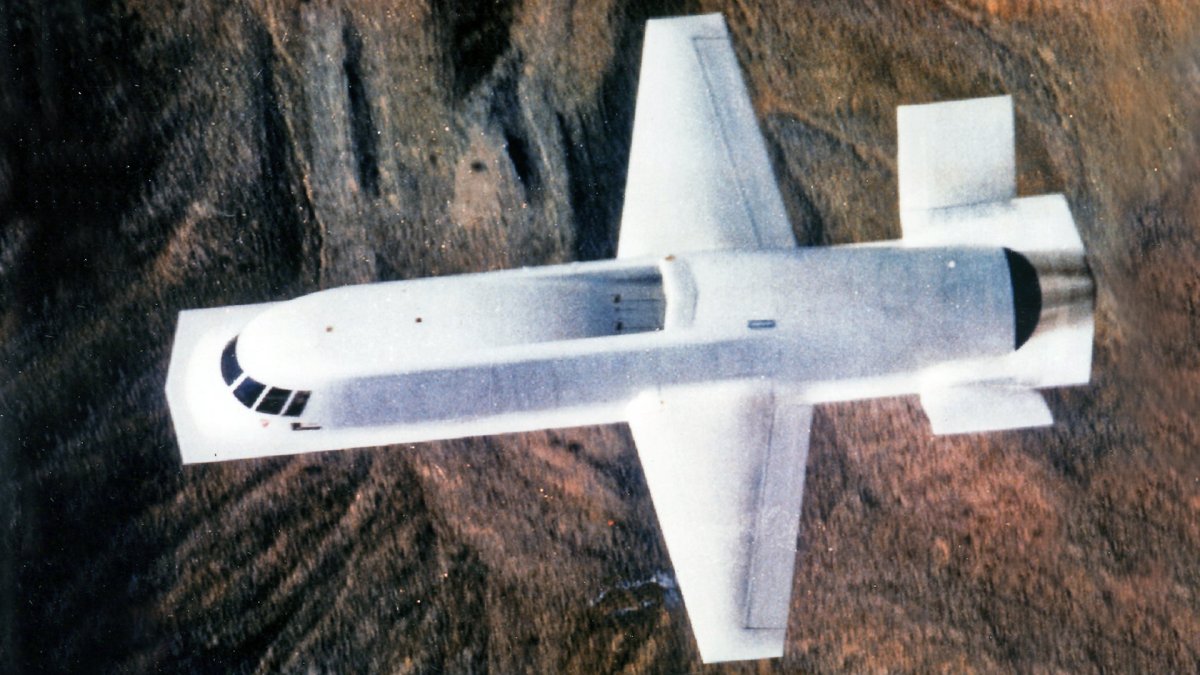
Northrop Tacit Blue, USAF
To shed light on the history of the Tacit Blue Project, the Western Museum of Flight in Torrance, California hosted veteran Northrop aerospace engineer Don Murray last year. The museum’s director introduced Murray as “a key player in the development of highly stealthy technology” and “widely recognized among the pioneers of stealth.” The long-time engineer began the talk with a brief introduction, stating he was involved with at least 12 “new aircraft programs” during his 50 years working for Northrop Corporation, which then merged with Grumman Aerospace in 1994. “Several of them were very unique, probably none of them more so than the Tacit Blue program,” Murray said.
Don Murray, left, in 2009 being awarded the Distinguished Engineering Achievement Award from Engineers’ Council, an independent non-profit group., Northrop Grumman
Murray was assigned to be a second shift supervisor for the Tacit Blue project, which grew out of an Air Force and Defense Advanced Research Projects Agency (DARPA) initiative known as the Battlefield Surveillance Aircraft-Experimental ( BSAX ) program. That program was aimed at producing a technology demonstrator aircraft that combined the battlefield survivability aspects of a low-observable stealth aircraft with a low probability of intercept (LPI) radar and data-link suite. This type of radar uses a variety of techniques to collect high-fidelity intelligence without compromising its own position. In other words, it is very hard for the enemy to detect its emissions and thus the presence of the platform it is mounted on.
In Tacit Blue’s case, the giant Hughes radar it was built around was designed to provide ground-moving target indicator (GMTI) capabilities, where formations of vehicles can be tracked with great precision over a wide area. It could also provide synthetic aperture radar mapping, which provides satellite picture-like images of the battlefield. None of the intel it gathered would be processed onboard. Instead, an LPI datalink would send it to a remote station on the ground for processing and rapid exploitation. The secret program existed in parallel to the larger PAVE MOVER/ASSAULT BREAKER initiatives underway at the time that were aimed at using a radar system like Tacit Blue’s to rapidly detect and counter Soviet armor advances in any weather.
While prior spy aircraft, like the SR-71, were able to collect brief ‘snapshots’ of intel while flying quickly in and out of target areas, the Tacit Blue project was aimed at producing a stealthy aircraft that could loiter deep inside or very near denied airspace and deliver a near real-time intelligence feed using its advanced sensors over long periods of time. This shift from momentary to persistent airborne intelligence-gathering over enemy territory was a revolutionary idea at the time, one that is still being expanded upon operationally today .
When giving an overview of the general specifications of the Tacit Blue demonstrator, designated AP-1, Murray said that the aircraft incorporated a Clark Y airfoil , a wing profile that features a flat bottom. This profile has a high lift-to-drag ratio and was used throughout the 1920s and 1930s on aircraft, but was rarely found on more modern aircraft. Northrop chose to use this older airfoil profile because the flat bottom offered a reduced radar cross-section and could offer the levels of lift needed for a high endurance aircraft such as the Tacit Blue. Remember, the idea is that Tacit Blue could penetrate and persist for long periods of time over or very near enemy territory, sucking up extremely high-quality intelligence without the enemy even knowing it was there.
When he joined the program, the basic airframe had been completed and assembled. Murray explained that the wings and fuselage of the demonstrator were constructed out of a standard aluminum alloy, while the radar-sensitive empennage and leading edges of the wings and fuselage/chines being built from a “proprietary Northrop composite material” that was key to the aircraft’s stealthiness. The front landing gear was from an F-5 , while the main landing gear was from an F-16 .
The program encountered few problems during pre-flight development, but Murray explained how the team had difficulty “attaining the smoothness and curvature on the fuselage to satisfy low observable requirements.” To remedy this, Northrop engineers turned to Bondo , a plastic-based auto body filler commonly found in auto parts stores. “We had a joke that if we ever lost our jobs we could always get a job with the car customizers in the L.A. area sanding Bondo because everybody got a chance to apply and sand Bondo,” Murray said with a laugh. Twenty years earlier, he says, Northrop had used Bondo on the X-21 demonstrator built to test drag reduction concepts.
Murray and his team were initially tasked with installing the jet’s subsystems and components, including its hydraulic and fuel lines, throttle system, and wiring up the Tacit Blue’s instrumentation and advanced flight control systems. Between 1981 and early 1982, Murray’s team performed in-hangar checks in order to verify the flight control systems and backup procedures that would be performed in the event of malfunctions. Murray describes the development and testing as being like a “typical ‘ Skunk Works operation,” employing an “abbreviated approval structure” that allowed engineers to rapidly make and integrate changes as they completed the Tacit Blue demonstrator.
Tacit Blue in flight., Northrop Grumman
The program worked under strict sight sensitivity controls, meaning the AP-1 demonstrator had to be hidden from view when not performing tests that required it to be moved outdoors at Area 51 . “The program was highly classified,” Murray said. “The vehicle was sight-sensitive. At the time, a lot of us didn’t know the objectives of the program. We were just there to make sure we had a safe flight test program and obtain quality flight test data.”
To protect the aircraft from being seen, Murray said that most of the ground testing was performed inside a hangar. “We even did low- and high-power engine runs inside the hangar. We towed out for certain low-observable information acquisition, and of course, we were outside for the low- and high-speed taxi tests,” he explained.
During these ground tests, the team discovered that it was impossible to start the AP-1’s Garrett ATF3 engines without starting them both at the same time. Because both turbofan jet engines shared a common intake without a splitter and were mounted side-by-side, any attempt to start the engines one at a time would fail due to the first engine “hogging up all the air,” Murray said.
To remedy this, Murray’s team developed what they called the “Almost Simultaneous Start, with the appropriate acronym,” according to the veteran engineer. “We’d get the first engine cranking, and before it lit off, we’d crank the second engine. So they more or less lit off and spooled up to idle speed at the same time.” Murray said the electrical demands of these “Almost Simultaneous Starts” would cause every light on base to dim, alerting the entire facility that engine tests were being performed.
Murray added that Tacit Blue’s engines also “leaked oil like a large radial piston engine,” an engine configuration used widely in propeller-powered aircraft throughout the early-to-mid 20th century. “I didn’t remember how bad that was in my previous life dealing with R-2800s, but this thing reminded me a lot of an R-2800 and its oil leaking problems.” The engine he was referring to, the Pratt & Whitney R-2800 Double Wasp engine, was used in Northrop aircraft like the XP-56 Black Bullet , P-61 Black Widow , and RF-61C Reporter , among many other aircraft made by various manufacturers.
Once these ground tests were completed, the Tacit Blue flight test program began. Missions were conducted at Area 51 from February 1982 until June 1985 and consisted of over 140 sorties totaling 250 hours. During these tests, the team was impressed by the handling and reliability of the AP-1 demonstrator, which is intended only to test the stealth and LPI radar concepts Northrop was tasked with demonstrating.
Murray said the main reason Tacit Blue was able to achieve stable flight and reliable handling was that it was designed with a “quad-redundant” fly-by-wire flight control system in order to make up for the aircraft’s unconventional aerodynamics. “It doesn’t take a PhD in aeronautical engineering to realize that this sort of edge treatment on the nose and the huge side area forward of the [center of gravity] for the LPI radar dish does terrible things to the flying qualities of a normal airplane, hence the quad-redundant flight control system,” the engineer explained.
This means the aircraft had four separate computers that could analyze a pilot’s control inputs, air data from various sources, and the aircraft’s static disposition, and then calculate how to best adjust the jet’s control surfaces in response. This is in contrast to manual flight controls, in which a pilot’s inputs directly activate the mechanical systems that adjust an aircraft’s control surfaces.
“To summarize,” Murray said, “the airplane weighed 30,000 pounds at takeoff, the ultimate load factor was around three Gs , so it was not, on purpose, a very highly maneuverable airplane.” The F-16, for comparison, can pull more than nine Gs.
Murray described being tasked with “acting as pilot” while his team fine-tuned the flight control laws on the airplane on the ground. “They had a flight simulator hooked into the airplane outside and I would sit in the cockpit and ‘fly the airplane’ if you will. With all four flight control computers working properly, the airplane flew just like any other airplane. No problems.”
The Tacit Blue demonstrator’s remarkably uncluttered cockpit, a staple of many Northrop designs., USAF
Murray said the AP-1 demonstrator performed admirably and rated highly on the Cooper-Harper rating scale , a system used by test pilots and flight test engineers to evaluate and categorize the handling qualities of aircraft. The scale ranges from 1 to 10, with best handling characteristics at 1 and worst at 10.
The Cooper-Harper rating was probably one or two. Very pleasant to fly, actually. But then the flight control engineers would start deactivating certain portions of the computers. With three computers operating we were getting down near the midpoint on the Cooper-Harper scale, four or five, it was very difficult to maintain straight and level flight. When they got down to two computers, it was almost impossible to maintain heading or pitch attitude. With just one computer operating the airplane was totally unflyable, which is something you would expect with a large amount of side area forward of the [center of gravity] due to the LPI installation and with the edge configuration on the nose of the airplane.
Aside from its flight characteristics, the Tacit Blue demonstrator also drew plenty of teasing for its unconventional looks, earning the nicknames ‘The Whale’ and ‘The Alien School Bus.’ In a separate interview, one of the program’s test pilots, Denny Jarvi, recalled that his first thought upon seeing the prototype jet was “Wow, haha, this is not the prettiest machine.” According to USAF Lt. Col. Norman “Ken” Dyson, who also flew the Tacit Blue , some of the test pilots would joke that “they forgot to take it out of the box!”
Murray echoed this while still defending the aircraft, adding that “beauty is in the eye of the beholder, and this airplane wasn’t beautiful, but every aspect of it performed admirably during this program.”
The Tacit Blue program was also noteworthy for its secrecy. Even though it was flown well over 100 times in broad daylight, the aircraft remained completely in the dark until it was declassified. The jet was finally revealed to the public by the Air Force in April 1996, 11 years after being placed in storage, presumably at Area 51 .
Don Murray ended his talk at the Western Museum of Flight by stating that while his team was paid “very well” for their work, the project was grueling. “It was a 24/7 operation and we worked very long hours… I’d just as soon not to go to that test site again.”
Tacit Blue in its preserved state at Wright Patterson AFB., USAF
Despite a hugely successful flight test program that resulted in zero accidents, the Tacit Blue program did not lead to a production aircraft, although it was proposed. In fact, a follow-on program for some sort of stealthy, persistent, deep-penetrating, manned reconnaissance platform, before the arrival of advanced unmanned systems decades later, remains one of the most notorious ‘missing links’ in modern military aviation history.
Now-retired Lt. Gen. George K. Muellner , who served as principal deputy assistant secretary of the Air Force for Acquisition, stated at the Tacit Blue’s unveiling that the program “turned into a test-bed because its low-observable technologies proved to be more valuable than its [mission] contribution.” While this may have been true to some degree, at least for a handful of years, it was not the case by the time the B-2 arrived on the scene and the F-117 was declassified just four years after Tacit Blue stopped flying.
Still, there were concerns that an operational version of the Whale would be limited to nighttime missions due to its visual signature. For this specific role of tracking large armored columns and Soviet troop movements, it was also an issue that an operational but still secret Tacit Blue offspring’s intel would have been so good that anyone who saw it would wonder where it came from and the asset’s existence would have been realized fairly quickly. In other words, it was too effective to regularly use and integrate into standard operations while maintaining any modicum of secrecy.
It’s also worth noting that other sensors were potentially going to be trialed on Tacit Blue as a possible expansion of the program, most notably an electronic intelligence suite that likely would have likely been a whole other game-changer. Optical surveillance systems, which are also passive and emit no detectable radiation, could have also been leveraged by the design but were never tested.
In the end, for the baseline GMTI-SAR mission, a very non-stealthy, less expensive, longer-endurance, unclassified aircraft that could carry a full staff on board and an even larger radar with enough standoff range to be effective based on the threats at the time was seen as good enough for the mission. That aircraft ended up becoming the E-8 Joint Surveillance Target Attack Radar System (JSTARS).
Still, the stealth concepts developed for the Tacit Blue program, which gave the jet a radar cross-section “below that of a bat,” according to Muellner, as well as its greatly reduced infrared signature, went on to be used in the B-2 Spirt , YF-23 , and influenced a wide range of other stealthy platforms and cruise missiles , including new designs , to this very day . Its LPI radar technology would also quickly become commonplace on stealthy aircraft, with B-2 taking advantage of it. Today LPI radar and datalinks are absolutely essential elements of American airpower and are deployed on stealthy and non-stealthy types.
In fact, JSTARS is now being retired, with an ecosystem of platforms, with stealthy penetrating ones at its core , will take its place. An airliner or bizjet conversion simply does not have the survivability or the sensor range to be effective in many peer-state combat scenarios today. If anything, this reality is a tribute to just how ahead of its time Tacit Blue truly was.
Ultimately, Tacit Blue remains one of the most ambitious and influential aircraft development programs in history, proving that even a ‘Whale’ sporting a giant radar can take to the skies and remain there undetected.
Today, the Tacit Blue demonstrator can be seen on display at the National Museum of the United States Air Force at Wright-Patterson Air Force Base.
Contact the author: Brett@TheDrive.com and Tyler@TheDrive.com
Comments couldn’t be loaded. Please refresh the page.
作者:Brett Tingley 和 Tyler Rogoway
更新于美国东部时间2022年2月21日下午12:14。
20世纪70年代末,五角大楼意识到需要一种新型战场侦察机,能够利用当时新兴的隐形技术,深入敌方禁飞区,并长时间实时收集情报。为此,美国空军和国防高级研究计划局(DARPA)找到了在隐形技术方面已有一定经验的诺斯罗普公司,委托其研发一款以先进雷达系统为核心的侦察机。最终的原型机名为“Tacit Blue”,如今被美国空军视为有史以来最成功的技术验证机之一。
诺斯罗普·塔西特蓝,美国空军
为了揭示“隐秘蓝”计划的历史,位于加州托伦斯的西部飞行博物馆去年邀请了诺斯罗普公司资深航空航天工程师唐·默里 (Don Murray) 出席活动。博物馆馆长介绍默里是“高隐身技术研发的关键人物”,也是“公认的隐身技术先驱”。这位资深工程师在演讲伊始做了简短的自我介绍,他提到自己在诺斯罗普公司(该公司于1994年与格鲁曼航空航天公司合并)工作的50年间,至少参与了12个“新型飞机项目”。默里说:“其中一些项目非常独特,而‘隐秘蓝’计划无疑是最独特的。”
2009年,唐·默里(左)荣获由独立非营利组织工程师理事会颁发的杰出工程成就奖。(诺斯罗普·格鲁曼公司)
默里被指派担任“隐秘蓝”项目的二班主管。该项目源于美国空军和国防高级研究计划局(DARPA)联合发起的“战场监视飞机实验”(BSAX)计划。该计划旨在研发一种技术验证机,将低可探测性隐形飞机的战场生存能力与低截获概率(LPI)雷达和数据链系统相结合。这种雷达采用多种技术收集高精度情报,同时又不暴露自身位置。换句话说,敌方很难探测到其辐射,从而难以发现其所搭载的平台。
以“静默蓝”系统为例,其核心设备——一台巨型休斯雷达——旨在提供地面移动目标指示(GMTI)能力,能够高精度地追踪大范围内的车辆编队。它还能提供合成孔径雷达测绘,生成类似卫星图像的战场图像。该系统收集的所有情报都不会在机载设备上进行处理,而是通过LPI数据链发送到地面远程站点进行处理和快速利用。这项秘密计划与当时正在进行的规模更大的“铺路者/突击破坏者”计划并行开展,后者旨在利用类似“静默蓝”的雷达系统,在任何天气条件下快速探测并反制苏联装甲部队的推进。
此前的侦察机,例如SR-71,只能在快速进出目标区域时收集短暂的情报“快照”,而“静默蓝”项目的目标是研发一种隐形飞机,使其能够深入敌方禁飞区内部或近距离盘旋,并利用其先进的传感器长时间提供近乎实时的情报信息。这种从短暂的空中情报收集转向持续的空中情报收集,在当时是一项革命性的理念,时至今日,这项理念仍在实际应用中不断拓展。
在概述“静默蓝”验证机(代号AP-1)的总体规格时,默里提到该机采用了克拉克Y型翼型,这是一种底部平坦的机翼剖面。这种翼型具有很高的升阻比,在20世纪20年代和30年代的飞机上广泛应用,但在现代飞机上却很少见到。诺斯罗普公司之所以选择这种老式翼型,是因为其平坦的底部可以降低雷达反射截面,并能为“静默蓝”这类高续航飞机提供所需的升力。要知道,“静默蓝”的设计理念是能够渗透敌方领空或近距离长时间滞空,在敌方毫无察觉的情况下收集高质量的情报。
他加入该项目时,飞机的基本机身已经完成组装。默里解释说,验证机的机翼和机身采用标准铝合金制造,而雷达敏感的尾翼以及机翼和机身/折角的前缘则采用“诺斯罗普专有的复合材料”制造,这对于飞机的隐身性能至关重要。前起落架来自F-5战斗机,主起落架则来自F-16战斗机。
该项目在飞行前研发阶段遇到的问题不多,但默里解释说,团队在“如何使机身达到低可观测性要求所需的平滑度和曲率”方面遇到了困难。为了解决这个问题,诺斯罗普公司的工程师们求助于邦多(Bondo),一种常见的汽车车身腻子,通常在汽车配件商店就能买到。“我们当时开玩笑说,如果我们哪天丢了工作,还可以去洛杉矶地区的汽车改装店打磨邦多,因为每个人都有机会涂抹和打磨邦多,”默里笑着说。他表示,二十年前,诺斯罗普公司曾在X-21验证机上使用过邦多,该验证机旨在测试减阻概念。
默里和他的团队最初的任务是安装喷气式飞机的子系统和组件,包括液压和燃油管路、油门系统,以及为“静默蓝”的仪表和先进飞行控制系统接线。1981年至1982年初,默里的团队在机库内进行检查,以验证飞行控制系统和故障发生时的备用程序。默里将开发和测试过程描述为“典型的‘臭鼬工厂’运作”,采用了一种“简化的审批流程”,使工程师能够在完成“静默蓝”验证机的过程中快速进行修改和整合。
飞行中的“Tacit Blue”,诺斯罗普·格鲁曼公司
该项目在严格的视线敏感度控制下进行,这意味着AP-1演示机在不进行需要在51区室外进行的测试时,必须隐藏起来。“该项目高度机密,”默里说。“这架飞行器对视线非常敏感。当时,我们很多人都不知道该项目的目标。我们只是在那里确保飞行测试项目的安全进行,并获得高质量的飞行测试数据。”
为了防止飞机被发现,默里说,大部分地面测试都是在机库内进行的。“我们甚至在机库内进行了低功率和高功率的发动机运转测试。我们把飞机拖到外面进行一些低可观测性信息采集,当然,我们也在室外进行了低速和高速滑行测试,”他解释道。
在这些地面测试中,团队发现,AP-1的两台盖瑞特ATF3发动机必须同时启动才能启动。穆雷解释说,由于这两台涡扇喷气发动机共用一个没有分离器的进气口,并且并排安装,任何尝试一次启动一台发动机的尝试都会失败,因为第一台发动机会“抢走所有空气”。
为了解决这个问题,据这位资深工程师介绍,默里的团队开发了一种名为“几乎同时启动”(Almost Simultaneous Start,简称“几乎同时启动”)的技术。“我们会先启动第一台发动机,在它点火之前,启动第二台发动机。这样,两台发动机几乎可以同时点火并达到怠速转速。”默里说,这种“几乎同时启动”技术对电力的需求会导致基地内所有灯光变暗,提醒整个基地正在进行发动机测试。
默里补充说,Tacit Blue的发动机也“像大型星型活塞发动机一样漏油”,这种发动机结构在20世纪早期到中期被广泛应用于螺旋桨飞机。“我以前接触R-2800发动机的时候,已经不记得漏油有多严重了,但这台发动机让我想起了R-2800及其漏油问题。”他指的是普惠R-2800双黄蜂发动机,这种发动机曾被用于诺斯罗普公司的XP-56黑子弹、P-61黑寡妇和RF-61C记者等众多飞机,以及其他许多制造商生产的飞机。
地面测试完成后,“静默蓝”飞行测试计划正式启动。从1982年2月到1985年6月,该计划在51区执行任务,共计飞行超过140架次,总飞行时间达250小时。在这些测试中,AP-1验证机的操控性和可靠性给团队留下了深刻的印象。AP-1验证机专门用于测试诺斯罗普公司委托其验证的隐身技术和低概率探测雷达概念。
默里表示,Tacit Blue之所以能够实现稳定的飞行和可靠的操控,主要原因在于它采用了“四重冗余”电传飞行控制系统,以弥补飞机非常规的空气动力学设计。“即使不是航空工程博士也能明白,机头这种特殊的边缘处理以及LPI雷达天线在重心前方巨大的侧向区域,会对普通飞机的飞行性能造成极其不利的影响,因此才需要四重冗余飞行控制系统。”这位工程师解释道。
这意味着这架飞机配备了四台独立的计算机,可以分析飞行员的控制输入、来自各种来源的空速数据以及飞机的静态姿态,然后计算出如何最佳地调整飞机的控制面。这与手动飞行控制截然不同,手动飞行控制中,飞行员的输入直接激活机械系统来调整飞机的控制面。
穆雷总结道:“总而言之,这架飞机起飞时重达3万磅,极限过载约为3G,因此它并非有意设计成一架机动性极强的飞机。”相比之下,F-16战斗机可以承受超过9G的过载。
默里描述了他当时的任务是“扮演飞行员”,而他的团队则在地面上对飞机的飞行控制律进行微调。“他们把飞行模拟器连接到飞机外面,我就坐在驾驶舱里‘驾驶飞机’。所有四个飞行控制计算机都正常工作后,飞机的飞行状态和其他飞机一样。没有任何问题。”
“沉默蓝”验证机的座舱设计极其简洁,这是诺斯罗普公司许多设计的标志性特征。(美国空军)
默里表示,AP-1验证机的表现非常出色,在库珀-哈珀评级体系中获得了高分。该体系由试飞员和飞行测试工程师用于评估和分类飞机的操控性能。评级范围从1到10,1分代表最佳操控性能,10分代表最差操控性能。
库珀-哈珀评级大概是1或2级。实际上,飞行体验非常舒适。但随后飞行控制工程师开始禁用部分计算机功能。当三台计算机同时运行时,库珀-哈珀评级接近中点,也就是4或5级,此时很难保持平直飞行。当只剩下两台计算机运行时,几乎无法保持航向或俯仰姿态。而当只剩下一台计算机运行时,飞机就完全无法飞行了,考虑到由于安装了LPI(低功率点火系统)以及机头采用边缘配置,导致重心前方侧面积较大,这种情况也在意料之中。
除了飞行特性之外,“Tacit Blue”验证机也因其非传统的外形而饱受戏谑,被戏称为“鲸鱼”和“外星校车”。在另一次采访中,该项目的试飞员之一丹尼·贾维回忆说,他看到这架原型机的第一反应是“哇,哈哈,这可真不好看”。据同样驾驶过“Tacit Blue”的美国空军中校诺曼·“肯”·戴森说,一些试飞员会开玩笑说“他们是不是忘了把它从盒子里拿出来!”
默里在为这架飞机辩护的同时也表达了同样的观点,他补充说:“美是主观的,这架飞机并不漂亮,但它的各个方面在这个项目中都表现出色。”
“无声蓝”计划的保密性也十分引人注目。尽管这架飞机在光天化日之下飞行了超过100次,但在解密之前,它一直处于完全保密状态。这架喷气式飞机最终于1996年4月由美国空军向公众公开,此前它已被封存了11年,据推测是在51区。
唐·默里在西部飞行博物馆的演讲结束时表示,虽然他的团队获得了“非常优厚的”报酬,但这个项目却十分艰苦。“这是一项全天候运作的项目,我们工作时间非常长……我宁愿再也不想去那个试验场了。”
保存完好的“沉默蓝”号,现藏于美国空军赖特-帕特森空军基地。
尽管“静默蓝”计划的飞行测试取得了巨大成功,且未发生任何事故,但该计划最终并未催生出量产型飞机,尽管它曾被提出过。事实上,在数十年后先进无人系统问世之前,一项旨在研发某种隐蔽、持久、深度穿透的有人侦察平台的后续计划,仍然是现代军事航空史上最令人扼腕的“缺失环节”之一。
现已退役的乔治·K·穆尔纳中将曾任空军负责采购的首席副助理部长,他在“隐秘蓝”项目揭幕仪式上表示,该项目“最终沦为试验场,因为其低可探测性技术的价值远大于其任务贡献”。虽然这在某种程度上可能是事实,至少在最初几年是如此,但随着B-2轰炸机的出现以及F-117战斗机在“隐秘蓝”项目停飞四年后解密,情况已截然不同。
然而,人们仍然担心,由于“鲸鱼”的视觉特征,其作战版本可能仅限于夜间任务。对于追踪大型装甲纵队和苏军动向这一特定任务而言,另一个问题是,一款仍在秘密运作的“沉默蓝”衍生产品所获取的情报过于精准,任何目击者都会疑惑其来源,该资产的存在很快就会被识破。换句话说,它的效能太高,难以在保持任何程度的保密性的同时,将其常规使用并融入标准作战行动中。
值得注意的是,Tacit Blue项目原本可能还会测试其他传感器,作为该计划的扩展,其中最引人注目的是一套电子情报系统,它很可能带来翻天覆地的变化。光学监控系统也是被动式的,不会发射可探测的辐射,该设计原本也可以利用这些系统,但从未进行过测试。
最终,对于基本的全球移动目标指示搜救(GMTI-SAR)任务而言,一款隐身性能较差、成本较低、续航时间更长、无需保密、能够搭载完整机组人员并配备更大尺寸雷达(具有足够远的探测距离以应对当时威胁)的飞机,被认为足以胜任该任务。这款飞机最终发展成为E-8联合监视目标攻击雷达系统(JSTARS)。
尽管如此,为“静默蓝”计划开发的隐身概念,正如穆尔纳所说,使喷气式飞机的雷达反射截面“比蝙蝠还小”,并大幅降低了其红外特征,后来被应用于B-2“幽灵”隐形轰炸机和YF-23战斗机,并影响了其他众多隐身平台和巡航导弹的设计,包括一些新型设计,直至今日。其低截获概率(LPI)雷达技术也迅速成为隐身飞机的标配,B-2轰炸机就采用了这项技术。如今,LPI雷达和数据链已成为美国空军不可或缺的组成部分,并部署在隐身和非隐身飞机上。
事实上,联合监视目标攻击雷达系统(JSTARS)正在逐步退役,取而代之的是一个以隐身穿透平台为核心的平台生态系统。如今,在许多与势均力敌的国家作战场景中,改装的客机或公务机根本无法提供足够的生存能力和传感器探测范围。从某种意义上说,这恰恰证明了“沉默蓝”系统在当时是多么超前。
最终,“静默蓝”仍然是历史上最具雄心和影响力的飞机开发计划之一,证明即使是配备巨型雷达的“鲸鱼”也能升空而不被发现。
如今,Tacit Blue演示机正在赖特-帕特森空军基地的美国空军国家博物馆展出。
联系作者:Brett@TheDrive.com 和 Tyler@TheDrive.com
评论加载失败,请刷新页面。