Great powers should shoulder higher expectations from smaller countries: Chan Chun Sing陈振声:大国应该对小国抱有更高的期望
Singapore Defence Minister Chan Chun Sing urges great powers to shoulder responsibility and build trust to enhance regional and global security cooperation. Read more at straitstimes.com.
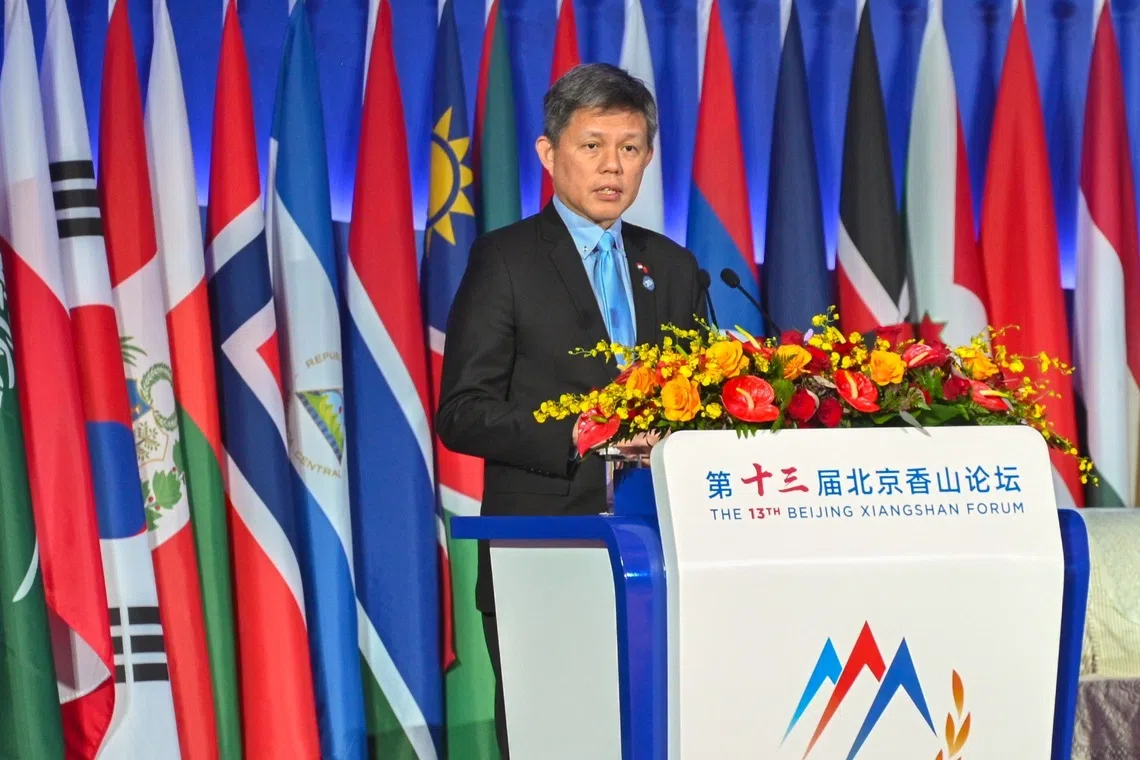
Defence Minister Chan Chun Sing delivering his speech at the 13th Beijing Xiangshan Forum on Sept 16.
Published Sep 16, 2026, 03:40 PM
Updated Sep 16, 2026, 11:05 PM
Great powers should take on greater responsibilities to reassure smaller countries amid shifting power dynamics, says Singapore Defence Minister Chan Chun Sing at the Xiangshan Forum.
Chan emphasises building trust through strategic patience, cooperation, and shared interests to overcome security dilemmas and promote regional stability.
Singapore's experience with China shows how differences can be managed for mutual benefit, advocating for an open, rules-based international order and long-term security.
BEIJING – Great powers should be prepared to shoulder higher expectations from smaller countries that may feel insecure and need reassurance when relative power shifts and perceptions change, said Singapore Defence Minister Chan Chun Sing.
“A country growing in strength may assert itself to address longstanding grievances and interests. Yet that same growth in strength may look very different to those around it. Smaller countries will look up to it and expect more of it,” he said at the Beijing Xiangshan Forum on Sept 16.
“In short, the more responsible major powers are, the less concerned small countries will be,” he added.
Speaking at a plenary session, Chan was addressing the topic of countries strengthening their own security without weakening that of others.
He is in China from Sept 15 to 17 at the invitation of Chinese Defence Minister Dong Jun. This marks Chan’s second appearance at the Xiangshan Forum .
The 13th forum brings together hundreds of defence and diplomatic officials, academics and representatives of international organisations to discuss regional and international security issues. It is often viewed as China’s version of Singapore’s Shangri-La Dialogue , the largest defence and security conference in Asia.
Chan, who is also Coordinating Minister for Public Services, met Dong and witnessed the signing of an upgraded Memorandum of Cooperation that will deepen exchanges between the Singapore Armed Forces’ SAFTI Military Institute and the National Defense University of the People’s Liberation Army (PLA), said Singapore’s Ministry of Defence.
At the Xiangshan Forum, Chan said overcoming what is commonly described in international relations theory as the “security dilemma” requires countries to rethink what “winning” means.
To some, “winning” means outgunning and outlasting a rival, he said.
“But in today’s world, a more realistic conception, and a stronger and better concept of ‘winning’, is to win over the world through the power of our example and not the example of our power,” he added.
Chan also said countries should build trust through strategic patience, which he describes as the wisdom to choose the course of action that best serves one’s long-term interest despite immediate pressures.
“Not every capability needs to be advertised, not every advantage must be immediately pressed, and not every provocation demands an immediate response,” he added.
Quoting Chinese Confucian philosopher Meng Zi, he said: “Power may compel others to comply. But in the end, it is trust that truly wins others over.”
While every country’s starting point is its own national interests, the object of diplomacy is not to deny these interests but to find out where they overlap and build real cooperation within that shared space, he added.
Singapore’s relationship with China illustrates this, said Chan. He cited Singapore’s support for China’s reform and opening up from the very beginning, and how the Republic advocated for China’s entry into the General Agreement on Tariffs and Trade in the 1980s, as well as started the first government-to-government project, Suzhou Industrial Park, in 1994.
“Despite our differences in perspective and ideology and the size of our population, our leaders found common ground to cooperate for mutual benefit,” he said.
Singapore welcomes China’s aspiration to be a responsible major country, said Chan, adding that China’s reform and opening up transformed the lives of its people and contributed greatly to the prosperity of the region.
As the PLA, which has made great strides in its military modernisation, approaches its centenary in 2027, there is much potential for it to make a positive contribution to global stability and security, he added.
Chan said that in the 12 months since he last spoke at the Xiangshan Forum, the global distribution of power, both real and perceived, has continued to evolve.
The technology race has been hotting up, the imbalance between consumption and production has grown, and trade and investment have been further securitised and weaponised, while warfare has evolved rapidly.
These trends exert pressure on countries to preserve and advance their national power at the expense of others, which, in isolation, may appear justifiable, said Chan. “Collectively, however, each action produces a reaction, leading to a spiral of insecurity benefiting no one,” he said.
“Therefore, it is not enough for each country to merely ensure its own security. The true test of statecraft is this: How do we strengthen our own security without weakening the security of others, or without aggravating the insecurity of others?”
He then shared how Singapore overcame such challenges in the past, first by achieving domestic stability.
This enables a country to cooperate with partners and act in its enlightened long-term interest internationally.
“In today’s uncertain world, we must work even harder to strengthen our domestic fundamentals rather than try to externalise our domestic issues,” he said.
Singapore’s leaders have also avoided exploiting foreign policy for political gain, even when there were historical issues with neighbours.
Instead, the Republic worked to settle issues amicably in favour of national interest, such as reaching a diplomatic resolution with Indonesia despite challenges in the Republic’s early years.
In today’s climate, it is tempting to view interdependence as a source of vulnerability, he said.
“But history tells us that in the long term, interdependence expands the pool of common interests between disparate countries,” Chan said, adding that it creates the incentive to cooperate or at least to compete within an agreed set of rules.
“I must emphasise that competition and rivalry do not mean that we’re enemies. Competition and rivalry, if well managed, can spur all of us to do better,” he said.
This is why Singapore has sought to build an open and inclusive external environment since its early years, such as working with neighbours to build up ASEAN, and continuing to advocate for the preservation of the international rules-based order.
“For example, Singapore has put on record our refusal to negotiate for safe passage or toll rates for straits used by international navigation, such as the Strait of Hormuz,” he added.
Trust is what makes cooperation last and endure, he said.
“When we have trust, we can resolve difficult issues quietly behind the scenes. Without trust, small misunderstandings can simmer over into major problems,” he said.
While this matters in the physical domain – such as at sea or in the air – where mishaps can happen if one is not careful, it matters even more in invisible domains like cyberspace, where intentions are unclear and attribution is not simple, said Chan.
China’s Dong spoke at the same plenary session, alongside Vietnamese Deputy Prime Minister and Defence Minister Phan Van Giang, Thai Defence Minister Adul Boonthumjaroen, Russian State Secretary and Deputy Defence Minister Anna Tsivileva, and France’s Ministry of the Armed Forces Deputy Director-General for International Relations and Strategy Sebastien Vallette.
In his opening speech, Dong urged countries to build a new security approach based on dialogue and consultation rather than confrontation, and partnership instead of alliance.
He also stressed the importance of maintaining stability through multilateralism and the need to have effective security governance systems to uphold international fairness and justice.
“Within such a system, major countries should take the lead in shouldering responsibilities. Small- and medium-sized countries can make active contributions,” he said.
The address comes just a week before Chinese President Xi Jinping is expected to travel to the US for a state visit and summit with President Donald Trump, more than a decade since Xi’s first state visit in 2015.
Michelle Ng is China correspondent at The Straits Times. She is interested in Chinese foreign policies, property trends, demographics, education and rural issues.
Singapore-China ties
国防部长陈振声于9月16日在第13届北京香山论坛上发表讲话。
发布于2026年9月16日下午3:40
更新于2026年9月16日晚上11:05
新加坡国防部长陈振声在香山论坛上表示,在权力格局不断变化的情况下,大国应该承担更大的责任来安抚小国。
陈强调要通过战略耐心、合作和共同利益来建立信任,以克服安全困境,促进地区稳定。
新加坡与中国的经验表明,可以通过管控分歧来实现互利共赢,倡导开放、以规则为基础的国际秩序和长期安全。
北京——新加坡国防部长陈振声表示,当相对实力发生变化和人们的观念改变时,大国应该做好准备,承担较小国家更高的期望,因为这些小国可能会感到不安全,需要得到保证。
“一个国力增强的国家可能会主动出击,解决长期存在的矛盾和利益问题。然而,这种国力增强在周边国家看来可能截然不同。小国会仰望它,并对它抱有更高的期望,”他在9月16日北京香山论坛上表示。
“简而言之,大国越负责任,小国就越不会感到担忧,”他补充道。
陈在全体会议上发言时,谈到了各国如何在不削弱他国安全的情况下加强自身安全的问题。
应中国国防部长董军邀请,陈先生将于9月15日至17日访问中国。这是陈先生第二次出席香山论坛。
第十三届论坛汇聚了数百名国防和外交官员、学者以及国际组织代表,共同探讨地区和国际安全问题。它常被视为中国版的“香格里拉对话”,后者是亚洲规模最大的防务与安全会议。
新加坡国防部表示,兼任公共服务统筹部长的陈茂波会见了董建华,并见证了升级版合作备忘录的签署。该备忘录将深化新加坡武装部队军事学院(SAFTI)与中国人民解放军国防大学之间的交流。
在香山论坛上,陈表示,要克服国际关系理论中通常所说的“安全困境”,各国需要重新思考“胜利”的含义。
他说,对某些人来说,“胜利”意味着在火力上胜过对手,并在持久战中击败对手。
“但在当今世界,更现实的观念,更强大、更好的‘胜利’概念,是通过我们的榜样的力量而不是我们的权力的力量来赢得世界,”他补充道。
陈先生还表示,各国应该通过战略耐心来建立信任,他将其描述为一种智慧,即尽管面临眼前的压力,也要选择最符合自身长期利益的行动方案。
“并非每项能力都需要大肆宣传,并非每项优势都必须立即发挥,也并非每一种挑衅都需要立即回应,”他补充道。
他引用中国儒家哲学家孟子的话:“权力可以迫使他人服从,但最终赢得他人的,是信任。”
他补充说,虽然每个国家的出发点都是自身的国家利益,但外交的目的不是否定这些利益,而是找出它们的重叠之处,并在这一共同空间内建立真正的合作。
陈先生表示,新加坡与中国的关系就说明了这一点。他列举了新加坡从一开始就支持中国改革开放的例子,以及新加坡在20世纪80年代如何倡导中国加入关税及贸易总协定,并在1994年启动了第一个政府间合作项目——苏州工业园区。
他说:“尽管我们在观点、意识形态和人口规模上存在差异,但我们的领导人找到了共同点,为了互利而合作。”
陈先生表示,新加坡欢迎中国成为负责任的大国的愿望,并补充说,中国的改革开放改变了人民的生活,为该地区的繁荣做出了巨大贡献。
他补充说,随着解放军在军事现代化方面取得长足进步,并即将迎来建军百年纪念(2027年),解放军有很大的潜力为全球稳定与安全做出积极贡献。
陈先生表示,自他上次在香山论坛发言以来的12个月里,全球权力分配,无论是实际的还是人们感知到的,都持续发生了变化。
技术竞赛日趋激烈,消费与生产之间的不平衡日益加剧,贸易和投资进一步安全化和武器化,而战争也在迅速演变。
陈先生表示,这些趋势迫使各国不惜牺牲他国利益来维护和提升自身国力,这种做法单独来看或许情有可原。“然而,综合起来,每项行动都会产生反作用,最终导致恶性循环,使任何人都无法从中受益。”
因此,每个国家仅仅确保自身安全是不够的。治国之道真正的考验在于:如何在不削弱他国安全、不加剧他国不安全的情况下加强自身安全?
然后他分享了新加坡过去是如何克服这些挑战的,首先是通过实现国内稳定。
这使得一个国家能够与伙伴合作,并在国际上采取符合其长远利益的明智行动。
他说:“在当今充满不确定性的世界里,我们必须更加努力地加强国内基本面,而不是试图将国内问题转移到外部。”
新加坡领导人也一直避免利用外交政策谋取政治利益,即使与邻国存在历史遗留问题。
相反,共和国致力于以友好方式解决问题,以维护国家利益,例如,尽管共和国成立初期面临诸多挑战,但仍与印度尼西亚达成外交解决方案。
他表示,在当今的形势下,人们很容易将相互依存视为一种脆弱性的来源。
“但历史告诉我们,从长远来看,相互依存扩大了不同国家之间的共同利益,”陈说,并补充道,这会激励各国合作,或者至少在既定规则内展开竞争。
“我必须强调,竞争和对抗并不意味着我们是敌人。如果处理得当,竞争和对抗可以激励我们所有人做得更好,”他说。
正因如此,新加坡自建国初期就致力于构建开放包容的外部环境,例如与邻国合作建设东盟,并持续倡导维护以规则为基础的国际秩序。
“例如,新加坡已公开表示,我们拒绝就国际航行所用的海峡(如霍尔木兹海峡)的安全通行或通行费率进行谈判,”他补充道。
他说,信任是合作能够长久维系的关键。
他说:“有了信任,我们就能私下解决棘手的问题。如果没有信任,小小的误会就会演变成大问题。”
陈先生表示,虽然这在物理领域(例如海上或空中)很重要——如果不小心,就可能发生事故——但在网络空间等无形领域,这一点就更加重要了,因为在这些领域,意图不明,归因也不简单。
中国总理董建华在同一全体会议上发言,与他一同发言的还有越南副总理兼国防部长潘文江、泰国国防部长阿杜尔·汶敦扎伦、俄罗斯国务秘书兼国防部副部长安娜·齐维列娃以及法国武装部队国际关系与战略副总干事塞巴斯蒂安·瓦莱特。
董建华在开幕致辞中敦促各国建立以对话协商而非对抗、以伙伴关系而非联盟为基础的新型安全方针。
他还强调了通过多边主义维护稳定的重要性,以及建立有效的安全治理体系以维护国际公平正义的必要性。
他说:“在这种体系下,大国应该率先承担责任,中小国家也可以积极做出贡献。”
此次讲话发表之际,正值中国国家主席习近平预计访问美国并与美国总统唐纳德·特朗普举行峰会的前一周。这是习近平自2015年首次访美以来,时隔十余年再次访美。
吴美玲是《海峡时报》驻华记者。她关注中国的外交政策、房地产趋势、人口统计、教育和农村问题。
新加坡与中国的关系