Russia’s Shahed-type drones are losing their bite in Ukraine俄罗斯的“沙赫德”型无人机在乌克兰的威力正在减弱。
Opinion: Ukrainian air defenders have become more successful in shooting down the Iranian-designed drones, according to data compiled by analyst Federico Borsari.
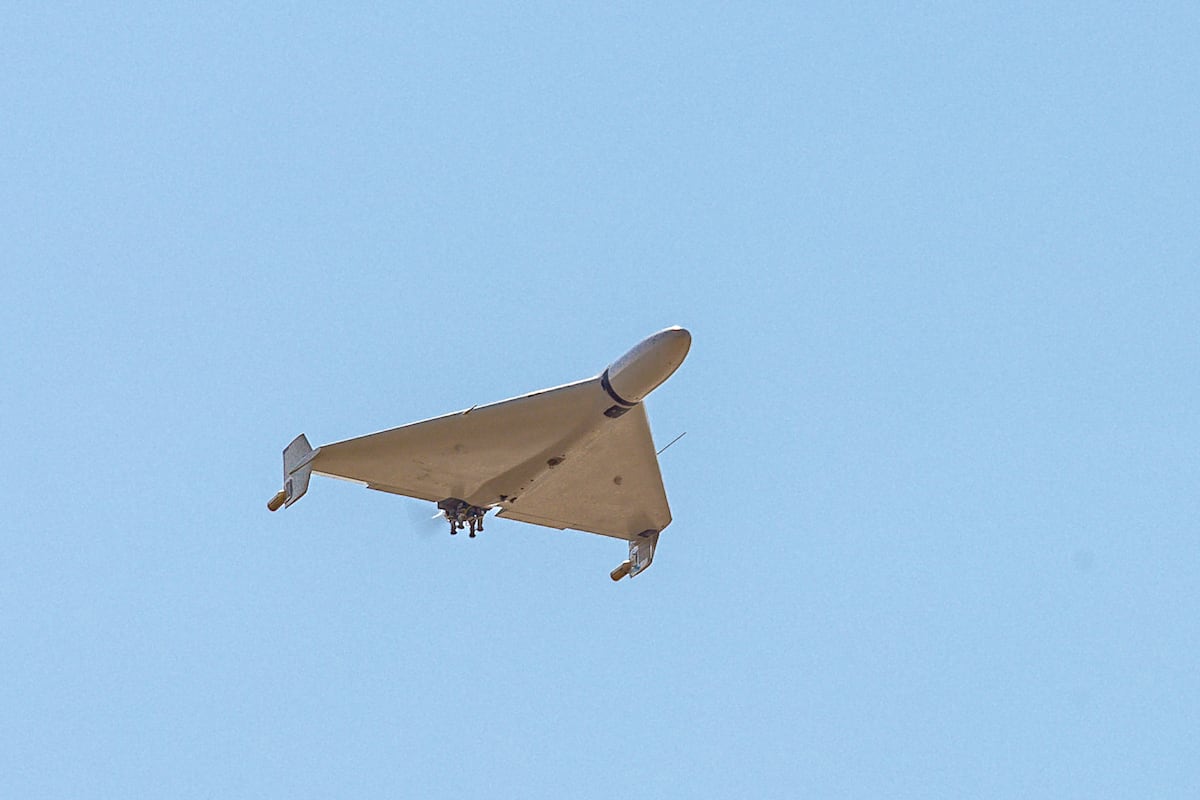
The Iranian-made Shahed 131 and 136 one-way attack unmanned aerial systems (UAS), which Russia now domestically produces under license with the designation Geran 1 and 2, respectively, have been major protagonists of Moscow’s strike campaign against Ukrainian critical infrastructure. They also represent a threat across the skies of many countries in the Middle East, from Saudi Arabia to the United Arab Emirates to Israel, over the past few years.
Several of them were used in the September 2019 Iranian-orchestrated attack against Saudi Aramco’s oil terminals in Khurais and Abqaiq, which temporarily knocked out 5% of the world’s oil supply. Shahed-136 drones are also among the Houthis’ weapons of choice to strike commercial vessels transiting in the Red Sea and Hormuz Strait, wreaking havoc on global maritime trade and connectivity.
Their effectiveness in the Ukrainian theater, however, seems on a declining trajectory. In recent months, Ukraine has been improving its counter-drone and low-tier air defense capabilities by expanding its early-warning network of fixed distributed radar, electro-optical and acoustic sensors. The military also has been training new “mobile fire groups” specialized in hunting Shahed and other one-way attack drones, the vast majority of which are shot down.
Aggregate data collected by this author and based on official numbers released by the Ukrainian Air Force indicate that the interception rate of Shahed UAS has steadily increased in the past five months, with an average of 91% since March 2024.
Shahed interceptions by Ukrainian air defenders have increased over time, according to data compiled by analyst Federico Bonsari.
By comparison, the average Shahed interception rate during the previous 6 months was 80%, with the highest figure of 83% recorded in November last year. Ukraine’s growing success against the Shaheds stems from the combination of widespread multispectrum sensor coverage and effective tactics, techniques and procedures. As for hardware, Ukrainian forces have fielded a mix of mobile counter-UAS and short-range air defense capabilities for combine electronic warfare (EW), anti-aircraft guns such as ZU-23-2 and German-made Gepard, shoulder-fired air defense systems such as Stinger and Igla, and cost-effective laser-guided rockets such as the U.S.-provided advanced precision kill weapon system (APKWS).
These operations can also include the use of medium-range air defenses and tactical aviation, thus requiring smooth coordination between ground-based fire teams, brigade command posts and aviation headquarters to deconflict and avoid friendly-fire incidents.
Overall, the Shaheds’ decreasing effectiveness is proportional to the improvement of Ukraine’s C-UAS and short-range air defense (SHORAD) capabilities and demystifies the drone’s overhyped operational impact often pushed across the mainstream debate. In fact, sufficiently dense, layered countermeasures – and the trained personnel required – are perfectly capable of dealing with Shahed and other one-way attack UAS, to the disappointment of “game-changer” theorists and drone-fetishist commentators.
Far from being arcane or expensive, these countermeasures should complement direct attacks against enemy drone teams and infrastructure and consist of cost-effective solutions such as anti-aircraft guns with airburst ammunition, MANPADS, and low-tier guided interceptors, like BAE Systems’ APKWS 70mm laser-guided rocket and Raytheon’s Coyote Block II+ missiles.
Defensive solutions to the threat posed by Shahed and other one-way attack drones are already out there and should be scaled up by NATO allies without hesitation. The only question is whether governments and planners across the alliance decide to invest in scalable low-cost interceptors and short-range air defense capabilities amidst many other defense priorities.
Nevertheless, while Shaheds’ effectiveness is diminishing, it would be a mistake to underestimate the threat these and other one-way attack drones pose. As seen in Ukraine and elsewhere, these systems can be used to reveal the positions of air defense assets, deplete air-defense interceptor stocks, and siphon capability resources that could be used elsewhere, while even a few systems (e.g., 2-3%) that manage to reach their target can provoke serious destruction, especially against critical infrastructure. In addition, the drones’ effectiveness dramatically increases when used as part of saturation attacks combining long-range missiles.
But this problem is hardly an unsolvable one and should be high on the defense agenda of NATO countries.
Federico Borsari is a resident fellow with the Transatlantic Defense and Security Program at the Center for European Policy Analysis (CEPA), where he also leads the Defense Technology Initiative.
伊朗制造的“沙赫德”131和136型单向攻击无人机系统(UAS),目前已获得许可在国内生产,分别命名为“格朗1”和“格朗2”。这些无人机一直是莫斯科对乌克兰关键基础设施发动打击行动的主要武器。过去几年,它们也对包括沙特阿拉伯、阿联酋和以色列在内的许多中东国家的领空构成威胁。
其中几架无人机曾被用于2019年9月伊朗策划的针对沙特阿美公司位于胡赖斯和阿布盖格石油码头的袭击,该袭击一度导致全球5%的石油供应中断。沙赫德-136无人机也是胡塞武装袭击红海和霍尔木兹海峡商船的常用武器之一,严重破坏了全球海上贸易和互联互通。
然而,它们在乌克兰战区的效能似乎正在下降。近几个月来,乌克兰一直在通过扩建其由固定分布式雷达、光电和声学传感器组成的预警网络,来提升其反无人机和低级防空能力。军方还一直在训练新的“机动火力小组”,专门用于猎杀“沙赫德”和其他单向攻击无人机,其中绝大多数都被击落。
根据作者收集的汇总数据以及乌克兰空军公布的官方数据,沙赫德无人机的拦截率在过去五个月中稳步上升,自 2024 年 3 月以来平均达到 91%。
根据分析师费德里科·邦萨里汇编的数据,乌克兰防空部队拦截沙赫德导弹的次数随着时间的推移而增加。
相比之下,过去六个月“沙赫德”无人机的平均拦截率为80%,最高拦截率出现在去年11月,达到83%。乌克兰打击“沙赫德”无人机的成功率不断提高,得益于其广泛的多光谱传感器覆盖以及有效的战术、技术和程序。在硬件方面,乌克兰军队部署了多种装备,包括用于联合电子战的移动式反无人机系统和短程防空系统,例如ZU-23-2和德国制造的“猎豹”高射炮,肩扛式防空系统(如“毒刺”和“针”),以及经济高效的激光制导火箭(如美国提供的先进精确杀伤武器系统(APKWS))。
这些行动还可以包括使用中程防空和战术航空,因此需要地面火力小组、旅指挥所和航空总部之间进行顺畅的协调,以化解冲突并避免友军误伤事件。
总体而言,沙赫德无人机效能的下降与乌克兰反无人机系统(C-UAS)和短程防空(SHORAD)能力的提升成正比,这也揭开了主流辩论中经常被夸大的沙赫德无人机作战影响力的神秘面纱。事实上,足够密集、多层次的反制措施——以及所需的训练有素的人员——完全能够应对沙赫德和其他单向攻击型无人机,这令那些鼓吹“颠覆性技术”的理论家和无人机狂热分子感到失望。
这些反制措施远非晦涩难懂或价格昂贵,它们应该与直接攻击敌方无人机队和基础设施相辅相成,并且包括经济有效的解决方案,例如配备空爆弹药的高射炮、便携式防空导弹系统和低级制导拦截器,如 BAE Systems 的 APKWS 70 毫米激光制导火箭和雷神公司的 Coyote Block II+ 导弹。
针对“沙赫德”和其他单向攻击无人机构成的威胁,防御方案已经存在,北约盟国应毫不犹豫地扩大规模。唯一的问题是,在众多其他国防优先事项中,联盟各国政府和规划者是否决定投资于可扩展的低成本拦截器和短程防空能力。
尽管“沙赫德”无人机的效能正在下降,但低估这些以及其他单向攻击无人机构成的威胁是错误的。正如在乌克兰和其他地区所见,这些系统可用于暴露防空设施的位置,消耗防空拦截弹库存,并窃取原本可用于其他方面的作战能力资源。即使只有少数系统(例如2-3%)成功击中目标,也能造成严重破坏,尤其针对关键基础设施。此外,当与远程导弹联合进行饱和攻击时,这些无人机的效能将显著提升。
但这个问题并非无法解决,应该成为北约国家国防议程上的首要议题。
Federico Borsari 是欧洲政策分析中心 (CEPA) 跨大西洋防务与安全项目的常驻研究员,同时他也是该中心国防技术倡议的负责人。