New Insights Into Mysterious Soviet ‘Dome Of Light’ Phenomenon In Declassified Documents解密文件揭示苏联神秘“光穹顶”现象的新见解
Air Force analysts were baffled by the massive light shows, which may have been a countermeasure against American early warning satellites.
By Joseph Trevithick
Updated Nov 27, 2020 6:02 PM EST
Last year, The War Zone published a piece exploring a bizarre, unexplained, superweapon-like phenomenon referred to as the “ Dome of Light ” associated with launches of the Soviet Union’s RSD-10 Pioneer intermediate-range ballistic missile, also known as the SS-20 Saber, in the 1980s. Now, we have obtained previously classified intelligence documents that show U.S. intelligence analysts were equally perplexed by these rapidly expanding walls of light, which could have been intended as a countermeasure against early warning satellites and missile defense systems . They look to have been concerned about it becoming a feature of other Soviet ballistic missile launches, as well.
The War Zone received the documents, which the Air Force’s Foreign Technology Division (FTD) produced, through a Freedom of Information Act request. FTD was established in 1961 as a component of Air Force Systems Command and quickly became the service’s premier Foreign Materiel Exploitation (FME) unit, charged with analyzing and evaluating foreign aerospace technology, including various flyable and non-flyable foreign aircraft. FTD was notably responsible for maintaining a working fleet of Soviet bloc and Chinese-made combat jets, which were later turned over to the storied and secretive 4477th Test and Evaluation Squadron, better known as the Red Eagles, at Tonopah Test Range Airport , which you can read more about in this past War Zone piece .
FTD, which has since evolved to become part of the Air Force’s present National Air and Space Intelligence Center (NASIC), was the go-to entity within the service to try to explain the Dome of Light, which was also referred to in some of the documents simply by the abbreviation DOL. A heavily redacted section of one 1986 report describes the basics of the phenomenon as follows:
“Although reports differ, most observers describe the phenomenon as a small white sphere on the horizon that expands uniformly outward and upward while maintaining its dome-like shape. It is initially opaque, but as it expands it becomes transparent, and the stars can be seen through the center of the dome. As it begins to fade, the outer boundary remains brighter forming a rainbow-shaped arc. At full extent it has been reported as being tremendously large, filling more than half of the sky. Approximate calculations [redacted] indicate is is on the order of 1,900 km [approximately 1,180.6 miles] wide, with its center 1,000 km [approximately 621 miles] high. Most Domes of Light are visible for around 20 minutes but events lasting up to 100 minutes have been reported. In almost all cases the Domes of Light have been seen while observers were in darkness or twilight [redacted]”
This fits with the first-hand account of the Dome of Light that Robert Hopkins, a veteran Air Force pilot and author of The Boeing KC-135 Stratotanker : More Than a Tanker , who flew the RC-135S Cobra Ball missile tracking aircraft, among other types, shared with The War Zone last year.
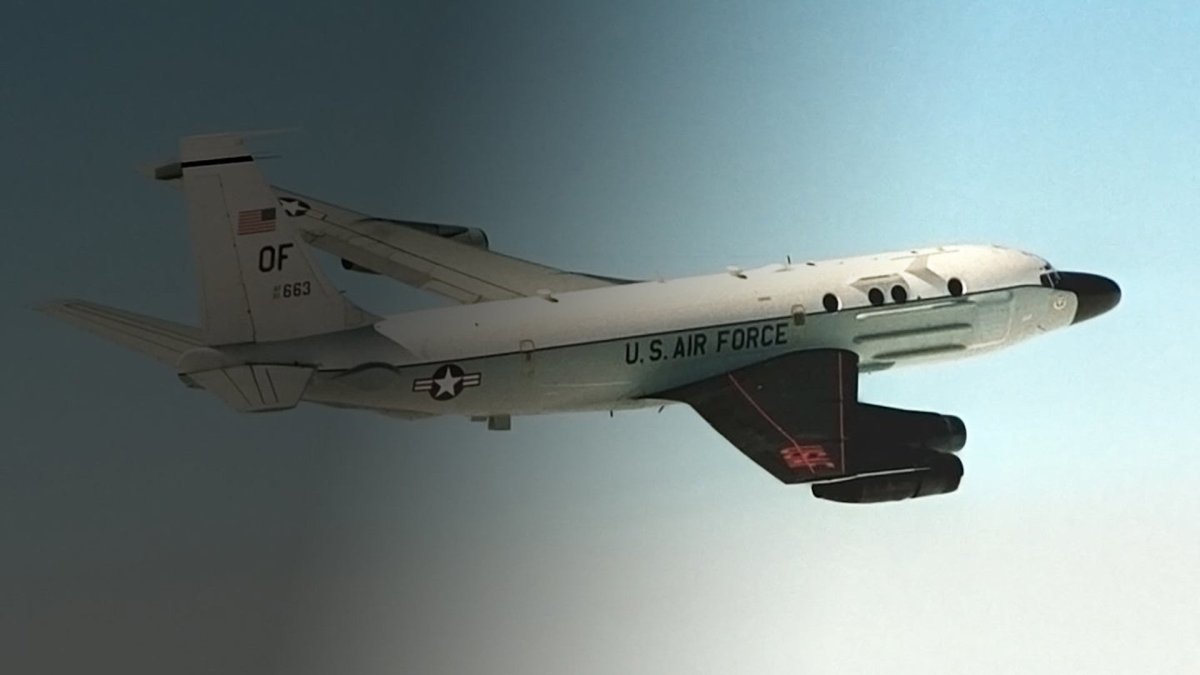
An RC-135S Cobra Ball aircraft., USAF
Hopkins described what he saw in 1988 as follows:
“As we looked for traffic, we noticed what appeared to be a translucent, milky white wall moving from the left, over the USSR, to the right, toward the Northern Pacific Ocean. It covered the entire sky from ground level to as far up as we could see looking out the front windows of the airplane. It moved very quickly—far faster than crossing airplane traffic—and rapidly approached us. The wall of light passed across our flight path and then continued eastward, leaving the empty and dark night sky in its wake. Our programmed turn time arrived and we began our bank to the left to collect on the RVs. Once we rolled out southbound the wall of light was no longer visible to the east.”
It’s not clear when the Air Force, or any other branch of the U.S. military or element of the Intelligence Community, first encountered the Dome of Light or how many total instances American analysts and other personnel observed or were otherwise aware of. However, the unredacted portions of FTD’s 1986 report describe a relationship between the phenomenon and the road-mobile RSD-10/SS-20 intermediate-range ballistic missile (IRBM).
First deployed by the Soviets in 1976, this was that country’s most advanced IRBM design, with the final versions having a range of 4,700 miles and up to three Multiple Independently Targetable Reentry Vehicle warheads, or MIRVs.
A transporter-erector-launcher for the RSD-10/SS-20 IRBM., George Chernilevsky via wikimedia
While FTD saw a clear link between the RSD-10/SS-20 and the Dome of Light, its analysts, scientists, and engineers struggled to define exactly how the two were related. Every recorded instance of a Dome of Light at the time the 1986 report was written had been associated in some way with an RSD-10/SS-20 launch, but not all launches of this missile featured the phenomenon. On top of that, in some cases, the light show appeared before there was a launch, while other sightings were reported to have occurred after the missile blasted off.
“To date. no satisfactory explanation exists that does not conflict with some portion of the reported observations,” the 1986 FTD report states bluntly. “Speculations range from a naturally occurring phenomenon as a result of venting unused rocket fuel to the release of ion clouds to simulate a post-nuclear attack environment for the purpose of communication experiments.”
“Observations of the dispersion can then be used to calculate physical properties of the upper atmosphere such as density, temperature, and particle flow rates,” the unredacted portions of the report continue, offering additional details about the ion cloud theory. “These experiments differ from the reported Domes of Light observations in several respects, most importantly in appearance, size, and observed duration. The domes do not appear to contain charged particles since there is no striation or tendency for the particles to follow the magnetic field lines as in ion release experiments. Additionally, the domes are much larger and are visible for a longer period of time than any known ionization experiment.”
A passage detailing a “second explanation” is entirely redacted. However, an uncensored portion of the report that follows refers to a computer model a Russian mathematician developed to predict the formation of “an ethylene cloud of spherical shape created at an altitude of 141 km [approximately 87.6 miles]” and that was the subject of an “unclassified article.”
A heavily redacted page from a 1986 FTD report discussing the Dome of Light., USAF via FOIA
One of the documents that The War Zone received via FOIA was a copy of FTD’s official translation of this article, titled “Stochastic Mathematical Model of a Chemiluminescent Artificial Cloud in the Upper Atmosphere,” which was published in a Soviet scientific journal in 1983. The work is attributed to Ye. G. Slekenichs of the Obninsk Branch of the Moscow Engineering Physics Institute.
“A prevalent method of studying the upper atmosphere today involves observing the behavior of artificial luminescent clouds in it,” Slekenichs wrote. “Specifically, observations of artificial chemiluminescent clouds allow determining the concentrations of the minor components of the atmosphere.”
The first page of the translation of Ye. G. Slekenichs’ paper. It’s unclear why the author’s name appears to be redacted here, but is unredacted on the cover sheet., USAF via FOIA
However, the paper notes that creating these clouds is difficult and requires significant preparation, making it valuable to use mathematical modeling to work out various particulars in advance. “This article examines a stochastic mathematical model of a spherical chemiluminescent cloud formed by ejection of a reagent at an altitude of over 120 km [approximately 74.5 miles],” Slekenichs explained.
In addition to describing, theoretically, how one would go about creating this cloud, Slekenichs notably mentions that “this probability algorithm was used to calculate the radiance brightness of a chemiluminescent ethylene cloud, the prototype of which was obtained experimentally.” That sentence includes a footnote that cites another report, dated 1974.
The portion of the translation of Slekenichs’ paper discussing an apparent test of a chemiluminescent artificial cloud in 1974., USAF via FOIA
“Unfortunately there is no discussion of any possible purpose for the [1974] experiment,” FTD said of Slekenichs’ paper. It’s also interesting to note that there were reported sightings in Afghanistan of Dome of Light-like phenomena, emanating from what was then the neighboring Soviet Union, as early as 1976.
One of the most compelling theories, of course, remains that the Dome of Light was some kind of countermeasure against American early warning or anti-ballistic missile capabilities, a possible explanation for the phenomenon that was publicly discussed in newspapers and other publications in the late 1980s. It’s certainly very plausible that the cloud could blind or otherwise confuse early warning satellites watching for missile launches or make it hard to spot and track incoming re-entry vehicles for a possible interception – or at least that the Soviets hoped it would be able to do these things.
The RSD-10/SS-20’s range and MIRVed warhead already presented a major challenge for NATO and had prompted the United States to deploy Pershing II medium-range ballistic missiles (MRBM) and BGM-109G Gryphons , a ground-launched derivative of the Tomahawk cruise missile, to Europe in response. Getting rid of the RSD-10/SS-20s was a key objective of the now-defunct Intermediate-Range Nuclear Forces Treaty (INF), which the two countries signed in 1987.
Pershing II MRBMs, DOD
Still, while the INF did lead to the destruction of the RSD-10/SS-20s, save for a small number of them that were decommissioned and put on display, the U.S. military clearly had concerns that the Dome of Light, whatever it was, would become associated with other Soviet ballistic missiles. In 1990, FTD published an engineering memorandum titled “SS-25 DOL Flights.”
The copy of this report that The War Zone obtained via FOIA is heavily redacted, but appears to discuss computer modeling of flights of the road-mobile SS-25 Sickle intercontinental ballistic missile (ICBM), also known as the RT-2PM or RS-12M , as well as by the name Topol, producing a Dome of Light-like effect. “The computer model used [redacted] in this memo has been prepared to generate performance estimates of the SS-25 system for various scenarios,” one unredacted passage reads.
A transporter-erector-launcher for the RT-2PM/RS-12M/SS-25 ICBM., Vitaly Kuzmin
“This phenomenology [the Dome of Light] has been the center of much discussion, and various researchers have attempted to explain it with varying degrees of success,” this document also noted. “By folding in sun and moon angular data, as well as weather data, one should be better prepared to unravel more of the DOL associated mystery.”
We don’t know if FTD or any other element of the U.S. military or Intelligence Community was aware of any actual sightings of a Dome of Light associated with an RT-2PM/RS-12M/SS-25 launch at that time or has been made aware of any such event since then. This ICBM is in increasingly limited service in Russia, but has been publicly used to test new countermeasures against ballistic missile defenses as recently as 2017.
You can find the full copies of the three Dome of Light-related documents we obtained via FOIA here .
These documents, taken together with what had already been known, certainly offers more insight into the Dome of Light, though a conclusive explanation, at least publicly, remains elusive. The 1990 memo also raises interesting questions about whether the Soviets, or subsequently the Russians, continued to experiment with chemiluminescent clouds or other such phenomena after dismantling the RSD-10/SS-20s.
When we at The War Zone initially wrote about this last year, we raised the possibility that, if the concept was indeed a countermeasure against ballistic missile defense systems and was at all viable, that the Russians might be interested in revisiting it in light of new early warning and other missile defense efforts that the United States is pursuing now. The Kremlin has certainly shown a proclivity for exploring other “superweapon”-esque concepts in recent years .
In the meantime, we are continuing to dig into this absolutely fascinating mystery.
Contact the author: joe@thedrive.com
Comments couldn’t be loaded. Please refresh the page.
作者:约瑟夫·特雷维西克
更新于美国东部时间2020年11月27日下午6:02
去年,《战区》网站发表了一篇文章,探讨了一种与苏联20世纪80年代RSD-10“先锋”中程弹道导弹(又称SS-20“佩刀”)发射相关的、被称为“光穹”的奇异且无法解释的超级武器式现象。如今,我们获得了此前被列为机密的情报文件,这些文件显示,美国情报分析人员同样对这些迅速扩张的光墙感到困惑,这些光墙可能被用作对抗预警卫星和导弹防御系统的手段。他们似乎也担心这种现象会成为苏联其他弹道导弹发射的特征。
《战区》栏目通过《信息自由法》申请获得了这些文件,这些文件由空军外国技术处(FTD)提供。FTD成立于1961年,是空军系统司令部的一个组成部分,并迅速发展成为空军首屈一指的外国物资开发(FME)部门,负责分析和评估外国航空航天技术,包括各种可飞行和不可飞行的外国飞机。FTD曾负责维护一支苏联集团和中国制造的战斗机机队,这些飞机后来移交给了位于托诺帕试验场机场的传奇而神秘的第4477测试与评估中队,即著名的“红鹰”中队。您可以在《战区》栏目之前的一篇文章中了解更多相关信息。
FTD(现已发展成为空军现今的国家航空航天情报中心 (NASIC) 的一部分)是空军内部负责解释“光穹”现象的首选机构,在一些文件中,“光穹”也简称为 DOL。1986 年的一份报告中,有一段经过大量删减的内容,对这一现象的基本原理描述如下:
尽管各方报道不尽相同,但大多数观测者将这种现象描述为地平线上一个白色的小球体,它均匀地向外向上扩张,同时保持着穹顶状的形状。起初它是不透明的,但随着扩张逐渐变得透明,人们可以透过穹顶中心看到星星。当它开始消退时,外缘仍然保持明亮,形成一道彩虹状的弧线。据报道,它完全展开时非常巨大,占据了超过一半的天空。根据近似计算(此处已编辑),它的宽度约为1900公里(约1180.6英里),中心高度约为1000公里(约621英里)。大多数“光穹”现象持续约20分钟,但也有报道称持续时间长达100分钟。几乎所有情况下,“光穹”都是在黑暗或黄昏时分观测到的(此处已编辑)。
这与罗伯特·霍普金斯(Robert Hopkins)的亲身经历相吻合。霍普金斯是一位经验丰富的空军飞行员,也是《波音 KC-135 同温层加油机:不仅仅是一架加油机》一书的作者,他曾驾驶过 RC-135S 眼镜蛇球导弹跟踪飞机等多种机型。去年,他向《战区》杂志分享了他对“光之穹顶”的描述。
一架RC-135S“眼镜蛇球”遥控飞机,美国空军
霍普金斯这样描述他在1988年所看到的景象:
“当我们观察周围交通情况时,注意到一道半透明的乳白色光墙从左侧,越过苏联,向右侧,朝着北太平洋方向移动。它遮蔽了从地面到我们透过飞机前窗所能看到的整个天空。它移动得非常快——远比交叉的飞机快得多——并迅速向我们逼近。这道光墙横穿了我们的航线,然后继续向东移动,留下一片空旷漆黑的夜空。预定的转弯时间到了,我们开始向左倾斜机身,准备与房车连接。当我们向南滑行后,东边的光墙就消失不见了。”
目前尚不清楚美国空军或其他任何美军部门或情报机构何时首次发现“光穹”,也不清楚美国分析人员和其他人员总共观察到或知晓过多少次此类现象。然而,FTD 1986 年报告中未删节的部分描述了这种现象与公路机动式 RSD-10/SS-20 中程弹道导弹 (IRBM) 之间的关联。
该导弹于 1976 年首次由苏联部署,是该国最先进的中程弹道导弹设计,最终版本射程达 4,700 英里,最多可携带三个多弹头独立重返大气层载具(MIRV)。
用于RSD-10/SS-20中程弹道导弹的运输-起竖-发射装置。(图片来自Wikimedia,作者:George Chernilevsky)
尽管FTD公司认为RSD-10/SS-20导弹与“光穹”现象之间存在明显的联系,但其分析师、科学家和工程师们却难以确切地界定二者之间的关系。在1986年报告撰写之时,所有记录在案的“光穹”现象都与RSD-10/SS-20导弹的发射存在某种关联,但并非所有该导弹的发射都会出现这种现象。此外,在某些情况下,“光穹”现象出现在导弹发射之前,而另一些目击报告则显示,该现象发生在导弹发射之后。
1986 年 FTD 的报告直言不讳地指出:“迄今为止,尚无令人满意的解释能够与部分已报告的观测结果相矛盾。各种猜测层出不穷,从排放未使用的火箭燃料导致的自然现象,到为了进行通信实验而释放离子云以模拟核攻击后的环境。”
报告未删节部分继续写道:“通过观测扩散情况,可以计算高层大气的物理性质,例如密度、温度和粒子流速”,并提供了关于离子云理论的更多细节。“这些实验与已报道的光穹观测结果在几个方面有所不同,最重要的是外观、大小和观测持续时间。这些光穹似乎不包含带电粒子,因为没有条纹,粒子也没有像离子释放实验中那样沿着磁力线运动的趋势。此外,这些光穹比任何已知的电离实验都要大得多,而且可见时间也更长。”
报告中详细描述“第二种解释”的段落被完全删去。然而,报告接下来未删节的部分提到了一位俄罗斯数学家开发的计算机模型,该模型用于预测“在141公里(约87.6英里)高空形成的球形乙烯云”,而该模型曾是一篇“非机密文章”的主题。
这是一份1986年FTD报告中关于“光之穹顶”的页面,内容已被大量涂黑。(美国空军,通过《信息自由法》获取)
《战区》通过《信息自由法》获得的一份文件是FTD对这篇文章的官方翻译,文章标题为“高层大气中化学发光人工云的随机数学模型”,发表于1983年的一份苏联科学期刊上。该作品的作者是莫斯科工程物理研究所奥布宁斯克分所的叶·格·斯列克尼奇。
斯莱克尼希斯写道:“目前研究高层大气的一种常用方法是观测其中人造发光云的行为。具体来说,观测人造化学发光云可以确定大气中微量成分的浓度。”
这是叶·G·斯莱克尼奇论文译文的第一页。目前尚不清楚为何此处作者姓名似乎被涂黑,但在封面页上却未被涂黑。(美国空军,通过《信息自由法》提供)
然而,该论文指出,制造这些云团十分困难,需要大量的准备工作,因此利用数学建模预先推算各种细节就显得尤为重要。“本文研究了一种随机数学模型,该模型描述了在120公里(约74.5英里)以上的高空喷射试剂所形成的球形化学发光云,”斯莱克尼希斯解释道。
除了从理论上描述如何制造这种云之外,斯莱克尼希斯还特别提到,“这种概率算法被用来计算化学发光乙烯云的辐射亮度,该云的原型是通过实验获得的。”这句话包含一个脚注,引用了另一份日期为 1974 年的报告。
斯莱克尼奇斯论文中关于1974年一次化学发光人工云测试的译文部分,美国空军通过《信息自由法》获得。
“遗憾的是,斯莱克尼奇的论文中并未探讨1974年那次实验的任何可能目的,”FTD在评论中说道。值得注意的是,早在1976年,就有报道称阿富汗出现了类似“光穹”的现象,其源头指向当时的邻国苏联。
当然,最引人注目的理论之一仍然是,这片“光穹”是针对美国预警或反弹道导弹能力的某种反制措施。这种解释在20世纪80年代末曾在报纸和其他出版物上公开讨论过。这片云层确实有可能使监视导弹发射的预警卫星失明或受到其他干扰,或者使它们难以发现和追踪来袭的再入飞行器以进行拦截——至少苏联人希望它能做到这一点。
RSD-10/SS-20导弹的射程和多弹头分导式导弹(MIRV)已经对北约构成重大挑战,促使美国向欧洲部署了潘兴II型中程弹道导弹(MRBM)和BGM-109G“狮鹫”巡航导弹(战斧巡航导弹的陆基衍生型号)作为应对措施。淘汰RSD-10/SS-20导弹是现已失效的《中导条约》(INF)的关键目标之一,该条约由美苏两国于1987年签署。
潘兴II型中程弹道导弹,美国国防部
尽管《中导条约》确实导致了RSD-10/SS-20导弹的销毁(除少数退役并用于展览外),但美军显然担心“光穹顶”(无论其本质是什么)会与其他苏联弹道导弹联系起来。1990年,FTD发布了一份题为“SS-25‘光穹顶’飞行”的工程备忘录。
《战区》通过《信息自由法》获得的这份报告副本经过大量删减,但似乎讨论了公路机动式SS-25“镰刀”洲际弹道导弹(ICBM,又称RT-2PM或RS-12M,以及“白杨”导弹)飞行时的计算机建模,该导弹会产生类似“光穹”的效应。“本备忘录中使用的计算机模型[已删减]旨在生成SS-25系统在各种场景下的性能评估,”一段未删减的文字写道。
RT-2PM/RS-12M/SS-25洲际弹道导弹的运输-起竖-发射装置,维塔利·库兹明
“这种现象(光穹)一直是讨论的焦点,许多研究人员都试图解释它,但成功程度不一,”该文件还指出。“通过结合太阳和月亮的角度数据以及天气数据,人们应该能够更好地解开与光穹相关的更多谜团。”
我们不清楚当时FTD或其他任何美国军方或情报机构是否知晓任何与RT-2PM/RS-12M/SS-25发射相关的“光穹”实际目击事件,也不清楚此后是否获悉过此类事件。这种洲际弹道导弹在俄罗斯的服役范围已日益缩小,但最近一次公开使用是在2017年,用于测试针对弹道导弹防御系统的新型反制措施。
您可以在这里找到我们通过《信息自由法》获得的与“光之穹顶”相关的三个文件的完整副本。
这些文件,连同此前已知的信息,无疑为“光穹”提供了更多见解,但至少在公开层面,仍未有确凿的解释。1990年的备忘录也提出了一个有趣的问题:苏联(或后来的俄罗斯)在拆除RSD-10/SS-20之后,是否继续进行化学发光云或其他类似现象的实验?
去年,《战区》网站首次报道此事时,我们曾提出,如果这一概念确实是一种针对弹道导弹防御系统的反制措施,并且具有可行性,那么鉴于美国目前正在推进的新型预警系统和其他导弹防御措施,俄罗斯或许会重新考虑这一方案。近年来,克里姆林宫确实表现出了探索其他类似“超级武器”概念的倾向。
与此同时,我们将继续深入调查这个引人入胜的谜团。
联系作者:joe@thedrive.com
评论加载失败,请刷新页面。