Japanese Global Hawk drone splashes down in crash日本全球鹰无人机坠毁时溅落
A Japanese Global Hawk drone nosedived into the Sea of Japan this week, instantly slashing the country’s fleet of these drones by a third.
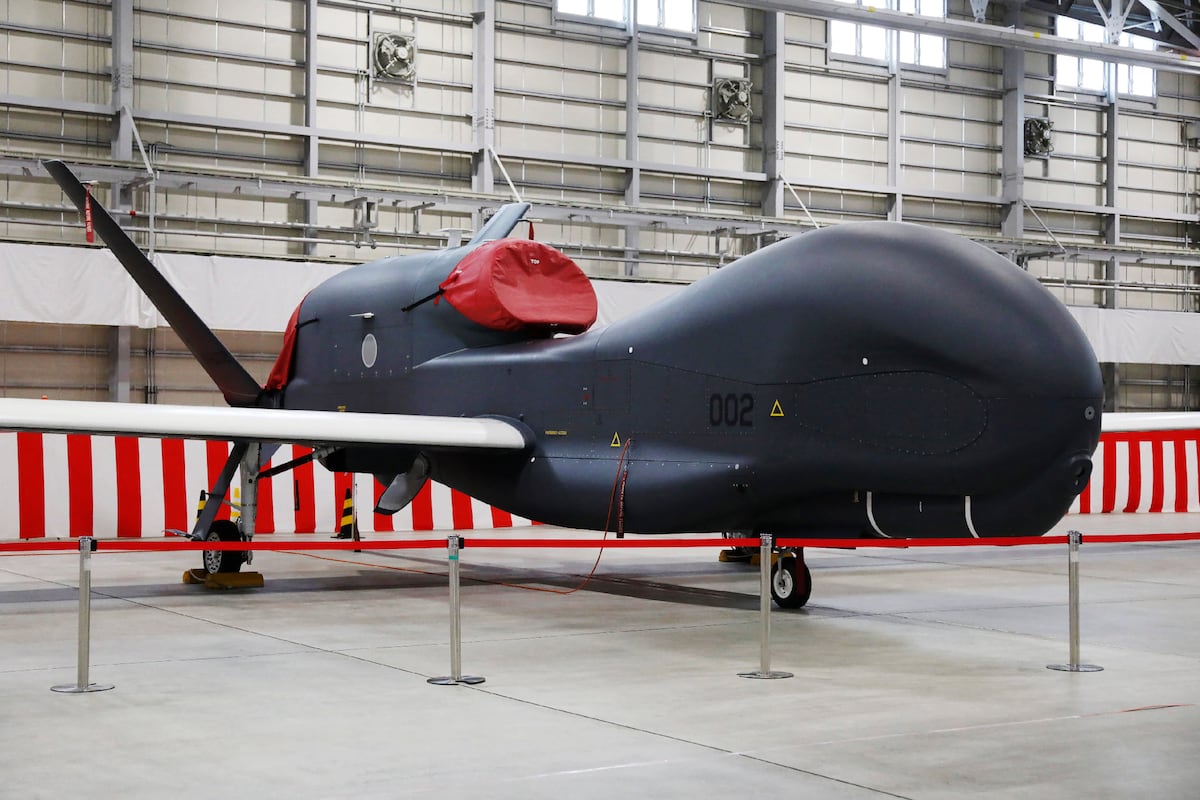
CHRISTCHURCH, New Zealand — A Japanese Global Hawk drone nosedived into the Sea of Japan on Sept. 15, instantly slashing the country’s fleet of these large-wingspan, unmanned surveillance aircraft by a third.
Japan paid roughly $163 million for Northrop Grumman to manufacture each of its three RQ-4B Block 30i Global Hawks nearly a decade ago.
The Japan Air Self-Defense Force (JASDF) on Sept. 16 revealed that it lost contact with the high-altitude drone at 12:55 p.m., before losing its radar signature three minutes later over international waters.
The JASDF’s 502nd Squadron operates its Global Hawks from Misawa Air Base in northern Japan. Before crashing, the drone had taken off at 10.20 a.m. on an unspecified mission, with JASDF Chief of Staff Gen. Takehiro Morita only divulging, “This particular flight was not a training exercise.”
One mission for Japanese Global Hawks, which can stay aloft for 32 hours at altitudes of up to 60,000 ft, is monitoring North Korean missile launch preparations. They are also useful for keeping an eye on Chinese military activities.
Morita said a Japan Coast Guard helicopter spotted debris in the water just 50 minutes after it had lost contact. Other assets spotted further wreckage and took photos, enabling precise identification of the aircraft.
No cause of the accident was revealed.
Japan received its first Global Hawk in March 2022, with the other two arriving later that year. Their integrated payload contains an electro-optic/infrared sensor, synthetic aperture radar and ground moving target indicator.
The Global Hawk purchase was controversial in Japan given their enormous cost and the fact that the U.S. retained tight control over the aircraft’s technology and the processing of gathered data.
Global Hawks possess the longest reach of any Japanese drone, so the loss of one among such a small fleet will be sorely missed.
However, as Japan increasingly prioritizes unmanned technologies, the Japan Maritime Self Defense Force is planning to induct the first of 23 MQ-9B SeaGuardians in 2027. Although these drones have a shorter endurance and range than the Global Hawk, Tokyo will use them for maritime domain awareness.
Japan’s draft 2027 defense budget requested US$1.88 billion for the first 17 SeaGuardians. These will take over some of the missions currently performed by P-1 and older P-3C Orion maritime patrol aircraft.
Incidentally, the U.S. Air Force currently has three RQ-4B Global Hawks stationed at Yokota Air Base in Tokyo, after relocating them from Guam in May to avoid the typhoon season.
The United States planned to quickly retire all its Global Hawks, but it will now keep operating them until 2033. After that, there will be only three in South Korea and two in Japan still flying.
Gordon Arthur is an Asia correspondent for Defense News. After a 20-year stint working in Hong Kong, he now resides in New Zealand. He has attended military exercises and defense exhibitions in about 20 countries around the Asia-Pacific region.
新西兰基督城——9 月 15 日,一架日本全球鹰无人机坠入日本海,瞬间使该国这种大翼展无人侦察机的数量减少了三分之一。
大约十年前,日本向诺斯罗普·格鲁曼公司支付了约 1.63 亿美元,用于制造其三架 RQ-4B Block 30i 全球鹰无人机。
日本航空自卫队于9月16日透露,当天下午12点55分,他们与一架高空无人机失去联系,三分钟后,该无人机在国际水域上空失去了雷达信号。
日本航空自卫队第502飞行队从日本北部的三泽空军基地起飞,操作其全球鹰无人机。这架无人机在坠毁前于上午10点20分起飞,执行一项未公开的任务。日本航空自卫队参谋长森田武弘将军仅透露:“这次飞行并非训练演习。”
日本的“全球鹰”无人机能够在高达6万英尺(约18000米)的高空持续飞行32小时,其一项主要任务是监视朝鲜的导弹发射准备工作。它们对于监视中国的军事活动也十分有用。
森田表示,日本海上保安厅的一架直升机在飞机失去联系仅50分钟后就在水中发现了残骸。其他救援力量也发现了更多残骸并拍摄了照片,从而能够精确识别飞机身份。
事故原因尚未查明。
日本于2022年3月接收了首架“全球鹰”无人机,其余两架于同年晚些时候交付。它们的集成有效载荷包括光电/红外传感器、合成孔径雷达和地面移动目标指示器。
鉴于全球鹰无人机的巨额成本,以及美国对该飞机的技术和收集数据的处理保持严格控制,日本购买该无人机的决定引起了争议。
全球鹰无人机是日本无人机中航程最远的,因此,在如此小的机队中损失一架全球鹰无人机将会造成很大的损失。
然而,随着日本越来越重视无人技术,日本海上自卫队计划于 2027 年接收首批 23 架 MQ-9B“海上卫士”无人机。尽管这些无人机的续航时间和航程比“全球鹰”无人机短,但东京将利用它们进行海上态势感知。
日本2027年国防预算草案申请拨款18.8亿美元,用于采购首批17架“海上卫士”海上巡逻机。这些飞机将接替目前由P-1和较老的P-3C“猎户座”海上巡逻机执行的部分任务。
顺便提一下,美国空军目前在东京横田空军基地驻扎了三架 RQ-4B 全球鹰无人机,这些无人机于 5 月份从关岛转移过来,以避开台风季节。
美国原计划迅速退役所有“全球鹰”无人机,但现在决定继续服役至2033年。之后,韩国将有3架“全球鹰”无人机,日本将有2架仍在服役。
戈登·阿瑟是《防务新闻》的亚洲特派记者。在香港工作20年后,他现居新西兰。他曾到访亚太地区约20个国家,参加过军事演习和防务展览。