Aussie defense chief confirms missing F-35 parts, says none are ‘sensitive’澳大利亚国防部长证实F-35战斗机零部件丢失,称其中没有“敏感”部件。
After parts reportedly made their way to Hong Kong, a Lockheed Martin spokesperson told Breaking Defense that the missing components “are unserviceable and deemed low risk for exploitation."
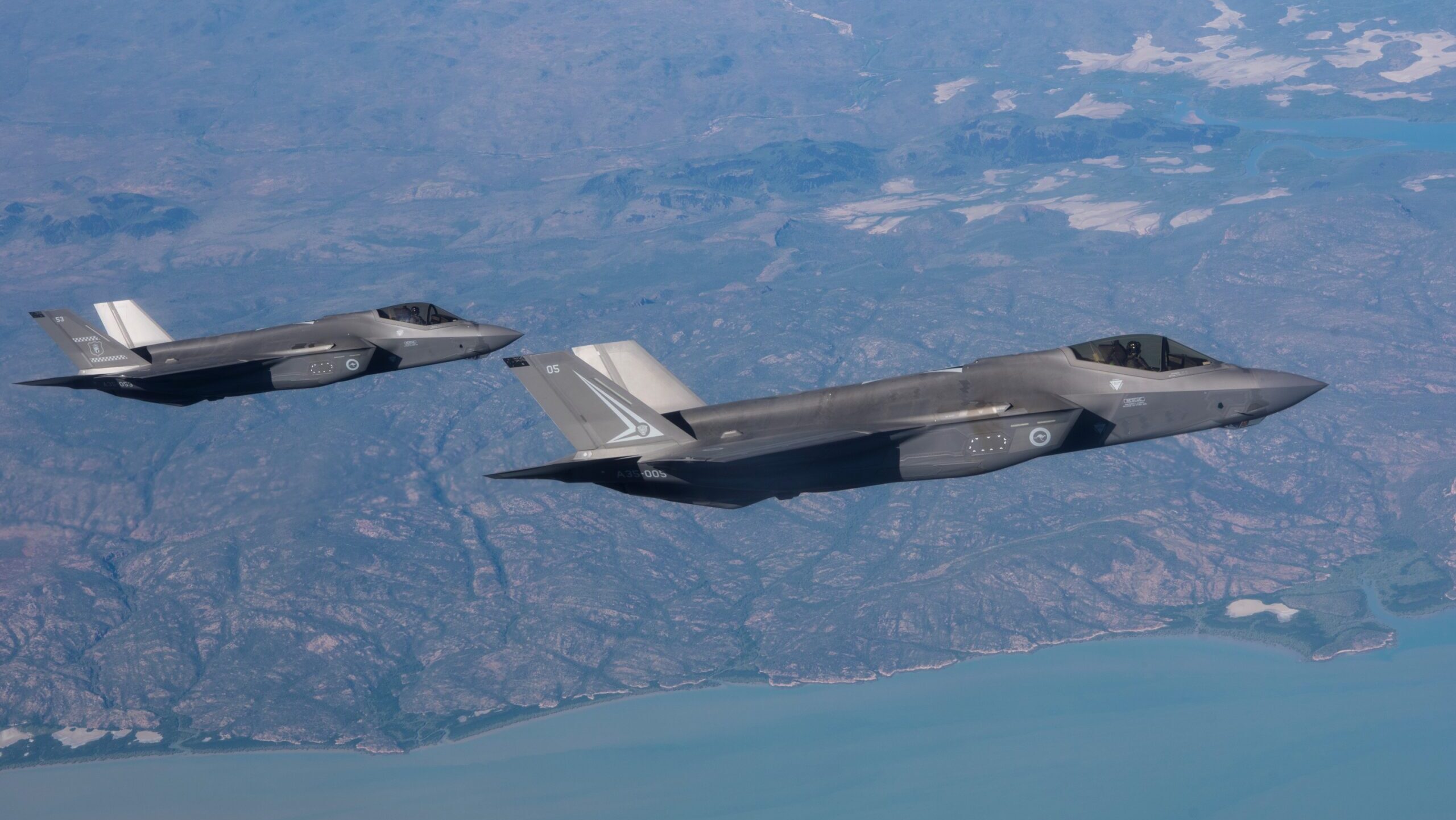
Royal Australian Air Force (RAAF) F-35A Lightning IIs, assigned to the No. 3 Squadron, arrive to receive fuel from a U.S. Air Force KC-46A Pegasus from the 13th Expeditionary Aerial Refueling Squadron over Australia during Talisman Sabre 23, Aug. 1, 2023. (Photo by Tech. Sgt. Eric Summers Pacific Air Forces.)
WASHINGTON — Australia’s defense minister said today that he did not believe any parts of F-35 Joint Strike Fighter aircraft reportedly diverted to Hong Kong were “sensitive,” but said Canberra was working with Washington and F-35-maker Lockheed Martin on the issue.
“We are examining very much everything that has occurred at the Australian end, but the point I would make here is that we are confident about the way in which we’ve engaged with the program, and through the US’s prime contractor, Lockheed,” Richard Marles said, according to a government transcript .
While ultimately referring questions about the nature of the missing components to the US government and Lockheed, Marles said his “understanding” is “we’re not talking about sensitive parts here.”
POLITICO first reported Sept. 18 that a collection of F-35 parts handled by a Lockheed “intermediary” bound for the US for repairs was apparently diverted after leaving Australia, winding up in Hong Kong. The shipment included one of the F-35’s canopies — coated in radar-absorbing material key to masking the stealth fighter’s signature — which, the outlet said, was still missing.
Both the Pentagon’s F-35 Joint Program Office and Lockheed released relatively sanguine statements, echoing Marles.
A spokesperson for the F-35 Joint Program Office said Pentagon officials “are aware of a shipment issue of unserviceable F-35 Lightning II components. We are actively working with U.S. authorities and industry partners to retrieve these components, investigate the incident, and place safeguards to avoid a future occurrence.”
A Lockheed spokesperson said the company “continues to work closely with the U.S. Government following this incident and we have complied fully with all laws, policies, and export‑control regulations.”
The spokesperson added that the missing components “are unserviceable and deemed low risk for exploitation. We manage every shipment with the highest levels of caution and security to protect the integrity of the program and the interests of our partners and customers.”
Still, the waylaid shipment making its way to Hong Kong is sure to raise fears that the Chinese government, which has strengthened its grip on the special administrative region, may gain access to the F-35’s stealth technology. Compromising the fighter’s stealth capabilities could help an adversary better understand how to counter it in battle, or enable Beijing to incorporate lessons for its own advanced aircraft projects . (For more than a decade China has faced allegations that it has stolen F-35 plans to better help it build its own fighter jets. Beijing has dismissed the claims.)
With 20 global customers — and another potentially on the way after the State Department cleared a sale for Saudi Arabia — the F-35 relies on a complex global supply chain. The F-35’s global spares pool is owned by the government but managed by Lockheed, and components are spread out over dozens of domestic and international facilities.
A 2023 Government Accountability Office report found that over 1 million F-35 parts collectively valued at $85 million were unaccounted for, warning that number could be much higher. A dearth of parts has been a key driver behind the F-35’s disappointing readiness rates, prompting officials in recent years to pursue a greater number of spares.
2023年8月1日,在“护身军刀23”联合军演期间,隶属于澳大利亚皇家空军第3中队的F-35A“闪电II”战斗机抵达澳大利亚上空,接受美国空军第13远征空中加油中队的KC-46A“飞马”加油机的空中加油。(照片由太平洋空军技术军士埃里克·萨默斯拍摄。)
华盛顿——澳大利亚国防部长今天表示,他不认为据报道被转运到香港的F-35联合攻击战斗机的任何部件是“敏感的”,但他表示,堪培拉正在就此问题与华盛顿和F-35制造商洛克希德·马丁公司合作。
根据政府记录,理查德·马尔斯说:“我们正在仔细审查澳大利亚方面发生的一切,但我在这里要指出的是,我们对我们参与该项目的方式,以及通过美国的主要承包商洛克希德公司参与该项目的方式,都充满信心。”
尽管最终将有关缺失部件性质的问题转给了美国政府和洛克希德公司,但马尔斯表示,他的“理解”是“我们这里讨论的不是敏感部件”。
据POLITICO 9月18日报道,一批由洛克希德·马丁公司“中间商”经手的F-35战斗机零部件,原本计划运往美国进行维修,但在离开澳大利亚后似乎被转运,最终抵达香港。报道称,这批货物中包含一个F-35的座舱盖——该座舱盖涂有雷达吸波材料,是掩盖隐形战斗机雷达信号的关键部件——目前仍下落不明。
五角大楼的 F-35 联合项目办公室和洛克希德公司都发表了相对乐观的声明,与马尔斯的说法相呼应。
F-35联合项目办公室发言人表示,五角大楼官员“已经注意到一批无法使用的F-35闪电II战斗机部件的交付问题。我们正在积极与美国当局和行业伙伴合作,回收这些部件,调查事件经过,并采取保障措施,防止类似事件再次发生。”
洛克希德公司的一位发言人表示,该公司“在此次事件发生后继续与美国政府密切合作,并且我们已完全遵守所有法律、政策和出口管制条例。”
发言人补充说,缺失的部件“无法使用,且被认为具有较低的被利用风险。我们对每一批货物的运输都采取最高级别的谨慎和安全措施,以保护项目的完整性以及我们合作伙伴和客户的利益。”
尽管如此,这批被拦截运往香港的货物无疑会引发人们的担忧:中国政府加强了对香港的控制,可能会获取F-35的隐形技术。泄露该战斗机的隐形能力可能有助于对手更好地了解如何在战斗中应对,或者使北京能够将经验借鉴到自己的先进飞机项目中。(十多年来,中国一直面临着窃取F-35设计图纸以更好地帮助其制造自身战斗机的指控。北京否认了这些指控。)
F-35战斗机拥有20个全球客户——而且在国务院批准向沙特阿拉伯出售后,可能还会再添一个客户——这依赖于复杂的全球供应链。F-35的全球备件库归政府所有,但由洛克希德·马丁公司管理,其零部件分布在数十个国内外设施中。
美国政府问责局2023年的一份报告发现,超过100万个F-35零部件下落不明,总价值达8500万美元,并警告称实际数字可能远高于此。零部件短缺一直是F-35战机战备率令人失望的主要原因,促使官员们近年来寻求增加备件数量。