Here’s What The Army’s Long-Awaited Super Air Defense Network Can Actually Do以下是陆军期待已久的超级防空网络实际能做到的:
We go in-depth with Northrop Grumman's Kenn Todorov on what the Integrated Battle Command System is capable of now and what it could do in the future.
新闻视频
Updated Apr 28, 2021 6:25 PM EDT
The Army’s potentially revolutionary integrated air defense networking and command and control system carries the somewhat vague moniker Integrated Battle Command System, or IBCS. It aims to connect disparate sensors and missiles, but also potentially cannons, lasers, electronic warfare capabilities, and more (commonly referred to as effectors), across a battlespace to counter enemy aircraft and missiles. IBCS has had a long and somewhat tortured development , but now, after a highly successful test last August, it seems to be coming into its own and could finally move from a research and development effort to a production program in the near future. Its operational deployment would drastically increase America’s ability to defend its forces from all types of aerial attacks, and it would provide a fertile open-architecture command and control and networking environment that can incorporate fast upgrades and future additions of more sensors and effectors that are all tied together in a seamless and highly-automated fashion.
We hear a lot about networks, computer systems that are weapons onto themselves, data-links, and sensor fusion these days. Often the real capabilities a system offers, or doesn’t, gets lost in an avalanche of acronyms and jargon. It all sounds more like magic and a good PowerPoint presentation than reality. Such systems are far harder to comprehend and even define than say a new fighter jet program, early warning satellite, or armored vehicle. This does a major disservice to something like the IBCS that stands to dramatically change the way the Army, and the joint force it is so deeply connected to, fights. As such, we wanted to cut through the muck and get to the essence of this system, including getting a clear view of its capabilities now and what it could be capable of in the future.
With this goal in mind, we went in-depth with Northrop Grumman’s Kenn Todorov, Vice President and General Manager, Combat Systems and Mission Readiness. The resulting conversation isn’t just enlightening in regards to IBCS, but also in terms of better understanding the future of highly networked and automated warfighting.
Here is that interview:
Kenn: In our portfolio and my portfolio here with the company, we have the Integrated Battle Command System [IBCS], and I always… I hesitate when I say Integrated Battle Command System because until very recently, the Army was calling it the Integrated Air and Missile Defense, that was the I, Battle Command System, but now it’s shortened much… It’s easier to say, but for me, it’s not because for years I’ve been saying IAMD Battle Command System, but… IBCS is of course the Army’s program of record.
They are our customer, and we’re very much in partnership and cooperation with them. We have been developing the system for nearly a decade now, and it really stems, Tyler, as I think you know, from the Gulf War with numerous fratricides in the battlespace, in the IAMD arena, particularly when the battlespace was just so complex that the warfighter was having difficulty weeding through important information and making decisions in real-time that led to some very unfortunate events.
Since those days, we have been, frankly, hard at work, and particularly in the last decade, on a modular, open-architected system that… employs a net-centric integrated fire control network that enables the acquisition, identification, and engagement of air and missile threats of all kinds. And so IBCS is an exciting system, I think we’re very proud to work with our customer in the United States Army as they develop it, as they near a Milestone C decision this fall and enter into full production…
Tyler: What capabilities does IBCS have today? Can you run down the list of what it can do and then juxtapose that as far as what in the future you’re hoping to make it capable of? We hear the acronyms and whatnot, and I think it’s kind of like, “Okay, yeah, I get it, you get a common picture. And it says it shoots down multiple things, provides multiple tracks, uses data links,” I think a lot of people’s eyes just glaze over. So, if you can give us the best top-down look at the system and how it works and what it can do, and then what you want it to in the future, that would be really helpful.
Kenn: Great. And I understand the question and I also understand the tendency for people like me particularly to talk about it in this high-tech kind of way, but at its core, I think what IBCS does is simplify the battlespace for the warfighter. When you look at the complexity of that space and how it’s grown and the threat has grown in quantities and qualities, but also diversities, and now you’ve got all ranges of threats, literally from the surface up into the exo-atmosphere. IBCS as a system can weed through all that information, and then, based on its modular, open system architecture approach, it can really adapt feeds and data from any of the sensors that might be out there to include airborne sensors like the F-35, but radars, airborne sensors, sensors that are maybe maritime-based, and it takes that into a single integrated air picture. But then the really unique thing about the system is its fire control capabilities in that it’s able to then recommend—there’s always a woman or a man in the loop—but recommend to the warfighter which effector [such as a missile, gun system, laser, microwave system, even electronic warfare] might be best used against a particular threat. Whereas, before, you had sort of stoved-piped systems that were developed in concert with each other, but frankly, without much consideration to linking with disparate systems in the battlespace.
IBCS can now, I’m gonna say it’s sensor and shooter agnostic in that it doesn’t care where the information might come from, it just wants to take that, fuse it with the rest of the data that it’s seeing, and create a really sharper picture for the warfighter to weed through some of those difficult circumstances and then make a recommendation on which effector might be best served to go after a particular threat.
Courtesy of Northrop Grumman
So, if I can give you an example of that, which I think was really remarkable. In the most recent limited user test, which we concluded… I say we concluded, to be clear, it’s the Army’s test, we were participating in it as their prime contractor. But on August the 20th and I’d refer you to the Army for specific details, but there was a cruise missile surrogate airborne and a theater ballistic missile airborne, and IBCS was doing its thing through a myriad of challenges presented to it, like electronic warfare, electronic attack to try to spoof it.
It was able to ignore those attacks and pass tracks from different sensors to each other, and then it was able to recommend a specific Patriot battery to shoot a PAC-3 at the threat, and, interestingly, it didn’t leave the launcher… There was a problem with the effector that was going after the threat, and what IBCS did was say, “Okay, got it. There’s a problem there. I’m now gonna recommend this next best shooter to take the shot,” which it did.
The warfighter acknowledged and took that shot and they splashed the target beautifully.
So, in that situation, you had the system that was helping the warfighter think through the problem, seeing through a myriad of challenges like EW [electronic warfare] and low mass terrain and the cruise missile surrogate flying low while the theater ballistic missile was flying high. Sending solutions to the warfighter on which effector should take the shot once the weapons release authority was granted…
Then when there was a problem, which, by the way, wasn’t part of the test, it just happened naturally in the system, the IBCS system recognized that and actually selected a different effector to take the shot, which it did and made the hit.
So, maybe a long answer to your question, but that’s trying to simplify really what the goodness of a system like IBCS does, and was really proven, I think, in the Army’s test in the desert…
For the future, as I mentioned, IBCS is clearly the Army’s program of record, and that’s a priority for us as a company. But the architectural framework that IBCS is built on this modular, open, software-defined, hardware-enabled framework, that can be applied in a number of different ways. It can be applied to… the Air Force’s ABMS construct , or… I know you’ve heard and written a lot about JBMS… I said JBMS, I meant the JADC2, the Joint All Domain Command and Control, where you’re having to now take what IBCS does and then sort of take that to a cross-domain kind of solution from all domains, to include space and cyber.
So, I think the future of a program like this, and the thing we’re thinking very keenly on, how do we apply the architectural framework or the technology that IBCS is built upon. Ignore IBCS because that’s the Army’s program of record, but what the system can do might be applicable to others in the department, to other services, to even our friends and allied partners across the world. As you know, I think Poland is already on contract for IBCS. Other countries as well have expressed interest in it. So, I think, as this capability continues to mature, it’ll be the command and control system of choice, at least in the integrated air missile defense fight and perhaps in other areas as well.
IBCS control during a major live-fire test. , Courtesy of Northrop Grumman
And the last thing, Tyler, I’ll say… I think the thing I would conclude this with is the ever-changing nature of the threat is such that you need this open architecture system to stay relevant to the future, because if you build things in a stovepipe way and then new threats or new capabilities come along, be they hypersonic, be they, you name them, new UAS systems that are stealthy, etcetera, etcetera, you can imagine these different kinds of threats that show up. Now, if your system is closed and it’s never quite as good as it is the day it leaves the manufacturer’s floor and gets out there, and now there’s a new requirement for it, with IBCS or a system like it, you can continue to add capability through this modular openness. You can continue to add sensors every year or as new capabilities come around, new effectors to deal with those new threats. So, I think when we talk about the future, a system like this is very exciting because it’s extensible to that future.
Tyler: When you talk about this being adaptable and open architecture, so there are quite a few different systems that have a similar, let’s just say brochure, but are not necessarily for the same thing. They’re dealing with different threat profiles, different domains of warfare, but they do similar sensor fusion, with some sort of AI built-in or at least high automation to help the warfighter actually make decisions or approve decisions. Do you see IBCS as being something that could be the system that links all systems or do you see it as one system that could plug into a system that links all systems?
Kenn: Yeah, that’s a great question… I want to be careful again to distinguish the Army’s program, IBCS, with where maybe your question is going with this. So, it’s not for me to say whether or not the Army is offering this up to other services or if other services are interested in the Army’s program per se. But again, going back to the capabilities resident in the program itself, which can be applied in a number of different ways. I think the potential is there. I don’t see this as the end-all-be-all network for the end of time, but rather as a network that has acquisition, identification, and most importantly, fire control enabled in it that can plug into others for the basis of an architecture or for extending the architecture or for a different part of the domain space. For instance, shorter-range integrated air-missile defense. So, I’m not trying to say that this capability can be a panacea for all of the JADC2 desires out there, but rather, it certainly can, this architecture can be built upon, and I think it’s worthy of exploration about how far it can go.
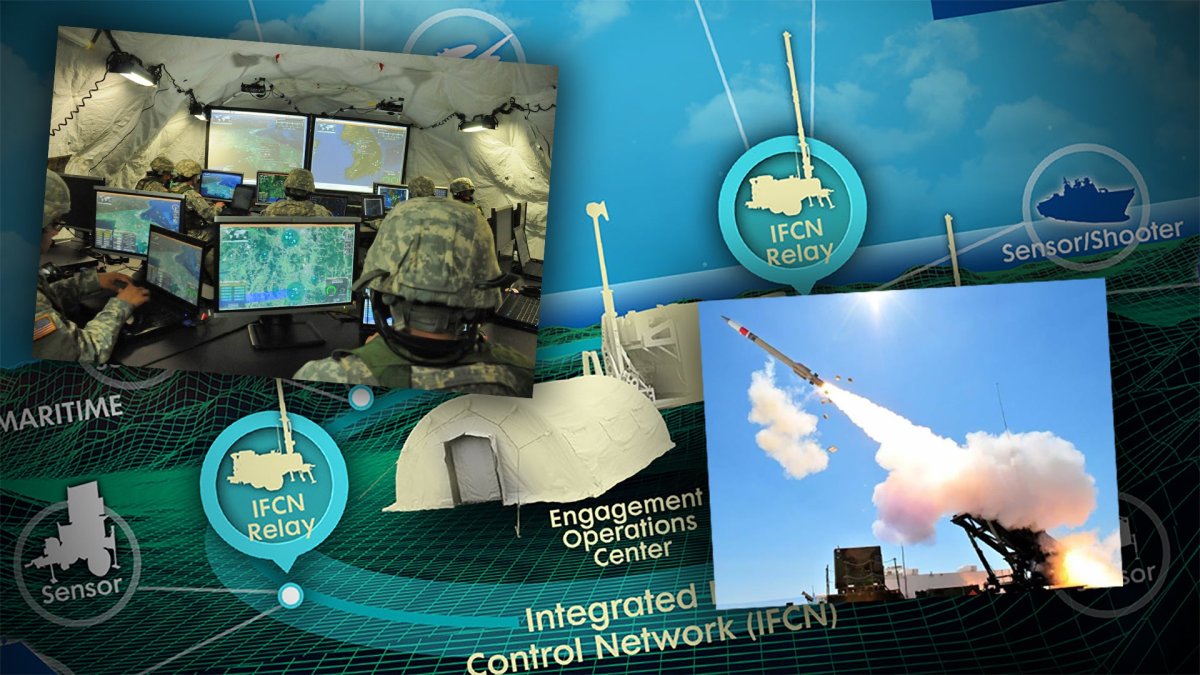
IBCS networking and C2 installation., Courtesy of Northrop Grumman
Tyler: On the fire control side and actually on the identification and tracking side, too… There’s obviously ballistic missile defense, hypersonics are now gonna be the next thing, trying to counter that, which is a huge bag of snakes. And then there are the various traditional air-breathing threats that you’re dealing with today. What about the very low-end? What about the quadcopter or small UAS swarm and the very low-end side of the Army’s air defense puzzle, which, honestly, is looking to be the most troublesome in the years to come. Does this system have the ability to deal with that voluminous lower-end threat as well as the higher-end threats?
Kenn: The short answer is yes, on the lower-end threats. In fact, it’s very much… I think as we listen to the customer and to the department talk about these challenges, the very challenges you kind of mentioned, we are doing a lot of work here at Northrop Grumman with regard to counter-UAS and how do we then take a kinetic control system like an IBCS, or one like it, and work in conjunction with some of the other kinetic and even some non-kinetic capabilities to deal with the problems that you just succinctly laid out. These quadcopters, these swarms of UASs… Our thinking is that this system is very capable, then, as I mentioned, any effector really, you can integrate with it. But we’re actually taking it a step further and some very specific capabilities we have resident within the company, and in the course of the next 18 months, we are going to be demonstrating some of those on ranges around the country.
And we’ve got some… I can’t get into… I don’t think too many specifics today, but certainly something I can follow up with you on. But actually taking a system like an IBCS and linking it with a 30-millimeter cannon or with a high powered microwave capability or with some other kind of a missile capability and demonstrating the very thing that you’re talking about, sort of the low-end tactical fight.
The other one that’s very much in the forefront of our mind is the Army’s DE M-SHORAD [Directed Energy Mobile Short-Range Air Defense System], which we’re involved in right now is to put a 50-kilowatt laser on a Stryker vehicle , and that program is in development. And, again, we’re one of two companies that I think are vying for that opportunity.
DE M-SHORAD., Northrop Grumman
We’re thinking beyond the laser platform itself, but rather, “How does that platform integrate then with the rest of the architecture or the rest of the IMD space?” So, that the data collected, either to or from the Stryker, can be shared with other sensors in the array on the battlespace, and then the old over-used cliche of one plus one can equal something greater than two, kind of incorporating that into the larger air picture.
On the higher end, I don’t want to get too much into… I used to work the counter-hypersonics portfolio for the company, and I would say that, I’ll just leave it very quickly and say that, getting to some kind of a space-based capability for sensing and for the hypersonic threat is certainly something that we’re working with customers on, as well, and hearing loud and clear that that has to be front and center in trying to solve the hypersonic challenge. So, I think a system like IBCS certainly can link data and information from any number of sources, and the future potential of something like this is really exciting when we think about it.
Tyler: When you say hypersonics, and honestly, we talked about all of this because any peer state’s going to layer a bunch of threats in at once, right? I mean, it’s not going to be a la carte, what we’re going to be facing in the future, as in one thing happening at a time and decisions are made, and an action happens. When you talk about hypersonics and you talked about very low-end threats and whatever’s in the middle that we’re probably more used to, time becomes the issue, right? How can the human being look at all that, figure it out, and actually put a countermeasure in place to stop it and do it thoughtfully? Do you see the system, obviously being monitored by people, but do you think it can operate automatically in a very high volume scenario?… Can you put that thing on automatic, and will shoot until there’s nothing left? Do you see this having that ability if it was needed during a peer state attack?
Kenn: The platform does have that capability, Tyler, and I think that the tactics and techniques and procedures, I don’t wanna speculate on because that’s not mine to do, but the capability certainly resides, and how it’s put into action would be certainly up to the, as you can imagine, to our customers, so maybe they’d be best to answer that. But one thing I do want to mention that may be a tangent of the question you just asked, is this idea of long-range precision fires… We’re making investments today to broaden the capabilities of an IBCS-like architecture to further enable multi-domain operations, not only from a defensive standpoint, but to have the potential for enhancing capabilities like long-range precision fires on the offensive side, as well.
So, I don’t want to leave you with the notion that this platform is strictly defensive because I think all of the goodness that goes into a system like an IBCS or an IBCS-like system is… Is certainly it’s within the technological capability of a system like that to then also be used to calculate long-range precision offensive fires as well, so it’s on offense and defense. We’re hearing a lot more from, I think, the department and our customers about the need to do that, and this system certainly would have that offensive/defensive capability, as well.
Tyler: Okay, so I have two questions based on both of those capabilities, offensive and defensive. One is getting to the low observable [stealth] issue. Stealth technology is proliferating, we’re no longer just the only people that have this capability, especially in the cruise missile realm, not just on the higher-end exquisite aircraft realm. Being able to link all those disparate sensors together and look at a common picture… Does that also get you a much better fidelity target track? Considering it is made up of data from multiple sensors, instead of a bunch of federated sensors and systems, that may be data linked together to some degree, but that data is not so well fused?
Author’s note: Simple English version of this question is can a networked and data-fused system like IBCS help spot, track, and even possibly engage stealthy aircraft and cruise missiles.
Kenn: Yeah, I think you’ve obviously been a designer on the system, Tyler. I think you just nailed it, nailed the, really what’s at the acme of the fusion, without getting too technical, which I won’t try to do with you, because I’ll fail, but also it gets into some of the classified realm, which we certainly don’t want to do. But yes, in essence, you’re right, when you fuse the data from disparate systems, I think you have a lot more fidelity in the track. And that’s some of the, I’ll just say, secret sauce of this system is the ability to fuse that information into a more refined fire control track, which we have, very proud to say seven for seven in-flight tests, including last month where we, in two consecutive weeks, knocked two very sophisticated targets out of the sky with the system, it was a very complex scenario. And again, during the Army’s limited users test that we were a part of.
Tyler: So, on the offensive side… The ability to take all that, kind of what we think of as a defensive capability, as you said, and migrate it to being able to punch the enemy, too… Obviously, there are some new interesting things that the Army is working on, penetrating airborne assets like FARA [Future Attack Reconnaissance Aircraft] and different capabilities that are manned, potentially unmanned, or optionally manned. Do you see a system like this or even this system in the not so distant future, being able to push its data out to those forward nodes that might be airborne downrange instead of on the ground next to some command or control capability, but they’re airborne and be able to rapidly respond to threats when they may represent the most efficient way to deal with those threats based on what’s nearby or what type of capability they possess?
Kenn: Yeah, it’s a great question. And I think I would maybe comment on it this way. I think a system like this… And go back to how it’s built, it’s MOSA network-enabled , it can play a critical role in these emerging JADC2 capabilities, offense and defense-wise. And it has the capability to be extensible to integrate with other networks and C2 [command and control] capabilities that are out there. So, back to an earlier question about will this being sort of the be-all-end-all or will it be part of a larger network? I think it’s probably the latter. However, the example I always give and have heard folks talk about, particularly in recent weeks in an Air Force context… Is that you can envision a system like an IBCS that helps to link either pull or push or pass data from a ground node to a ship at sea or to an F-35 or to an over horizon Special Operations Airman that’s deployed somewhere far, far away. I think this system has the ability to do that. And so it can be extensible to other networks and systems and pushed far beyond its own capability for what the Army is going to use it for… If that maybe gets at where your question was going.
Tyler: So the last question I have is about electronic warfare. And I know there are limitations in how much you can talk about this. But a lot of times when we hear “network, network, network,” there’s so many incredible benefits from it. And that’s absolutely clear and very well articulated by a lot of people… But what a lot of people ask is, what about vulnerabilities in depending so much on an integrated network. And with this [IBCS], you’re talking about really fast decisions, multiple sensors, waveforms, etcetera, etcetera. How do you guys look at the EW picture and the stability of such a system in regards to this, let’s say, threat?
Kenn: Well, you’re asking some really, really great questions first of all, which I know are based on how you write and what you write about, you’re pretty well versed in the problem set, which is your job to do, so good on you. The EW issue, the challenge is certainly a real one. I guess I would refer you back to the flight test, I think on the 13th of August, when our customer recognized the same thing you did in your question and said, “Hey, we’re gonna put… We’re gonna really make this hard for the system to figure this out.” And, again, I can’t get into the specifics as you understand, but we made it really challenging and tried to bring down these connected issues that were holding together this network. And the system found a way out of it, it would recognize that it was under some kind of an attack or at least some kind of an incursion to prevent it on its most natural path to pass data, and it found a way to get around it. So, through other connections and networks, which was really, really impressive to see. And the really impressive part is it barely missed a beat.
I don’t wanna get… I ask you not to put the specifics in if anything you’re gonna write about, but I will just say that in a matter of seconds… I was in the control room watching everything happen, I knew when the EW activity was going to begin and I could see through the sensors and the screens… It was temporarily made to be disoriented and pretty quickly was able to find another path and another channel to get the data where it needed to go and passed a fire control solution to a shooter, which took a first shot and nailed it. And that was eye-watering to me.
PAC-3 Patriot missile. , US Army
Now it’s not to say that that’s representative of every EW scenario that might be had out there, no, but I think it was proof that the system has the capability to work its way around problems like that, because those problems will exist clearly, as you said, particularly a conflict, a sophisticated conflict, threats are gonna come from all ways and shapes and sizes, from all angles, and it’s going to be very difficult, so these systems have to find their way out of these problems. And I’m really, really, really proud to say that the team and working with the Army, we found a way out of the one during the test. I refer you back to them for specific details on it, but just to paint a little picture of what I saw.
Editor’s note: We want to thank Kenn Todorov for taking the time to really dig in on this challenging topic. We also want to thank Bridget Slayen of the Northrop Grumman’s comms team for facilitating the exchange.
Contact the editor: Tyler@thedrive.com
Comments couldn’t be loaded. Please refresh the page.
更新于美国东部时间2021年4月28日下午6:25
美国陆军这项极具革命性的集成防空网络和指挥控制系统,被冠以“集成作战指挥系统”(IBCS)这一略显模糊的名称。其目标是将战场上各种不同的传感器和导弹,以及潜在的火炮、激光器、电子战能力等(通常称为效应器)连接起来,以对抗敌方飞机和导弹。IBCS的研发历程漫长而曲折,但经过去年8月一次非常成功的测试后,它似乎已步入正轨,并有望在不久的将来从研发阶段过渡到生产阶段。其作战部署将大幅提升美国防御各种类型空中攻击的能力,并提供一个灵活的开放式架构指挥控制和网络环境,能够快速升级并扩展未来新增的传感器和效应器,所有设备都能以无缝且高度自动化的方式连接在一起。
如今,我们经常听到网络、本身就是武器的计算机系统、数据链和传感器融合等术语。然而,一个系统真正具备的能力(或者说它不具备的能力)往往被淹没在铺天盖地的缩写词和专业术语之中。这一切听起来更像是魔法和精彩的PPT演示,而非现实。这类系统远比新型战斗机项目、预警卫星或装甲车等更难理解,甚至难以定义。这严重低估了像IBCS这样的系统,它有望彻底改变陆军及其紧密相连的联合部队的作战方式。因此,我们希望拨开迷雾,直击该系统的本质,包括清晰了解其现有能力以及未来的发展潜力。
为了实现这一目标,我们与诺斯罗普·格鲁曼公司作战系统与任务准备副总裁兼总经理肯·托多罗夫进行了深入交流。此次对话不仅让我们对集成作战控制系统(IBCS)有了更深刻的理解,也有助于我们更好地理解未来高度网络化和自动化作战的发展趋势。
以下是那次采访的内容:
肯恩:在我们公司以及我个人负责的产品组合中,有一套名为“集成作战指挥系统”(IBCS)的系统。我总是……每次提到“集成作战指挥系统”这个名字时都会犹豫,因为直到不久前,陆军还称其为“集成防空反导系统”(IAMD),也就是“作战指挥系统”(IBCS)。但现在缩写得更简洁了……说起来容易,但对我来说,这并不容易,因为多年来我一直都说的是IAMD作战指挥系统,但是……当然,IBCS是陆军的正式项目。
他们是我们的客户,我们与他们保持着密切的伙伴关系和合作。我们开发这套系统已经近十年了,泰勒,我想你也知道,它的起源可以追溯到海湾战争,当时战场上,尤其是在综合防空导弹系统(IAMD)领域,发生了许多误伤事件,特别是当战场环境极其复杂,作战人员难以筛选重要信息并实时做出决策时,导致了一些非常不幸的事件发生。
坦白说,从那时起,我们一直在努力工作,尤其是在过去十年中,致力于开发一种模块化、开放式架构的系统,该系统采用以网络为中心的集成火控网络,能够获取、识别和打击各种空中和导弹威胁。因此,IBCS 是一个令人振奋的系统,我们非常自豪能够与美国陆军的客户合作开发该系统,他们即将于今年秋季做出里程碑 C 决策并进入全面生产阶段……
泰勒:IBCS目前具备哪些功能?您能否列出它目前的功能,并展望一下未来您希望它具备的功能?我们经常听到各种缩写词,感觉就像是:“好吧,我明白了,大概了解了。它能击落多个目标,提供多条跟踪信息,使用数据链”,很多人听了之后就觉得很困惑。所以,如果您能给我们全面介绍一下这个系统,包括它的工作原理、现有功能以及未来的发展方向,那就太好了。
肯恩:太好了。我理解这个问题,也明白像我这样的人为什么倾向于用这种高科技的方式来谈论它,但我认为,IBCS 的核心作用是简化作战人员的作战空间。当你审视这个空间的复杂性,以及它如何不断扩大,威胁的数量、性质和多样性都在增长,如今威胁的范围涵盖了从地表到外大气层的各个层面。IBCS 系统能够筛选所有这些信息,然后,基于其模块化、开放的系统架构,它可以真正地整合来自任何传感器的信息和数据,包括像 F-35 这样的机载传感器、雷达、机载传感器以及可能来自海上的传感器,并将这些信息整合到一个统一的空中态势图中。但该系统真正独特之处在于其火力控制能力,它能够向作战人员推荐——当然,决策过程始终由男性或女性参与——哪种作战效应器(例如导弹、火炮系统、激光武器、微波系统,甚至是电子战武器)最适合应对特定威胁。而在此之前,各个系统各自独立开发,彼此之间缺乏协作,坦白说,很少考虑如何在战场上与其他系统协同作战。
IBCS现在可以,我要说它与传感器和射手无关,因为它不在乎信息来自哪里,它只想获取这些信息,将其与它看到的其他数据融合,并为作战人员创建一个更清晰的图像,以便他们能够从一些复杂的情况中筛选出来,然后就哪种效应器最适合对付特定威胁提出建议。
图片由诺斯罗普·格鲁曼公司提供
所以,我可以举个例子,我认为这个例子非常出色。在最近一次有限用户测试中,我们得出了结论……我说“我们得出了结论”,是为了澄清一下,这是陆军的测试,我们作为主承包商参与其中。8月20日那天,具体细节请参考陆军的资料,当时一枚巡航导弹模拟弹和一枚战区弹道导弹在空中进行测试,IBCS系统在应对各种挑战(例如电子战和电子攻击,试图干扰其运行)时,依然能够正常工作。
它能够忽略这些攻击,并将来自不同传感器的跟踪信息相互传递,然后推荐特定的爱国者导弹系统向威胁发射PAC-3导弹。有趣的是,导弹并没有离开发射器……攻击威胁的执行器出现了问题,IBCS系统发出指令:“好的,明白了。那里有问题。我现在推荐下一个最佳发射器进行发射。”系统照做了。
战士认输后开枪,子弹漂亮地击中了目标。
因此,在这种情况下,系统能够帮助作战人员理清思路,应对诸如电子战、低质量地形以及巡航导弹替代品低空飞行而战区弹道导弹高空飞行等诸多挑战。一旦获得武器投放授权,系统就会向作战人员提供解决方案,指导他们选择哪种武器进行攻击……
然后,当出现问题时(顺便说一句,这并不是测试的一部分,而是系统自然发生的),IBCS 系统识别出了这个问题,并实际上选择了不同的执行器来执行射击,结果击中了目标。
所以,也许对你的问题的回答会比较长,但这其实是为了简化IBCS这类系统的优势所在,而我认为,陆军在沙漠中的测试确实证明了这一点……
展望未来,正如我之前提到的,IBCS显然是陆军的重点项目,这也是我们公司的首要任务。IBCS的架构框架基于模块化、开放、软件定义、硬件支持的框架,可以应用于多种不同的场景。它可以应用于……空军的ABMS架构,或者……我知道您听说过也写过很多关于JBMS的文章……我刚才提到的JBMS,指的是JADC2,即联合全域指挥与控制系统。现在,您需要将IBCS的功能扩展到跨域解决方案,涵盖所有领域,包括太空和网络空间。
所以,我认为这类项目的未来,也是我们目前非常关注的问题,是如何应用IBCS所基于的架构框架或技术。先别管IBCS,因为它是陆军的正式项目,但该系统的功能或许可以应用于国防部的其他部门、其他军种,甚至我们世界各地的盟友和伙伴。正如您所知,波兰已经签订了IBCS的合同。其他国家也对此表示了兴趣。因此,我认为,随着这项能力的不断完善,它将成为首选的指挥控制系统,至少在综合防空导弹作战领域是如此,或许在其他领域也是如此。
在一次大型实弹射击测试中,IBCS 控制系统处于控制状态。(图片由诺斯罗普·格鲁曼公司提供)
最后,泰勒,我想说的是……我认为,威胁的不断变化决定了我们需要这种开放式架构系统才能与时俱进。因为如果你采用封闭式的开发方式,一旦出现新的威胁或新的能力,比如高超音速武器、隐形无人机系统等等,你可以想象会出现各种各样的威胁。如果你的系统是封闭的,它永远无法达到出厂时的最佳状态,而现在又出现了新的需求。但有了IBCS或类似的系统,你就可以通过这种模块化的开放性不断扩展功能。你可以每年添加传感器,或者随着新能力的出现,添加新的执行器来应对这些新威胁。所以,我认为,当我们谈论未来时,像这样的系统非常令人兴奋,因为它具有可扩展性,能够适应未来的需求。
泰勒:您提到这种架构具有适应性和开放性,这意味着有很多不同的系统,它们的宣传册内容相似,但用途却不尽相同。它们应对不同的威胁,不同的作战领域,但它们都采用类似的传感器融合技术,内置某种人工智能,或者至少具备高度自动化功能,以帮助作战人员做出决策或批准决策。您认为IBCS能否成为连接所有系统的枢纽,还是仅仅作为一个可以接入其他连接所有系统的独立系统?
肯恩:是的,这是一个很好的问题……我想再次强调,区分一下陆军的IBCS项目和你这个问题可能指向的方向。所以,我不能妄言陆军是否向其他军种提供该项目,或者其他军种是否对陆军的项目本身感兴趣。但再次回到项目本身所蕴含的能力,这些能力可以以多种不同的方式应用。我认为它的潜力是存在的。我不认为这是一个包罗万象、无所不能的网络,而是一个具备采集、识别以及最重要的火力控制能力的网络,它可以与其他系统连接,作为架构的基础,或者用于扩展现有架构,或者应用于不同的领域。例如,短程一体化防空反导系统。所以,我并不是说这种能力可以满足所有 JADC2 的需求,而是说,它当然可以,这种架构可以不断发展,我认为值得探索它能发展到什么程度。
IBCS网络和C2安装,图片由诺斯罗普·格鲁曼公司提供
泰勒:在火控方面,实际上在识别和跟踪方面也是如此……显然,弹道导弹防御是关键,高超音速导弹将是下一个挑战,如何应对它可谓是一团乱麻。此外,还有各种传统的吸气式威胁,这些都是我们目前正在应对的。那么低端威胁呢?比如四旋翼无人机或小型无人机群,以及陆军防空难题中低端威胁的部分,说实话,这部分在未来几年可能会是最棘手的。这套系统是否有能力应对数量庞大的低端威胁,以及高端威胁?
肯恩:简而言之,是的,针对低端威胁。事实上,情况确实如此……我认为,当我们倾听客户和部门讨论这些挑战时,也就是您刚才提到的那些挑战,诺斯罗普·格鲁曼公司正在针对反无人机系统(UAS)开展大量工作,研究如何将像IBCS这样的动能控制系统,或类似的系统,与其他动能甚至非动能能力协同工作,以应对您刚才简要概述的问题。这些四旋翼无人机,这些无人机群……我们认为,这套系统功能非常强大,而且正如我提到的,几乎任何效应器都可以与之集成。但我们实际上正在更进一步,公司内部拥有一些非常具体的技术,在接下来的18个月里,我们将在全国各地的靶场进行演示。
我们还有一些……我不能透露太多细节……我觉得今天不方便说太多,但肯定有一些我可以跟你进一步讨论的内容。比如,把像IBCS这样的系统和30毫米火炮、高功率微波武器或其他类型的导弹连接起来,来演示你刚才提到的那种低端战术作战。
另一个我们非常关注的项目是陆军的定向能移动式短程防空系统(DE M-SHORAD),我们目前正在参与该项目,计划在“斯特瑞克”装甲车上安装一台50千瓦的激光器,该项目正在研发中。而且,我认为我们是竞标该项目的两家公司之一。
DE M-SHORAD,诺斯罗普·格鲁曼公司
我们考虑的不仅仅是激光平台本身,而是“该平台如何与其余架构或IMD空间的其他部分集成?”这样,无论是向“斯特瑞克”装甲车发送还是从“斯特瑞克”装甲车接收的数据,都可以与战场上阵列中的其他传感器共享,然后,用一句老生常谈的话——“一加一可以大于二”——将其融入到更大的空中态势中。
关于高端领域,我不想过多赘述……我以前负责公司的反高超音速产品组合,我只想简单说一下,我们当然也在与客户合作,致力于开发某种基于太空的感知能力,以应对高超音速威胁。我们也清楚地听到客户强调,这必须是解决高超音速挑战的核心。因此,我认为像IBCS这样的系统能够整合来自各种来源的数据和信息,而这类系统的未来潜力着实令人振奋。
泰勒:你提到高超音速武器,说实话,我们讨论这些是因为任何势均力敌的国家都会同时发起一系列威胁,对吧?我的意思是,未来我们将面临的威胁不会像以前那样逐一出现,然后做出决策并采取行动。你谈到高超音速武器,也谈到了低端威胁以及我们可能更熟悉的中间级别威胁,时间就成了关键,对吧?人类如何才能全面应对所有这些威胁,找出答案,并制定出切实可行的应对措施来阻止它们?你认为这个系统(显然需要人工监控)能否在高发情况下自动运行?……能否让它自动运行,直到目标全部消灭?你认为在势均力敌的国家发起攻击时,它是否具备这种能力?
肯恩:泰勒,这个平台确实具备这种能力。至于具体的战术、技术和流程,我不想妄加猜测,因为这并非我职责范围。但这种能力是毋庸置疑的,至于如何运用,正如你所想,肯定取决于我们的客户,所以或许他们才是最佳人选。不过,我想提一点,这可能与你刚才的问题有些偏离,那就是远程精确火力……我们目前正在进行投资,以扩展类似IBCS架构的能力,从而进一步增强多域作战能力,不仅从防御角度出发,而且还有潜力提升进攻方面的远程精确火力等能力。
所以,我不想让大家觉得这个平台仅仅是防御性的,因为我认为像IBCS或类似IBCS的系统所蕴含的所有优点……当然,以这类系统的技术能力,它也完全可以用于计算远程精确进攻火力,也就是说,它兼具进攻和防御能力。我认为,我们从部门和客户那里听到的越来越多关于这方面需求的呼声,而这个系统也确实具备这种攻防能力。
泰勒:好的,我有两个问题,分别基于进攻和防御能力。第一个问题是关于低可探测性(隐身)的问题。隐身技术正在迅速普及,我们不再是唯一拥有这种能力的国家,尤其是在巡航导弹领域,而不仅仅是高端精密飞机领域。能够将所有这些不同的传感器连接起来,并查看一个共同的图像……这是否也能带来更精确的目标跟踪?考虑到它是由来自多个传感器的数据组成的,而不是一堆联合传感器和系统的数据,这些数据可能在某种程度上相互关联,但融合得并不好?
作者注:这个问题的简单英文版本是:像 IBCS 这样的联网数据融合系统能否帮助发现、跟踪甚至可能打击隐形飞机和巡航导弹?
肯恩:是的,泰勒,我想你显然是这套系统的设计师之一。我觉得你刚才说得太对了,真正抓住了融合技术的精髓,我不想跟你讲太多技术细节,因为我肯定讲不好,而且这涉及到一些机密信息,我们当然不想涉及这些。但本质上,你说得对,当你融合来自不同系统的数据时,我认为跟踪的精度会大大提高。而这正是这套系统的“秘诀”之一,我只能说,它能够将这些信息融合成更精细的火控跟踪。我们非常自豪地说,我们在七次飞行测试中都取得了成功,包括上个月,我们在连续两周内用这套系统击落了两个非常复杂的目标,那是一个非常复杂的场景。此外,在我们参与的陆军有限用户测试中,也取得了成功。
泰勒:所以,在进攻方面……正如你所说,我们通常认为的防御能力,需要转化为能够打击敌人的能力……显然,陆军正在研究一些有趣的新事物,例如突破空中力量,比如未来攻击侦察机(FARA)以及其他有人驾驶、潜在无人驾驶或可选有人驾驶的能力。你认为在不久的将来,像这样的系统,甚至像这样的系统,能够将数据推送到前沿节点,这些节点可能位于空中,而不是位于地面指挥控制能力附近。这些空中节点能够根据附近的情况或自身拥有的能力,快速响应威胁,并根据这些威胁的最有效应对方式做出反应吗?
肯恩:是的,这是一个很好的问题。我想我可以这样回答。我认为像这样的系统……回到它的构建方式,它是基于MOSA网络的,可以在新兴的联合空中指挥控制(JADC2)能力中发挥关键作用,无论是在进攻还是防御方面。而且它具有可扩展性,可以与其他网络和现有的指挥控制(C2)能力集成。所以,回到之前的问题,它会成为最终的解决方案,还是会成为更大网络的一部分?我认为很可能是后者。不过,我经常举的例子,也是最近几周在空军背景下经常听到的一个例子……你可以想象一个类似IBCS的系统,它可以帮助连接地面节点和海上舰艇、F-35战斗机,或者部署在遥远地区的超视距特种作战空军人员,实现数据的拉取、推送或传递。我认为这个系统具备这种能力。因此,它可以扩展到其他网络和系统,并远远超出其自身能力范围,以满足陆军的用途……如果这能解答你的疑问的话。
泰勒:我的最后一个问题是关于电子战的。我知道这方面能说的有限。但我们经常听到“网络、网络、网络”这个词,它确实有很多令人难以置信的好处。这一点很多人都非常清楚,也阐述得很清楚……但很多人会问,如此依赖集成网络会带来哪些脆弱性?就拿这个(IBCS)来说,它涉及到快速决策、多传感器、波形等等。你们如何看待这种电子战系统在应对特定威胁时的稳定性?
肯恩:首先,你问的问题都非常棒。我知道,根据你的写作风格和写作内容来看,你对这方面的问题非常熟悉,这也是你的工作,所以你做得很好。电子战问题确实是一个真正的挑战。我想让你回顾一下8月13日的飞行测试,当时我们的客户也意识到了你在问题中提到的问题,他们说:“嘿,我们要……我们要让系统很难识别这个问题。” 正如你所理解的,我不能透露具体细节,但我们确实设置了很大的挑战,并试图找出维系这个网络的那些关联问题。系统最终找到了解决办法,它能够识别出自己正遭受某种攻击,或者至少是某种入侵,阻止它通过最自然的路径传输数据,然后它找到了绕过的方法。所以,它通过其他连接和网络做到了这一点,这真的非常令人印象深刻。更令人印象深刻的是,它几乎没有出现任何差错。
我不想……如果你要写什么,请不要透露细节,但我只想说,就在几秒钟之内……我当时在控制室里,目睹了一切,我知道电子战活动何时开始,我能透过传感器和屏幕看到……系统被暂时干扰,但很快就找到了另一条路径和另一条通道,将数据传输到需要的地方,并向射手提供了火控方案,射手第一枪就命中目标。这让我震惊不已。
PAC-3“爱国者”导弹。美国陆军
当然,这并不是说这种情况能代表所有可能出现的电子战场景,不,但我认为这证明了该系统有能力解决这类问题。正如你所说,这些问题肯定会存在,尤其是在冲突中,复杂的冲突中,威胁会来自四面八方,形式各异,非常棘手,所以这些系统必须找到应对之策。我非常自豪地说,我们的团队与陆军合作,在测试中找到了解决其中一个问题的方法。关于具体细节,请参考他们的报告,但我只想简单描述一下我所看到的。
编者按:我们要感谢肯·托多罗夫抽出时间深入探讨这个具有挑战性的话题。我们还要感谢诺斯罗普·格鲁曼公司通讯团队的布里奇特·斯莱恩促成了这次交流。
联系编辑:Tyler@thedrive.com
评论加载失败,请刷新页面。