The Navy’s Giant Hangar That Housed The Hindenburg Hides A Mock Aircraft Carrier Inside海军用于停放兴登堡号飞艇的巨型机库内隐藏着一艘模拟航空母舰。
There are few places as steeped in aviation history as Lakehurst, New Jersey, and fabled Hangar 1 sits at the center of it all.
新闻视频
Updated Jan 18, 2018 11:01 AM EST
The Navy’s connection with Lakehurst, New Jersey dates back roughly a century. Today the sprawling 7,400 acre site is littered with various test facilities used to develop the latest in naval aviation infrastructure. Most notably it’s where the seagoing force perfects its catapult and arresting gear technology for its aircraft carriers. But nearly 100 years ago, Lakehurst was America’s epicenter of lighter-than-air transportation. Anchoring the base and its then high-tech mission was the absolutely massive Hangar 1, a structure that once housed the Hindenburg and stood vigil across a grass field during that famous airship’s notoriously catastrophic demise. Later Hangar 1 become the home of a little known replica of a U.S. Navy flattop named CALASSES—it remains the Navy’s largest training aid to this very day.
NAES Lakehurst today, with Hangar 1 still looming over the the sprawling installation., USN
The 1920s was truly the age of airships, and the Navy looked to further leverage the budding technology for coastal patrol and maritime scouting duties, with a special focus on anti-submarine warfare. By 1921 the service had established Lakehurst as its headquarters of lighter-than-air technology, and it would also eventually became a hub for its related form of international commercial transportation. Hopes were high that massive dirigibles could “shrink the globe” for civilians and the military alike, and give war planners an unprecedented new mode of long-range aerial support.
Hangar 1 was built upon the Naval Air Station’s founding in 1921. Measuring 961 feet in length and 350 feet in width, with its roofline soaring to 200 feet, the steel, wood, and asbestos-concrete structure was designed to accommodate the largest of airships and had a helium processing and delivery system nearby to service its mammoth tenants. It was also built to accommodate hydrogen-filled zeppelins as well in as safe a manner as possible. Its floor was spark-proof, electrical systems and lighting were explosion proof, among other special treatments. Volatile hydrogen was brought in via railroad tanker cars if needed.
Hangar 1’s counter-balanced doors weigh 2.7 million pounds each, of which there are four. A trolley track system ran through the hangar and out to circular mooring stations beyond to dramatically ease handling of huge airships that would call the hangar home—even if just temporarily.
Shenandoah being constructed in and rolled out of Hangar 1., US Naval Historical Center
The hangar housed many of the most known airships of the era, including the first American-built rigid airship, the Shenandoah. The Navy’s hulking Macon and Akron airships had also called the base home. In fact, every one of the Navy’s relatively tiny fleet of rigid airships was based in the hangar at some point in time.
German Dirigible Graf Zeppelin (LZ-127) (at right) in the airship hangar at Naval Air Station Lakehurst, New Jersey. Photo is dated 7 August 1929. Also in the hangar is USS Los Angeles (ZR-3), which had been built in Germany as Zeppelin airship LZ-126 as a WWI war reparation., US Naval Historical Center
As airship testing continued throughout the 1920s, the concept of commercial air travel on airships picked up as well. Lakehurst became an international gateway for these flights. The Graf Zeppelin stopped at Lakehurst on its around the world tour in 1929, and others followed well into the 1930s, including visits by the Nazi’s Hindenburg , which only had 18 inches of clearance forward and aft when docked inside Hangar 1.
The U.S. Coast Guard Douglas RD-4 Spica (s/n V125) escorts the German Zeppelin LZ 129 Hindenburg on arrival at Lakehurst, New Jersey (USA), after its inaugural flight from Friedrichshafen, Germany, on the early morning of 9 May 1936. The decommissioned U.S. Navy airship USS Los Angeles (ZR-3) is visible in the background., USCG
Hindenburg with no room to spare inside Hangar 1., Planet News Archive/SSPL/Getty Images
The Navy’s success with these monster aircraft was far from stellar, with nearly all of the service’s dirigibles crashing over close to a decade and a half of operations. Then in 1937, the hydrogen-filled Hindenburg took the dream of widespread commercial air travel aboard dirigibles with it as it was consumed by flames within line-of-sight of Hangar 1.
By that time the Navy’s airship program had pretty much folded, but World War II would see an airship renaissance of sorts, although those craft would be smaller anti-submarine warfare blimps, not the hulking rigid airships of the past. Still, during the height of WWII, the Navy has some 130 of these craft in service, making NAS Lakehurst a bustling place.
A crowded Hangar 1 seen during WWII., USN/Public Domain
By the dawn of the jet age, Lakehurst was morphing from a lighter-than-air master base to one that had a wide array of uses, with testing and training become its primary missions. This included the establishment of the Naval Air Test Facility (NATF) that would evaluate aircraft carrier launch and recovery systems and other naval aviation support capabilities. This is the same high-profile mission the base primarily executes till this very day.
In 1951 the Naval Air Technical Training Center (NATTC), now called Center for Naval Aviation Technical Training (CNATT), was established at Lakehurst as well. The outfit would go on to train thousands of Boatswain’s Mates, Naval Security Guards, Marine Airfield Technicians, Aircrew Survival Equipment Men, and Aerographer’s Mates. In the 1960s a very unique training aid was developed and constructed to help in NATTC’s mission—a one third scale replica of an aircraft’s carrier’s deck.
Lakehurst was especially well suited to receive such a giant training aid as it had one of the world’s largest hangars, Hangar 1, free to shield it from the elements. By 1962 the Navy had no lighter-than-air craft left for Hangar 1 to accommodate. In other words, there was no shortage on interior space at Lakehurst to field such a large and unique contraption. And its name, the Carrier Aircraft Launch and Support System/Equipment Simulator, better known as “CALASSES,” aptly describes its mission and its size.
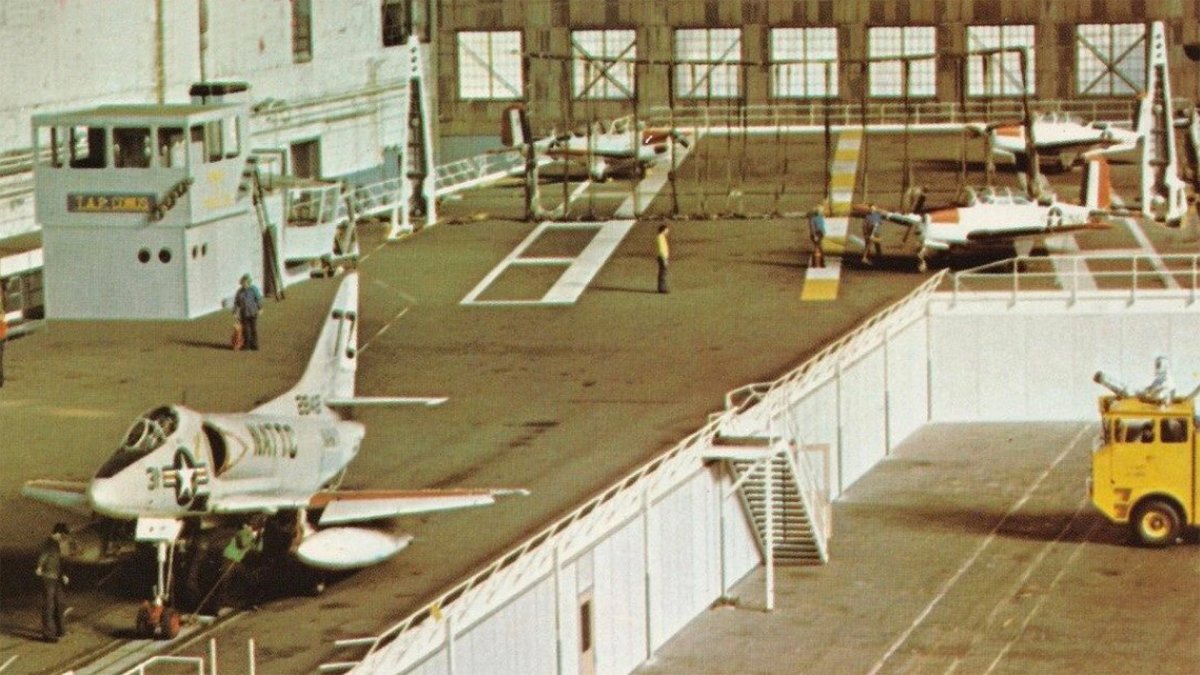
CALASSES is 390 feet long, with the flight-deck sitting elevated above the hangar’s floor. Underneath it are the same launch and recovery systems found on American supercarriers, including the guts of the ship’s arresting gear and catapults. Up top features everything you would find on a carrier’s deck, including an island control tower, emergency barrier rigging, arresting cables, catapult tracks, Fresnel lens “meatball” visual landing aid, and so on—all the things that are needed to train Boatswain Mates before they head out to real McCoy. CALASSES is a far more forgiving and anemic environment for trainees to learn and make mistakes compared to an actual aircraft carrier deck which is one of the most dangerous places to work in the entire world.
CALASSES seen in 1985 with aircraft on its deck., USN
It’s not exactly clear when the practice ended, but for decades CALASSES operated with real airframes on its deck, along with the tractors and other equipment used to facilitate their movement and operation. The practice continued at least through the 1980s, but today no airframes are scurried around its flattop.
Navy Lakehurst Historical Society
The funny thing is that even such a massive installation looks small in Hangar 1, with the replica carrier situated in one of the hangar’s four corners. By some accounts, CALASSES came to be at least partially as an attempt to keep the Navy from demolishing the historic structure. The idea being if the Navy’s biggest training aid—a truly one of a kind and unmovable apparatus—was built inside of it, the hangar would probably survive as long as the training aid does. Regardless if this was actually part of CALASSES’s genesis or not, both it and the historic hangar it rests under exist in good condition today.
With nearly a century of aviation history under its belt, Naval Air Engineering Station Lakehurst is truly a fascinating and supposedly even haunted place . The work done there over the years and today is so unique that there are seemingly unlimited stories wrapped in stories to tell. But Hangar 1 is truly the grand historical prize of the installation, and it’s only fitting that its massive facade cocoons another peculiar and massive piece of naval aviation history inside of it.
A big thank you to NAES Lakehurst public affairs and the Navy Lakehurst Historical Society for their help with this article.
Contact the author: Tyler@thedrive.com
Comments couldn’t be loaded. Please refresh the page.
更新于美国东部时间2018年1月18日上午11:01。
美国海军与新泽西州莱克赫斯特的渊源可以追溯到大约一个世纪前。如今,这片占地7400英亩的庞大基地遍布着各种测试设施,用于研发最新的海军航空基础设施。其中最引人注目的是,这里是美国海军完善其航空母舰弹射器和阻拦装置技术的中心。但近百年前,莱克赫斯特是美国轻于空气运输的中心。支撑着这座基地及其当时高科技任务的是规模庞大的1号机库,这座建筑曾是“兴登堡”号飞艇的停泊地,并在那艘著名的飞艇发生灾难性事故时,静静地矗立在一片草地上。后来,1号机库成为了一架鲜为人知的美国海军平底船复制品“卡拉塞斯”号的所在地——时至今日,它仍然是海军最大的训练设施。
今天,位于莱克赫斯特的美国海军航空站(NAES Lakehurst)1号机库依然巍然耸立在庞大的设施之上。
20世纪20年代堪称飞艇的时代,海军希望进一步利用这项新兴技术执行海岸巡逻和海上侦察任务,尤其侧重于反潜作战。到1921年,海军已将莱克赫斯特设立为轻于空气技术的总部,该地最终也将成为相关国际商业运输的枢纽。人们对巨型飞艇寄予厚望,认为它们能够为平民和军方“缩小地球”,并为战争策划者提供一种前所未有的远程空中支援新模式。
1号机库建于1921年海军航空站成立之时。这座钢、木、石棉混凝土结构的机库长961英尺,宽350英尺,屋顶高达200英尺,旨在容纳最大的飞艇,附近还设有氦气处理和输送系统,为这些庞大的“租户”提供服务。此外,该机库在建造时也考虑到了氢气飞艇的安全存放。其地板采用防爆设计,电气系统和照明设备也经过防爆处理,并进行了其他特殊防护。如有需要,易挥发的氢气则通过铁路罐车运输。
1号机库的四扇平衡门,每扇重达270万磅。机库内设有轨道系统,并延伸至更远处的圆形系泊站,大大简化了停泊在该机库的巨型飞艇(即使只是暂时停泊)的搬运工作。
谢南多厄号在1号机库内建造并推出。美国海军历史中心
这座机库曾停泊过当时许多最著名的飞艇,包括美国第一艘自主建造的硬式飞艇“谢南多厄”号。海军庞大的“梅肯”号和“阿克伦”号飞艇也曾以这里为母港。事实上,海军规模相对较小的硬式飞艇舰队中的每一艘都曾在某个时期驻扎过这座机库。
1929年8月7日,位于新泽西州莱克赫斯特海军航空站飞艇机库内的德国齐柏林伯爵号飞艇(LZ-127)(右图)停泊于此。机库内还有美国海军洛杉矶号巡洋舰(ZR-3),该舰原为德国制造的齐柏林飞艇LZ-126,是第一次世界大战的战争赔偿。(美国海军历史中心)
20世纪20年代,随着飞艇测试的持续进行,飞艇商业旅行的概念也逐渐兴起。莱克赫斯特成为了这些航班的国际门户。1929年,格拉夫·齐柏林号飞艇在环球飞行途中曾在莱克赫斯特停留。此后,其他飞艇也陆续到访,直至20世纪30年代,其中包括纳粹德国的兴登堡号飞艇。兴登堡号停靠在1号机库内时,前后净空仅有18英寸。
1936年5月9日清晨,美国海岸警卫队的道格拉斯RD-4“斯皮卡”号(序列号V125)护送德国齐柏林飞艇LZ 129“兴登堡”号从德国腓特烈港首飞后抵达美国新泽西州莱克赫斯特。照片背景中可见已退役的美国海军飞艇“洛杉矶”号(ZR-3)。
兴登堡号飞艇停在1号机库内,空间已十分有限。(图片来源:Planet News Archive/SSPL/Getty Images)
海军使用这些巨型飞机的成功率远非一流,在近十五年的服役期间,几乎所有飞艇都坠毁了。1937年,装满氢气的“兴登堡”号飞艇在1号机库附近被火焰吞噬,也带走了飞艇大规模商业航空旅行的梦想。
那时海军的飞艇计划基本已经终止,但二战期间飞艇项目出现了某种程度的复兴,尽管这些飞艇是较小的反潜作战飞艇,而非过去那种庞大的硬式飞艇。即便如此,在二战高峰时期,海军仍有约130艘此类飞艇服役,使得莱克赫斯特海军航空站异常繁忙。
二战期间拥挤的1号机库,美国海军/公共领域
喷气机时代伊始,莱克赫斯特基地从一个轻于空气飞行器的主基地转型为一个用途广泛的基地,测试和训练成为其主要任务。这其中包括建立海军航空试验设施(NATF),该设施用于评估航空母舰的起降系统和其他海军航空支援能力。时至今日,该基地仍然主要执行着这项备受瞩目的任务。
1951年,海军航空技术训练中心(NATTC,现更名为海军航空技术训练中心CNATT)也在莱克赫斯特成立。该机构后来培训了数千名水手长、海军警卫、海军陆战队机场技术员、机组人员生存装备员和航空测量员。20世纪60年代,为了辅助NATTC的训练任务,一种非常独特的训练辅助设备被研发并建造出来——一个按三分之一比例缩小的航空母舰甲板模型。
莱克赫斯特海军航空站尤其适合容纳这样一台巨型训练设备,因为它拥有当时世界上最大的机库之一——1号机库,可以为其遮风挡雨。到1962年,海军已经没有轻于空气的飞行器需要1号机库了。换句话说,莱克赫斯特海军航空站的内部空间完全足够容纳这样一台庞大而独特的装置。它的名字——舰载飞机发射与支援系统/设备模拟器,简称“CALASSES”——恰如其分地描述了它的任务和规模。
“卡拉塞斯”号训练舰长390英尺,飞行甲板位于机库地面之上。其下方是与美国超级航母相同的起降系统,包括舰艇阻拦装置和弹射器的核心部件。舰上配备了航母甲板上的所有设施,包括舰岛控制塔、应急屏障索具、阻拦索、弹射器轨道、菲涅尔透镜“肉丸”式目视着陆辅助装置等等——所有这些都是水手长在正式上舰前进行训练所必需的。与真正的航母甲板(世界上最危险的工作场所之一)相比,“卡拉塞斯”号为受训人员提供了一个更加宽容和相对宽松的学习环境,让他们可以自由地学习和犯错。
1985年,卡拉塞斯号航母甲板上停放着飞机。(美国海军)
目前尚不清楚这种做法何时终止,但几十年来,卡拉塞斯航母的甲板上一直停放着真正的飞机机身,以及用于辅助飞机移动和操作的牵引车和其他设备。这种做法至少持续到20世纪80年代,但如今,甲板上已不再有飞机机身穿梭往来。
海军莱克赫斯特历史学会
有趣的是,即使是如此庞大的设施,在1号机库里也显得很小,因为复制的航母就位于机库的四个角落之一。据一些说法,CALASSES的建造至少部分是为了阻止海军拆除这座历史建筑。他们的想法是,如果将海军最大的训练设备——一个真正独一无二且不可移动的装置——建造在机库内部,那么机库很可能就能与这台训练设备一样长久保存下去。无论这是否真的是CALASSES建造的初衷,如今它和它所在的这座历史悠久的机库都保存完好。
拥有近一个世纪的航空历史,莱克赫斯特海军航空工程站的确是一个引人入胜,甚至据说闹鬼的地方。多年来,这里开展的工作以及如今的工作都独具特色,仿佛有无数的故事层层展开。但1号机库才是该设施真正的历史瑰宝,其宏伟的外立面内包裹着另一段奇特而重要的海军航空历史,可谓恰如其分。
非常感谢 NAES Lakehurst 公共事务部和海军 Lakehurst 历史学会对本文的帮助。
联系作者:Tyler@thedrive.com
评论加载失败,请刷新页面。