Pakistan test-fires Ababeel nuclear missile巴基斯坦试射阿巴比尔核导弹
Pakistan last tested the weapon on Jan. 24, 2017.
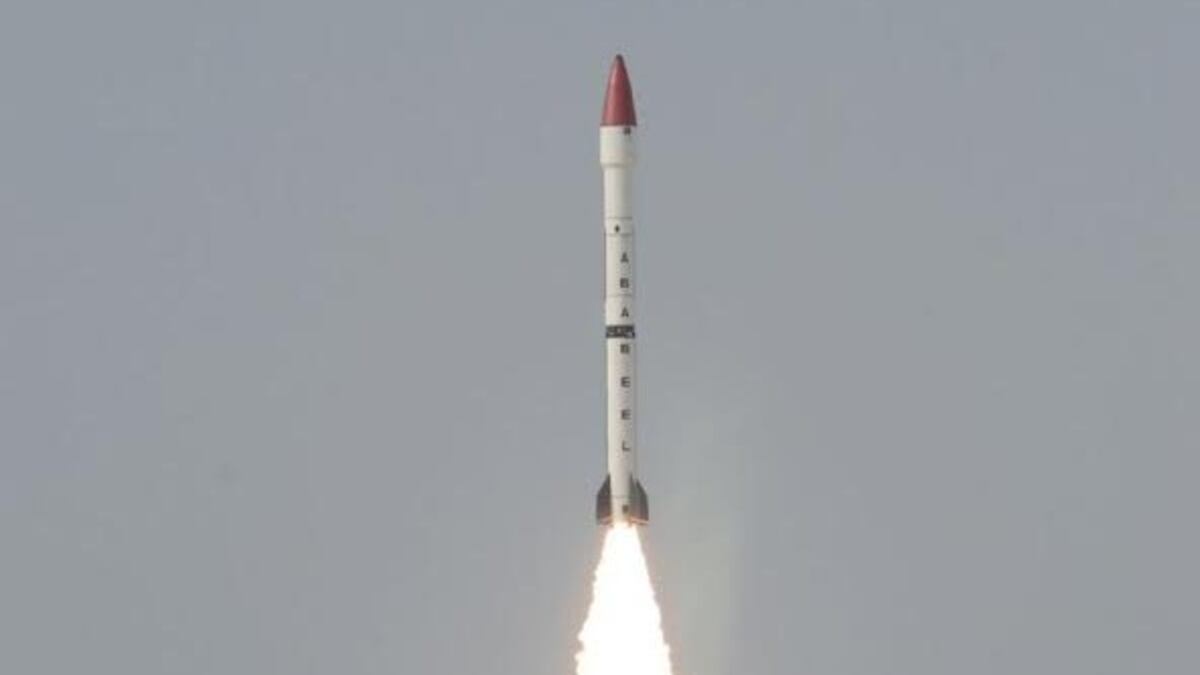
ISLAMABAD — Pakistan has test-fired an Ababeel missile capable of carrying multiple warheads that can attack different targets.
Pakistan last tested the multiple independently targetable reentry vehicles-capable weapon on Jan. 24, 2017.
The military’s media branch, Inter Services Public Relations Pakistan, stated Wednesday’s test was meant to revalidate “various design, technical parameters, and performance evaluation of different sub-systems” and was “aimed at strengthening deterrence and enhancing strategic stability in the region.”
The Strategic Plans Division, which handles Pakistan’s nuclear deterrent, did not respond to Defense News’ request for information about the latest test.
In 2017, the public relations organization stated the Ababeel had a 2,200-kilometer (1,367-mile) range and was developed to ensure the “survivability of Pakistan’s ballistic missiles” in a region in which state actors are bolstering countermeasures .
An expert on Pakistan’s nuclear program, Mansoor Ahmed, said the long time between tests was likely due to efforts to improve “technical and performance parameters.”
Ahmed, now in academia at the Australian National University, told Defense News that the Ababeel missile is the “most important engineering milestone for Pakistan’s nuclear triad in almost two decades and a major breakthrough in improving the survivability of land-based strategic forces against a preemptive Indian counterforce strike.”
Former Pakistan Army officer Naeem Salik, who served with the Strategic Plans Division and is now executive director at the Islamabad-based Strategic Vision Institute think tank, said the Ababeel “enhances Pakistan’s targeting choices.”
“Ababeel gives the advantage of engaging several targets at a time, with each delivery vector providing a cost-effective solution while complicating the job of India’s [ballistic missile defense],” he told Defense News. “In this context, it also fits well into [full-spectrum deterrence] by affording the ability to hit from amongst a wide variety of targets.”
Atia Ali Kazmi, a research director at the Islamabad-based Center for International Strategic Studies think tank, said the nuclear imbalance between India and Pakistan is pronounced, citing the expansion and technological leaps in India’s missile programs over the last two decades .
It’s the Ababeel, she told Defense News, that maintains deterrence vis-à-vis India.
Usman Ansari is the Pakistan correspondent for Defense News.
伊斯兰堡——巴基斯坦试射了一枚阿巴比尔导弹,该导弹能够携带多个弹头,攻击不同的目标。
巴基斯坦上一次测试多枚独立目标重返大气层载具武器是在 2017 年 1 月 24 日。
巴基斯坦军方媒体部门“三军公共关系部”周三表示,此次测试旨在重新验证“不同子系统的各种设计、技术参数和性能评估”,并且“旨在加强威慑并增强该地区的战略稳定性”。
负责巴基斯坦核威慑的战略计划司没有回应《防务新闻》关于最新试验的信息请求。
2017 年,该公关机构表示,阿巴比尔导弹射程为 2200 公里(1367 英里),其研发目的是为了确保巴基斯坦弹道导弹在国家行为体正在加强反制措施的地区“生存能力”。
巴基斯坦核计划专家曼苏尔·艾哈迈德表示,两次核试验之间间隔时间较长,可能是因为巴基斯坦一直在努力改进“技术和性能参数”。
艾哈迈德目前在澳大利亚国立大学任教,他告诉《防务新闻》,阿巴比尔导弹是“近二十年来巴基斯坦核三位一体最重要的工程里程碑,也是提高陆基战略部队在面对印度先发制人的反击时的生存能力方面的一项重大突破”。
曾在巴基斯坦陆军战略计划部门任职、现任伊斯兰堡战略愿景研究所执行主任的前巴基斯坦陆军军官纳伊姆·萨利克表示,阿巴比尔“增强了巴基斯坦的打击目标选择”。
“阿巴比尔导弹的优势在于能够同时打击多个目标,每个投送载体都能提供经济高效的解决方案,同时增加印度弹道导弹防御系统的难度,”他告诉《防务新闻》。“从这个角度来看,它也能很好地融入全方位威慑体系,因为它能够打击多种类型的目标。”
伊斯兰堡国际战略研究中心智库的研究主任阿提亚·阿里·卡兹米表示,印度和巴基斯坦之间的核不平衡十分明显,他指出,过去二十年来,印度的导弹计划得到了扩展,技术也取得了飞跃式发展。
她告诉《防务新闻》,正是阿巴比尔对印度保持了威慑力。
乌斯曼·安萨里是《防务新闻》驻巴基斯坦记者。