Closing the Navy’s find, fix, and finish kill chain with remote mine hunting利用遥控扫雷技术完成海军的“发现、定位和歼灭”杀伤链
Remote mine hunting combines AI, advanced sonar and unmanned vessels to help navies detect, classify and neutralize naval mines faster and from greater stand-off distances.
新闻视频
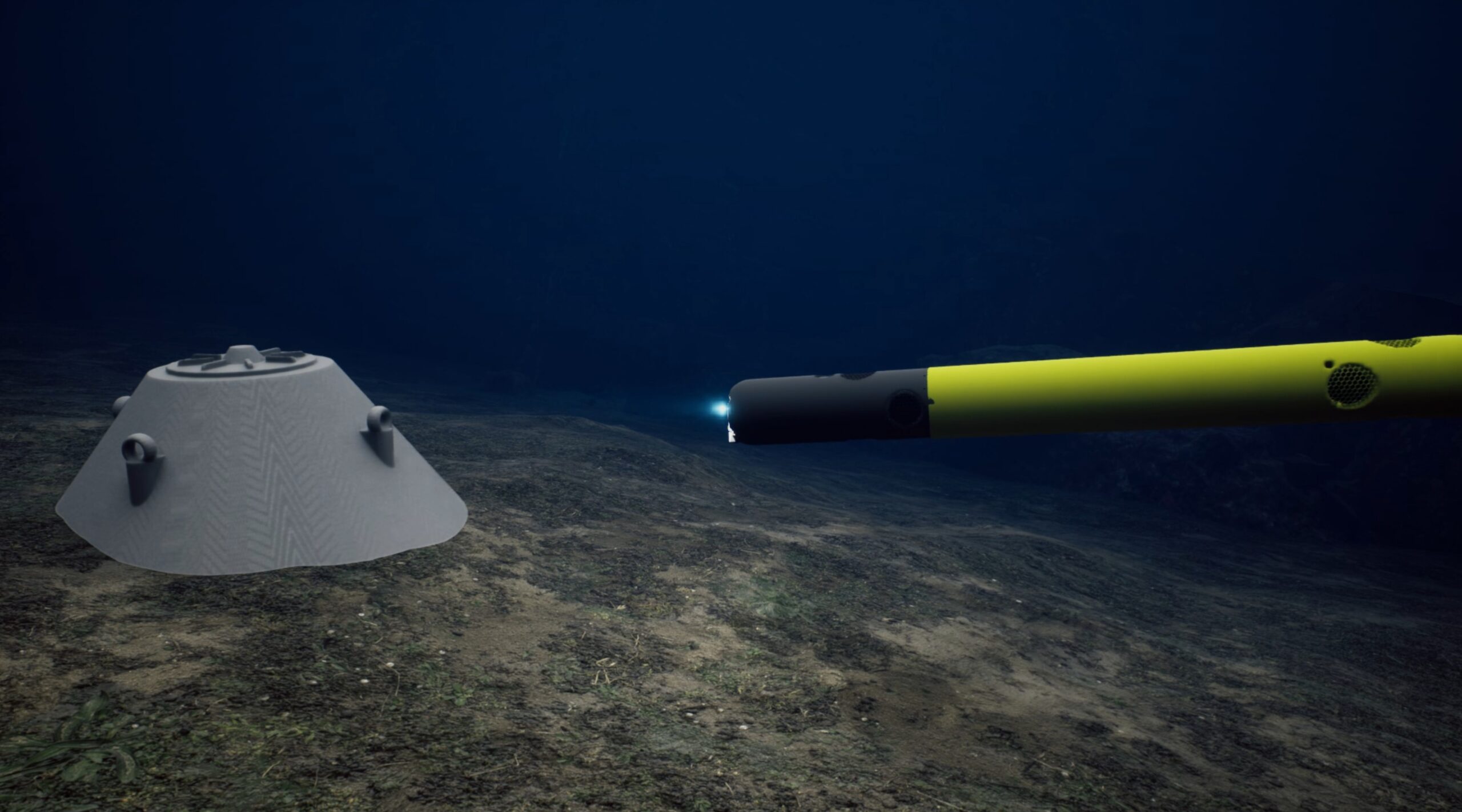
The ANGLER mine neutralization system can not only neutralize mines, but observe and document the aftermath. (Photo courtesy of Advanced Acoustic Concepts, a Thales company.)
Naval mines remain one of the cheapest ways for an adversary to disrupt global commerce, restrict military movement, and turn strategic waterways into global flash points. Clearing them can take weeks or months and expose sailors and ships to both the minefield and enemy fire.
To discuss how unmanned vessels, advanced sonar, artificial intelligence, and remote effectors will accelerate that mission, Breaking Defense spoke with Mark Bock, vice president for strategy and business development at Advanced Acoustic Concepts (AAC), a Thales company.
Breaking Defense: What is a modern naval mine, and why does it remain such a serious strategic threat?
Mark Bock, vice president for strategy and business development at Advanced Acoustic Concepts, a Thales company.
Bock: In the broad sense, mine threats come down to anti-access/area-denial (A2/AD) issues, either for economic or military reasons. Mines are extremely inexpensive and provide an asymmetric way of potentially denying a powerful nation’s ability to maintain free commerce or protect security.
The low-tech World War II-like mines are still effective in that and they’re easily rolled off of small boats. They’re cheap. A couple thousand dollars apiece, especially on the secondary market. And yet they’re indiscriminate and lethal.
Navies and commercial fleets also have to deal with more modern bottom mines, which get increasingly sophisticated and some can even be buried. In today’s contested maritime environments you have a whole host of different mines, but they’re all for the same reason, and that is to deny either specific or general access to sea lines of communication for either economic or military purpose.
How does the Navy conduct mine hunting and clearance today, and can it be dangerous?
When you have to find targets, you have to fix them, meaning locate them as a unique target, and classify them before you can dispose. We call this ‘find, fix and finish.’ Right now, navies worldwide – but the US Navy in particular – does this in three distinct steps. These steps take a long time to close the kill chain, which could be weeks or even months for complex regions.
The first thing is to ‘find’ what is beneath the surface. Asset location is literally ‘everything’ that’s on the bottom of the seabed. That could be anything from old refrigerators and anchors to perhaps a mine. There’s even terrain that looks like a man-made object. In the Navy, we call that a high-false-target environment.
The second phase, ‘fix,’ is to go back in and start looking at eliminating the objects that aren’t man-made, then eliminating the ones that are man-made but not mines, and then classifying the objects. This takes a long time and a lot of dedicated work. Oftentimes it means dwelling on each of those targets one by one. You can imagine how complex this process is in highly trafficked areas such as the Straits of Hormuz.
The in-column mines are less hard, although there are other things suspended from the bottom of the ocean. Floating mines can be found by airborne lasers. It’s what we call the ‘volume’ mines, the bottom mines, particularly, that are the hardest to get to and guarantee that you’ve got safe access.
The last step is to’finish’ and figure out which of those mines you want to dispose of. You have to go in and sit on that mine in the minefield today using disposal that is capable of blowing up the mine in place. That’s not only dangerous because you’re disposing of high explosives, it’s dangerous to whoever is there in the area.
The second piece is that when you’re overtly in a minefield, the enemy knows where you’ve cleared. You can argue that that’s playing out in the Straits of Hormuz right now. What a navy really wants to do is have access and options that the enemy is at least unaware of until you put traffic through them.
Latvian Navy Buyskes-class survey vessel LVNS Varonis (A 90), Polish Navy’s Gardno-class minesweeper, ORP Nakło (640), and Lithuanian Naval Force Hunt-class mine countermeasures vessel LNS Skalvis (M 53) steam across the Baltic Sea as part of Baltic Operations (BALTOPS) 2026, June 8, 2026. (U.S. Navy courtesy photo)
What does remote mine hunting consist of from the sensor point of view and boat point of view? Unmanned surface or underwater vessels?
The proposed RMH solution actually consists of both because it’s about the sensor you’re using in terms of that kill chain. The towed sensor can be integrated onto both manned and unmanned surface vessels, which is preferred, to provide remote stand off capability. The Towed Synthetic Aperture Sonar, or TSAM, technology that Thales uses is common to both.
From a remote ability perspective, it gets at these technology warfighting gaps we talked about earlier, and that is getting the man farther away from the minefield and maintaining a certain sense of covertness. The difference is that the real-time data that comes from the USV, the surface tow, can be immediately sent to either a man in the loop or to AI if you’re using it as a classification capability.
A mixture of both manned vessels and USVs does one more thing because it also allows navies to deliver capacity. Putting 15 or 20 towed vessels in the environment and another 30 or 40 unmanned vessels hunting for mines gives you a much higher clearance rate than a single manned mine-hunting ship that doesn’t give you a large search or classification rate.
You can throw a lot more unmanned vessels at a problem than you can manned vessels just from an economic perspective, but also just from a bulk and size perspective. For instance, the unmanned systems can be put on airplanes and flown into the region, which gives response time and capacity.
Tell us about your technology for the remote mine hunting mission, the SAMDIS sonar sensor.
The key issue is this huge false-target rate and multiple targets you detect on the bottom – figuring out which ones are man-made and then distilling those down into what are mines. An old refrigerator thrown onto the ocean bottom is not a mine, but it sometimes is roughly the same size.
The advanced synthetic aperture sonar (SAS) sensor we call SAMDIS is a multi‑aspect imaging sonar that illuminates targets from multiple angles in a single pass. That multi-aspect sensor allows for this low-false target, high-probability to detect and high-probability to classify the first time it goes by the target.
What that means is that when you go through the minefield, the first time you see a mine, you have options now to neutralize. We call it a real-time detect-to-engage kill chain.
The SAMDIS sensor is European-developed technology, and AAC here in North America is doing the integration work of the whole suite to make sure these components can function together and be integrated onto whatever the US platforms are. The UK is using a version of this technology today as part of their Towed Synthetic Aperture Sona.
What Thales AAC is doing is importing and adapting this advanced, highly mature technology into the US market as quickly as possible.
The advanced Thales synthetic aperture sonar (SAS) sensor called SAMDIS is a multi‑aspect imaging sonar that illuminates targets from multiple angles in a single pass. (Video courtesy of Thales.)
Your mine warfare neutralization system is called Angler – a submersible, reusable, micro-sized, remotely operated vehicle (ROV) with either a 66mm shaped charge or high-velocity 20mm underwater cargo projectiles. Tell us about this.
The way you neutralize a mine today is you cause it to blow up, whether using explosives or some other means. What you would see in the Straits of Hormuz, for instance, are geysers of water in the air within an exclusion area so that nobody gets hurt. Well, that’s not covert.
The Angler countermine ROV system does not necessarily cause sympathetic detonation. It will deliver an effect to the mine to neutralize it without the massive explosive reaction
Angler also has the capability after delivering the effects to observe the mine or seabed object and document the effects for the operators. In the tool bag of effectors, it’s the only solution today that has semi-covert attributes where the operators are a long ways away depending on the scenario from the location of the dastardly deed.
How do AI, command and control, and change detection bring the full system together?
We have a software application called Mi-Map, which is loaded with AI automatic target recognition software. Part of what allows the sensor to be so good is the physics of the multi-aspect. Because the multi-aspect gives you such a good view of the target, it’s easy to bring in AI to help finish the final work – that is, make measurements on the target and correlate them to known threat mines.
Information then feeds into our combat system called M-Cube. M-Cube is a target management system for all things underwater, including seabed targets. Data is fed into a common operating picture database that allows an operator to pick targets to service.
By having a clear picture of what’s in the water column, we can do what’s called change detection. As we tow back through again, the system using AI will find all the things that you knew were there already and haven’t changed in their classification or their location, and also find all the things that are new.
ANGLER地雷清除系统不仅可以清除地雷,还能观察并记录后续情况。(图片由泰雷兹旗下公司Advanced Acoustic Concepts提供。)
水雷仍然是敌方扰乱全球贸易、限制军事行动以及将战略水道变成全球冲突热点的最廉价手段之一。清除水雷可能需要数周甚至数月的时间,而且会使水兵和舰船同时暴露在雷区和敌方炮火之下。
为了探讨无人船、先进声呐、人工智能和远程效应器将如何加速这一任务,《防务新闻》采访了泰雷兹旗下公司先进声学概念公司 (AAC) 的战略和业务发展副总裁马克·博克。
突破防务:什么是现代水雷?为什么它仍然是一个严重的战略威胁?
Mark Bock,泰雷兹旗下公司 Advanced Acoustic Concepts 的战略与业务发展副总裁。
博克:从广义上讲,地雷威胁归根结底是反介入/区域拒止(A2/AD)问题,其原因可能是经济上的,也可能是军事上的。地雷成本极低,能够以非对称的方式削弱一个强国维持自由贸易或维护安全的能力。
这些类似二战时期的低技术水雷仍然有效,而且很容易从小型船只上投放。它们价格低廉,每枚只需几千美元,尤其是在二手市场上。然而,它们却不分青红皂白,而且致命。
海军和商船队还必须应对日益精密的现代化水雷,有些甚至可以埋设在海底。在当今竞争激烈的海域环境中,存在着种类繁多的水雷,但它们的目的都一样,那就是为了经济或军事目的,切断特定或一般海上交通线的通行。
海军目前如何进行扫雷和排雷作业?这项工作是否危险?
当你需要寻找目标时,必须先确定其位置,也就是将其识别为唯一目标,并在摧毁目标前对其进行分类。我们称之为“发现、定位和摧毁”。目前,世界各国海军——尤其是美国海军——都采用三个独立的步骤来完成这一过程。这些步骤需要很长时间才能完成杀伤链,在复杂地区可能需要数周甚至数月。
首先要做的就是“找到”水面下的东西。资产定位实际上就是海底的一切。这可能包括旧冰箱、锚,甚至水雷。有些地形看起来像是人造物体。在海军里,我们把这种情况称为高假目标环境。
第二阶段,即“修复”,是返回现场,首先清除非人为物体,然后清除人为但非地雷的物体,最后对所有物体进行分类。这需要很长时间和大量专注的工作。通常这意味着要逐一仔细检查每个目标。您可以想象,在像霍尔木兹海峡这样交通繁忙的区域,这个过程有多么复杂。
柱状水雷相对容易清除,尽管海底还有其他悬浮物。漂浮水雷可以用机载激光探测到。我们称之为“体积”水雷,特别是海底水雷,才是最难清除的,也最能保证安全。
最后一步是“完成”并确定要处置哪些地雷。今天你必须进入雷区,坐在那枚地雷上,使用能够就地引爆地雷的处置设备。这不仅因为处置的是高爆炸药而危险,而且对附近人员也十分危险。
第二点是,当你明目张胆地进入雷区时,敌人会知道你清除了哪些雷区。可以说,霍尔木兹海峡目前的情况正是如此。海军真正想要的是拥有敌人至少在通行之前都无法察觉的通道和选择。
2026年6月8日,拉脱维亚海军布伊斯克斯级勘测船LVNS Varonis号(A 90)、波兰海军加尔德诺级扫雷舰ORP Nakło号(640)和立陶宛海军亨特级扫雷舰LNS Skalvis号(M 53)在波罗的海航行,这是2026年波罗的海行动(BALTOPS 2026)的一部分。(美国海军供图)
从传感器和船艇的角度来看,远程扫雷包括哪些内容?是使用无人水面舰艇还是无人水下舰艇?
拟议的RMH解决方案实际上包含了这两种方案,因为关键在于杀伤链中使用的传感器。拖曳式传感器可以集成到有人和无人水面舰艇上,这是首选方案,因为它可以提供远程防区外打击能力。泰雷兹公司使用的拖曳式合成孔径声呐(TSAM)技术在这两种情况下都适用。
从远程作战能力的角度来看,它弥补了我们之前讨论过的技术作战缺口,即让作战人员远离雷区并保持一定的隐蔽性。不同之处在于,来自无人水面艇(USV)和水面拖曳装置的实时数据可以立即发送给作战人员,或者如果您将其用作机密信息收集工具,则可以发送给人工智能。
有人舰艇和无人水面艇(USV)的混合部署还有另一个优势,那就是能够提升海军的作战能力。部署15到20艘拖曳式扫雷艇,再加上30到40艘无人水面艇进行扫雷,其扫雷效率远高于单艘有人扫雷艇,后者搜索和分类能力有限。
从经济角度来看,以及从数量和规模角度来看,你可以投入比有人驾驶船只多得多的无人船来应对问题。例如,可以将无人系统装载到飞机上,飞抵事发区域,从而提高响应速度和行动能力。
请介绍一下你们用于远程扫雷任务的技术——SAMDIS声呐传感器。
关键问题在于极高的误报率和海底探测到的多个目标——如何分辨哪些是人造目标,然后再从中筛选出真正的地雷。被扔到海底的旧冰箱虽然不是地雷,但有时体积却与地雷相仿。
我们称之为SAMDIS的先进合成孔径声呐(SAS)传感器是一种多角度成像声呐,它能够在一次扫描中从多个角度照射目标。这种多角度传感器使得它能够在首次经过目标时就实现低误报率、高概率的探测率和高概率的分类率。
这意味着,当你穿越雷区时,第一次发现地雷时,你现在有多种方法可以将其排除。我们称之为实时探测并拦截的杀伤链。
SAMDIS传感器是欧洲开发的技术,北美AAC公司负责整套系统的集成工作,以确保这些组件能够协同工作并集成到美国的各种平台上。英国目前在其拖曳式合成孔径声呐系统中也使用了这项技术的某个版本。
泰雷兹AAC公司正在做的,就是尽快将这项先进、高度成熟的技术引进美国市场并进行改造。
泰雷兹公司先进的合成孔径声呐(SAS)传感器SAMDIS是一种多角度成像声呐,可在一次扫描中从多个角度照射目标。(视频由泰雷兹公司提供。)
你们的水雷清除系统名为“垂钓者”(Angler)——它是一种可潜水、可重复使用的微型遥控潜水器(ROV),配备有66毫米聚能装药弹或20毫米高速水下弹药弹。请介绍一下这个系统。
如今排除地雷的方法是引爆它,无论是使用炸药还是其他手段。例如,在霍尔木兹海峡,你会看到在隔离区内喷出水柱,这样就不会有人受伤。嗯,这可不是什么秘密措施。
Angler反地雷ROV系统不一定会引发同向爆炸。它会对地雷施加某种作用,使其失效,而不会产生大规模爆炸反应。
Angler 还具备在投放效果后观察水雷或海底目标并记录效果的能力,供操作人员参考。在众多效果器中,它是目前唯一一款具备半隐蔽性的解决方案,操作人员可以根据具体情况,在距离恶意行为发生地点较远的地方进行操作。
人工智能、指挥控制和变化检测如何将整个系统整合在一起?
我们有一款名为Mi-Map的软件应用,它搭载了人工智能自动目标识别软件。该传感器性能如此卓越的部分原因在于其多角度成像的物理特性。由于多角度成像能够提供清晰的目标视图,因此很容易引入人工智能来完成最后的分析工作——即对目标进行测量并将其与已知的威胁地雷进行关联。
信息随后被输入到我们的作战系统M-Cube中。M-Cube是一个水下目标管理系统,包括海底目标。数据被输入到一个通用的作战图数据库中,操作员可以通过该数据库选择需要维护的目标。
通过清晰了解水体中的物质构成,我们可以进行所谓的变化检测。当我们再次拖曳探测时,利用人工智能的系统会找出所有已知存在且分类或位置未发生变化的物质,同时也会找出所有新出现的物质。