Chinooks Over Afghanistan: The Unsung Workhorse Of America’s Never Ending War奇努克直升机飞越阿富汗:美国永无止境战争中默默无闻的主力军
Big and fast, the helicopters have moved troops, heavy weapons, and cargo to the country's most remote areas.
新闻视频
By Ed Darack and Joseph Trevithick
Updated Jun 29, 2019 11:37 PM EDT
The CH-47 Chinook is not a particularly sleek or sexy looking helicopter and it’s been a ubiquitous feature of most American military operations since the Vietnam War. Its age and shape give the overall appearance of a slow and lumbering aircraft. Ed Darack, a writer and photographer who has embedded with American troops in both Iraq and Afghanistan, and is the author of the new book The Final Mission of Extortion 17 , says that reputation is entirely undeserved and that the type has been the unsung workhorse of the war in Afghanistan in particular.
Not only is the Chinook still an extremely capable design after decades of service, it is actually the fastest helicopter in U.S. military service at present, owing in no small part to its uncommon tandem rotor configuration. Darack has been kind enough to share his own experiences with the CH-47, as well as those of the aviators, crew members, maintenance crews, and other personnel who have flown, rode in, or otherwise seen the “Hooks” in combat. The pictures he took and video he obtained offer even more insight into how valuable the helicopter has been to Americans warfighters.
My introduction to the Chinook
“Remember to put your head down when they start shooting at you!” a grinning Sergeant First Class Rick Scavetta said in late September 2005. Rick, the media chief for Combined Joint Task Force 76 (CJTF-76), had just dropped me off on the southern end of Afghanistan’s Bagram Airfield for the start of my first-ever combat embed. I lifted my photography gear and backpack out of his pickup truck and hiked across the concrete apron toward my journey’s next ride, a CH-47D Chinook helicopter. “Have a nice flight!” Rick yelled over the THWACK-THWACK-THWACK of spinning rotors and the screams of two turboshaft engines of the “bird” that idled just one hundred feet from his truck.
A CH-47D Chinook makes a landing approach at a small airfield in Jalalabad, Afghanistan., Courtesy Ed Darack
I momentarily lost my breath walking through the hot, pungent exhaust plume roiling out of the right-side engine before shuffling up the helicopter’s loading ramp. Dropping my gear at the aft end of the Chinook, call sign “Big Windy 21,” I sat down on the webbed bench seat as the aircraft’s flight engineer raised the ramp a couple feet off the ground with a stiff push of a handle. With word that I was seated, the pilot on the controls “pulled thrust” and the helicopter mildly vibrated side-to-side for a second and then a smiling Rick and his pickup grew small as the helicopter smoothly lifted into the sky.
Ed shared the video below, showing CH-47Ds from Extortion Company taking off for a mission as seen through night vision goggles.
Ker-chunk! The flight engineer armed the M240 7.62mm machine gun on the ramp as the Chinook nosed down and accelerated toward the southeast. The two other crew members on board armed their M240s as well, one on each side behind the cockpit bulkhead. As we passed over the perimeter of the base, two U.S. Army AH-64 Apache gunship helicopters joined our single-Chinook flight as escorts. The Apaches carved broad S-shaped patterns in the sky above and behind us, the pilots of each constantly scanning for threats and ready to unleash rockets or high explosive 30mm rounds on any attackers below.
The author., Courtesy Ed Darack
Flying just a few hundred feet above ground level at around 190 miles per hour, the orderly mosaic of Bagram’s paved roads, stacks of shipping containers, and lines of aircraft shrank into the hazy distance. With the large base to our rear, I took in views far more representative of the character of landscapes throughout Afghanistan: raw to the brink of feral.
We sped above sweeps of bare, wind-scoured desert, past swaths of labyrinthine badlands, and over knife-edged ridges and vertical rock walls. While we flew over a few tiny mud hut villages and some roughhewn agricultural patchworks during the 45 minute journey, I picked out only a few roads. They were all dirt, and most of these were just tracks barely scratched into the landscape. They looked passable only by dirt bikes, donkeys, or human footsteps—certainly not by any standard military vehicle.
A flight engineer mans an M240 machine gun on the ramp of a CH-47D Chinook flying over Afghanistan., Courtesy Ed Darack
A workhorse in Afghanistan
The helicopter, I quickly understood during that first flight in Afghanistan, wasn’t a luxury for the war, but an absolute necessity. I would further learn in the subsequent days and weeks that the type of helicopter in which I rode, the Chinook, had repeatedly proven itself to be the premier aviation logistical workhorse for the war effort.
I would also learn of the importance and roles played by people of the Chinook world—the pilots, maintainers, and crew members—who hailed from the active Army, the Army Reserve, and the Army National Guard. Soldiers from all three worked side-by-side, day and night, on the ground and in the skies of Afghanistan, continuing the legacy of the storied aircraft in what has been perhaps the most difficult, most austere operating environment the modern U.S. military has faced.
That first flight took me to Jalalabad Provincial Reconstruction Team base, or “J-Bad PRT,” a small outpost on the edge of the eastern Afghan city of Jalalabad. After shuffling out of the helicopter onto the base’s gravel landing zone, I spotted a UH-60 Black Hawk approaching from the east.
A UH-60 Black Hawk flies behind a CH-47 Chinook during a training exercise in Colorado., US Army
The Black Hawk’s passage above the airstrip highlighted, through contrast, the key distinguishing characteristic of the CH-47: its rotor configuration. The Black Hawk is a “tail rotor” helicopter, relying on a tail rotor to counteract the torque effect of the main rotor system—and through “anti-torque” foot pedal control inputs, yaw the aircraft clockwise and counterclockwise. By far the most common form of rotary-wing aircraft throughout the world, the tail-rotor helicopter suffers a fundamental disadvantage: that tail rotor draws upwards of 15 percent of available power that would otherwise be used for thrust simply to keep the helicopter from spinning wildly out of control.
The Chinook, on the other hand, uses a torque-cancelling configuration of two counter-rotating rotor systems, one three-bladed assembly at the front of the helicopter’s fuselage, and one at the rear. With this design, virtually 100% of available horsepower its two turboshaft engines produce is applied to thrust—a small amount is lost due to internal friction of the gears in the combiner box and transmissions.
All of this thrust allows the Chinook to carry upwards of 50 troops and their gear in its spacious fuselage. The helicopter can also haul tens of thousands of pounds of cargo, loaded internally or slung beneath it. The ability for CH-47s to externally sling heavy military implements like howitzers quickly became so renowned that it inspired an enduring nickname for those in the Chinook world: “Hookers,” for the hooks found on the underside of the aircraft’s fuselage to which the slings attach.
The Chinook also ranks as the fastest helicopter in the Department of Defense, contrary to an unfortunate stereotype frequently repeated in media reports characterizing it as “huge and slow.” All three primary iterations of the U.S. Military’s largest helicopter, the CH-53D, E, and now K , dwarf the Chinook in size, but not speed.
I watched and photographed all types of helicopters land, refuel, and then re-launch from the small airfield at the J-Bad PRT during my half-day stay at the base. Chinooks arrived and re-launched more than any other type of helicopter, an indicator of its broad utility and high demand in the war effort.
During Operation Enduring Freedom, CH-47s transported troops of all nations involved in the war and hauled all types of cargo, from mail, to spare rotor blades, to engines for other helicopters, and sometimes entire helicopters slung beneath the Chinook by cables. CH-47s participated in all types of combat operations of all sizes, both conventional and special operations, all throughout Afghanistan, from the beginning of the operation to its final days.
A CH-47D Chinook makes a dusty approach to a landing at the Marine Corps Mountain Warfare Training Center, near Bridgeport, California., Courtesy Ed Darack
The CH-47’s storied history
Today, Chinooks continue to support combat operations in Afghanistan, furthering a long legacy that began decades ago. The CH-47 evolved out of a lineage of tandem rotor helicopters first pioneered in the 1940s by an inventor named Frank Piasecki, through his firm, Piasecki Helicopter. The company changed hands, becoming known as Boeing-Vertol in 1960 before ending up as part of the consolidated Boeing Defense, Space & Security division today.
Over the years, these firms produced a number of high performance helicopters, such as the HRP Rescuer and the H-21 Shawnee, the latter setting a number of altitude and speed records for helicopters at the time. In 1960, the newly formed Boeing-Vertol released the tandem rotor CH-46 Sea Knight , relying on technology developed through Piasecki’s earlier models like the Shawnee.
The CH-46, the only tandem rotor helicopter other than the Chinook employed by the U.S. military in recent decades, would serve as one of the longest-used aircraft in military aviation history, spanning over a half century of operation. Similar in appearance to the larger, more powerful Chinook, untrained eyes often confuse the CH-46 with the CH-47. The Chinook, however, is a far more powerful helicopter. The last of the U.S. military Sea Knights, flown by the Marine Corps—who called them “Phrogs”—retired in 2015, replaced by the tilt-rotor V-22 Osprey .
In 1961, Boeing-Vertol introduced the world to the Chinook with the CH-47A, originally known by the Army-specific nomenclature of HC-1B. The aircraft would evolve through a number of improvements and iterations in the subsequent decades, but its basic configuration and physical dimensions endured.
An HC-1B Chinook., US Army
In conflicts throughout the world, notably the Vietnam War and later the Gulf War, the Chinook proved itself to be a legendary mainstay of U.S. combat prowess due to its speed, reliability, and cargo and troop carrying capacity. The Army even converted four into heavily armed “ACH-47” gunships for use in the Vietnam war.
The legendary 160th Special Operations Aviation Regiment, the “Night Stalkers,” created a number of modified versions throughout the decades. The 160th’s MH-47D, E, and G “ Special Operations Aircraft ,” or “SOA,” each have in-flight refueling capability, enhanced defensive weapons, expanded fuel capacity, specialized navigation and avionics systems, and a number of other additions for the Night Stalkers’ specialized nighttime operations.
Between 1982 and 1994, the U.S. Army converted all A, B, and C models of the Chinook to the D model, which had flown in Afghanistan from nearly day one of Operation Enduring Freedom. The 160th’s Chinooks, most all of which evolved from one of the conventional A through D model CH-47s, also flew in Afghanistan from the very start of the war.
Some of the 160th’s specialized MH-47s., US Army
In 2006, Boeing began production of the latest version of the Chinook, the F model. While some F models have re-used engines, rotors, and transmissions from D models, most of them are completely brand new. By contrast, all D models were upgrades from earlier versions. First test flown in 2001, the CH-47F began arriving in Afghanistan in November and December of 2008, with “Varsity,” B Company, 7th Battalion, 101st Aviation Regiment, which is part of the 159th Combat Aviation Brigade, a unit of the storied 101st Airborne Division.
These weren’t the first F model CH-47s to deploy to combat, however. That distinction went to CH-47Fs from the 4th Infantry Division, who took them to Iraq a few months prior to the Afghan deployment. The F model, while incorporating a number of improvements over the “legacy” A through D models, nevertheless retained the overall character of the original CH-47. Only those with a keen eye for Chinook detail can distinguish the F model from versions. With the debut of the F model, the Chinook may very well be the first military helicopter to reach the century mark of operational use.
A CH-47D Chinook lands at a small landing zone at Firebase Blessing in Kunar Province., Courtesy Ed Darack
After my brief stay at the J-Bad PRT, I hauled my gear aboard another CH-47D, taking to the skies headed northeast, toward the restive Kunar Province, a hotbed of the war. The air crew first dropped supplies at a tiny Special Forces outpost on the Pakistan border and then unloaded me at Forward Operating Base Wright (FOB Wright), just outside of the city of Asadabad, the capital of the Kunar Province. That’s where the luxury of smooth, fast travel in the back of a Chinook ended, and my visceral appreciation for the CH-47 really began, courtesy of a ground convoy.
I squeezed into the back of a Humvee a few hours after nightfall with Marines bound for Camp Blessing, deep in the Pech River Valley near the small village of Nangalam. Cold rain poured on us during most of the five hour journey and the Humvee slammed through potholes and ruts, knocking us off the steel bench seats a few times every minute.
Despite the worsening condition of the road, the convoy accelerated when we passed by the opening of the Korangal Valley. We needed to move quickly as we’d entered “IED Alley,” where improvised explosive devices, buried under the dirt road and remotely detonated by insurgents and terrorists hiding in the Korangal, had destroyed a number of Humvees and other vehicles in the past months and years. These explosions had also killed and maimed American and Afghan military personnel, as well as Afghan civilians.
Marines in back of a Humvee returning from a combat operation near the village of Wanat, in Afghanistan’s Kunar Province., Courtesy Ed Darack
As the speed combined with the road conditions pounded us in the back, and as the thought of an IED detonating beneath our Humvee pounded in my head, I dreamed of the comfort, speed, and safety of the Chinook. Then a Marine in the back of the Humvee reminded me that deadly threats exist for CH-47s and other helicopters too. He pointed to the south, toward a mountain cloaked at that moment by darkness: Sawtalo Sar.
Just three months earlier, during Operation Red Wings, an insurgent fired a rocket propelled grenade at a 160th MH-47D helicopter, “Turbine 33,” as it prepared to deploy a fast rope for the insertion of a quick reaction force of Navy SEALs high on the mountain’s slopes. The explosive round slammed into the rear transmission of the helicopter, sending Turbine 33 crashing onto the steep slopes of the upper peak, killing all sixteen on board: eight Night Stalkers and eight Navy SEALs. At that point, it was the greatest single-incident loss of life of American life in the war in Afghanistan.
“Welcome to the edge of the empire,” Marine 1st Lieutenant Matt Bartels, the 25 year-old commander of Camp Blessing said when I arrived at three in the morning, drenched. Named after Jay Blessing, a Green Beret killed by an IED a couple years earlier, Camp Blessing held the distinction of being one of the most insular combat outposts in the War on Terror—and one of the most frequently attacked.
Just a couple days before my arrival, a mortar had landed near the base’s command post, killing 20 year-old Marine Lance Corporal Steven Valdez. Matt told me that I’d arrived just in time, as the Marines were planning a raid to locate the mortar used to kill Valdez, and to seek out those who used it to kill him.
Marines in the back of a Humvee on a narrow, winding, dirt road in eastern Afghanistan’s Kunar Province,, Courtesy Ed Darack
An airmobile raid with the Marines
The following morning started with a number of very loud bangs. The Marines pounded a ridge a few thousand feet above and a few miles to the northeast of the base with 120mm mortars borrowed from the Army. As dust and smoke rose from the ridge, two CH-47D Chinooks sped into view and then landed side-by-side just outside the base’s perimeter next to a corn field. As two AH-64 Apache gunships orbited overhead, a platoon of Marines, about 30 “Afghan Security Forces” personnel, and I loaded onto the two idling Chinooks with all our gear. The Chinooks additionally carried enough MREs—meals, ready to eat—and bottled water to sustain us for a week. The Afghans also brought some of their own food: bags of rice, fresh vegetables, two live goats, and some live chickens.
With our backpacks on the floor, M16s, AK-47s, rocket propelled grenade launchers, machine guns, grenades, and boxes of high explosives resting throughout the interior, the fully-loaded CH-47s lifted into the sky. As we passed the ridge that just minutes prior exploded under the mortar barrage, the pilots banked us hard toward it.
An AH-64 Apache gunship at an airfield in Jalalabad, Afghanistan., Courtesy Ed Darack
If there were any enemy on the ridge, and if they survived the mortar attack, the pilots wanted to give them as little chance to shoot us down as possible. The site of Turbine 33’s shoot down, just across the Pech Valley, was plainly in sight of the ridge, and as such, the memory of that recent tragedy. According to the Marines, this was the first combat insert by Chinooks in the area since the Red Wings MH-47 shoot down.
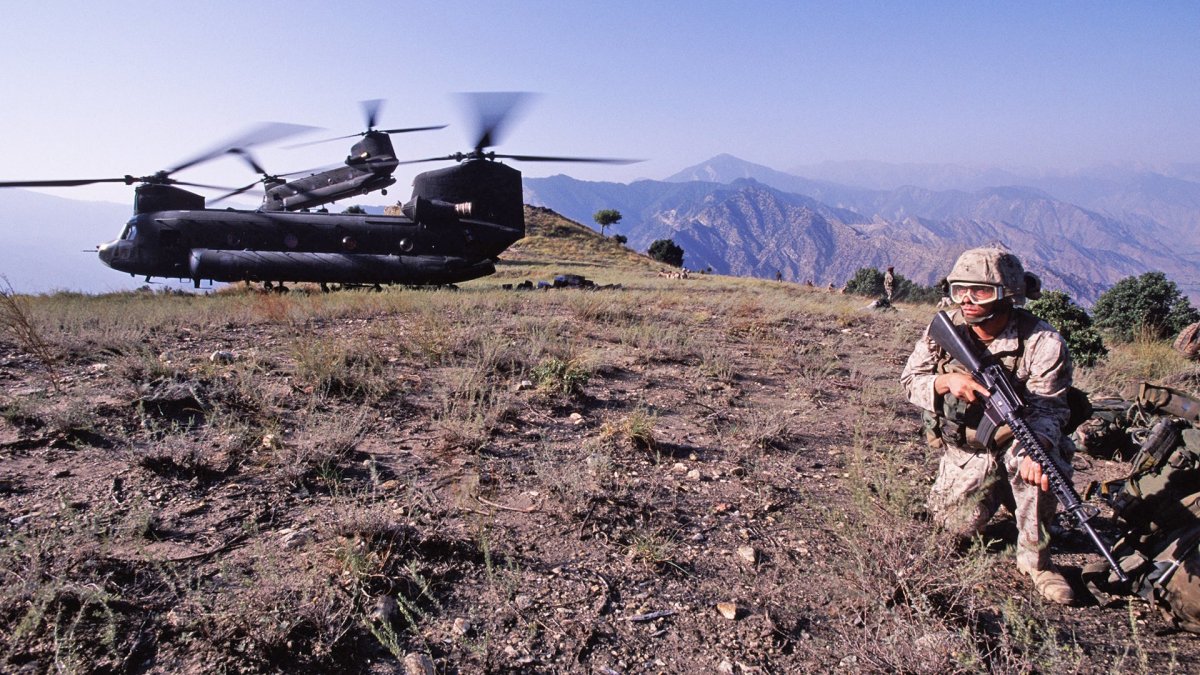
Just minutes after launching, the two Chinooks smoothly landed side-by-side on the grassy ridge. The Marines and Afghan fighters sped down the ramp and formed a ring of security around the two idling CH-47s as others offloaded the cargo and I ran around shooting photographs. The Marines had trained with Chinooks before, months earlier at the Marine Corps Mountain Warfare Training Center near Bridgeport, California, where I met their battalion prior to their deployment to Afghanistan. While there I watched them conduct training for the type of real world raid I experienced first hand, courtesy of CH-47D Chinooks from the Nevada Army National Guard.
A Marine machine gunner and Navy Hospital Corpsman man the perimeter while the two Chinooks unload., Courtesy Ed Darack
With all personnel and gear offloaded, and with an A-10 Thunderbolt II “Warthog” and the two Apache gunships flying high and low overhead, the Chinooks lifted off and disappeared down valley. Despite the heavy loads, the high altitude and difficult terrain of the location in the Hindu Kush Mountains, and the warm air of late summer, which degrades a helicopter’s performance similar to high altitude’s effect, the insertion proceeded flawlessly.
The insertion was a demonstration not only of the power and agility of the Chinook, but of the pilots, crew members, and maintainers of the aircraft. Shortly after the insertion, Lieutenant Bartels told me of another operation they had planned, this one in the Korangal Valley, just a mile from the shoot down location of Turbine 33, which we eyed from the ridge from which the Chinooks just departed. First, however, we needed to locate the mortar, and possibly those responsible for Steven Valdez’s death.
A Marine speaks into a radio and troops unload a CH-47D Chinook after a combat insertion in Kunar Province., Courtesy Ed Darack
Chinooks rush to help in Pakistan
While the Marines discovered the small cave where the mortar system was hidden—and promptly destroyed it with 75 pounds of C-4 high explosive, the helicopter raid into the Korangal Valley never happened. A few seconds after the Marines blasted the cave, we felt the ground shake slowly side-to-side. 150 miles away, near Muzaffarabad, Pakistan, a 7.6 magnitude quake had struck.
The “Kashmir Earthquake” had killed 100,000 people and left three million without homes. As a key component of America’s humanitarian assistance in response to the devastation, all available CH-47 Chinooks were dispatched to Pakistan. Chinooks proved so critical to combat operations in many of the most austere parts of Afghanistan that many missions simply could not be undertaken without them. No other helicopter can replicate its unique capabilities—not even close.
One of the CH-47 pilots who journeyed to Pakistan for the earthquake relief mission was a young Army reserve lieutenant named Justin “Buddy” Lee. Buddy, who may have piloted a Chinook carrying myself and the Marines with whom I was embedded into the Korangal had the earthquake not occurred, had just recently been “winged” at Fort Rucker in Alabama, where all Army aviators receive their flight training. The months-long humanitarian mission brought Buddy a tremendous amount of Chinook piloting experience, which he then continued to build in the final months of his deployment where he supported combat operations in southern Afghanistan, including many special operations missions.
Years later, Buddy would deploy to Afghanistan again, as a Captain, where he commanded “Extortion Company” out of Forward Operating Base Shank, south of Kabul in eastern Afghanistan. Almost a decade to the day after the earthquake that altered both our courses in each of our first journeys to Afghanistan, I met Buddy in person.
Out of the military and working as a newly minted attorney, Buddy provided me incredible insight into the untold story of Extortion Company and Extortion 17, the CH-47D Chinook helicopter downed in the Tangi Valley by a rocket propelled grenade round in the dark early morning hours of Aug. 6, 2011. The tragedy marked the greatest single incident loss of life in America’s war in Afghanistan, with 30 American and eight Afghan personnel, and one American military working dog killed. The incident also marked the greatest single incident loss of life in the history of SEAL Team Six, the Navy SEALs overall, and in the history of U.S. Special Operations Command.
One of two CH-47D Chinooks lifts off from a ridge in the Pech River Valley region while a US Navy Corpsman mans the perimeter. , Courtesy Ed Darack
Learning the story of Extortion 17
Through Buddy, and those to whom Buddy introduced me who were close to the people of Extortion 17 and the world of the Chinook, I was able to learn the full, in-depth story of Extortion 17 for my book on the topic. I learned about the machine itself, and its unique capabilities that allowed it to carry the Marines and myself onto that ridge above Camp Blessing and so many other operations in Afghanistan. I learned about the training that pilots undertake to fly such missions, including basic flight training, and then advanced mountain and high altitude training at a small facility in Colorado called HAATS, the High Altitude Army National Guard Aviation Training Site.
A CH-47D Chinook speeds through the Sierra Nevada Mountains at the Marine Corps Mountain Warfare Training Center, near Bridgeport, California., Courtesy Ed Darack
I learned about the camaraderie of those throughout the world of Army Aviation and the reverence that pilots, crew, and maintainers of Chinooks and other Army helicopters have for ground units like the Marines with whom I was embedded. I learned about the people of Extortion 17 themselves – about Bryan Nichols, a close personal friend of Buddy’s and one of the Extortion 17 pilots killed. In late June 2011, Buddy and Bryan piloted a CH-47D Chinook that was downed just a few miles from the location of the downing of Turbine 33—all survived.
I learned about Dave Carter, co-pilot of Extortion 17, with whom Buddy flew a mission the night before Extortion 17’s shoot down. I learned the stories of the helicopter’s crew: Spencer Duncan, Pat Hamburger, and Alex Bennett; all hailed from different backgrounds, but all were bound by their common love of the Chinook and dedication to national service, the Army, and Army Aviation. I also learned of the passengers on board Extortion that dark early morning, and the close relationship and deep trust that Extortion Company shared with the special operations personnel they flew night after night—members of SEAL Team Six, the 75th Ranger Regiment, and Air Force Special Operations personnel.
I learned of the details of the mission itself, and how the operation was developed. I learned the second-by-second details of the downing, and then the tragic aftermath experienced by those near and far to those lost. I also learned of the story how American forces identified, tracked, and then struck back at those responsible for the downing—an incredibly gripping, seldom-discussed, aspect of the Extortion 17 story.
Most importantly, I learned that far more than just a terrible tragedy noted in history, and far more than just a vital chapter in the enduring legacy of the Chinook and those who fly, crew, and maintain these incredible aircraft in the skies over Afghanistan and beyond, the Extortion 17 story opens a door of full-spectrum understanding of a world of human experience at its most extreme, war, like few stories ever have before.
One of the first CH-47F Chinooks to fly in Afghanistan at FOB Wright in May of 2009. , Courtesy Ed Darack
A big thanks to Ed for sharing some of his experiences and thoughts on the Chinook in Afghanistan with us. Make sure to pick up a copy of Ed Darack book The Final Mission Of Extortion 17: Special Ops, Helicopter Support, SEAL Team Six, and The Deadliest Day of the U.S. War in Afghanistan. Available now on Amazon.com.
Contact the author: joe@thedrive.com
Comments couldn’t be loaded. Please refresh the page.
作者:埃德·达拉克和约瑟夫·特雷维西克
更新于美国东部时间2019年6月29日晚上11:37
CH-47“支奴干”直升机外形并不时尚或吸引人,自越南战争以来,它一直是美军大多数军事行动中不可或缺的机型。它的机龄和外形给人一种缓慢笨重的印象。曾随美军在伊拉克和阿富汗作战的作家兼摄影师埃德·达拉克(Ed Darack)在其新书《勒索17号的最终任务》(The Final Mission of Extortion 17)中指出,这种印象完全是误解,尤其是在阿富汗战争中,CH-47“支奴干”一直是默默奉献的“主力军”。
奇努克直升机服役数十年后依然性能卓越,而且目前是美国军方速度最快的直升机,这很大程度上要归功于其独特的串列双旋翼设计。达拉克慷慨地分享了他自己驾驶CH-47的经历,以及其他飞行员、机组人员、维护人员和在战斗中驾驶、乘坐或以其他方式目睹过“奇努克”直升机的人员的经历。他拍摄的照片和视频更让我们深入了解了这款直升机对美国作战人员的价值。
我第一次接触奇努克直升机
“记住,他们开枪的时候一定要低下头!”2005年9月下旬,一级军士长里克·斯卡维塔咧嘴笑着说道。里克是第76联合特遣部队(CJTF-76)的媒体主管,他刚刚把我送到阿富汗巴格拉姆空军基地南端,开始我的第一次战地随军报道。我从他的皮卡车里拿出摄影器材和背包,穿过水泥停机坪,走向我的下一站——一架CH-47D“支奴干”直升机。“祝你飞行愉快!”里克对着旋翼旋转的“啪嗒啪嗒”声和两台涡轴发动机的尖啸声喊道,这架“鸟”就停在他卡车一百英尺外。
一架CH-47D“支奴干”直升机正在阿富汗贾拉拉巴德的一个小型机场进行着陆进近。(图片由Ed Darack提供)
我穿过右侧发动机喷出的滚烫刺鼻的尾气,一时喘不过气来,然后才挪动脚步走上直升机的装载坡道。我把装备放在这架呼号为“大风21号”的奇努克直升机的尾部,然后坐在网状座椅上。这时,飞机的飞行工程师用力一推把手,将坡道抬离地面几英尺。听到我坐好后,飞行员拉动油门,直升机轻微地左右摇晃了一秒钟,然后,面带微笑的里克和他的皮卡车渐渐消失在视野中,直升机平稳地升空了。
Ed 分享了以下视频,视频中通过夜视镜看到了 Extortion Company 的 CH-47D 直升机起飞执行任务的画面。
咔嚓!随着奇努克直升机机头向下俯冲,加速向东南方向飞去,飞行工程师在停机坪上为M240 7.62毫米机枪装填弹药。机上另外两名机组人员也分别装填了位于驾驶舱隔板后方两侧的M240机枪。当我们飞越基地外围时,两架美国陆军AH-64阿帕奇武装直升机加入我们这架奇努克直升机的护航编队。阿帕奇直升机在我们上方和后方的天空划出宽阔的S形图案,每架直升机的飞行员都时刻警惕着威胁,随时准备向下方任何来犯之敌发射火箭弹或30毫米高爆弹。
作者:艾德·达拉克
飞机以大约每小时190英里的速度,在离地仅几百英尺的高度飞行,巴格拉姆基地整齐排列的柏油路、堆积如山的集装箱和成排的飞机渐渐消失在朦胧的远方。庞大的基地在我们身后,我看到的景色更能代表阿富汗各地的地貌特征:原始而近乎野蛮。
我们飞驰在光秃秃、被风侵蚀的沙漠上空,掠过迷宫般的荒地,越过刀刃般的山脊和垂直的岩壁。在45分钟的航程中,我们飞越了几个泥屋村落和一些简陋的农田,但我只注意到几条路。它们都是土路,而且大多数只是在地面上勉强划出的车辙。看起来只有越野摩托车、驴子或人的脚才能通行——任何标准的军用车辆肯定都无法通过。
一名飞行工程师正在一架飞越阿富汗的CH-47D“支奴干”直升机的停机坪上操作一挺M240机枪。(图片由Ed Darack提供)
阿富汗的功臣
在阿富汗的第一次飞行中,我很快就明白,直升机对于战争而言并非奢侈品,而是绝对必需品。在接下来的几天和几周里,我进一步了解到,我乘坐的这种奇努克直升机,已经反复证明自己是战争中首屈一指的航空后勤保障主力。
我还了解到奇努克直升机世界——飞行员、维护人员和机组人员——的重要性及其所扮演的角色,他们来自现役陆军、陆军预备役和陆军国民警卫队。来自这三个部队的士兵日夜并肩作战,在阿富汗的地面和空中,延续着这款传奇飞机的辉煌,而阿富汗或许是现代美军所面临的最艰难、最艰苦的作战环境。
第一次飞行把我带到了贾拉拉巴德省重建队基地,简称“J-Bad PRT”,这是位于阿富汗东部城市贾拉拉巴德边缘的一个小型前哨站。我从直升机上下来,踏上基地的砾石着陆区后,发现一架UH-60黑鹰直升机正从东边飞来。
在科罗拉多州的一次训练演习中,一架UH-60“黑鹰”直升机跟在一架CH-47“支奴干”直升机后面飞行。(美国陆军)
黑鹰直升机飞越跑道上空,与主旋翼形成鲜明对比,凸显了CH-47的关键特征:其旋翼布局。黑鹰是一款“尾桨式”直升机,依靠尾桨来抵消主旋翼系统的扭矩效应——并通过“反扭矩”脚蹬控制,使飞机顺时针和逆时针偏航。作为迄今为止世界上最常见的旋翼飞机,尾桨式直升机存在一个根本性的缺陷:尾桨会消耗高达15%的可用动力,而这些动力原本可以用于产生推力,仅仅是为了防止直升机失控旋转。
另一方面,奇努克直升机采用了扭矩抵消式设计,由两套反向旋转的旋翼系统组成,一套是位于机身前部的三叶旋翼组件,另一套位于机身后部。这种设计使得其两台涡轴发动机产生的几乎100%的可用功率都用于产生推力——只有少量功率因组合箱和变速箱内部齿轮的摩擦而损失。
所有这些推力使得奇努克直升机宽敞的机身能够搭载多达50名士兵及其装备。该直升机还能运载数万磅的货物,这些货物可以装载在机身内部,也可以悬挂在机身下方。CH-47直升机能够悬挂榴弹炮等重型军用装备的能力很快就闻名遐迩,以至于奇努克直升机的用户们因此得了一个流传至今的绰号:“钩子”(Hookers),因为机身下方的钩子就是用来连接吊索的。
与媒体报道中经常出现的“体型庞大、速度缓慢”的刻板印象相反,奇努克直升机也是美国国防部速度最快的直升机。美国军方最大的直升机——CH-53D、E 和现在的 K——的三个主要型号,在体积上都远超奇努克,但在速度上却不逊色。
在J-Bad PRT基地停留的半天时间里,我观察并拍摄了各种类型的直升机在小型机场起降、加油和重新起飞的场景。其中,奇努克直升机的起降次数最多,这表明它在战争中用途广泛且需求量大。
在“持久自由行动”期间,CH-47直升机运送了所有参战国的部队,并运输了各种类型的货物,从邮件、备用旋翼叶片到其他直升机的发动机,有时甚至用缆绳将整架直升机悬挂在“支奴干”直升机下方。从行动开始到结束,CH-47直升机参与了阿富汗境内各种规模的常规作战和特种作战行动。
一架CH-47D“支奴干”直升机扬起尘土,在加利福尼亚州布里奇波特附近的美国海军陆战队山地作战训练中心降落。(图片由Ed Darack提供)
CH-47的传奇历史
如今,奇努克直升机仍在阿富汗继续支援作战行动,延续着数十年前开启的悠久历史。CH-47 源自串联旋翼直升机系列,该系列最早由弗兰克·皮亚塞基 (Frank Piasecki) 于 20 世纪 40 年代通过其皮亚塞基直升机公司 (Piasecki Helicopter) 开创。该公司几经易手,于 1960 年更名为波音-伏托尔 (Boeing-Vertol),最终成为如今波音防务、航天与安全集团的一部分。
多年来,这些公司生产了多款高性能直升机,例如HRP救援者(HRP Rescuer)和H-21肖尼(H-21 Shawnee),后者在当时创造了多项直升机飞行高度和速度纪录。1960年,新成立的波音-伏托尔公司推出了串列旋翼CH-46海骑士(Sea Knight),该机型采用了皮亚塞基早期机型(如肖尼)所开发的技术。
CH-46是近几十年来美军除奇努克(Chinook)之外唯一使用的串列双旋翼直升机,也是军用航空史上服役时间最长的飞机之一,服役时间超过半个世纪。由于外形与更大、动力更强的奇努克相似,不熟悉的人常常会将CH-46与CH-47混淆。然而,奇努克的动力要强大得多。美国海军陆战队(绰号“蛙人”)最后一批CH-46“海骑士”直升机于2015年退役,被倾转旋翼机V-22“鱼鹰”取代。
1961年,波音-伏托尔公司向世界推出了CH-47A“支奴干”直升机,该机最初以陆军专用名称HC-1B为人所知。在随后的几十年里,该机经历了多次改进和迭代,但其基本结构和物理尺寸始终保持不变。
一架HC-1B“支奴干”直升机,美国陆军
在世界各地的冲突中,尤其是在越南战争和后来的海湾战争中,奇努克直升机凭借其速度、可靠性和强大的载货及载兵能力,证明了自身是美国作战力量的传奇主力。陆军甚至将四架奇努克直升机改装成重型武装的“ACH-47”炮艇机,用于越南战争。
传奇的第160特种作战航空团,绰号“夜行者”,在几十年间制造了许多改进型直升机。第160团的MH-47D、E和G型“特种作战飞机”(SOA)均具备空中加油能力、增强型防御武器、更大的燃油容量、专用导航和航空电子系统,以及其他一些专为“夜行者”夜间作战而增加的设备。
1982年至1994年间,美国陆军将所有A、B、C型奇努克直升机改装为D型,而D型奇努克直升机几乎从“持久自由行动”伊始就已在阿富汗服役。第160奇努克直升机大队的奇努克直升机,几乎全部由传统的A至D型CH-47直升机改装而来,也从战争伊始就参与了阿富汗战争。
美国陆军第160特种部队的部分MH-47直升机
2006年,波音公司开始生产最新款的“支奴干”直升机——F型。虽然部分F型直升机沿用了D型的发动机、旋翼和变速箱,但大多数都是全新设计的。相比之下,所有D型直升机都是在早期型号的基础上升级而来。CH-47F于2001年首次试飞,并于2008年11月和12月开始交付阿富汗,首批交付部队是隶属于第101空降师第159战斗航空旅的第101航空团第7营B连,该连代号为“Varsity”。
然而,这些并非首批投入实战的CH-47 F型直升机。这一殊荣属于第四步兵师的CH-47F型,他们在阿富汗部署前几个月就已将其开赴伊拉克。F型虽然在“传统”A至D型的基础上进行了多项改进,但仍然保留了CH-47的整体特征。只有对“支奴干”细节极其敏锐的人才能将F型与其他型号区分开来。随着F型的问世,“支奴干”很可能成为首款服役年限突破百年的军用直升机。
一架CH-47D“支奴干”直升机降落在库纳尔省布莱辛基地的一个小型着陆区。(图片由Ed Darack提供)
在杰巴德省重建小组短暂逗留后,我把装备搬上另一架CH-47D直升机,向东北方向的库纳尔省进发,那里是战火纷飞的热点地区。机组人员先在巴基斯坦边境的一个小型特种部队哨所空投补给,然后把我送到库纳尔省首府阿萨达巴德市郊的赖特前线作战基地(FOB Wright)。从此,我告别了乘坐奇努克直升机舒适快捷的旅程,而地面车队的护送让我真正领略到了CH-47的威力。
天黑几个小时后,我和一些海军陆战队员挤进一辆悍马车的后座,前往位于佩奇河谷深处、靠近南加拉姆小村的布莱辛营地。在长达五个小时的旅程中,大部分时间都下着冷雨,悍马车颠簸着驶过坑洼和车辙,几乎每分钟都会把我们从钢制长椅上颠下来好几次。
尽管路况日益恶化,车队在驶过科兰加尔山谷入口时还是加快了速度。我们必须迅速行进,因为我们已经进入了“简易爆炸装置走廊”。这条走廊的土路下埋设着简易爆炸装置,藏匿在科兰加尔山谷的叛乱分子和恐怖分子通过遥控引爆这些装置,在过去的几个月甚至几年里,已经摧毁了多辆悍马军车和其他车辆。这些爆炸还造成美军和阿富汗军人以及阿富汗平民伤亡。
阿富汗库纳尔省瓦纳特村附近,海军陆战队员乘坐悍马车从作战行动中返回。(图片由埃德·达拉克提供)
高速行驶加上颠簸的路面,震得我们后座生疼,脑海中不断浮现出简易爆炸装置可能在我们悍马车底下爆炸的画面,我不禁幻想起奇努克直升机的舒适、速度和安全。这时,悍马车后座的一名海军陆战队员提醒我,CH-47和其他直升机也面临着致命的威胁。他指向南方,那里有一座山峰,此刻被黑暗笼罩:萨瓦塔洛山。
就在三个月前,在“红翼行动”期间,一架隶属于第160中队的MH-47D直升机“涡轮33号”正准备展开快速索道,将一支海军海豹突击队快速反应部队部署到山顶斜坡上。一名叛乱分子向该直升机发射了一枚火箭弹。这枚爆炸弹击中了直升机的后部变速箱,导致“涡轮33号”坠毁在山顶陡峭的斜坡上,机上16人全部遇难:8名“夜行者”特种部队成员和8名海军海豹突击队员。当时,这是美军在阿富汗战争中单次事件伤亡最惨重的一次。
“欢迎来到帝国的边缘,”海军陆战队中尉马特·巴特尔斯说道。这位25岁的少尉是布莱辛营的指挥官,凌晨三点我浑身湿透地抵达营地时,他这样说道。布莱辛营以杰伊·布莱辛的名字命名,他是一名绿色贝雷帽特种兵,几年前被简易爆炸装置炸死。布莱辛营是反恐战争中最封闭的作战前哨之一,也是遭受袭击最频繁的营地之一。
就在我抵达前几天,一枚迫击炮弹落在基地指挥所附近,炸死了20岁的海军陆战队下士史蒂文·瓦尔德斯。马特告诉我,我来得正是时候,因为海军陆战队正计划突袭,找到炸死瓦尔德斯的迫击炮弹,并追捕凶手。
在阿富汗东部库纳尔省一条狭窄蜿蜒的土路上,几名海军陆战队员坐在悍马车的后座上。(图片由 Ed Darack 提供)
与海军陆战队一起进行空中机动突袭
第二天清晨,一阵震耳欲聋的炮声响起。海军陆战队员用从陆军借来的120毫米迫击炮猛烈轰击基地东北方向几英里、海拔数千英尺的一处山脊。随着山脊上尘土和硝烟升腾,两架CH-47D“支奴干”直升机疾驰而来,并排降落在基地外围的一片玉米地旁。两架AH-64“阿帕奇”武装直升机在头顶盘旋,一个海军陆战队排、大约30名“阿富汗安全部队”人员和我带着所有装备登上了两架停在空中的“支奴干”直升机。“支奴干”还携带了足够我们一周使用的即食口粮(MRE)和瓶装水。阿富汗人也带来了一些他们自己的食物:几袋大米、新鲜蔬菜、两只活山羊和一些活鸡。
我们的背包放在地上,机舱内到处散落着M16步枪、AK-47步枪、火箭筒、机枪、手榴弹和成箱的高爆炸药,满载的CH-47直升机腾空而起。当我们飞过几分钟前被迫击炮火炸毁的山脊时,飞行员猛地将飞机倾斜,朝着山脊的方向飞去。
一架AH-64“阿帕奇”武装直升机停在阿富汗贾拉拉巴德的一个机场。(图片由Ed Darack提供)
如果山脊上有敌军,而且他们侥幸躲过了迫击炮袭击,飞行员们希望尽可能减少他们击落我们的机会。33号涡轮机被击落的地点就在佩奇山谷对面,清晰可见于山脊之上,因此,那场悲剧的记忆依然萦绕在人们心头。据海军陆战队称,这是自红翼MH-47被击落后,奇努克直升机首次在该地区执行战斗任务。
起飞仅几分钟后,两架奇努克直升机平稳地并排降落在长满草的山脊上。海军陆战队员和阿富汗战士迅速走下舷梯,在两架怠速运转的CH-47直升机周围组成一道警戒圈,其他人则卸下货物,我则四处奔走拍照。几个月前,这些海军陆战队员曾在加利福尼亚州布里奇波特附近的海军陆战队山地作战训练中心接受过奇努克直升机的训练。在那里,我见到了他们所在的营,当时他们正准备部署到阿富汗。在那里,我观看了他们进行实战训练,而我亲身经历了的正是内华达州国民警卫队提供的CH-47D奇努克直升机。
一名海军陆战队机枪手和一名海军医务兵在两架奇努克直升机卸货时警戒。(图片由埃德·达拉克提供)
所有人员和装备卸载完毕,一架A-10“雷电II”攻击机和两架阿帕奇武装直升机在空中高低盘旋,奇努克直升机随即升空,消失在山谷深处。尽管负重沉重,且任务地点位于兴都库什山脉,海拔高,地形崎岖,再加上夏末的暖空气会像高海拔一样降低直升机的性能,但这次渗透行动依然进行得非常顺利。
这次空降行动不仅展现了奇努克直升机的强大威力和敏捷性,也展现了飞行员、机组人员和维护人员的精湛技艺。空降行动结束后不久,巴特尔斯中尉告诉我他们计划的另一项行动,地点在科兰加尔山谷,距离33号涡轮机被击落的地点仅一英里,我们正是从奇努克直升机刚刚起飞的山脊上观察到了那里。不过,首先我们需要找到迫击炮,以及可能造成史蒂文·瓦尔德斯死亡的凶手。
在库纳尔省的一次战斗突击行动后,一名海军陆战队员正在对着无线电讲话,士兵们正在卸载一架CH-47D“支奴干”直升机上的人员。(图片由Ed Darack提供)
奇努克直升机紧急赶赴巴基斯坦提供援助
虽然海军陆战队员发现了藏匿迫击炮系统的小洞穴,并迅速用75磅C-4高爆炸药将其摧毁,但对科兰加尔山谷的直升机突袭却从未发生。海军陆战队员炸毁洞穴几秒钟后,我们感到地面缓慢地左右摇晃。150英里外,巴基斯坦穆扎法拉巴德附近发生了7.6级地震。
“克什米尔地震”造成10万人死亡,300万人流离失所。作为美国应对这场灾难的人道主义援助的重要组成部分,所有可用的CH-47“支奴干”直升机都被派往巴基斯坦。事实证明,“支奴干”直升机在阿富汗许多最艰苦地区的作战行动中至关重要,没有它们,许多任务根本无法完成。没有任何其他直升机能够复制其独特的性能——甚至相差甚远。
参与巴基斯坦地震救援任务的CH-47飞行员中,有一位名叫贾斯汀·“巴迪”·李的年轻陆军预备役中尉。如果不是地震发生,巴迪或许会驾驶一架奇努克直升机,载着我和与我一同驻扎在科朗加尔的海军陆战队员们。巴迪不久前才在阿拉巴马州的鲁克堡获得飞行员资格,所有陆军飞行员都在那里接受飞行训练。长达数月的救援任务为巴迪积累了丰富的奇努克直升机驾驶经验,之后他在阿富汗南部执行任务的最后几个月里继续提升飞行技能,参与了包括多次特种作战在内的作战行动。
多年后,巴迪以陆军上尉的身份再次被派往阿富汗,指挥驻扎在喀布尔以南、阿富汗东部尚克前线作战基地的“勒索连”。将近十年后,就在那场改变我们各自阿富汗之旅的地震发生后,我终于见到了巴迪本人。
退伍后,巴迪成为了一名新晋律师。他让我深入了解了“勒索连”和“勒索17号”行动中鲜为人知的故事。2011年8月6日凌晨,一架CH-47D“支奴干”直升机在坦吉山谷被一枚火箭弹击落。这场悲剧是美国在阿富汗战争中单次事件伤亡最惨重的一次,造成30名美军人员、8名阿富汗人员以及一条美军军犬丧生。同时,这也是海豹突击队第六分队、整个海豹突击队以及美国特种作战司令部历史上单次事件伤亡最惨重的一次。
两架CH-47D“支奴干”直升机中的一架从佩奇河谷地区的山脊上起飞,一名美国海军医护兵在周围警戒。(图片由Ed Darack提供)
了解勒索17号的故事
通过巴迪,以及巴迪介绍给我的那些与“勒索17号”行动人员和奇努克直升机世界关系密切的人,我得以深入了解“勒索17号”行动的完整故事,并将其运用到我的书中。我了解了这架直升机本身,以及它独特的性能,正是这些性能使它能够搭载我和海军陆战队员登上布莱辛营地上方的山脊,并执行阿富汗的许多其他行动。我还了解到飞行员为执行此类任务所接受的训练,包括基础飞行训练,以及在科罗拉多州一个名为HAATS(高海拔陆军国民警卫队航空训练基地)的小型设施进行的高级山地和高海拔训练。
一架CH-47D“支奴干”直升机飞越加利福尼亚州布里奇波特附近海军陆战队山地作战训练中心的内华达山脉。(图片由Ed Darack提供)
我了解到陆军航空兵世界各地官兵之间的深厚情谊,以及奇努克直升机和其他陆军直升机的飞行员、机组人员和维护人员对像我曾随行的海军陆战队这样的地面部队的敬重之情。我还了解了“勒索17”行动中遇难者——布莱恩·尼科尔斯,他是巴迪的挚友,也是“勒索17”行动中遇难的飞行员之一。2011年6月下旬,巴迪和布莱恩驾驶一架CH-47D奇努克直升机,在距离33号涡轮机坠毁地点几英里处被击落——他们全部幸存。
我了解到戴夫·卡特,他是“勒索17号”的副驾驶,巴迪曾在“勒索17号”被击落的前一天晚上与他一起执行过一次任务。我还了解到直升机机组人员的故事:斯宾塞·邓肯、帕特·汉堡和亚历克斯·贝内特;他们来自不同的背景,但都因对奇努克直升机的共同热爱以及对国家服务、陆军和陆军航空兵的忠诚而紧密相连。我还了解到那天清晨“勒索17号”上的乘客,以及“勒索”连队与他们夜复一夜运送的特种作战人员——海豹突击队第六分队、第75游骑兵团和空军特种作战人员——之间密切的关系和深厚的信任。
我了解了任务本身的细节,以及行动的策划过程。我了解了飞机被击落的每一个瞬间,以及随后亲友和遇难者所经历的悲惨后果。我还了解到美军如何识别、追踪并最终反击击落飞机的肇事者——这是“勒索17”行动中一个扣人心弦却鲜为人知的方面。
最重要的是,我了解到,勒索17号事件不仅仅是历史上记载的一场可怕的悲剧,也不仅仅是奇努克直升机以及那些在阿富汗及其他地区上空驾驶、操控和维护这些令人难以置信的飞机的飞行员、机组人员和维护人员的持久遗产中的重要篇章,它打开了一扇通往对人类经验最极端形式——战争——的全面理解之门,这是以前很少有故事能够做到的。
2009年5月,首批在阿富汗赖特前沿作战基地飞行的CH-47F“支奴干”直升机之一。(图片由Ed Darack提供)
非常感谢埃德与我们分享他在阿富汗使用奇努克直升机的经历和感想。请务必购买埃德·达拉克所著的《勒索17号的最终任务:特种作战、直升机支援、海豹突击队第六分队以及美国在阿富汗战争中最致命的一天》。该书现已在亚马逊网站发售。
联系作者:joe@thedrive.com
评论加载失败,请刷新页面。