How Ukraine can defeat Russian glide bombs乌克兰如何才能击败俄罗斯的滑翔炸弹?
Opinion: In warfare, silver bullets are rare. Fighting often requires multiple capabilities and innovative or flexible use.
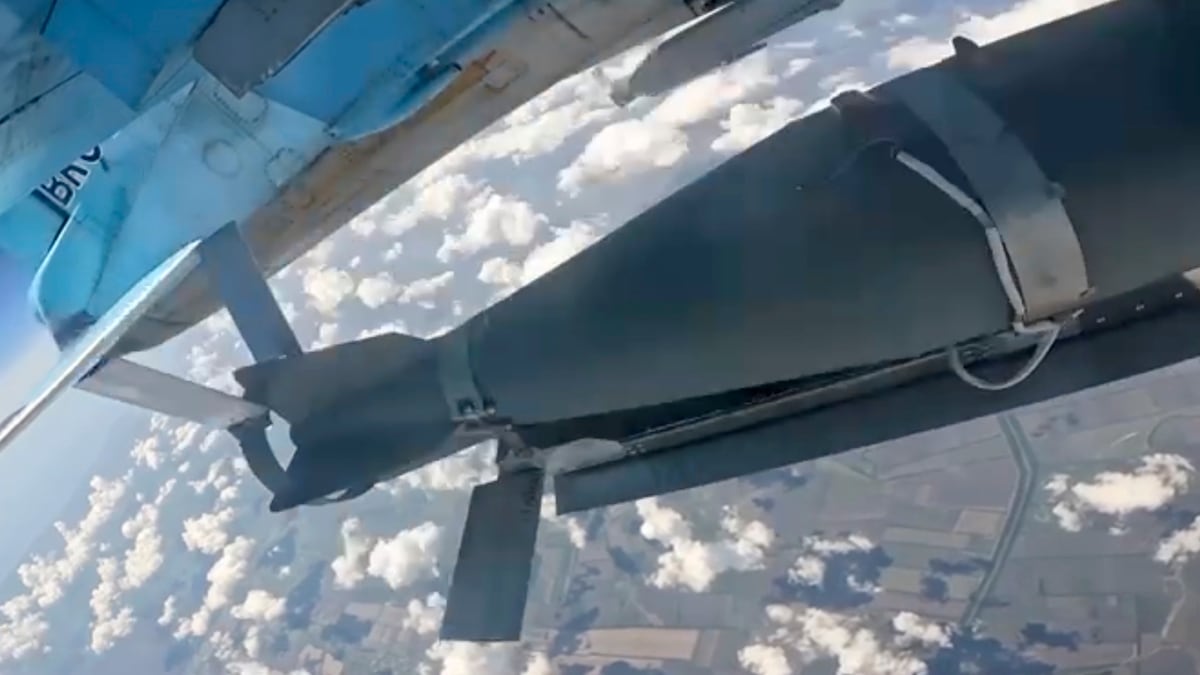
In recent months, Russia has terrorized Ukraine’s front-line troops and nearby cities with glide bombs . They are large, free-fall bombs with pop-out wings and satellite navigation, which operate similarly to weapons equipped with the United States’ precision-guided, aerial Joint Direct Attack Munition.
Currently, Ukraine has few counters to glide bomb strikes.
As Ukraine gains new Western arms and technologies, it can better address the threat. But the West will also need to show more flexibility in the conditions it sets for Ukraine’s use of advanced weaponry.
Glide bombs are cheap. Russia is firing hundreds a week at Ukrainian targets at and behind the front lines . These bombs are small and difficult to spot on radar. They do not use propulsion or emit a detectable heat signature. Russian aircraft launch glide bombs dozens of miles behind the front lines, in relative sanctuary.
Ukrainian President Volodymyr Zelenskyy said that 3,000 glide bombs hit targets in March. More Patriot air defenses were needed, he said, to stop the bombs from wreaking destruction on infrastructure. The U.S. is sending more Patriots , but interceptors are expensive. The cost-exchange ratio is unfavorable.
The most practical counter to glide bombs is to destroy the launching aircraft — on the ground or in the air. This can be done by employing a mix of tactical missiles, air-to-air capabilities and electronic warfare.
Ukraine is skillfully using tactical missiles and drones against ground targets. In May, long-range (as in 186 miles) U.S.-produced Army Tactical Missile Systems destroyed three advanced combat aircraft in Crimea.
In June, Ukraine fired at least 70 of its own drones against a faraway Russian airfield, possibly destroying three aircraft configured to launch glide bombs.
Under recently relaxed U.S. policy, Ukraine can fire Army Tactical Missile Systems, or ATACMS, at forces in Russia that are attacking or about to attack Ukraine. But Ukrainians say this applies only to targets 60 or so miles inside Russia . The U.S. may be wise to permit ATACMS to strike distant airfields.
If even longer ranges are needed, the U.S. might provide air-launched, ground-attack Joint Air-to-Surface Standoff Missiles. The Finnish and Polish air forces rely on these low-observable arms.
Incoming Western equipment could offer a second way to neutralize glide bombs. Ukraine may soon acquire European F-16 fighters and two Swedish airborne early warning and control, or AEW&C, aircraft.
Pairing them would create a new capability, especially if the U.S. provided long-range (or 20-plus-mile) Advanced Medium-Range Air-to-Air Missiles. They could strike many aircraft before bombs were launched. Radar-guided AMRAAMs have a range longer than glide bombs.
Saab AEW&C aircraft will be a force multiplier. They can identify targets out to some 250 nautical miles and detect airborne and ground-based radars. This is essential to track and destroy distant aircraft and air defenses.
Although Ukraine’s F-16s will be older, they will have many modern electronics. This may include Link 16, a NATO-standard system to exchange tactical data. Flying over Ukraine at a safe distance, the AEW&C aircraft could vector F-16s to targets. Some proficient Swedish air battle managers may be needed until Ukrainians are fully trained.
Over time, the U.S. might also assist Ukraine to build a more substantial air force. Some retired F-16s and U.S. Navy E-2 Hawkeye AEW&C aircraft stored in Arizona could be refurbished for Ukraine.
Electronic warfare offers a third way to defeat glide bombs, by confusing their GLONASS or GPS satellite navigation systems . Electronic warfare works better against some systems than others. To protect critical infrastructure, Ukraine would need powerful jammers to block satellite signals over a wide expanse.
A glide bomb may rely on a backup inertial guidance system should satellite navigation fail, but this is less accurate for precision targeting. Errors increase the farther the bomb flies without satellite guidance.
In warfare, silver bullets are rare. Fighting often requires multiple capabilities and innovative or flexible use. More of both will be needed to enable Ukraine to defeat the glide bomb threat. Long-range tactical missiles, F-16s and AEW&C aircraft, plus advanced electronic warfare tools — and more flexible U.S. policies for their use — could give Ukraine a potent force.
John Hoehn is an associate policy researcher at the think tank Rand. He was previously a military analyst with the Congressional Research Service. William Courtney is an adjunct senior fellow at Rand. He previously served as the U.S. ambassador to Kazakhstan, Georgia and the U.S.-Soviet Commission.
近几个月来,俄罗斯使用滑翔炸弹恐吓乌克兰前线部队和附近城市。这些大型自由落体炸弹带有弹出式机翼和卫星导航系统,其工作原理与美国配备精确制导空中联合直接攻击弹药的武器类似。
目前,乌克兰几乎没有应对滑翔炸弹袭击的手段。
随着乌克兰获得西方的新型武器和技术,它就能更好地应对威胁。但西方也需要在乌克兰使用先进武器的条件方面展现出更大的灵活性。
滑翔炸弹价格低廉。俄罗斯每周向乌克兰前线及其后方的目标发射数百枚此类炸弹。这些炸弹体积小,雷达难以探测。它们不使用推进装置,也不会发出可探测的热信号。俄罗斯飞机在距离前线数十英里的相对安全区域发射滑翔炸弹。
乌克兰总统泽连斯基表示,3月份有3000枚滑翔炸弹击中目标。他指出,需要部署更多“爱国者”防空导弹系统,以阻止这些炸弹对基础设施造成破坏。美国正在增派“爱国者”导弹系统,但拦截导弹造价昂贵,性价比不高。
应对滑翔炸弹最有效的办法是摧毁发射飞机——无论是在地面还是空中。这可以通过结合使用战术导弹、空对空作战能力和电子战来实现。
乌克兰正巧妙地运用战术导弹和无人机打击地面目标。今年5月,美国陆军生产的远程(射程达186英里)战术导弹系统在克里米亚摧毁了三架先进作战飞机。
6 月,乌克兰向遥远的俄罗斯机场发射了至少 70 架无人机,可能摧毁了三架配置用于发射滑翔炸弹的飞机。
根据美国近期放宽的政策,乌克兰可以使用陆军战术导弹系统(ATACMS)打击俄罗斯境内正在或即将攻击乌克兰的部队。但乌克兰方面表示,这项政策仅适用于俄罗斯境内约60英里(约97公里)内的目标。美国或许应该允许ATACMS打击远距离机场。
如果需要更远的射程,美国可能会提供空射对地攻击型联合空对地防区外导弹。芬兰和波兰空军都依赖这种低可探测性武器。
西方引进的装备可能为乌克兰提供第二种应对滑翔炸弹的手段。乌克兰可能很快会获得欧洲的F-16战斗机和两架瑞典的空中预警与控制(AEW&C)飞机。
将它们结合起来将创造一种新的作战能力,尤其是在美国提供远程(或射程超过20英里)先进中程空空导弹的情况下。它们可以在炸弹发射前击落多架飞机。雷达制导的先进中程空空导弹的射程比滑翔炸弹更远。
萨博预警机将成为战斗力倍增器。它们能够识别约250海里外的目标,并探测到机载和地面雷达。这对于追踪和摧毁远距离飞机和防空系统至关重要。
尽管乌克兰的F-16战机机龄较老,但它们将配备许多现代化电子设备,例如北约标准的战术数据交换系统Link 16。预警机可在乌克兰上空安全距离飞行,引导F-16战机攻击目标。在乌克兰飞行员完成全部训练之前,可能需要一些经验丰富的瑞典空中作战指挥官。
随着时间的推移,美国或许还会帮助乌克兰建立一支更强大的空军。一些存放在亚利桑那州的退役F-16战斗机和美国海军E-2“鹰眼”预警机可以进行翻新,供乌克兰使用。
电子战提供了第三种对抗滑翔炸弹的方法,即干扰其格洛纳斯或全球定位系统(GPS)的卫星导航系统。电子战对某些系统的效果优于其他系统。为了保护关键基础设施,乌克兰需要强大的干扰器来阻断大范围区域的卫星信号。
滑翔炸弹在卫星导航失效时可以依靠备用的惯性制导系统,但这种方式的精确制导精度较低。炸弹在没有卫星制导的情况下飞行距离越远,误差就越大。
在战争中,灵丹妙药极为罕见。作战往往需要多种能力以及创新或灵活的运用。为了使乌克兰能够战胜滑翔炸弹的威胁,这两方面都需要加强。远程战术导弹、F-16战斗机和预警机,加上先进的电子战工具——以及美国更灵活的使用这些工具的政策——可以赋予乌克兰一支强大的力量。
约翰·霍恩是兰德智库的副政策研究员。他此前曾任国会研究服务处的军事分析师。威廉·考特尼是兰德智库的兼职高级研究员。他曾任美国驻哈萨克斯坦、格鲁吉亚大使以及美苏委员会成员。