Philippines seeking call with China over emerging Sierra Madre crisis菲律宾就马德雷山脉危机寻求与中国通话
Manila has sought to calm ties with Beijing after Chinese sailors escalated a standoff near a Filipino outpost this June.
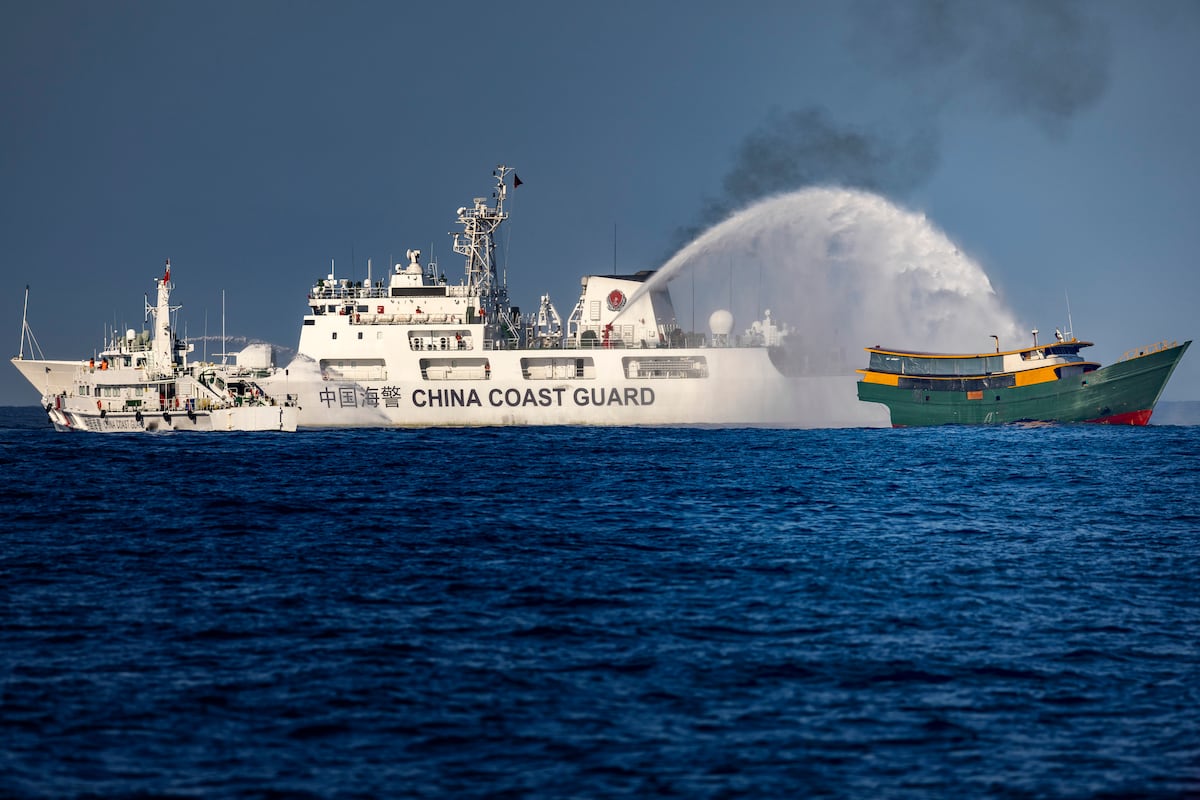
The Philippines is seeking to schedule a call with Beijing “very soon” amid an emerging crisis in the South China Sea, according to the Southeast Asia country’s ambassador to the U.S.
At issue is the Sierra Madre, a rusting World War II-era ship run aground on a reef known as the Second Thomas Shoal. The Philippines uses the ship as an outpost and resupplies its soldiers there about once a month.
China considers the area part of its rightful territory — despite a 2016 ruling by the UN Convention on the Law of the Sea to the contrary. The Chinese Coast Guard has long harassed Filipino ships resupplying the post but has recently grown more violent.
Those confrontations escalated on June 17, when Chinese sailors boarded Filipino vessels, jettisoned equipment and injured eight personnel, according to Manila. One lost his thumb, prompting a hospital visit from President Ferdinand Marcos jr, who only weeks earlier warned that he would consider the death of a Filipino citizen “very close” to an act of war.
Such a decision could invoke a mutual defense treaty with Washington and pull American into the conflict. When asked about that possibility in early June, U.S. Secretary of Defense Lloyd Austin said America’s commitment to the treaty was “ironclad” but declined to comment further.
Since the escalation, the Philippines Department of Foreign Affairs has tried to schedule a call with counterparts in China, said Ambassador Jose Manuel Romualdez, speaking with reporters at the embassy in Washington.
That call could occur by early July, he said.
“We have tried all sorts of ways to be able to bring down the level of tension,” he said. “Obviously, most of [those] have not worked and so we feel that perhaps a frank, clear discussion ... with the Chinese is probably the best way to go.”
Romualdez also confirmed reporting that the Philippines has reinforced the Sierra Madre — a concern for China, which objects to any attempts to harden the fragile site. That said, the work done so far has been to improve “living conditions” for the soldiers stationed there, the ambassador said.
“As to what we will do down the road if, if that ship starts to fall apart, we don’t know,” said Romualdez. “But again, we have no intention of abandoning” it.
On Wednesday, Austin spoke over the phone with his counterpart in Manila. According to a Pentagon readout of the call , Austin “reaffirmed” America’s support for the Philippines amid the standoff.
In the last year, the two countries have deepened their security relationship. America now has access to four new potential military sites in the Philippines’ north, and a military exercise hosted in the country known as “Balikitan” — or “shoulder to shoulder” in Tagalog — is larger than ever. In April, America deployed a mid-range missile system to the Philippines for the first time , though officials in both countries haven’t specified where it is now.
Despite objections in Beijing, which considers each of these steps a provocation, the Philippines maintains that the new security agreement is defensive.
“It is not going to be used for any kind of offensive situation,” Romualdez said, “unless, of course, the situation calls for it”
In April, the U.S. passed a massive new round of extra security funding, including $4 billion for the Indo-Pacific. Half of that was in long-term arms sales subsidized by the U.S. and another half was to replace Pentagon stocks sent directly to other countries.
Most of that money is headed for Taiwan, but the Philippines will likely get a share . Romualdez said Manila is hoping for a portion of the longer-term Foreign Military Financing and didn’t specify whether his country was seeking a part of the other funding.
“A situation like this calls for decisive action on our part — on all our parts,” he said.
Noah Robertson is the Pentagon reporter at Defense News. He previously covered national security for the Christian Science Monitor. He holds a bachelor’s degree in English and government from the College of William & Mary in his hometown of Williamsburg, Virginia.
据菲律宾驻美国大使称,鉴于南海危机日益加剧,菲律宾正寻求“尽快”安排与北京的通话。
问题的关键在于“塞拉马德雷”号,这是一艘锈迹斑斑的二战时期船只,搁浅在被称为第二托马斯浅滩的暗礁上。菲律宾将这艘船用作前哨基地,每月大约一次向那里的士兵运送补给。
尽管联合国海洋法公约2016年作出了相反的裁决,中国仍认为该地区是其合法领土的一部分。中国海警长期以来一直骚扰向该哨所运送补给的菲律宾船只,但最近其行为愈演愈烈。
6月17日,双方冲突升级。据马尼拉方面称,中国水兵登上菲律宾船只,抛弃设备,并造成8名菲律宾人员受伤。其中一人失去了一根拇指,菲律宾总统小费迪南德·马科斯亲自前往医院探望。就在几周前,马科斯还曾警告说,他会将菲律宾公民的死亡视为“非常接近”战争行为。
这样的决定可能会触发与华盛顿的共同防御条约,并将美国卷入冲突。6月初,当被问及这种可能性时,美国国防部长劳埃德·奥斯汀表示,美国对该条约的承诺“坚如磐石”,但他拒绝进一步置评。
菲律宾驻华盛顿大使馆大使何塞·曼努埃尔·罗穆亚尔德斯在接受记者采访时表示,自局势升级以来,菲律宾外交部一直试图安排与中国同行通话。
他说,最早可能在7月初就会接到电话。
他说:“我们尝试了各种方法来降低紧张局势。显然,大多数方法都没有奏效,所以我们认为,或许与中方进行坦诚、清晰的对话才是最佳途径。”
罗穆亚尔德斯还证实了有关菲律宾已加固马德雷山脉的报道——这令中国感到担忧,中国反对任何加固这一脆弱地区的企图。不过,大使表示,迄今为止所做的工作主要是改善驻扎在那里的士兵的“生活条件”。
“至于如果这艘船开始出现问题,我们将来该怎么办,我们还不知道,”罗穆亚尔德斯说。“但我们再次重申,我们绝没有放弃它的打算。”
周三,奥斯汀与马尼拉的对口官员通了电话。根据五角大楼发布的通话记录,奥斯汀在通话中“重申”了美国在对峙期间对菲律宾的支持。
过去一年,美菲两国深化了安全关系。美国目前可以使用菲律宾北部四个新的潜在军事基地,在菲律宾举行的名为“Balikitan”(塔加洛语意为“肩并肩”)的联合军事演习规模也空前盛大。今年4月,美国首次向菲律宾部署了一套中程导弹系统,但两国官员均未透露该系统的具体部署地点。
尽管北京方面对此表示反对,认为这些举措都是挑衅,但菲律宾坚持认为新的安全协议是防御性的。
罗穆亚尔德斯说:“除非情况需要,否则它不会被用于任何进攻性局面。”
今年4月,美国通过了一项规模庞大的新一轮安全援助计划,其中包括为印太地区拨款40亿美元。这笔资金的一半用于美国补贴的长期军售,另一半则用于替换五角大楼直接向其他国家出口的库存武器。
大部分资金将流向台湾,但菲律宾也可能分得一部分。罗穆亚尔德斯表示,马尼拉希望获得一部分长期对外军事融资,但他没有具体说明菲律宾是否也在寻求其他资金。
他说:“这种情况需要我们所有人采取果断行动。”
诺亚·罗伯逊是《防务新闻》的五角大楼记者。他此前曾为《基督教科学箴言报》报道国家安全新闻。他拥有弗吉尼亚州威廉斯堡威廉与玛丽学院的英语和政治学学士学位。