US, Philippines wrap up naval drill amid clashes in South China Sea美国和菲律宾在南海发生冲突之际结束了海军演习
The exercise took place amid ongoing tension in the South China Sea, with resupply operations stoking diplomatic spats between the Philippines and China.
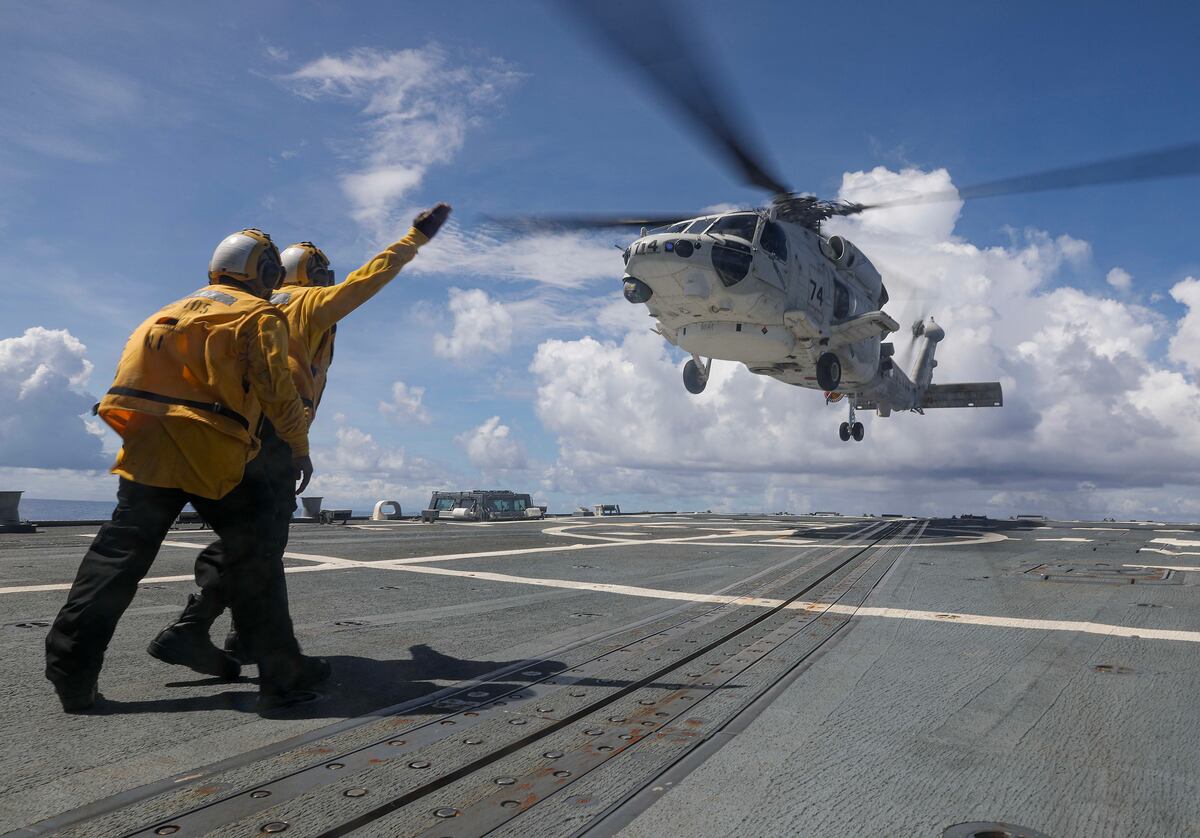
MANILA, Philippines — The United States and the Philippines have wrapped up joint naval drills near the Asian nation that focused on replenishment at sea, naval warfare, and human assistance and disaster response.
The exercise took place amid ongoing tension in the South China Sea, with resupply operations stoking diplomatic spats between the Philippines and China.
Started in 2017, Sama Sama is an annual maritime training event between the Philippines and the U.S. that includes nontraditional security drills. In 2016, then-President Rodrigo Duterte scrapped military drills with the United States, including the Cooperation Afloat Readiness and Training effort and the amphibious landing exercise PHILBEX.
But President Ferdinand Marcos Jr. reimplemented joint training efforts. The Japan Self-Defense Force joined the exercise in 2019, and the Royal Australian Navy joined in 2022. The most recent iteration of Sama Sama, which began Oct. 2, also included Canada, the United Kingdom and France.
“One of the main areas we focused on is the replenishment at sea, and we saw a great capability enhancement there,” Cmdr. Jun Chen, a foreign affairs officer with the U.S. Navy’s Destroyer Squadron 7, told the press during Friday’s closing ceremony. “It opened up a lot of Philippine Navy [human assistance and disaster response] and interoperability we can do later on.”
U.S. Navy Cmdr. Jun Chen, a foreign area officer with Destroyer Squadron 7, speaks at the closing ceremony of Sama Sama in the Philippines on Oct. 13, 2023. (Staff Sgt. Kai W. Huber/U.S. Marine Corps)
The navies of the U.S., the Philippines, Canada, and Japan participated in shore-based and at-sea drills, while the French and Australian navies took part in subject matter exchanges and the New Zealand and Indonesian navies attended as observers.
Drills includes anti-surface, anti-submarine and electronic warfare scenarios — critical areas given the Philippines only recently acquired and equipped its guided-missile frigate BRP Antonio Luna for South China Sea operations, according to Philippine Commodore Joe Orbe, the officer in charge of Sama Sama.
“We need [to develop capabilities for] resupply at sea — transferring fuel and supplies from one ship to another,” Orbe said. “We can use these capabilities in both warfighting and humanitarian assistance.”
The exercise also saw participation by Marine Rotational Force-Southeast Asia, a U.S. Marine Corps task force dedicated to working with regional allies and partners on security initiatives.
U.S. Marine Corps Cpl. Kayden Riggs with Marine Rotational Force-Southeast Asia launches an RQ-20 Puma drone during a shore-based drill in Sorsogon, Philippines, on Oct. 9, 2023. (Staff Sgt. Kai W. Huber/U.S. Marine Corps)
In addition, five military ships joined: the Philippine Navy frigate BRP Antonio Luna, the U.S. Navy destroyer Dewey, the Japan Maritime Self-Defense Force destroyer JS Akebono, Royal Canadian Navy frigate HMCS Vancouver, and British Royal Navy offshore patrol vessel HMS Spey.
Other U.S. Navy assets included the dry cargo/ammunition ship USNS Wally Schirra, the replenishment vessel USNS Yukon, a P-8 Poseidon maritime surveillance aircraft, two Hawker Hunter fighters and an MH-60R Seahawk helicopter.
Sama Sama is particularly important in building Philippine military capacities as the country shifts from its focus on counterterrorism and counterinsurgency operations to addressing threats in the South China Sea, according to Collin Koh, a senior fellow at the Singapore-based S. Rajaratnam School of International Studies.
“The AFP [Armed Forces of the Philippines] has been basically oriented to internal security for so many decades,” Koh told Defense News. “The skills that were there were lost over the decades of internal security focus, and they are not up to scratch with modern combat. The AFP needs to gain a wide spectrum of skill sets.”
Since Marcos became president in 2022, he has taken a more aggressive stance against China in the South China Sea. Last month, during the 18th East Asia Summit in Indonesia, he urged member countries of the Association of Southeast Asian Nations to take action against China’s “dangerous use of coast guard and maritime militia vessels.”
Earlier this month, two supply boats crewed by Philippine Navy personnel and escorted by two larger Philippine Coast Guard vessels breached a Chinese Coast Guard blockade. They succeeded in delivering food, water and other supplies to Filipino marines and naval personnel stationed on a long-marooned but still actively commissioned ship, the BRP Sierra Madre, at the shallows the Second Thomas Shoal.
And this week, the Philippine military accused China of shadowing and hampering a Navy vessel on a resupply mission to Philippine-occupied Thitu Island, a feature China claims as part of its territory.
The U.S. Navy destroyer Dewey, the British Royal Navy offshore patrol vessel HMS Spey and the Philippine Navy frigate BRP Antonio Luna steam in formation in the Philippine Sea during the exercise Sama Sama on Oct. 8, 2023. (MC1 Greg Johnson/U.S. Navy)
The Philippines intends to protect what it considers its archipelagic territories, including islands and features within its exclusive economic zone. It occupies these areas in what the government calls the West Philippine Sea.
The country has steadily built up its naval arsenal in recent years, acquiring frigates, fighter jets, landing dock vessels, corvettes, UAVs and missiles. An upcoming third phase in the military’s modernization program will focus on strengthening and developing assets in the South China Sea, according to Chief of Staff Romeo Brawner.
A buildup of Philippine naval capabilities is also crucial given tension over Taiwan, which China considers a rogue province and has threatened to take back by force, Koh explained. Such a conflict would likely include military activities in the greater South China Sea, he added.
China has built and militarized outposts in the sea, and it its Southern Theater Command operates in the area.
“The [Chinese People’s Liberation Army Navy’s] Southern Theater Command has two primary roles or directions: The first direction is definitely the South China Sea dispute,” Koh said. “But the second direction, or what we call the second task it’s mandated to do, is Taiwan. In the case of a Taiwan scenario ... the Southern Theater Command is supposed to secure the southern flex of the operation.”
“The AFP will be expected to do more in the West Philippine Sea in the event of Taiwan,” Koh added. “If there will be a war in Taiwan, there will be a South China Sea dimension.”
The Associated Press contributed to this report.
Leilani Chavez is an Asia correspondent for Defense News. Her reporting expertise is in East Asian politics, development projects, environmental issues and security.
菲律宾马尼拉——美国和菲律宾在菲律宾附近海域结束了联合海军演习,演习重点是海上补给、海战以及人道主义援助和灾害应对。
此次演习正值南海局势持续紧张之际,补给行动加剧了菲律宾和中国之间的外交争端。
“萨玛萨玛”联合军演始于2017年,是菲律宾和美国之间一年一度的海上训练活动,其中包括非传统的安全演习。2016年,时任总统罗德里戈·杜特尔特取消了与美国的军事演习,包括“海上合作战备与训练”和“菲律宾两栖登陆演习”。
但费迪南德·马科斯总统重启了联合训练计划。日本自卫队于2019年加入,澳大利亚皇家海军于2022年加入。最近一次“Sama Sama”联合演习于10月2日开始,加拿大、英国和法国也参与其中。
“我们重点关注的领域之一是海上补给,我们看到这方面的能力得到了极大的提升,”美国海军第七驱逐舰中队外交官陈俊中校在周五的闭幕式上对媒体表示。“这为我们日后在菲律宾海军的人道主义援助和灾害响应以及互操作性方面开展更多工作奠定了基础。”
2023年10月13日,美国海军第七驱逐舰中队外事军官、海军中校陈军在菲律宾举行的“Sama Sama”活动闭幕式上发表讲话。(美国海军陆战队参谋军士凯·W·胡贝尔摄)
美国、菲律宾、加拿大和日本海军参加了岸基和海上演习,法国和澳大利亚海军参加了专题交流,新西兰和印度尼西亚海军作为观察员出席。
演习包括反水面、反潜和电子战场景——鉴于菲律宾最近才获得并装备了用于南海作战的导弹护卫舰“安东尼奥·卢纳”号,这些都是至关重要的领域。负责“萨玛萨玛”演习的菲律宾准将乔·奥尔贝表示。
奥尔贝说:“我们需要发展海上补给能力——将燃料和物资从一艘船转移到另一艘船。我们可以将这些能力用于作战和人道主义援助。”
此次演习还有美国海军陆战队东南亚轮换部队的参与,该部队是美国海军陆战队的一支特遣部队,致力于与地区盟友和伙伴合作开展安全倡议。
2023年10月9日,美国海军陆战队下士凯登·里格斯(Kayden Riggs)在菲律宾索索贡进行岸基演习时,从美国海军陆战队东南亚轮换部队发射了一架RQ-20“美洲狮”无人机。(美国海军陆战队参谋军士凯·W·胡贝尔摄)
此外,还有五艘军舰加入:菲律宾海军护卫舰 BRP Antonio Luna、美国海军驱逐舰 Dewey、日本海上自卫队驱逐舰 JS Akebono、加拿大皇家海军护卫舰 HMCS Vancouver 和英国皇家海军近海巡逻舰 HMS Spey。
美国海军的其他资产包括干货/弹药船 USNS Wally Schirra、补给船 USNS Yukon、P-8 海神海上巡逻机、两架霍克猎人战斗机和一架 MH-60R 海鹰直升机。
据新加坡拉惹勒南国际研究院高级研究员柯林·科赫 (Collin Koh) 称,随着菲律宾从反恐和反叛乱行动转向应对南海威胁,Sama Sama 在建设菲律宾军事能力方面尤为重要。
“菲律宾武装部队几十年来基本上都以维护内部安全为重,”科赫告诉《防务新闻》。“几十年来,由于过于关注内部安全,原有的技能逐渐流失,无法应对现代战争。菲律宾武装部队需要掌握更广泛的技能。”
自马科斯2022年就任总统以来,他在南海问题上对中国采取了更为强硬的立场。上个月,在印度尼西亚举行的第18届东亚峰会上,他敦促东盟成员国对中国“危险使用海警船和海上民兵船只”的行为采取行动。
本月初,两艘由菲律宾海军人员驾驶、两艘菲律宾海岸警卫队大型舰艇护航的补给艇突破了中国海警的封锁。他们成功地向驻扎在二仁爱礁浅滩的“塞拉马德雷”号(BRP Sierra Madre)上的菲律宾海军陆战队员和海军人员运送了食品、水和其他物资。这艘军舰虽然长期搁浅,但仍处于服役状态。
本周,菲律宾军方指责中国跟踪并阻挠一艘菲律宾海军舰艇向菲律宾占领的提图岛(中国声称该岛是其领土的一部分)执行补给任务。
2023年10月8日,美国海军驱逐舰“杜威”号、英国皇家海军近海巡逻舰“斯佩”号和菲律宾海军护卫舰“安东尼奥·卢纳”号在菲律宾海参加“萨玛萨玛”联合演习,并列航行。(美国海军一级军士长格雷格·约翰逊/美国海军)
菲律宾意图保护其视为群岛领土的区域,包括其专属经济区内的岛屿和地貌。菲律宾政府称这些区域为西菲律宾海。
近年来,中国稳步扩充海军力量,先后购置了护卫舰、战斗机、船坞登陆舰、轻型护卫舰、无人机和导弹。据参谋长罗密欧·布劳纳称,即将启动的第三阶段军事现代化计划将重点加强和发展在南海的军事资产。
鉴于台湾问题上的紧张局势,菲律宾海军能力的提升也至关重要。中国视台湾为叛乱省份,并威胁要武力收复台湾,科赫解释道。他还补充说,此类冲突很可能涉及南海地区的军事活动。
中国已在海上修建并军事化了前哨基地,其南部战区在该地区开展行动。
“中国人民解放军海军南部战区有两个主要职责或方向:第一个方向无疑是南海争端,”许先生说。“但第二个方向,或者我们称之为它被赋予的第二项任务,是台湾问题。在涉及台湾的局势下……南部战区应该确保行动的南部前沿安全。”
“如果台湾局势恶化,菲律宾武装部队将被要求在西菲律宾海采取更多行动,”许先生补充道。“如果台湾爆发战争,南海局势也将受到影响。”
美联社对本报道亦有贡献。
莱拉尼·查韦斯是《防务新闻》的亚洲记者。她的报道专长是东亚政治、发展项目、环境问题和安全。