US commander says China has failed to coerce rivals in South China Sea美国指挥官称中国未能胁迫南海对手
Adm. Stephen Koehler gave assurances of U.S. commitment to help defend freedom of passage and the rule of law in the Indo-Pacific region.
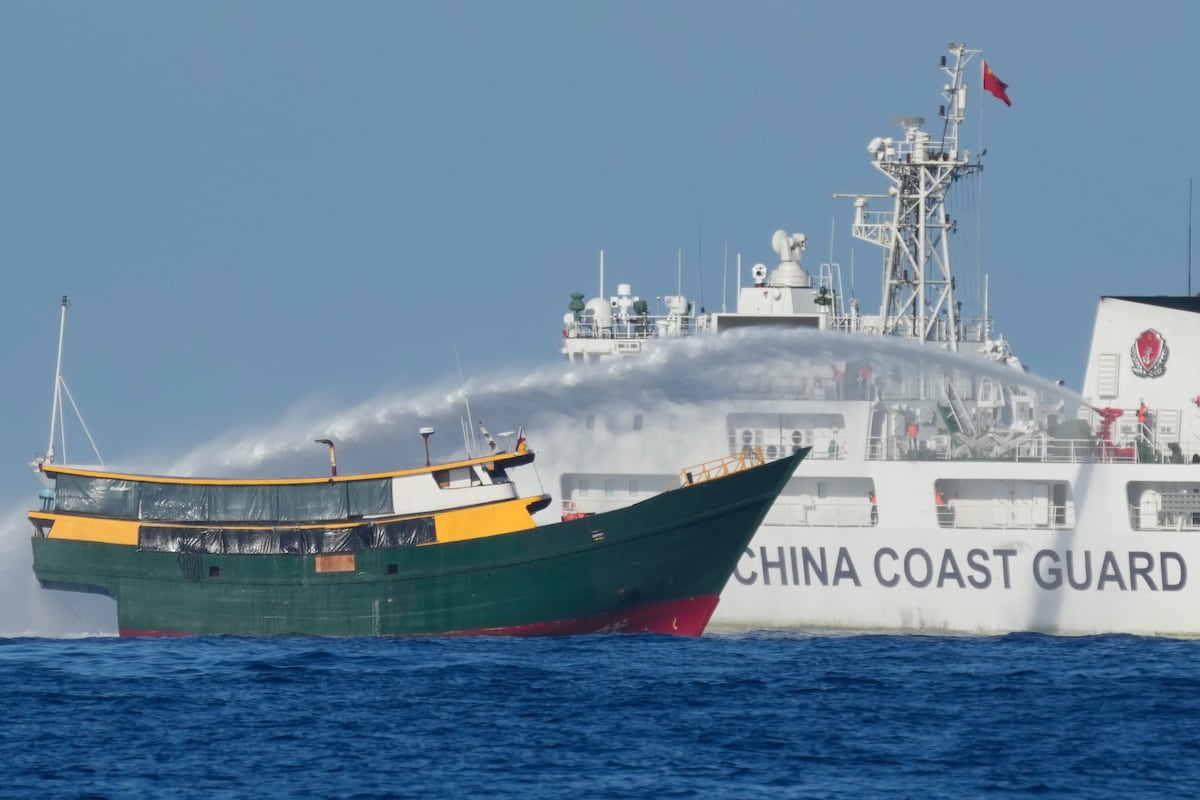
MANILA, Philippines (AP) — China has failed to intimidate rival claimant states into surrendering their sovereign interests in the disputed South China Sea despite its intensifying “bullying tactics,” and the United States and other allied countries are ready to further boost deterrence against Beijing’s aggression, the U.S. Pacific Fleet commander said.
Adm. Stephen Koehler, who oversees the largest naval fleet command in the world, gave assurances Friday in a Manila forum of U.S. commitment to help defend freedom of passage and the rule of law in the Indo-Pacific region. The Pacific Fleet’s mission, he said, was to deter aggression across the region with allies and partners “and to prevail in combat if necessary.”
China’s tactics have “grown steadily and more aggressive with rammings, water cannons, lasers and sometimes worse,” Koehler said. “But despite these bullying tactics … China has failed to intimidate Southeast Asian claimants into surrendering their sovereign rights.”
Chinese officials did not immediately comment on Koehler’s remarks, but they have warned Washington in the past to stop meddling in what Beijing says is a purely Asian dispute that China has been trying to resolve peacefully.
Koehler cited how Indonesia, Malaysia and Vietnam have sustained or expanded their offshore oil and gas operations in their Exclusive Economic Zones in the South China Sea despite Beijing’s growing assertiveness. The Philippines, he said, has boldly exposed China’s assertive actions by publicizing the dangerous maneuvers of Chinese forces, including the use of powerful water cannons and laser beams.
“We’ve seen a laudable resilience and resolve to defend their maritime rights in the face of mounting pressure. Nearly all Southeast Asian littoral states are now prioritizing stronger maritime capabilities,” Koehler told the forum. “The U.S. Pacific Fleet is always ready to work with you to strengthen deterrence and show no individual country can be pushed around.”
Deterrence, he said, has worked to prevent a larger conflict and crisis that could hamper the flow of trade through the waterway and affect many economies.
Western and Asian ambassadors, including from the U.S., Canada, Australia, France, Germany, the European Union, Japan and New Zealand, spoke at the forum, which marked the 9th anniversary of the issuance of a 2016 international arbitration ruling that invalidated China’s claims to virtually the entire South China Sea.
The Philippines brought its conflicts with China in the South China Sea to international arbitration in 2013, a year after a tense standoff over a disputed shoal which Beijing’s forces surrounded and effectively seized. China refused to participate in the arbitration, rejected its outcome as a “sham” and continues to defy it.
U.S. Ambassador to the Philippines MaryKay Carlson said the arbitration ruling was a triumph for the Philippines and “a beacon guiding us toward a future where powerful countries cannot trample on the legal rights of other states.”
“Nine years on, Beijing has ignored the ruling and continues to operate with impunity,” Carlson said. “China continues to engage in illegal, coercive, aggressive and deceptive actions in support of its spurious claims.”
She renewed a warning that the U.S. is obligated to defend the Philippines under a 1951 Mutual Defense Treaty if Philippine forces come under an armed attack, including in the South China Sea.
With China’s “worrisome” rejection of the arbitration ruling, the Philippines has moved to strengthen its forces and territorial defense, including by pursuing legislation to demarcate the limits of its territory, which has further strained Manila’s ties with Beijing, Philippine Foreign Secretary Theresa Lazaro told the forum in a video message.
But she said that “it is a strategic consideration that we continue the dialogue and consultation with China, even amidst tensions that severely impact the bilateral relationship.”
Chinese and Philippine officials plan to hold another round of talks in Beijing on their increasingly tense disputes in the South China Sea later this month to prevent further escalation.
菲律宾马尼拉(美联社)——美国太平洋舰队司令表示,尽管中国不断升级“欺凌手段”,但未能恐吓其他声索国放弃其在有争议的南海的主权利益。美国和其他盟国已准备好进一步加强对北京侵略行为的威慑。
负责指挥全球最大海军舰队的斯蒂芬·科勒海军上将周五在马尼拉的一个论坛上保证,美国致力于帮助捍卫印太地区的航行自由和法治。他表示,太平洋舰队的任务是与盟友和伙伴共同遏制该地区的侵略行为,“并在必要时赢得战斗”。
科勒表示,中国的策略“稳步升级,愈发咄咄逼人,包括冲撞、水炮、激光,有时甚至更恶劣”。“但尽管采取了这些霸凌手段……中国仍未能迫使东南亚声索国放弃其主权权利。”
中国官员没有立即对科勒的言论发表评论,但他们过去曾警告华盛顿停止干涉北京所说的纯粹的亚洲争端,中国一直试图和平解决这一争端。
科勒指出,尽管北京方面日益强硬,印尼、马来西亚和越南仍在南海专属经济区维持或扩大了海上油气作业。他还表示,菲律宾通过公开中国军队的危险行动,包括使用强力水炮和激光束,勇敢地揭露了中国的强硬行径。
科勒在论坛上表示:“我们看到,面对日益增长的压力,东南亚各国展现出了令人钦佩的韧性和捍卫其海洋权利的决心。几乎所有东南亚沿岸国家现在都将加强海上能力建设列为优先事项。美国太平洋舰队随时准备与你们合作,加强威慑力量,并表明没有任何一个国家可以被轻易摆布。”
他说,威慑作用有效地防止了可能阻碍水道贸易流通并影响许多经济体的更大规模的冲突和危机。
包括美国、加拿大、澳大利亚、法国、德国、欧盟、日本和新西兰在内的西方和亚洲大使在论坛上发表了讲话。此次论坛是为了纪念2016年国际仲裁裁决发布9周年,该裁决否定了中国对几乎整个南海的主权声索。
2013年,菲律宾将与中国在南海的冲突提交国际仲裁。此前一年,双方在一块争议礁石上发生紧张对峙,北京方面包围并实际控制了该礁石。中国拒绝参与仲裁,称其结果为“骗局”,并持续藐视仲裁结果。
美国驻菲律宾大使玛丽凯·卡尔森表示,仲裁裁决对菲律宾来说是一次胜利,“它犹如一座灯塔,指引我们走向一个强权国家不能践踏其他国家合法权利的未来”。
卡尔森说:“九年过去了,北京方面无视裁决,继续逍遥法外。中国继续从事非法、胁迫、侵略和欺骗性活动,以支持其虚假主张。”
她再次警告说,根据 1951 年美菲共同防御条约,如果菲律宾军队遭受武装攻击,包括在南海,美国有义务保卫菲律宾。
菲律宾外交部长特蕾莎·拉扎罗在论坛上发表视频讲话称,由于中国“令人担忧地”拒绝接受仲裁裁决,菲律宾已采取行动加强其军队和领土防御,包括通过立法划定其领土范围,这进一步加剧了马尼拉与北京之间的紧张关系。
但她表示,“即使在双边关系受到严重影响的紧张局势下,我们继续与中国进行对话和磋商也是出于战略考虑。”
中菲官员计划于本月晚些时候在北京举行新一轮会谈,讨论双方在南海日益紧张的争端,以防止局势进一步升级。