Space Force braces for stalled progress amid lack of full funding由于资金不足,太空部队预计将面临进展停滞的局面。
Fiscal 2027 program starts are already on hold until December.
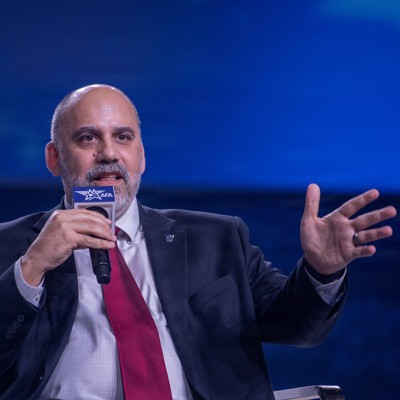
Erich Hernandez-Baquero, assistant secretary of the Air Force for space acquisition and integration, speaks during the 2026 Air and Space Forces Association Air, Space & Cyber Conference, Sept. 15. U.S. Air Force / Tech. Sgt. William OBrien
Fiscal 2027 program starts are already on hold until December.
Air, Space & Cyber Conference
NATIONAL HARBOR, Md.— Space Force modernization efforts could slow if Congress doesn’t pass a full budget at the end of the year, the service’s leaders said.
“We're on this ramp-up, right, consistent with our overall strategy and the recognition that the space domain is a critical domain, in and of itself, but also for the joint force,” Erich Hernandez-Baquero , the Space Force’s top buyer, told reporters Tuesday. “Now we're going to run into [fiscal year 2027]—and you saw that our budget request was to continue on that—and this [ continuing resolution ] is definitely going to put the brakes on that for a time period.”
The Space Force has requested $71.1 billion for 2027, including $19.1 billion for procurement. But with little time remaining before fiscal 2027 begins on Oct. 1, Congress has passed stopgap legislation—a continuing resolution—to keep funding the Pentagon at 2026 levels through Dec. 11. The CR permits no new programs to begin.
“We certainly appreciate at least not being shut down. So…that's a good thing, but on the CR, it really does pace us at a time where we really need to go faster. So we are obviously encouraging Congress to do what they can to help support the president's budget on that,” Hernandez-Baquero said. “In the meantime, we'll just do what we always do: prioritize the things that will yield the most mission capability soonest, and make sure we're executing on those.”
Hernandez-Baquero, who was sworn into the chief space acquisition role last month, declined to specify which priorities could be most affected by a continuing resolution because things were “pre-decision at this point.”
Gen. Doug Schiess, the chief of space operations, said about 10 percent of the service’s programs could be slowed down due continuing resolution.
“About 90 percent of the programs we have are programs from last year—so we can still get after those,” but there’s a remaining 10 percent of programs that require full budget funding, Schiess said. “It's going to slow us down, and the threat is not slowing down.”
Amid a broader push for acquisition reform, Hernandez-Baquero said he’s focused on streamlining and speeding up military purchasing. And when it comes to technology initiatives, there will be a new senior leadership role dedicated to it.
The Air Force’s new program acquisition executives , or PAEs, are “establishing those pathways for onboarding new technology, but I'm just conscious that that by itself is not going to support drawing in the right technologies,” he said. “I want somebody that's focused—100 percent—on looking at the most promising tech and driving the prototyping initiatives that are going to help mature it to the level where a PAE can say, ‘Ah, it meets my criteria for this onboard path, and I can go do that’.”
That person is a technology portfolio executive, who “will have the most promising technology coming out of the [research and development] side, and…will work with industry to ensure that we have the right pathways to do that. Conceptually, there would be prototype efforts that get executed out of that to support the mission areas.”
The technology portfolio executive office already exists but the role hasn’t yet been filled, he said.
“When I designate a TPE, for example, that person is going to report directly to me and represent my authority when it comes to the technology transition,” Hernandez-Baquero said. “I cannot do this without the buy-in of the PAEs that are executing the mission areas, and so my charter to them is going to be not only to deliver on those missionaries, but be part of the enterprise team that's going to deliver on those cross-cutting capabilities.”
NEXT STORY: The Pentagon must prepare for battles around the moon: Joint Chiefs chair
美国空军负责太空采购和整合的助理部长埃里希·埃尔南德斯-巴克罗于9月15日在2026年空军和太空部队协会空天网络会议上发表讲话。美国空军/技术军士威廉·奥布莱恩
2027财年的项目启动已经暂停至12月。
航空航天网络会议
马里兰州国家港——太空部队领导人表示,如果国会在年底前不通过全部预算,太空部队的现代化努力可能会放缓。
“我们正在加大投入,这符合我们的整体战略,也符合我们对太空领域重要性的认识,无论从其自身还是对联合部队而言都是如此,”太空部队首席采购官埃里希·埃尔南德斯-巴克罗周二告诉记者。“现在我们将进入(2027财年)——你们也看到了,我们的预算申请是为了继续推进该财年——而这项(持续拨款决议)肯定会在一段时间内阻碍这一进程。”
美国太空军已申请2027财年711亿美元的预算,其中包括191亿美元的采购预算。但由于2027财年将于10月1日开始,时间所剩无几,国会通过了一项临时拨款法案——一项持续拨款决议——以确保五角大楼的预算维持在2026财年的水平,直至12月11日。该持续拨款决议不允许启动任何新项目。
“我们当然很感激至少没有被停摆。所以……这是件好事,但就持续拨款法案而言,它确实拖慢了我们的进度,而我们现在真的需要加快速度。因此,我们显然在敦促国会尽其所能,支持总统的预算案,”埃尔南德斯-巴克罗说。“与此同时,我们将继续一如既往地工作:优先处理那些能够尽快提升任务能力的项目,并确保我们切实执行这些项目。”
上个月宣誓就任首席太空采购官的埃尔南德斯-巴克罗拒绝具体说明哪些优先事项可能会受到持续决议的影响,因为目前“还没有做出决定”。
太空作战部长道格·希斯将军表示,由于持续的决议,该部门约 10% 的项目可能会放缓。
“我们大约90%的项目都是去年的项目——所以我们仍然可以继续推进这些项目,”但希斯说,还有10%的项目需要全额预算拨款。“这会拖慢我们的进度,而且威胁并没有减弱。”
在更广泛的采购改革推进背景下,埃尔南德斯-巴克罗表示,他正致力于简化和加快军事采购流程。此外,在技术创新方面,将设立一个新的高级领导职位专门负责。
他说:“空军新设立的项目采购主管(PAE)正在建立引进新技术的途径,但我意识到,单靠这一点并不能确保引进合适的技术。我需要有人能够百分之百地专注于寻找最有前景的技术,并推动原型开发项目,帮助这些技术走向成熟,最终达到PAE可以认可的水平,即‘啊,它符合我为这条引进路径设定的标准,我可以着手做了’。”
这个人是一位技术组合主管,他“将负责研发方面最有前景的技术,并且……将与业界合作,确保我们拥有正确的途径来实现这些技术。从概念上讲,这将促成原型项目的实施,以支持各个任务领域。”
他说,技术组合执行办公室已经存在,但该职位尚未有人担任。
“例如,当我指定一名技术转型负责人(TPE)时,这个人将直接向我汇报,并在技术转型方面代表我的权威,”埃尔南德斯-巴克罗说道。“如果没有负责执行任务领域的项目执行人员(PAE)的支持,我无法做到这一点,因此,我对他们的要求不仅是完成这些任务,还要成为负责交付这些跨领域能力的企业团队的一员。”
下一篇报道:参谋长联席会议主席:五角大楼必须为绕月作战做好准备